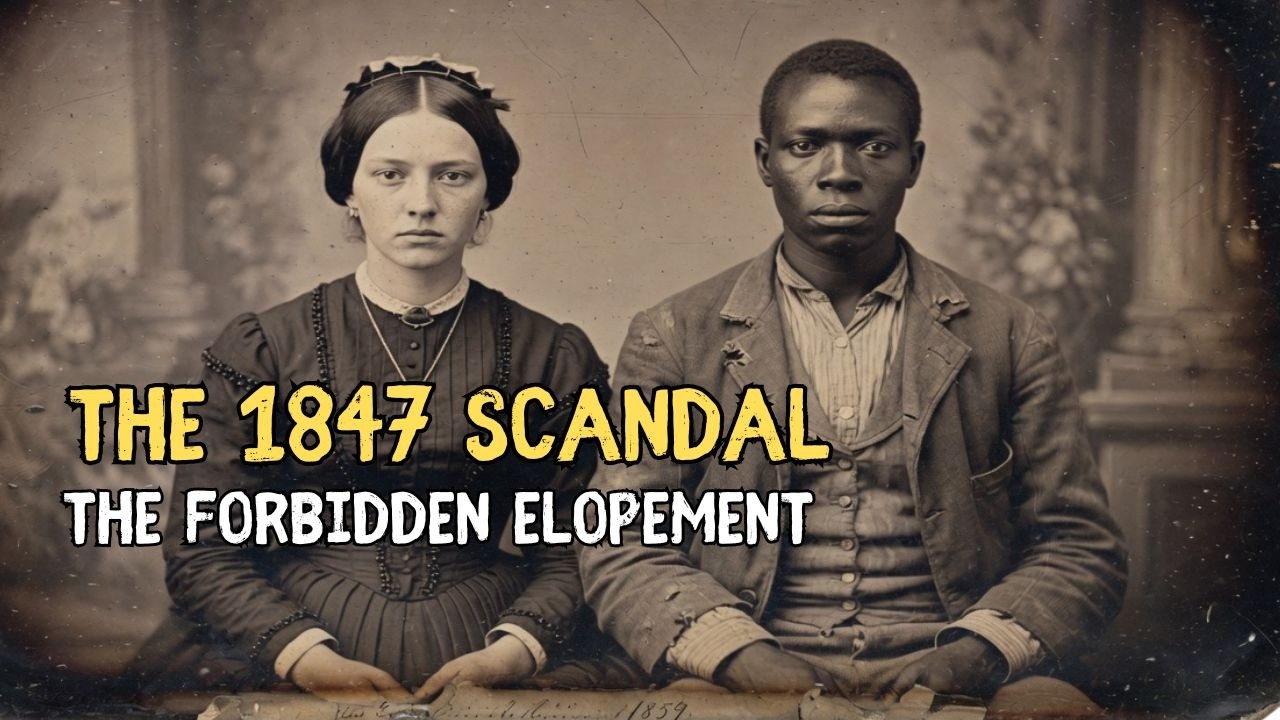
Evelyn Duval vanished from her husband’s plantation on the night of April 10, 1847. She was last seen around eight in the evening, when she asked the cook to bring tea to the library. By morning, she was gone. So was Henry Carter, a skilled carpenter and literate man who had been purchased at the New Orleans slave market in January 1846 and assigned to manage the Duval family’s library.
The plantation stood along the Mississippi River in St. James Parish, a two-story white mansion with twelve columns that symbolized the wealth and rigid social order of the Antebellum South. Gerard Duval, Evelyn’s husband, had acquired the property in 1839 and expanded it steadily, buying adjoining land and increasing his workforce to more than one hundred enslaved people by 1845. Evelyn had arrived from Charleston in 1844, the daughter of a shipping merchant who arranged the marriage to strengthen business connections.
Public announcements described her as a woman of extraordinary beauty and refined accomplishments. Her private letters told a different story. Three months after arriving, she wrote to a cousin in Virginia that the air suffocated her and that the house felt like a museum where she was both exhibit and visitor. The plantation’s accounting books from 1846 showed rising sugar profits, and Gerard Duval appeared often in parish meeting minutes, arguing for stricter controls on the movement of enslaved people between plantations.
But the carefully maintained order began to crack in the spring of 1847. A ledger entry from March 3rd noted disciplinary action required for Henry after he was found in Evelyn’s private sitting room without permission. He was reassigned to field duties as punishment. Yet a counter entry dated March 28th returned him to household duties with the notation: at mistress’s insistence, H.
C. returned to library management. On April 10th, Gerard Duval departed for New Orleans on business, expected to return in three days. Heavy rains began at sunset and continued through the night.
When morning came, both Evelyn and Henry Carter were gone. The search that followed was unprecedented for the parish. Gerard returned and organized parties that combed the surrounding swamps and checked every road. Fifty men with dogs traversed the wilderness, and notices were posted as far north as Natchez and as far east as Mobile.
The official narrative solidified quickly: a respected planter’s wife had been abducted by a runaway slave. Gerard claimed Henry had shown signs of instability and developed an unhealthy fixation on Evelyn due to their shared interest in literature. A reward notice offered $1,000 for the return of Mrs. Duval and the capture, dead or alive, of the negro man Henry.
Contradictions emerged almost immediately. An enslaved woman named Rachel, who served as Evelyn’s lady’s maid, told parish authorities that her mistress had been packing a small valise for several days, adding items gradually so as not to draw attention. Her statement was stricken from official records but preserved in the private notes of Sheriff Thomas Wilkinson, discovered after his death in 1861. An inventory of Evelyn’s belongings revealed the absence of clothes, personal items, and several books from the library, including copies of Voltaire and Rousseau ordered from New Orleans the previous autumn.
As the search entered its second week, a riverboat captain reported seeing a white woman and a negro man board his vessel at a small landing ten miles downriver on the morning of April 11th. They purchased passage to New Orleans, where they disembarked and disappeared into the city. The captain said they spoke little but sat closely together, and the woman wore a dark veil throughout the journey. Asked if she appeared under duress, he replied no more than any woman traveling with a man.
The trail went cold in New Orleans. Despite extensive searches, no further confirmed sightings emerged. A rumor circulated that they had boarded a vessel bound for Haiti, but shipping records showed no passengers matching their descriptions. By June, the Picayune published an article suggesting the marriage had been troubled from its inception, hinting at cruel treatment that may have driven Evelyn to flee.
Gerard threatened legal action, and subsequent coverage retreated to the abduction narrative. By autumn the case had largely disappeared from public discussion. Gerard sold the plantation in December 1847 and returned to France, citing unhappy memories. The plantation house burned to the ground in 1849, officially attributed to lightning.
Local rumors suggested arson, though no investigation was conducted. The case might have remained buried had it not been for discoveries that surfaced over the following decades. In 1958, workers renovating an old townhouse in the French Quarter found a sealed tin box hidden within a wall cavity. Inside was a water-damaged journal bearing the inscription property of E.
D. Tulane University historians dated it to the mid-19th century. Only fragments remained readable, but they painted a startling picture. An entry from early 1846 read: “G treats his books with more tenderness than he has ever shown me.
The new man H understands their value as well, and speaks of authors I had not expected anyone here to know. ” A later entry described H learning through paths she could not imagine, acquiring knowledge despite every barrier erected against it. By winter of 1846 the tone shifted: “The way G looks at H when he thinks I do not notice, with suspicion, with malice. I fear what may come.
” Another entry recorded that Gerard struck her when she protested Henry’s reassignment to the fields. The final legible entry, presumably from early April 1847, read: “We have agreed. When G goes to New Orleans, the riverboat at dawn, H says there are people in the city who can help us reach Philadelphia. ”
In 1964, research in Philadelphia City Archives uncovered a marriage certificate dated October 3rd, 1847, between an Ellen Davis and Harold Carter.
Both parties were noted as free colored persons, a common designation used by light-skinned black individuals or interracial couples attempting to build lives in northern cities. The officiating minister’s private records included a cryptic note: the woman speaks with a Southern accent despite claiming Charleston birth; husband protective; watches door throughout ceremony; fear evident. Tax records showed Harold Carter established a small carpentry business in Philadelphia’s 7th Ward, operating until 1853, when city directories indicated the Carters relocated, possibly to Canada, following the passage of the Fugitive Slave Act. No further official records of the couple have been found.
But conflicting evidence emerged as well. In 1966, an archaeological survey of the former plantation site uncovered the remains of a root cellar beneath where the main house had stood. Among the charred debris were a woman’s pearl hair comb matching the style of the 1840s, a carpenter’s measuring tool with the initials HC scratched into the handle, and fragments of a letter addressed to “my dearest E” that appeared to have been concealed in the cellar wall. The fragments contained disturbing lines: “Cannot delay any longer.
He suspects. And said today he would sooner see you dead than…” The letter’s date was partially preserved at April 7th, 1847, just days before the disappearance. In 1983, renovations to an old church in Philadelphia’s Northern Liberties neighborhood revealed a hidden compartment containing documents related to the Underground Railroad. Among them was a list of individuals who passed through between 1847 and 1851.
An entry dated November 1847 mentioned ED and HC from Louisiana, provided with papers and funds for passage to Canada, with the woman ill and recovering from injuries, both traumatized but determined. Extensive searches of Canadian records yielded no conclusive evidence of their settlement under either their original names or known aliases. Then in 1991, a descendant of Gerard Duval’s French relatives discovered a locked journal among family heirlooms in Paris. Written in French and dating from 1848 to 1857, it contained entries referencing Evelyn.
In 1851, Gerard wrote that he had received word she may have been seen in Montreal. “I will not pursue. Let the dead bury their dead. ” A later entry, dated just weeks before his death in 1857, read: “I dreamt of Louisiana again.
The house in flames, her voice calling from below. I wake each night at 3:00, the hour when we found the cellar door open. ” A 2002 hydrological survey detected traces of accelerant in the soil near the former plantation, contradicting the official record that the 1849 fire was caused by lightning. Deeper layers contained traces of human remains, though fragmentary evidence made it impossible to determine age, gender, or number of individuals.
The Louisiana Historical Society commissioned a comprehensive review in 2005, bringing together historians, archaeologists, and forensic experts. Their report, published in 2007, concluded that while no single definitive narrative could be established, the preponderance of evidence suggested Evelyn Duval and Henry Carter likely perished on or near the plantation property in April 1847, possibly at the hands of Gerard Duval or his agents, with their remains concealed to prevent discovery. A minority opinion argued the Philadelphia and Montreal documentary evidence offered a plausible case for their successful escape. The case remains officially unsolved.
The St. James Parish Sheriff’s Department technically maintains an open file on the disappearance of Evelyn Duval, cross-referenced with that of Henry Carter, one of the few official acknowledgements that their fates were inextricably linked. In 2021, on the 174th anniversary of the disappearance, a small marker was placed near the presumed site of the plantation house. It bears no names, dates, or definitive claims, only the inscription: “For those who sought freedom by whatever path was offered.
Their story continues. ”






