Seven years into a 99-year prison sentence, DNA testing proved that Roy Kriner was not the source of the biological evidence used to convict him of a teenage girl’s murder. Texas kept him locked up for three more years anyway. The person whose DNA was actually at the scene remained free for more than two decades. It took Montgomery County almost forty years to close the file on the death of sixteen-year-old Deanna Og, and the answer arrived not through a witness or a confession, but through a family tree built from a distant relative who had no idea they were connected to the case at all.
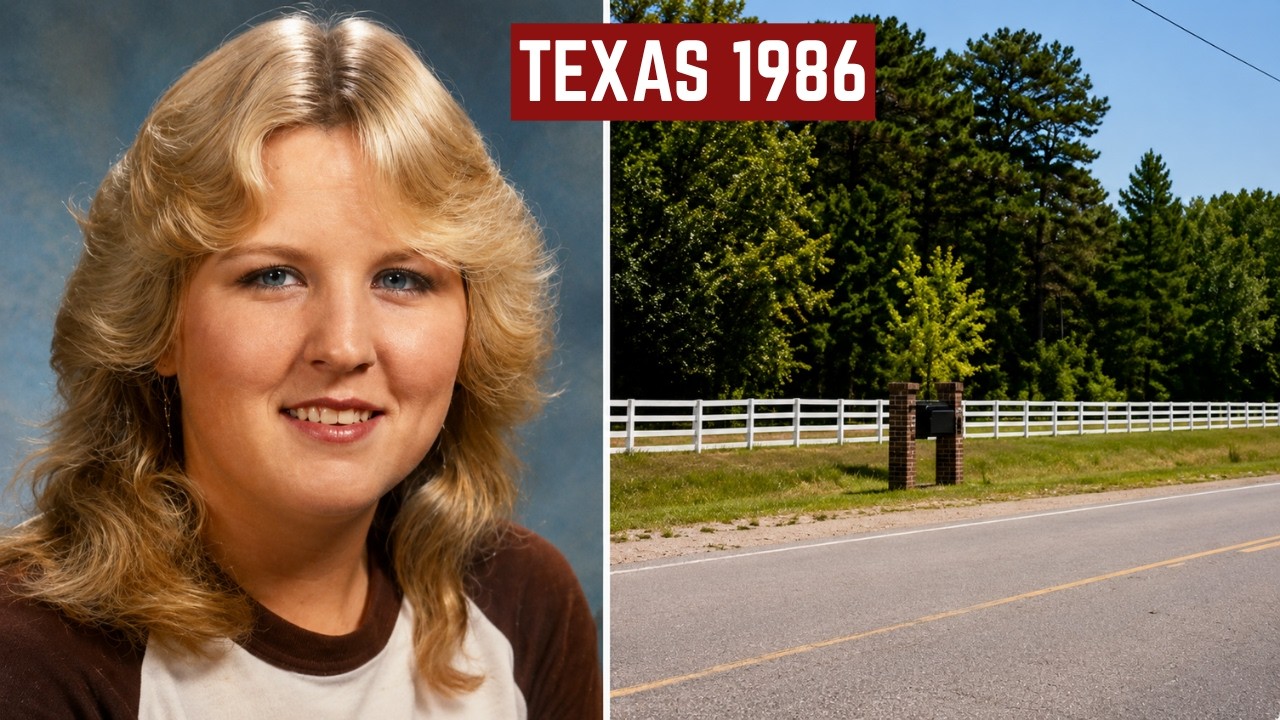
On September 27, 1986, Deanna Og was a student at New Caney High School, living about thirty miles north of Houston in Porter, Texas. Family described her as close to her grandmother, interested in music and fashion. That Saturday, she planned to attend a family dance with her grandmother and an uncle who lived thirty minutes away. Around five in the evening, she set out on foot toward a convenience store to arrange a ride.
A clerk, Virginia Matthews, later confirmed Deanna bought cigarettes there sometime between 5:30 and 7:00 p. m. It was the last confirmed sighting of her alive. Around 7:15 p.
m. , two teenagers riding off-road vehicles along a logging trail off Old Houston Road in Conroe, roughly seven miles from where Deanna started, found her body. They flagged down a passing car for help. Deanna had been sexually assaulted, beaten, and killed.
Investigators cataloged her scattered belongings: clothing, a wallet, a makeup case, a pill bottle, a hairbrush. She was identified in part through a school lunch card among her things. Her wallet was never recovered. Near her body lay a single Marlboro cigarette.
In 1986, that cigarette was just an object. DNA profiling barely existed as a forensic discipline and was nowhere near available to a county sheriff’s office. The cigarette went into an evidence bag, and the bag went into storage. Everything needed to identify a suspect was already sitting in that evidence box.
They just had no way to read it yet. Within days, a name surfaced. Roy Kriner, twenty-one, was a logger working for a man named Jeffrey Pitts, twenty-three, who had known Kriner since grade school. According to Pitts and two other acquaintances, Michael Ringo and Terry Dale Hooker, Kriner had described picking up a hitchhiker, driving her to Pitts’s logging site, and threatening her with a screwdriver before assaulting her.
Kriner’s defense would later describe him as a young man of limited intellect with no history of violence. The first crack in the case was simple: the three witnesses didn’t agree with each other. All three described the woman involved as around twenty and intoxicated. Deanna was sixteen, and her toxicology results showed no alcohol or drugs at all.
Ringo said Kriner never specified when this happened. Hooker thought Kriner meant the night before the murder. Three witnesses, three different stories, and no physical evidence connecting Kriner to the scene. At trial, the prosecution’s case rested almost entirely on those three inconsistent accounts.
The forensic science available at the time was blood typing, a method that could only narrow a donor to a broad category. The biological evidence matched a type shared by Kriner and roughly forty percent of all men. The jury was never told that the victim’s own blood markers could mask a perpetrator’s entirely, meaning the test excluded no one. It wasn’t proof.
It was noise. The trial began in mid-April 1990. On May 1st, the jury convicted Roy Kriner of aggravated sexual assault, the charge prosecutors had settled on after initially filing murder a month after the crime. The sentence was ninety-nine years.
As far as the state of Texas was concerned, the file was closed. It didn’t stay closed quietly. Sixteen months after the trial, an intermediate appeals court reviewed the case and found the evidence insufficient to support the conviction. In September 1991, that court vacated the conviction and ordered the case dismissed.
Kriner was released. It didn’t last. The state appealed, and in December 1992, the Texas Court of Criminal Appeals reinstated the conviction, ruling the lower court had misapplied the legal standard. Rather than return to a ninety-nine-year sentence, Kriner went on the run.
He was recaptured and sent back to prison in 1994. In 1997, after years of pushing, Kriner’s legal team got DNA testing approved on the biological evidence from the scene. The result left no room for interpretation: Kriner was excluded as the source. In January 1998, District Court Judge Michael Mays reviewed the exclusion and recommended Kriner be granted a new trial.
Four months later, the Texas Court of Criminal Appeals overruled that recommendation in a 5-3 decision. Writing for the majority, Judge Sharon Keller argued the DNA exclusion didn’t necessarily prove Kriner’s innocence, reasoning that another man could have contributed the biological evidence. She suggested Deanna might have had consensual sex with someone else before the attack, or that Kriner used a condom or simply didn’t ejaculate. None of these theories had been raised at trial, and there was no evidence supporting any of them.
Defense attorneys now have a name for this reasoning pattern: the unindicted co- ejaculator theory, a phrase that has become a case study in law schools on how institutions resist admitting error even against hard science. One of Keller’s fellow judges on that court, Tom Price, dissented and later said the case had made the court a national laughingstock. In 1998, freelance journalist Bob Burtman read the court’s decision and couldn’t reconcile it. He published an investigation in the Houston Press challenging the court’s claim that the evidence overwhelmingly supported the conviction.
The story reached Judge Mays, the same judge who had tried and failed to win Kriner a new trial. This time Mays ordered a different approach: a second DNA test, this time on the cigarette filter recovered from the scene in 1986. A cigarette filter is a passive but effective DNA collector. Saliva and skin cells transfer onto it every time it’s smoked.
A private lab in California ran the test. The male DNA on the cigarette matched the same profile already excluded from Kriner. One person was connected to both the cigarette and the assault, and it wasn’t Roy Kriner. Judge Mays said there was no remaining doubt of Kriner’s innocence.
The Texas Board of Pardons and Paroles agreed unanimously. On August 14, 2000, Governor George W. Bush signed the pardon. Roy Kriner walked out after ten years in prison for a crime he did not commit.
It had taken a journalist, a second judge’s order, and a governor’s signature to get him out. Kriner was free. The actual source of that DNA was not identified, not in custody, and as far as investigators knew in 2000, not anywhere near a database that could find him. They entered the unidentified male DNA profile into CODIS, the FBI’s national database.
But CODIS only returns a match if the person’s own DNA is already logged in the system, which depends on the person having passed through the criminal justice system once. Whoever left that DNA hadn’t. For over a decade, investigators ran the profile against new entries every year. Every year, nothing.
Meanwhile, the person authorities would eventually connect to this DNA left Texas for Mexico, wanted separately on an unrelated felony charge. In March 2020, the Texas Rangers flagged Deanna’s case for the Sexual Assault Kit Initiative, a federal program funding testing on backlogged sexual assault evidence nationwide. Investigators turned to a different method entirely. Investigative genetic genealogy doesn’t need the suspect’s own DNA on file.
It needs a relative. Someone who took a consumer ancestry test years ago and has no idea it’s relevant to anything. In 2021, the evidence went to Bode Technology, a Virginia lab specializing in this method. It took three years of work.
By 2024, the genealogical tree pointed to one name: Bobby Charles Taylor Senior. He was sixty years old and had been living roughly two miles from where Deanna’s body was found. He had prior convictions for burglary, DWI, and assault. Investigators found no indication the two ever knew each other.
He was already wanted separately on an unrelated felony charge and believed to be hiding in Mexico. Locating him required the Texas Rangers, the Montgomery County Sheriff’s Office, the District Attorney’s Office, the FBI, the DPS Crime Laboratory, and the Federal Bureau of Justice Assistance, whose grant funding had made the genealogy testing possible. On April 24, 2026, Taylor walked into an FBI field office in Mexico City and turned himself in for that unrelated charge. According to investigators, he had no indication a capital murder case had quietly been built against him for two years.
He was extradited to Texas the next day. On May 4, 2026, he was formally charged with capital murder in Deanna Og’s death. The reported DNA match probability was one in 27 octillion. Sheriff Wesley Doolittle called it an insane number, roughly three times the population of the entire planet, leaving no meaningful room for doubt.
Taylor remained in custody at the Montgomery County Jail. No trial date had been set, and he was presumed innocent unless proven guilty in court. The district attorney’s office said it intended to pursue the case fully. Investigators also said the file wasn’t closed with this charge alone.
They were examining Taylor’s history for other possible victims. At the press conference, Sheriff Doolittle read a letter from Deanna’s mother, Patricia Og. She was eighty-two now, and forty-two when her daughter was killed. The letter wasn’t about the man now charged.
It was about Deanna. She wrote that her daughter wasn’t on this earth for a long time, but she was here for a good time. The letter spoke to the family’s faith, which had carried them through every decade since. Then she asked for something few expected: compassion for the family of the man now charged.
Because while the Og family had forty years to grieve, that family was only just beginning to.
