The bullet took John Wesley Hardin in the back of the head. He had been standing over a craps game at the Acme Saloon in El Paso, one hand holding his dice, the other resting near his pistol, when John Selman Sr. walked through the door behind him. Selman did not announce himself.
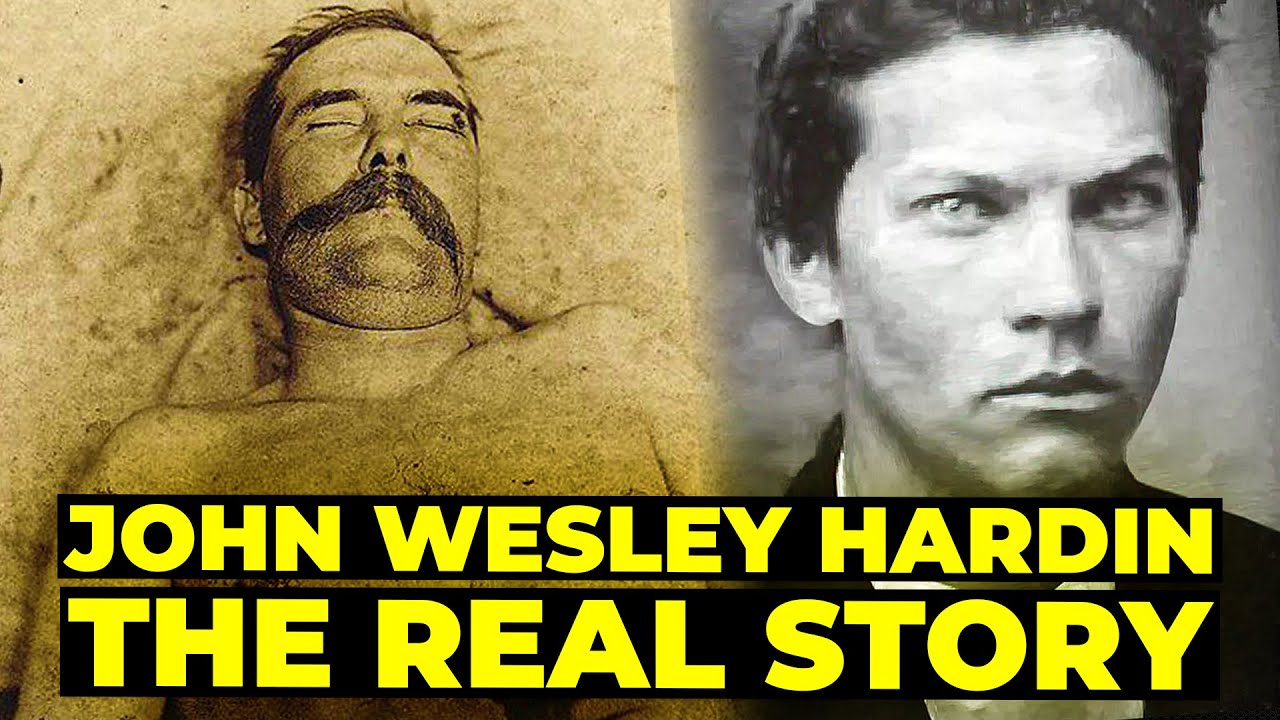
He did not call Hardin’s name. He simply drew his revolver, raised it, and fired at point-blank range. Hardin collapsed onto the floor, and Selman, standing over the fallen outlaw, fired three more times to make certain the job was finished. Hardin never saw his killer.
By all accounts he had not even known Selman had entered the saloon. But the man who shot him claimed otherwise, and in the courts of the West, that claim would be enough. The man who died that night had spent more than two decades building a reputation that stretched across Texas and beyond. He had been born in the state, the son of a Methodist preacher and a mother described as cultured and refined.
On the surface, the family was respectable, but John Wesley Hardin showed trouble early. When he was fourteen years old, another student at his school accused him of writing vulgar graffiti about a female classmate on the wall. A fight broke out. The other boy drew a knife, and Hardin disarmed him, then stabbed him with his own blade.
The wound nearly killed the boy. Hardin was not yet old enough to shave, and he had already come within a breath of committing murder. The following year, at fifteen, he killed his first man. According to the story that Hardin himself would later tell, he had beaten a former slave in a wrestling match, and the man, humiliated by his defeat, ambushed him the next day as Hardin rode by on his horse, brandishing a stick.
Hardin drew his revolver and shot the man dead. Whether the fight had truly been about a wrestling match or something else entirely, the result was the same: Hardin fled and went into hiding. Lawmen tracked him down. When they moved in to arrest him, he shot and killed four of them.
From that moment on, John Wesley Hardin lived as a fugitive from justice, and he made no effort to stay quiet about it. In the years that followed, the killings stacked up. Hardin shot cattle rustlers, fellow outlaws, cheating gamblers, and anyone else who crossed him. Some of the deaths could be justified as self-defense; others could not.
One of the most infamous incidents occurred in August 1871 in Abilene, Kansas, at the American House Hotel. Hardin had spent the evening drinking and gambling with his cousin Gib Clemens and a friend of Clemens named Charles Couger. When the night was over, Hardin and Clemens shared a room, while Couger took the room next to theirs. In the middle of the night, Hardin was awakened by loud snoring coming through the wall.
He pounded on the wall and shouted for Couger to roll over, but the snoring continued. Drunk and unable to sleep, Hardin fired his gun into the wall separating the rooms. The snoring stopped. The next morning, Couger was found dead with a bullet through his heart.
Hardin would later claim he had only meant to wake the man, not kill him. Whether or not that was true, the story spread, and John Wesley Hardin earned the reputation of being so mean that he shot a man for snoring too loudly. For years he stayed on the run, never keeping a low profile. Lawmen who tried to capture him found themselves outgunned.
Fellow outlaws who crossed him found themselves buried. By the time he was finally captured in 1877, at the age of twenty-three, he was known to have killed twenty-seven men. Hardin himself insisted the number was higher. He claimed he had murdered forty-two people.
His reputation for lying and exaggeration was as well established as his reputation for violence, and many of his claims could not be corroborated. Even so, he was not blamed for the other murders attributed to him, despite his high body count. His murder trial ended with a sentence of twenty-four years in prison. In the end, he served only about eighteen of them.
While locked up, Hardin wrote his autobiography, a book filled with outlandish and unsubstantiated claims about his life and exploits. He also used the time to study law, preparing himself for a future that would have seemed impossible to the young man who had once shot four lawmen in a single confrontation. On February 17, 1894, at the age of forty, John Wesley Hardin walked out of prison. He was still handsome, and he had a plan.
A few months after his release, he took and passed the bar examination. On January 9, 1895, he received his license to practice law. He also found love, of a sort. He married a fifteen-year-old girl named Callie Lewis, though the couple separated a short time later.
Hardin moved to El Paso and took up with a prostitute named M. Rose. The new life did not last. In August 1895, M.
Rose was arrested for brandishing a gun in public. The arresting officer was a young constable named John Selman Jr. Hardin confronted the officer about the arrest and ended up pistol-whipping the young man. That beating set in motion the chain of events that would end Hardin’s life.
John Selman Jr. had a father, John Selman Sr. , a constable, a former outlaw, and an expert gunslinger in his own right. The elder Selman approached Hardin, and the two men exchanged angry words.
Nothing came of the confrontation at that moment, but the matter was not settled. Later that night, Hardin was at the Acme Saloon enjoying a game of craps. He had no reason to expect trouble. The man who walked through the door behind him was the one person in El Paso who had both the skill and the motive to kill him.
John Selman Sr. was arrested and stood trial for the killing of John Wesley Hardin. He got off, claiming the shooting had been self-defense, insisting that he had seen Hardin reach for his gun and fired first, even though he had approached Hardin from behind and in all likelihood Hardin never knew he had entered the saloon. As news of Hardin’s death spread, reactions across Texas were anything but unified.
Some saw him as a ruthless killer who had finally met the end he deserved. Others romanticized him as a legendary gunslinger, one of the last of a dying breed. Regardless of opinion, one thing was certain: the Wild West had lost one of its most notorious figures. M.
Rose, devastated by the loss of her lover, spiraled into despair. She left El Paso, wandering from town to town, never quite escaping the shadows of her past. The events of that fateful night haunted her, and she struggled to find peace. The younger Selman carried his own weight.
Despite his father’s exoneration in court, John Selman Jr. could not shake the guilt of taking a man’s life. He began to question the legitimacy of the wild justice that had characterized the West for so long. In the years that followed, the American frontier began to change.
Law and order slowly crept into the untamed lands, and the violent era of outlaws and gunfights began to fade. The vast wilderness saw the establishment of towns, cities, and organized communities. John Selman Jr. , now a seasoned lawman, became an instrumental figure in bringing order to the lawless territories.
He vowed to uphold justice and protect the innocent, determined to atone for the death of John Wesley Hardin and the violence of his past. Meanwhile, M. Rose found herself in a small town called Harmony Springs, far from the chaos of the Wild West. The peaceful surroundings and warm-hearted locals helped her heal slowly.
She decided to start a new life there, away from her dark history. As the years passed, Harmony Springs grew, and its peaceful community thrived. John Selman Jr. was appointed as the town’s sheriff, and under his guidance, the law flourished and crime dwindled.
One day, as the town was preparing for its annual summer festival, a stranger arrived in Harmony Springs. He was tall, rugged, and carried an air of mystery. His name was Jesse Carter, and he was a traveler roving the country in search of a place to call home. Jesse quickly caught M.
Rose’s eye, and the two began spending time together. His presence brought light to her life, and the two found comfort in each other’s company. Little did she know that Jesse carried secrets of his own. As the bond between M.
Rose and Jesse deepened, so did John Selman Jr. ’s suspicions. He could not help but feel a sense of familiarity about Jesse, and as he dug deeper, he discovered that Jesse had a hidden past, one that tied him to the violent days of the Wild West. One evening, as the sun dipped below the horizon casting a golden glow over Harmony Springs, John Selman Jr.
confronted Jesse about his past. Jesse, aware that his secrets were catching up to him, confessed to his former life as a hired gun and outlaw. But as he spoke of his past, he revealed a transformation. He had left his violent ways behind and had been seeking redemption, just as John Selman Jr.
had. They both realized they shared a common desire for a better, more peaceful future. M. Rose, caught in the middle, understood that the two men she cared for had experienced a significant change of heart.
She saw the potential for harmony among them and in the town they all loved. As the summer festival approached, tensions ran high in Harmony Springs. The townspeople were divided in their opinion of Jesse, uncertain whether to trust a man with such a dark past. But the festival also presented an opportunity for redemption, a chance to prove that the wild west days were truly behind them.
On the day of the festival, John Selman Jr. stood before the community and spoke of his own transformation. He confessed his guilt over the death of John Wesley Hardin and expressed his commitment to upholding the law and protecting the town. Jesse also stood before the crowd, sharing his story of redemption and promising to leave his violent past behind.
He spoke of a vision for Harmony Springs, a place where people could start new and leave behind the shadows of their history. Moved by their words and inspired by their willingness to change, the townspeople embraced Jesse and John Selman Jr. They saw in them the hope for a better future, one where justice prevailed and violence was a thing of the past. And so Harmony Springs became a symbol of transformation and redemption.
John Selman Jr. and Jesse Carter worked side by side, keeping the peace and upholding the law. M. Rose, their guiding light, found solace in the love and forgiveness she had found in their shared journey.
As the years passed, Harmony Springs flourished, becoming a beacon of hope in a changing world. The story of its transformation spread far and wide, reminding people that even in the darkest of times, redemption and forgiveness could prevail. And so the legend of John Wesley Hardin, once a symbol of lawlessness and violence, faded away, replaced by the tale of Harmony Springs, a town that had defied its past and forged a brighter future.
