On April 12, 1945, General George S. Patton, the most ferocious commander in the American army, walked behind a wooden shed in a forest in central Germany and vomited against the wall. He was fifty-nine years old. He had led tanks in two world wars, but he had never done this before.
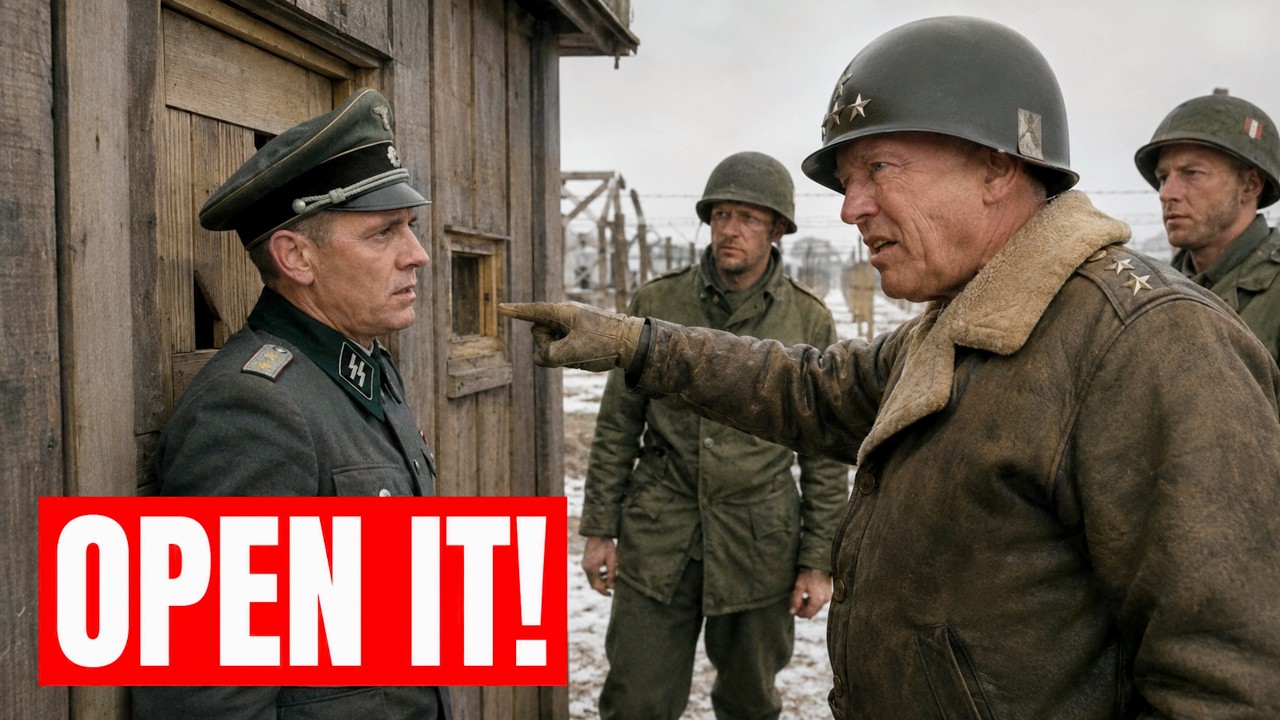
What he had just seen inside that shed was something that would consume the short remainder of his life as he tried to forget it. That same day, four thousand miles away in Warm Springs, Georgia, President Franklin Roosevelt was dying, and he would not live long enough to hear about any of it. The story had begun eight days earlier, with an eighteen-year-old American soldier who stepped through an iron gate and stopped walking. Thirty men lay on the ground between the gate and the first barracks.
The blood beneath them had not yet turned black; some of it was still wet. The soldier’s name was Don Timmer, a private in the 89th Infantry Division of the U. S. Third Army.
In high school in Ohio, he had studied German, a choice that felt inconvenient at first, then useful, and now, standing at this gate, closer to a burden. Within minutes he would begin translating what the survivors were saying. He would remember that smell for the rest of his life. In March 1945, the war in Europe was ending faster than anyone had predicted.
The German lines west of the Rhine had collapsed. On the night of March 22, elements of Patton’s Third Army crossed the Rhine near the town of Oppenheim in wooden assault boats. Patton waited until the far bank was secure. Then he stopped in the middle of the pontoon bridge, and in a moment his photographer would document, urinated into the river.
He wanted his men to see him do it. He wanted the Germans to hear about it. He wanted history to record the gesture. The Third Army pushed east at a speed that outstripped the ability of maps to keep pace.
Patton’s tanks entered Thuringia, with infantry following. Somewhere ahead of them, in a stretch of forest south of the town of Gotha, there was a site the SS called Esre. The Americans did not know it existed, but they were about to find out. Ohrdruf did not appear on any Allied intelligence map because it was officially a construction site.
In November 1944, with the Reich collapsing on both fronts, the SS Main Economic and Administrative Office established a new subcamp of Buchenwald in the woods thirty miles to the west. The site had no official name, only a code name: Esre, three Latin letters that meant nothing to anyone outside a small circle of engineers and officers. The prisoners knew what Esre was, because they were the ones building it. Their task was to dig tunnels through the side of a mountain near a place called Möhrberg.
The tunnels were intended to house a communications center for the final defense of the Reich, and also to hide, if the war lasted long enough, something else: a Führer escape route aboard Hitler’s train, his mobile command center, and his road out of Berlin if it fell. The men digging those tunnels were being killed while they worked. By late March 1945, the prisoner population at Ohrdruf exceeded ten thousand, drawn from every occupied European country. They were Jews, Poles, Hungarians, Russians, and Frenchmen.
They lived in barracks never designed for human habitation. They were shot when they slowed down and beaten when they did not. Starvation was official policy. Esre was a method of exploiting human beings until they lost their usefulness, then disposing of them in a shed near the parade ground.
In early April 1945, two men in Berlin made different decisions about the fate of the camps. The first was Ernst Kaltenbrunner, forty-one years old, chief of the Reich Main Security Office and head of the SS intelligence and police apparatus that ran the entire concentration camp system. On April 3, Kaltenbrunner issued an order for the immediate evacuation of Ohrdruf. The prisoners were to be marched on foot to Buchenwald, and anyone who could not walk was to be dealt with on the spot.
The second man was Heinrich Himmler, Kaltenbrunner’s superior in the SS. Six days earlier, on April 7, Himmler had met with a Swiss intermediary named Benoît Musy, the son of Jean-Marie Musy, a former president of Switzerland. Himmler used the meeting to make a promise to this Swiss intermediary. He said that Buchenwald would be left intact for liberation by the Allies.
It would be handed over quietly and without violence as a gesture. The gesture was aimed at one man. Himmler wanted it to reach General Dwight Eisenhower. He was already thinking about what came after the war.
He was already thinking about a deal. He was already thinking about survival. Kaltenbrunner knew nothing of this promise. By the time Himmler learned of it, through Walter Schellenberg, who had heard it from Musy, the evacuation of Ohrdruf had already begun, and tens of thousands of prisoners were on the roads.
Himmler stopped the order on April 10, but he was three days too late. The evacuation of Ohrdruf was a death march in the most literal sense. Along the road between Ohrdruf and Buchenwald, SS men, local militia, and Hitler Youth shot an estimated one thousand prisoners. They shot those who lagged behind, those who tried to escape, and in some cases those who simply looked at them the wrong way.
Mass graves along the route were reopened, and the bodies were burned to conceal what had happened to them. Not everyone could be evacuated. Inside the camp, in a section called the north camp, hundreds of prisoners were too sick or too weak to move. The SS did not want to leave them alive for the Americans.
They also did not want to spend the day shooting men one by one in the barracks, so they lied. They announced that food was being distributed on the parade ground. Men who had not eaten a real meal in weeks rose from their bunks. They limped, or were carried, or crawled.
They went to the parade ground because they had been told there was food. When they arrived, the guards were waiting with their rifles. The bodies were left where they fell. Then the SS fled.
Shortly after sunrise on April 4, 1945, the leading elements of the 4th Armored Division of the U. S. Third Army reached a barbed-wire fence in the forest south of Gotha. They had not expected to find it.
There was nothing on their maps. There was nothing in their briefings. The commander was Brigadier General Joseph F. H.
Cotrona. Behind him, advancing in support, was the 89th Infantry Division under Major General Thomas D. Finley and the 602nd Tank Destroyer Battalion. None of these men had been trained for what was inside.
Private Don Timmer entered the gate with his rifle at low port and stopped when he saw thirty men on the ground. Behind him, another young soldier, Private David Cohen of the 4th Armored Division, followed the smell to a shed on the edge of the compound. He would later say only this: the bodies were stacked like firewood. There were no words to describe it.
The smell was sharp, unforgettable. News of what the Americans had found spread up the chain of command that morning. It reached the headquarters of the 12th Army Group by noon. It reached Supreme Headquarters Allied Expeditionary Force by evening.
Within a week it would reach General George S. Patton Jr. , who would fly to Ohrdruf with two of the most famous generals in the U. S.
Army. But that would come later. The gate was opened. The barbed wire was cut, and for a long moment the soldiers of the 4th Armored Division stood inside the perimeter of Ohrdruf without moving.
They were combat soldiers. They had crossed France. They had crossed the Rhine. They had seen burning cities and friends dying and the ordinary horrors of war fought in the open.
None of it had prepared them for what was waiting inside the barbed wire. A young soldier stopped at the corner of the first barracks and vomited in the mud. No one said a word. The camp had been hastily evacuated, and it showed.
Smoke still rose from the crematorium near the parade ground. Lime had been scattered in the shed by the gate by the handful, without any care. Papers were left on desks in the small guard room near the entrance, half-burned in a bucket that the last man to leave had not bothered to empty. Those who had fled had fled to save their own lives.
Not everyone had fled. There were survivors. They came out slowly from the remaining barracks, from the corners of the parade ground, from behind the sheds. They did not come out quickly.
They could not. Some could barely walk. They came out in the striped uniforms that every American would recognize in the years to come. They came out silent, because they were not yet sure what an American soldier would do to them.
Don Timmer was eighteen years old. He was from Ohio. He had studied German in high school because it was his grandmother’s language. He became the interpreter.
He stood in the yard with a notebook and pencil that his sergeant had handed him, and he listened. One by one, the survivors came forward and told him what had happened there. He wrote as fast as he could. He wrote down places he had never heard of.
He wrote down methods that had never occurred to him. He wrote down the names of men who were no longer alive to speak for themselves. When his hand cramped, he switched hands and kept writing. The men talking to him were not asking for revenge.
They were asking to be believed. The first thing the Americans learned at Ohrdruf was not what the Nazis had done, though they learned that too. The first thing they learned was that the survivors were afraid the world would not believe them. Some guards had not survived.
On the morning of that first day, a photographer from the 4th Armored Division walked the camp perimeter with a rapid-wind camera and took photographs that would later be preserved in the U. S. National Archives. Two of those photographs show the bodies of SS men lying inside the camp.
They had not been killed by American gunfire, nor in battle. They had been killed by the prisoners in the hours between the SS flight and the American arrival. No American officer at Ohrdruf on April 4, 1945, made much effort to find out exactly who had done it. That would become important later.
Some SS men were captured alive. They sat in a corner of the camp under guard, hands on their heads, and were interrogated through Private Timmer. There was one specific question the Americans wanted answered, and it was simple: where were the other bodies? Because the prisoners were saying, and Timmer was recording it as fast as he could, that there was a pit a mile from the camp, behind the treeline, where three thousand men had been buried since January 1.
Men shot in the head. Men starved to death. Men worked until their hearts gave out. The captured SS men did not want to answer.
They looked at their boots, at the sky, anywhere but at the Americans. When they spoke, their sentences were short and clipped, empty of the requested information. The Americans did not need them. The prisoners took charge.
Men who could barely stand insisted on walking with the American officers around the perimeter of the parade ground to show them where things were. Here they beat us. Here they hanged us. Here they forced us to stand for hours in the snow.
Here is the pit. Here is the pit. Here is the pit. They pointed and described and explained.
When words failed, they used their bodies to demonstrate what had been done to them. In one corner of the parade ground, a group of prisoners took an American officer aside and showed him a wooden tool. They needed no special wood for him to understand its purpose. Word of what was happening at Ohrdruf reached the high command during the first week through the normal chain of command, and it reached higher than expected.
On April 11, elements of the 6th Armored Division of Patton’s Third Army passed into another stretch of the same forest, about thirty miles east, and made contact with a place called Buchenwald. This was not a subcamp. It was the main camp itself. On April 11, Buchenwald was doing something no one outside knew about.
Inside the main camp, in a room in the basement of one of the buildings, two men were working on a radio transmitter they had built in secret over the previous months. The transmitter was a shortwave device assembled from stolen and hidden parts, and it belonged to the underground resistance organization that had operated inside Buchenwald for years. One operator was a Polish engineer named Giyon Damasin, and the other was a Soviet prisoner of war named Konstantin Ivanovich Leonov. They began transmitting in the early afternoon.
Damasin sent the message in English and German; Leonov sent it in Russian. It was a short message, repeated over and over amid the jamming, because the transmitters were not sure anyone was listening. To the Allies. To the army of General Patton.
This is Buchenwald concentration camp. Distress call. We ask for help. They want to evacuate us.
The SS wants to destroy us. Then they waited. Somewhere in the signal network of the U. S.
Third Army, a radio operator heard them. The message climbed the hierarchy, from the signalman to the section chief, to the duty officer, to the staff of the Third Army. Without waiting for permission from anyone, the staff sent a reply through the same jamming the message had come through. The reply, when it reached Damasin’s ears, was five words: We are rushing to your aid.
Third Army staff. Damasin fainted at his desk. He had spent years inside Buchenwald, watching men die. He had built a radio from spare parts that could have cost him his life dozens of times.
He had sent a message not knowing if it would ever be heard, and the reply had come in five words from an army that had already begun moving into Buchenwald that very day. Something else was happening. The prisoners were rising. The resistance had been preparing for months.
They had hidden weapons. They had traded for weapons. They had stolen weapons. When the SS leadership inside the camp panicked and fled, the resistance came out into the square and seized the towers and gates and barracks.
By the time American tanks reached the barbed wire, Buchenwald had already been liberated, in the most literal sense, by the prisoners themselves. Some SS men had not been able to get out. That is all the historical record says. Some of them had not been able to get out.
On that same day, thousands of miles away, in a small house in a place called Warm Springs, Georgia, a man was sitting for a portrait. He was sixty-three years old. He had been president of the United States for twelve years, and had led his country through the Great Depression and into the Second World War. At around one in the afternoon on April 12, 1945, Franklin Delano Roosevelt put his hand to his temple and said one sentence: I have a terrific pain in the back of my head.
Then he lost consciousness. His death was announced a few hours later. The news spread slowly across the Atlantic. It reached supreme headquarters that evening.
It reached Third Army headquarters later. It reached the men who at that very hour were walking through the gate at Ohrdruf. None of them knew when they landed at the airfield near the camp that the president had died. They would find out later that night, and they would remember for the rest of their lives that they had been standing in front of the shed at Ohrdruf on the day their commander in chief died.
The visit had been Eisenhower’s idea. Dwight Eisenhower was fifty-four years old, a five-star general in the U. S. Army and Supreme Commander of the Allied Expeditionary Force.
He had spent the first week of April receiving reports from the field about what the Third Army was discovering at Ohrdruf. He read the telegrams. He looked at the first photographs. He listened to officers who had returned from the camp and could not stop talking about what they had seen.
He decided he needed to see it for himself. He was not motivated by curiosity. He was already thinking about the years after the war, about what would happen when a whole generation passed, when the men who had seen the camps grew old or died, and someone somewhere stood up and said it had never really happened, that it had been exaggerated, that it had been propaganda. He wanted to be able to say, in his own voice and his own words, that he had walked through the camp himself.
He asked General Omar Bradley to accompany him. Bradley was fifty-two, commander of the 12th Army Group and one of Eisenhower’s closest colleagues throughout the war. Bradley agreed. Eisenhower also asked General George Smith Patton Jr.
to come. Patton was fifty-nine, a forty-year army veteran, commander of the army that had liberated the camp. Patton agreed, but he noted in his diary later that he had not wanted to go. On the morning of April 12, 1945, the three men flew to an airfield near Gotha in central Germany, then were driven in a small convoy to the gate of Ohrdruf.
A prisoner met them at the gate, emaciated, his striped shirt hanging loose around him. He had been in the camp until nine days earlier, then escaped and returned to serve as a guide. He had no rank and no title, and his name is not recorded in the historical record. But he was the man who escorted General Eisenhower, General Bradley, and General Patton through Ohrdruf that morning.
He led them first to the place of the bodies. There were still bodies in the square, more bodies near the barracks, more still near the parade ground. The prisoners had not yet been able to bury them, and the Americans had decided not to move them until Eisenhower had seen them in place. The prisoner guide walked slowly; it was the fastest he could manage.
He stopped and pointed and explained, and sometimes he gave demonstrations. In one corner of the parade ground, he showed the three American generals how the SS had beaten men with wooden clubs, how they had died from it, and how the bodies had been taken to the crematorium in the square. Then he took them to the shed. The shed stood at the edge of the parade ground.
It was a small wooden building, no larger than a garden shed on an American farm. The door was open. Inside, the bodies of some forty men were stacked from the floor to above waist level. They were naked.
They had starved to death. Their skin was stretched tight over their bones. They had been sprinkled with a thin layer of lime, not enough to decompose anything, only enough to dull the smell, because there was nowhere else to put them. The prisoner guide stopped at the entrance.
Bradley went in. Eisenhower went in. Robert D. Murphy, Eisenhower’s political adviser, went in with them.
And General George Smith Patton Jr. , who had fought at Casablanca, who had led armor in Sicily, who had crossed the Rhine three weeks earlier and told his men he wanted history to remember him for it, stopped at the entrance. He refused to enter. He said loudly that he would be sick.
He turned and walked around the side of the shed, and there, out of sight of his men, vomited against the wooden wall. Then he came back and did not speak for a long time. Eisenhower did not comment on it. He would write about it later.
In a telegram to General George C. Marshall in Washington, he mentioned only that in one room where the bodies of twenty or thirty naked, starved men were piled, George Patton had refused even to enter. He said he would be sick if he did. That was all Eisenhower said about it.
He did not need to say more. Patton, when he wrote in his diary about what he had seen at Ohrdruf, chose different words. He described it as one of the most appalling sights he had ever seen. He described in precise detail what had been in the shed, how the bodies had been sprinkled with lime, and what the prisoners had said about the three thousand men buried since January 1 in a pit a mile from the camp.
He wrote it all down, wanting to document the events. He did not know, as he wrote, that a few hours later, on the road back to the airfield, he would be told of the death of Franklin Roosevelt. He did not know that Eisenhower, standing in that same shed, had made the decision that would change the world’s understanding of what had happened there. He did not know that within seventy-two hours Eisenhower would send a telegram to Washington requesting that members of Congress and the American press be flown to the camps.
He did not know that within a week two thousand civilians from the town of Weimar would be marched under armed guard to the hill at Buchenwald and forced to walk through it with their eyes open. He did not know that seventeen days later, at another camp called Dachau, an American colonel would give an order that would end with SS men shot against the wall of a coal yard by soldiers who had just seen what was inside, and that the investigation into what happened at Dachau would be quietly closed without any charges. George Smith Patton Jr. stood behind the shed at Ohrdruf on April 12, 1945, wiping his mouth with the back of his hand.
He knew none of that yet. All he knew was what was in the shed, and he knew he would have to keep walking. He wiped his mouth with the back of his hand and came back around the corner of the shed. Eisenhower was waiting for him.
Bradley was waiting. The prisoner guide was waiting. Behind them, in the yard, the survivors of Ohrdruf watched a man wearing a helmet with four stars come back from the side of the wooden building. They did not look away.
They did not say a word. Patton had spent forty years in the U. S. Army.
He had been shot in the First World War. He had been shot at in Morocco, Tunisia, Sicily, France, and Germany. He had led men into places he knew some of them would never leave. He wrote in his private diary that he loved war more than anything else a man could love in this life.
At the corner of that shed at Ohrdruf on April 12, 1945, something inside him broke. He did not speak of it, not to Eisenhower, not to Bradley, not to Murphy. He wrote about it later in his diary and in a letter to his wife, Beatrice. That was as close as he ever came to describing what had happened behind that building.
He wrote one sentence that summed up that entire day: Ohrdruf was the first concentration camp, and we all prayed it would be the last one we would see. But we were not lucky. That is all there is to it. The tour continued.
There was more to see, because there was always more to see. The guide took them to the punishment sites. Then he took them to the barracks, where men slept four to a bunk on wooden planks. Then to the place near the fence where the SS had lured the last sick prisoners to the parade ground with the promise of food, then shot them there and left their bodies where they fell.
Eisenhower kept walking. He wrote about it later, in the telegram he sent that same week to General George Catlett Marshall, U. S. Army Chief of Staff in Washington.
That telegram became one of the most famous of the entire war. Eisenhower described what he had seen in the clearest words a professional soldier could find. He said it was beyond description. He said the visual evidence and the verbal testimony of starvation, cruelty, and bestiality were so overpowering as to leave him sickened.
Then he wrote one line he wanted history to remember. He said he had made the visit deliberately, in order to be in a position to give firsthand evidence of these things if ever, in the future, there developed a tendency to charge these allegations merely to propaganda. He was not writing to his wife. He was not writing to a friend.
He was writing to the Chief of Staff of the U. S. Army, and through him to the President, to lodge the evidence in the historical record. He was writing so that no one could deny what had happened.
They flew back to the airfield in the late afternoon. During the drive, or at the airfield, or during the return flight to headquarters, one of the three generals was told of the death of Franklin Delano Roosevelt that day in Warm Springs, Georgia. The historical records do not agree on exactly when each of them heard the news, but by that night, all three knew. Patton, in his diary that evening, wrote about Ohrdruf.
He wrote about the pit, about the shed, about the three thousand men in the hole near the treeline. He wrote about the survivors and what they had said. Then he wrote about Roosevelt. He recorded both matters side by side on the same day, in a steady hand, as if the writer could not believe both had happened on the same day.
But both had happened on the same day. Three days later, on April 15, Patton traveled to Weimar for a different reason. He was scheduled to visit what he thought would be his next command post. General Walton Walker, one of his key commanders, suggested that since he was in the area, he might take a short drive up the hill to visit Buchenwald.
Patton went. He walked through Buchenwald with the same officers who had accompanied him at Ohrdruf. He wrote that inside the barracks he found bunks stacked four high, built at right angles to the corridor, tilted forward so that the men’s waste ran down onto the floor. He wrote that the filth on the floor was at least three inches deep.
He wrote that the inmates looked like faded mummies. He wrote it in the same style he had used to describe Ohrdruf. He was by then a man who no longer wondered at anything. That same day, on the explicit order of General Walker, two thousand civilians from the town of Weimar were marched at bayonet point up the hill to Buchenwald and forced to walk through it.
They saw the barracks, the crematorium, the ovens. They saw the pile of remains outside the crematorium that had not made it to the ovens when the fuel ran out. Some of them fainted. Some of them wept.
Some refused at first to continue until the American soldiers behind them made clear this was not a request but an order, issued from the very top of the American command. Eisenhower had decided, standing in the shed at Ohrdruf three days earlier, that the world would see what happened here, and that the Germans who lived in the towns near the camps would see it first. In Ohrdruf, the same order had been issued days earlier. The local civilians were marched to the camp, and the mayor of the town was forced to walk through it with his wife.
That night, the mayor of Ohrdruf and his wife returned to their home and hanged themselves. Their names are not preserved in the records that reached the U. S. archives.
What is preserved is the fact that they did it. The war did not stop because of what was discovered at Ohrdruf or Buchenwald. The Third Army kept advancing. On April 23, Patton’s 90th Infantry Division reached a place called Flossenbürg.
On May 5, three days before the war in Europe ended, the 11th Armored Division of the Third Army reached a place in Austria called Mauthausen. The camps kept being discovered, one after another, and each one was worse than the American soldiers had been prepared for, because there was no preparation for what they were facing. On April 29, 1945, at a camp called Dachau in Bavaria, elements of the 42nd and 45th Infantry Divisions of the U. S.
Seventh Army, not Patton’s Third but the Seventh under General Alexander Patch, reached the barbed wire. What they found inside was not new. By the end of April 1945, the American army generally knew what a Nazi concentration camp would look like, from the outside and from the inside. But what happened at Dachau that day was different, and it is worth being honest about it.
A group of SS guards inside the camp surrendered to the American soldiers. Some of them dropped their weapons and put their hands on their heads and walked under guard to a corner of the compound near the coal yard. The soldiers guarding them had, in the previous hour, passed a stopped train outside the camp, a train whose cars were still packed with the bodies of men who had died on it while being transported from another camp. According to the investigations that followed, an American officer gave an order.
Then the soldiers opened fire with their rifles on the SS guards standing at the wall of the coal yard, killing about sixteen men. Lieutenant Colonel Felix Sparks, the battalion commander responsible for the sector, rushed to the scene and pushed his soldiers’ rifles down to stop the firing. In his account of the incident years later, he said the whole thing took about thirty seconds. The U.
S. Army investigated the retaliation at Dachau as a war crime, but the case was dropped, and no one was tried. Patton noted in his diary, in the weeks before Ohrdruf, that a prisoner had killed a guard in front of him and that he had not tried to intervene. He recorded it without comment, the way one records what one has decided to accept.
This is not the version that suits a movie. It is the truth as the records show it. Patton was not a saint. He was a professional soldier who had fought a brutal war and come out of it with firm convictions about vengeance, closer to the convictions of his own men than to the principles of his superiors.
On September 28, 1945, five months after Ohrdruf and four months after the surrender of Germany, Dwight Eisenhower relieved George Smith Patton Jr. of his command as military governor of Bavaria. Patton had made public statements in those months that would have been better left unmade. At a press conference in the town of Bad Tölz, he compared members of the Nazi Party to Republicans and Democrats in the United States and suggested that most of them had joined under duress.
He resisted the American denazification program, which required removing former Nazi officials from their posts in the civilian administration of Bavaria. He said that if all former party members were dismissed, there would be no one left to run the trains. Eisenhower had had enough. A few weeks later, on October 7, Patton was transferred from the Third Army to the Fifteenth Army.
Instead of a command, he was given a phantom army with almost no soldiers, tasked with writing the historical account of the war in Europe. The man who had stood behind the shed at Ohrdruf and vomited against the wall was, five months later, writing history at a desk. On December 9, 1945, near the town of Mannheim in the American occupation zone of Germany, General George Smith Patton Jr. was riding in a Cadillac Model 75 on his way to a pheasant hunt.
His driver, Private Horace Woodring, was twenty years old. Patton was sitting in the back seat. A U. S.
Army truck turned suddenly at low speed at an intersection, and the Cadillac collided with it. Patton was thrown forward, his head striking the metal partition between the front and rear compartments. Woodring was not seriously injured. Patton was paralyzed from the neck down.
He was taken to the U. S. Army hospital in Heidelberg. His wife, Beatrice, flew from Massachusetts to be at his side.
He was conscious, aware of what had happened to him and of what it meant. He remained in the hospital for twelve days and died on December 21, 1945, of a heart attack in his sleep. He had turned sixty the previous month. He was buried, at his own request, beside the men of the Third Army who had fallen in the Battle of the Bulge.
His grave is in the American military cemetery in Hamm, Luxembourg. It is a small white cross in a field of small white crosses. Nothing on it indicates that the man buried beneath it was different from any of the other men buried around him. That is how he asked to be buried.
Eight months earlier, he had stood behind a shed at Ohrdruf and vomited against a wall. Between those two days, he lived a life that most men do not live in ten years. The last thing worth saying about Ohrdruf is not about Patton, nor Eisenhower, nor Bradley. The last thing worth saying about Ohrdruf is what Eisenhower wrote in the telegram to Marshall, and in the statements he made in the weeks after the visit.
He said one sentence that has been quoted more than almost anything any American general said about the Second World War: The American soldier has been told for years that he does not know what he is fighting for. He said: The American soldier now knows at least what he is fighting against. He was fifty-four then. He lived to be seventy-eight.
He was elected president of the United States twice. He was buried in Kansas. And every year on April 12, he remembered what he had seen inside a wooden shed in a forest in Thuringia on the day President Roosevelt died. The men who liberated Ohrdruf went home.
Private Don Timmer of the 89th Infantry Division returned to Ohio. Private David Cohen of the 4th Armored Division went home as well. Most of them did not talk about it much, not for the rest of their lives. When they did talk, they returned to the same short sentences they had used in April 1945.
They did not add anything to them. That is what the records show. That is what the men who were there said. That is what happened at Ohrdruf on April 4 and April 12, 1945.
And that is what General George Smith Patton Jr. did behind a wooden shed on the day the president of the United States died. He vomited against the wall.
