On the evening of April 18, 1942, the most powerful naval commander in the Pacific closed the door of his private cabin aboard the battleship Yamato and did not come out. Admiral Isoroku Yamamoto, the architect of the Pearl Harbor attack, had handed command of the Combined Fleet to his chief of staff and sat alone with a twelve-page intelligence report. At the bottom of the final page, a single line: launching point unknown. Sixteen American bombers had appeared over Tokyo that afternoon.
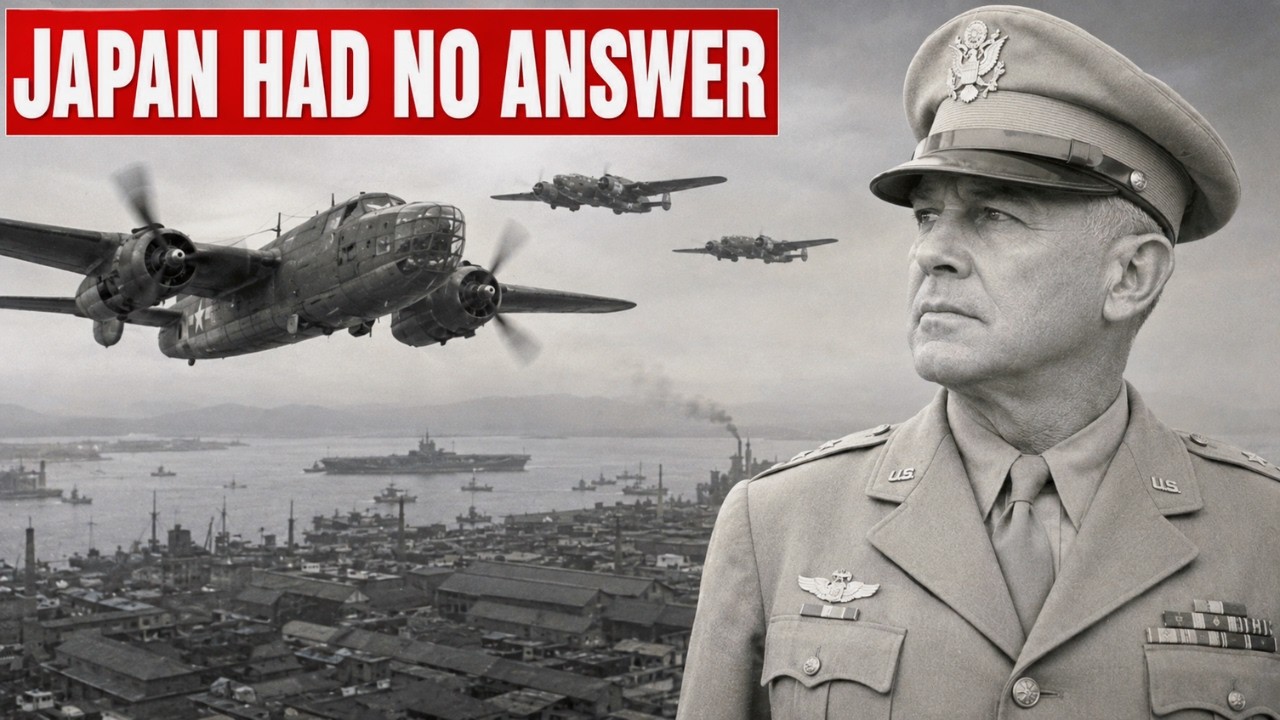
Sixteen. And no man in Japan’s high command, not an admiral, not a general, not an intelligence officer, could tell him where they had come from. The numbers said it was impossible. Those numbers held for four months.
That morning, at 7:38 in the gray North Pacific, a forty-five-year-old lieutenant colonel named James Harold Doolittle proved them wrong. At 7:38 a. m. on April 18, the North Pacific was gray and turbulent.
Twenty-foot waves lifted and dropped the deck of the USS Hornet. Rain swept sideways across the flight deck, cold rain that soaked into wool and stayed there. In the cockpit of the lead B-25, Doolittle sat with his hands on the controls. Four hundred sixty-seven feet of wet steel stretched ahead of him.
That was his runway. At its end, nothing. Just gray ocean and a sixty-foot drop. He already knew what the fuel gauges would say when this was over.
There would not be enough to return. No ship waited for him on the other side of Japan. No rescue plan, no withdrawal route. Washington had given these eighty men a mission and quietly decided not to plan their return.
Doolittle knew this before he set foot on the carrier. Still, he climbed into the cockpit. By April 1942, Japan had been at war with the United States for exactly 129 days. In that time, they had taken Hong Kong, Malaya, Singapore, Burma, the Dutch East Indies, and Wake Island, and driven the British Royal Navy from the Indian Ocean.
They had sunk or crippled most of the American Pacific Fleet at Pearl Harbor. Every advance had succeeded. Every objective had fallen. Throughout that period, no enemy bomb had touched Japanese soil.
For the Japanese military, this was not luck. It was arithmetic. Japanese strategists had carefully measured every American aircraft in service, its range, and the nearest American base. The closest American base capable of launching bombers was Midway Island, 2,000 nautical miles from Tokyo.
The furthest American bomber available in early 1942 could fly roughly 1,500 miles with a combat load. The gap was final. Japan was safe, not because the enemy lacked courage, but because the enemy lacked aircraft that could reach her. One man in the Imperial Japanese Navy did not sleep easily because of these calculations.
Yamamoto, fifty-eight, commander of the Combined Fleet, had lived in the United States, studied at Harvard, served as naval attaché in Washington, and traveled the country. He understood the scale of American industry in a way most Japanese officers could not. After Pearl Harbor, something in his instincts refused to settle. He wrote to close friends about his unease.
He told them the people celebrating in the streets of Tokyo were wrong. He summarized it in a single sentence: the fact that the enemy has not come is not to our credit. That credit belongs to the enemy. He formally proposed to the Naval General Staff that an American carrier task force might attempt to strike the home islands.
The staff reviewed the same calculations every planner had reviewed. Their conclusion was the same as every serious officer’s: impossible. Yamamoto did not press further. Two weeks later, sixteen American bombers appeared over Tokyo.
To understand what was about to happen, you had to understand who Jimmy Doolittle actually was. He was not a professional soldier. He had not graduated from West Point. He had spent the 1920s and 1930s as a stunt pilot and daredevil, flying faster and lower than anyone thought survivable.
In September 1929, he became the first pilot in history to take off, fly a full distance, and land relying entirely on instruments. He also held a doctorate in aeronautical engineering from MIT. When people looked at Doolittle, they saw a showman. What they missed was the engineer, a man who understood precisely what an aircraft could and could not do.
That combination of audacity and calculation was exactly what this mission required. The idea did not begin with him. It began with a Navy captain named Francis Low. On January 10, 1942, Low was in Norfolk, Virginia, watching Army twin-engine bombers take off from a runway painted to look like a carrier deck.
Navy pilots used it to practice landings; Army pilots borrowed the airfield. Low watched them take off and had a simple thought: those aircraft could pretend to take off from a carrier. Could they really do it? A medium bomber needed at least 1,500 feet of runway.
A carrier deck was under 500 feet. The laws of physics said no. Low presented the idea to Admiral Ernest King, the commander of the U. S.
Fleet. King referred the question to his air officer, Captain Donald Duncan. Duncan spent five weeks working the problem by hand on yellow legal pads, alone in a locked office in Washington. Range, deck length, takeoff distance, wind over the deck, payload, every figure checked.
He emerged with a handwritten thirty-page operational plan. King took it to General Henry Arnold, commander of the Army Air Forces. Arnold called one man: Jimmy Doolittle. Doolittle approached the problem the way an engineer approaches any problem.
He looked at the B-25 Mitchell, a twin-engine medium bomber designed for land bases, and stripped it down. The lower gun turret was removed. The radio was removed. The Norden bombsight, one of the most secret pieces of equipment in the American arsenal, was removed.
One of his men, a lieutenant named Ross Greening, designed a replacement bombsight from scrap metal at a cost of about twenty dollars; he called it the Mark Twain. Additional fuel tanks were installed. Rubber containers were placed in the bomb bay. Ten five-gallon cans of fuel were stored in the rear cabin to be used when main tank levels dropped.
Crews would have to hand-pump reserve fuel forward, one can at a time. Eighty men were about to fly across the Pacific with open aviation fuel cans in the tails of their aircraft, giving off fumes the entire way. One spark, one static discharge, one nervous gunner reaching for a cigarette. That was all it would take.
Doolittle knew this. Still, he approved the plan. There was no other way. Doolittle trained his crews for six weeks at Eglin Field, Florida, under a Navy lieutenant named Henry Miller.
Miller was thirty-two and had never flown a B-25 in his life. But he knew how to launch an aircraft from a carrier deck, and that was what Army pilots needed to learn. Takeoff from a short runway, full power, flaps down, airborne at the painted point or dead trying. Doolittle told his crews almost nothing about their destination.
Most figured it out themselves. Japan was the only target on the map that made sense. What they did not figure out, and what Doolittle chose not to tell them, was the fuel calculation. The original plan called for launching 400 nautical miles off the Japanese coast.
At that distance, with careful power management and favorable winds, the B-25s could barely reach friendly airfields in eastern China. Barely, with almost nothing left in the tanks. That was the plan he presented to his men. At night, Doolittle reviewed the numbers himself.
He thought about what would happen if the task force was discovered early, or if they had to launch from farther out, or if the winds were against them. Every scenario ended the same way. Some of those aircraft would not have enough fuel to reach China. He did not share this with anyone.
Not with his crews, not with Miller, not with Mitscher on the Hornet. He carried the weight alone. The USS Hornet sailed from Alameda, California on April 2, 1942. She was a new Yorktown-class carrier, 25,000 tons full load, 825 feet long, commanded by Marc Mitscher, fifty-five, a professional naval aviator.
Sixteen B-25s sat on her deck as she left the pier, exposed and impossible to hide. Dockworkers pointed and shook their heads. Mitscher had received his orders in a sealed envelope. He opened it once the ship passed under the Golden Gate Bridge.
The orders were four sentences. Proceed west. Join Task Force 8 and launch Army bombers 400 miles from Japan. Return.
He read them twice. Folded them. Put them in his pocket. Climbed to the bridge and said nothing to anyone.
On April 13, the Hornet met Task Force 8 in the middle of the Pacific. Task Force 8 was built around the USS Enterprise, commanded by Vice Admiral William Halsey, fifty-nine, nicknamed Bull, a man who wrote in his diary that he preferred to fight from the front lines. Halsey took overall command of the combined force. Two carriers, four cruisers, eight destroyers, two oilers, and sixteen bombers on the Hornet’s deck that were never supposed to be there.
They turned west. At 7:38 a. m. on April 18, the plan died.
A Japanese picket boat, the Nitto Maru No. 23, a small wooden vessel with a radio and a few fishermen turned naval observers, emerged from the fog off the Hornet’s starboard bow. She was 650 nautical miles east of the Japanese home islands, 250 miles farther out than the task force had planned. She had seen everything.
The cruiser USS Nashville turned toward her and opened fire. She fired more than 900 six-inch shells before the Nitto Maru finally sank. It did not matter, because before she sank, her radio operator had already sent a message. Three enemy carriers sighted heading west.
On the Hornet’s bridge, Doolittle stood in the rain reading the intercepted signal. Halsey was on the Enterprise 10,000 yards away. The message came in one line. Launch the aircraft.
Doolittle turned and walked toward the flight deck. He did not call a meeting. He did not gather his men to explain the new fuel numbers. He already knew what those numbers said.
He had known for weeks. Ten hours early, 250 miles farther out. Some of those aircraft would not reach China. It was now a certainty.
He kept it to himself and walked toward his plane. At 8:20 a. m. , the Hornet’s deck was rising and falling.
Twenty-foot waves, rain, salt spray blowing over the ship. Doolittle sat in the pilot’s seat. In the right seat, two feet away, sat a twenty-six-year-old first lieutenant named Richard Cole. Cole had been a co-pilot for six months.
He had never flown in combat. The deck officer knelt at the edge of the deck, holding a checkered flag, watching the horizon, waiting for the bow to start rising. Now. He waved the flag.
Doolittle pushed the throttles forward. The engines screamed. The B-25 began to move. Four hundred sixty-seven feet of wet steel.
The deck rose beneath him. The aircraft accelerated. The Hornet’s bow reached the top of the wave and started to drop. For one moment, as the bow began to fall, the runway ahead of Doolittle pointed not at the sky but straight at the ocean.
He did not pull back on the yoke. He kept the nose down. He waited for the numbers. The aircraft lifted off the deck with room to spare.
The men watching from the catwalks let out a sound one of them later described as half cheer, half prayer. Fifteen more aircraft followed, one after another. The last one, number sixteen, ran off the end of the deck and dropped below the flight deck level for two full seconds before clawing its way back into the sky. Every aircraft got airborne.
Not one went into the water. Inside the cabins, crews prepared for the long flight. The rubber fuel tanks gave off fumes in the tight space. The reserve fuel cans in the rear cabin clattered with every course correction.
No smoking. No radio. No electronic transmission of any kind. Five men in a metal tube at two hundred feet over the ocean, flying toward a country that did not know they were coming.
The country did not know because it had already decided that was impossible. That afternoon, Tokyo time, Doolittle’s B-25 crossed the Japanese coast. He flew low over the water, two hundred feet off the surface, low enough for people on the ground to see the faces of the men in the cockpit if they happened to look up at the right moment. Most of them did look up.
What they saw was two engines, American-style wings, and a white star on the fuselage. In a working-class neighborhood along the east bank of the Sumida River, a group of men was repairing a roof. They heard the engines first, then saw the aircraft coming in low from the east, moving fast, gray against the pale April sky. One man raised his hand and waved.
He was waving at what he assumed were Japanese aircraft returning from a training flight over the coast. The white star on the fuselage was clear to anyone who knew what a white star meant. Why would a Japanese carpenter on a rooftop know what the American military insignia looked like? No one had told him.
No one had thought about it. Over the industrial districts north of Tokyo, Doolittle climbed to 1,500 feet. Low enough to hit the target, high enough to survive the blast of his own bombs. The first bomb hit a factory in the Honjo district.
Four minutes later, Doolittle briefed his men: military and industrial targets only. Oil storage tanks, naval power plants, steel mills. Sixteen aircraft spread over five cities. Tokyo, Yokohama, Yokosuka, Nagoya, Osaka.
Each crew had specific coordinates. Each crew headed toward them. At the Imperial Palace, the Emperor’s guard had been told that Japanese aircraft would be conducting drills over the capital that morning. The first reports of anti-aircraft fire reached the palace, and the aides assumed it was part of the exercise.
That belief lasted about thirty seconds. Then a fuel tank exploded along the waterfront. The telephone lines at the Naval General Staff began ringing all at once. Japanese anti-aircraft crews responded the way any unit responds to something they have never trained for.
Slowly, then incorrectly. The B-25s were flying below the altitudes the gunners had trained for. The guns around Tokyo were set for targets at 2,000 feet or higher. Gunners lowered their barrels to the maximum the mounts allowed.
It was not enough. The shells burst above the bombers or behind them or in empty sky while the bombers passed underneath and continued on. A handful of Japanese fighters took off from a nearby airfield. They found the B-25s.
They could not catch them. A B-25 at low altitude with engines at full power was faster than the fighters of 1942 expected. The fighters attacked. They scored no confirmed kills.
Not one American bomber was shot down over Japanese territory that day. Not one. That evening, Radio Tokyo broadcast an official announcement. The raid was a minor nuisance.
Damage had been contained. Japanese fighters had engaged the attackers and shot down several enemy aircraft. The last part of that sentence was not true. Not one B-25 had been shot down over Japan.
The government needed a story that matched what the numbers said should have happened. So they invented one on the radio. Inside the war operations rooms, the numbers were collapsing. The Naval General Staff held an emergency session hours after the last bomb fell.
The question on the table was simple. Where did they come from? The B-25 was a medium bomber that flew from land. It needed a long runway.
There was no American base within range of Tokyo with a runway long enough. So the bombers did not come from a land base. They could not have come from a carrier. The deck was too short.
That was physics. Everyone in that room knew it. But it had just happened. The room fell silent.
One officer suggested the bombers had taken off from a secret base in Soviet territory. Another suggested a hidden airfield in China. A third, higher-ranking officer proposed that the Americans had built a new long-range variant of the B-25 that Japanese intelligence had failed to detect. All three explanations were wrong.
The correct answer, that an American force had sailed to within 650 miles of the home islands, launched sixteen Army bombers from the deck of a Navy carrier, then turned and gone home, was not on the table for discussion because it was considered impossible. Aboard the Yamato, anchored at Hashirajima, Admiral Yamamoto sat alone in his private cabin. Before him lay the twelve-page intelligence report compiled from every observation post between Tokyo Bay and the mountains west of Nagoya. He read it carefully.
He set it aside. At the bottom of the last page stood one line: launching point unknown. Yamamoto had lived in America. He had studied at Harvard.
He had done the arithmetic himself. He knew what that line meant. It did not mean the intelligence division had failed. It meant the answer lay outside what Japanese military planning had ever imagined.
The aircraft had not come from a secret place. They had come from a place that was not supposed to exist. He closed the report. He called his chief of staff.
Rear Admiral Matome Ugaki, fifty-two, entered the cabin. Yamamoto handed him the report and asked him to take command of the fleet for the rest of the evening. Ugaki did not ask why. He took the report, bowed, and left.
Yamamoto closed the door. That evening, at his own desk, Ugaki opened his diary. He did not write about the damage, which was minor. He did not write about casualties, which were few.
He wrote about the sky. He wrote seven words. Today, victory belongs to the enemy. The past tense settled it.
No room for doubt. The chief of staff of the most powerful naval force in the Pacific had written, in his own hand, that the other side had won this day and this encounter. Somewhere in the darkness of the East China Sea, sixteen B-25s were still flying. Doolittle in the lead aircraft was running calculations in his head.
Cole in the right seat watched the fuel gauges drop. Behind them sat five more men. In the fifteen aircraft following, seventy-five more. The fuel was nearly gone.
The weather ahead was getting worse. The airfields waiting in China were dark, unmarked, unknown to anyone on those aircraft. The mission had succeeded. The men who flew it were about to disappear.
Doolittle’s B-25 crossed the coast of Jiangxi Province just after 9 p. m. The fuel gauges read empty. The needles were steady at zero.
The aircraft was flying on residual fuel and reserve cans for the last thirty minutes. Below, only clouds. No lights. No radio beacons.
No airfields. The Chinese navigational aids promised for this mission had never worked because of failed communications between Chiang Kai-shek’s government and Washington. The airfield crews did not know the raid had happened that night. Doolittle looked at the fuel gauges again.
He looked at Cole. He said one word: bail out. Cole stared at him for half a second. Then he unfastened his harness, moved to the bomb bay, and dropped through the open hatch into the darkness.
Doolittle was last. He put the aircraft in a gentle climb, set it for straight and level flight, unbuckled, and went out the hatch at 5,000 feet. His parachute opened. He came down through the rain and hit the side of a rice paddy hard enough to bruise both ankles.
He lay there for a moment in the mud. He was somewhere in occupied China. He did not know exactly where. He did not know if any of his men were alive.
He got up and started walking. Behind him, across two hundred miles of coastline, the same scene repeated fifteen more times. Ten other B-25s came down in the dark. Some crews parachuted.
Some pilots attempted forced landings in fields they could not see. Three men were killed that night. Corporal Leland Faktor, twenty-one, died when his parachute failed to open properly. Sergeant Donald Fitzmaurice, twenty-three, and Technical Sergeant William Dieter, twenty-nine, both drowned when their aircraft went down off the Chinese coast and they could not get out of the wreckage in time.
Sixteen aircraft. Not one reached a friendly airfield. One aircraft, number eight, piloted by Captain Edward York, had replacement engines that burned fuel far faster than the original specifications. York knew before reaching Japan that he did not have the range to reach China.
He turned north instead and landed near Vladivostok, where the Soviet Union interned the crew for the next thirteen months. The rest came down in China. Three men dead. Eight captured by Japanese forces operating in the coastal provinces.
Doolittle spent his first night in a farmer’s hut, sitting by a small fire, running his calculations again. Sixteen aircraft destroyed, all of them. Not one survived. Three men confirmed dead, an unknown number missing.
The mission he had personally led, in which the United States had invested months of preparation and risked an entire carrier, had ended with every aircraft at the bottom of a rice paddy or in the East China Sea. He turned to one of his crewmen who had reached the same hut and quietly said he expected to be court-martialed when he got home. He was not being dramatic. He meant it exactly.
What Doolittle did not know, sitting in that hut, was that he had already changed the course of the Pacific War. He did not know about the closed door on the Yamato. He did not know about the diary entry Ugaki had written that same evening. He did not know that four complete fighter groups, among the best aircrews in Japan, were about to be withdrawn from Pacific combat zones and stationed in the home islands to defend against a raid that would never be repeated.
He did not know that the argument inside the Naval General Staff about where the next American strike would come had just ended in Yamamoto’s favor. He knew only the broken aircraft and the missing men. The people of Zhejiang and Jiangxi provinces learned about the raid before the Japanese army did. They found the American airmen in fields and rivers and on hillsides.
They fed them. They hid them. They guided them on foot, sometimes for days, across Japanese-occupied territory to safe areas controlled by Chinese nationalist forces. Most of the raiders who survived did so because a Chinese farmer, schoolteacher, or priest chose, at grave personal risk, to protect strangers they had never met.
Then the Japanese army came looking for them. The retaliatory campaign that followed, called in Japanese records the Sei-Sakusen, began in May 1942 and lasted four months. Imperial Japanese Army units moved through the villages of Zhejiang and Jiangxi in coordinated sweeps. They burned homes, poisoned wells, and executed anyone suspected of helping the American crews.
In some villages, they did not bother to ask who had helped and who had not. They killed everyone. Estimates of Chinese civilian deaths during the Sei-Sakusen range from a minimum of one hundred thousand to as many as a quarter million. The figure most historians accept is around 250,000.
Two hundred fifty thousand people in exchange for thirty seconds over Tokyo. Japanese forces captured eight of the raiders. They were taken to Shanghai, where they were tried by military court on charges of attacking civilian targets. The trial was a formality.
The verdict had been decided before it began. On October 15, 1942, three of them, Lieutenant Dean Hallmark, Lieutenant William Farrow, and Sergeant Harold Spatz, were taken to Public Cemetery No. 1 outside Shanghai and executed by firing squad. Hallmark was twenty-eight.
Farrow was twenty-four. Spatz was twenty-one. A fourth, Lieutenant Robert Meder, died of starvation and disease in a Japanese military prison in December 1943. He was twenty-six.
Four of the eight captured raiders survived the war. They were liberated by American forces in August 1945. Doolittle spent three days making his way west through occupied China. A network of soldiers and civilians, whose names he never learned, moved him to Chungking, then to India, then finally back to Washington.
He arrived home in May 1942 still carrying the conviction he had held in that farmer’s hut on the first night: that he had failed, that he had lost every aircraft, and that the men who trusted him were now dead or in enemy hands. He was summoned to the White House. Franklin Roosevelt was sixty years old that spring, fighting a war on two oceans for less than six months, and nearly every report he received from the Pacific was bad. Wake Island, Bataan, the surrender of the Philippines.
In the midst of that darkness, sixteen bombers had appeared over Tokyo. At his next press conference, when a reporter asked where the bombers had come from, Roosevelt smiled. He said they came from Shangri-La, a reference to a novel about a hidden paradise in the mountains of Asia. The press loved it.
The American public loved it. In Tokyo, Japanese intelligence officers looked at their maps to see if Shangri-La was a real place. It was not. That was the point.
Roosevelt awarded Doolittle the Medal of Honor and promoted him two ranks, from lieutenant colonel directly to brigadier general, skipping the rank of colonel entirely. Doolittle stood in the East Room of the White House and quietly told the president he did not believe he deserved it. He was not being modest. He meant it.
Roosevelt disagreed. As it turned out, history agreed with Roosevelt. Six weeks after the last raider returned home, the second consequence of Doolittle’s mission arrived. Yamamoto got what he wanted.
The Naval General Staff, stung by the raid, dropped every objection it had raised against Operation Midway. Yamamoto assembled the largest naval force Japan had ever sent to sea. Four carriers, Akagi, Kaga, Soryu, and Hiryu, with the best carrier aircrews in the world. Cruisers, destroyers, more than two hundred ships.
He had one objective: destroy the American carriers, end the question the Doolittle raid had raised, secure the ocean, restore certainty. He did not know that American codebreakers at Pearl Harbor had broken the Japanese naval code. He did not know that Admiral Chester Nimitz knew he was coming. He did not know that three American carriers, Enterprise, Hornet, and Yorktown, still leaking oil from repairs after the Battle of the Coral Sea, were waiting for him in ambush northeast of Midway, outside the range of his scout aircraft.
On the morning of June 4, 1942, Japanese aircraft struck the airfield at Midway. While they were rearming the second wave on the flight decks, American dive bombers found the fleet. Within six minutes, three Japanese carriers were bombed, set ablaze, and abandoned. Akagi, Kaga, Soryu.
The fourth carrier, Hiryu, launched a counterattack that inflicted fatal damage on Yorktown before she too was found and destroyed later that evening. Four carriers in one day. With them went their aircraft, their pilots, and the irreplaceable store of experience those men had built over years of training and combat. Japan could build new carriers.
It could not build new pilots who knew how to take off from a carrier deck at night, or land on one in bad weather, or read the wind and sea the way those men did. The knowledge sank with the ships. The offensive phase of the Pacific War ended for Japan. It had lasted exactly six months, from Pearl Harbor to Midway.
Yamamoto had once told the prime minister that if the war lasted more than six months, he could not guarantee anything. He was right in a way he had not intended. Midway, the battle that ended Japan’s offensive capacity and gave the United States the initiative for the rest of the war, would not have happened when, where, and how it did if sixteen B-25s had not appeared over Tokyo on a Saturday morning in April. The raid gave Yamamoto his argument.
The argument gave him Midway. Midway gave the Americans the Pacific. There is a room in Dayton, Ohio, at the National Museum of the United States Air Force. In that room sit eighty silver goblets, each engraved with the name of a Doolittle Raider.
When a raider died, the survivors gathered at their annual reunion and turned his goblet upside down. For decades they met every year, raised toasts to the men who had gone, recited the names, turned the goblets over one by one. In April 2019, a 103-year-old man named Richard Cole died quietly in Texas, the same Richard Cole who had sat two feet to the right of Jimmy Doolittle in the cockpit of the first B-25 on the Hornet. He was the last of the eighty raiders.
With his death, the living memory of what it felt like to sit on that flight deck ended. The smell of sea air and aviation fuel. The sound of engines spinning up in the rain. The way the deck moved beneath you as the carrier rose and fell through the waves.
All of it gone. What remains is what was written down. And what was written down includes a page from Admiral Matome Ugaki’s diary dated April 18, 1942. Seven words: today, victory belongs to the enemy.
He did not know the man he was writing about. He did not know Doolittle’s name until later. He did not know about the five-gallon gas cans, the twenty-dollar bombsights, the eight men in Japanese prisons, or the court-martial Doolittle was preparing for. He knew only the result.
Sixteen aircraft had come from nowhere. His fleet could not stop them. His admiral had closed the door of his cabin, and the victory that day belonged to the enemy. Japan lost the war for many reasons: the industrial power of the United States, the breaking of the naval code, the defeat at Midway, the long and brutal island campaigns, the atomic bombs.
Any historian can list them. But if you asked Ugaki himself, and you could reach his diary, you would find his answer written on the evening of April 18, 1942, in his own hand, before the war was even six months old. Today, victory belongs to the enemy. Eighty men and thirty seconds over Tokyo.
A closed door on a battleship, a diary entry written by lamplight, and a question no admiral in the Imperial Japanese Navy could answer. Where did those aircraft come from? Now you know.
