On May 9, 2016, Christopher Hampton walked into Bristol Crown Court and pleaded guilty to the murder of Melanie Road. The trial lasted one hour and twenty minutes. It had taken thirty-two years to arrive. Hampton, then sixty-four, sat expressionless as the judge described what he had done on a warm June night in 1984: attacked a seventeen-year-old girl on a residential street in Bath, chased her around a corner into a cul-de-sac, and left her there to die.
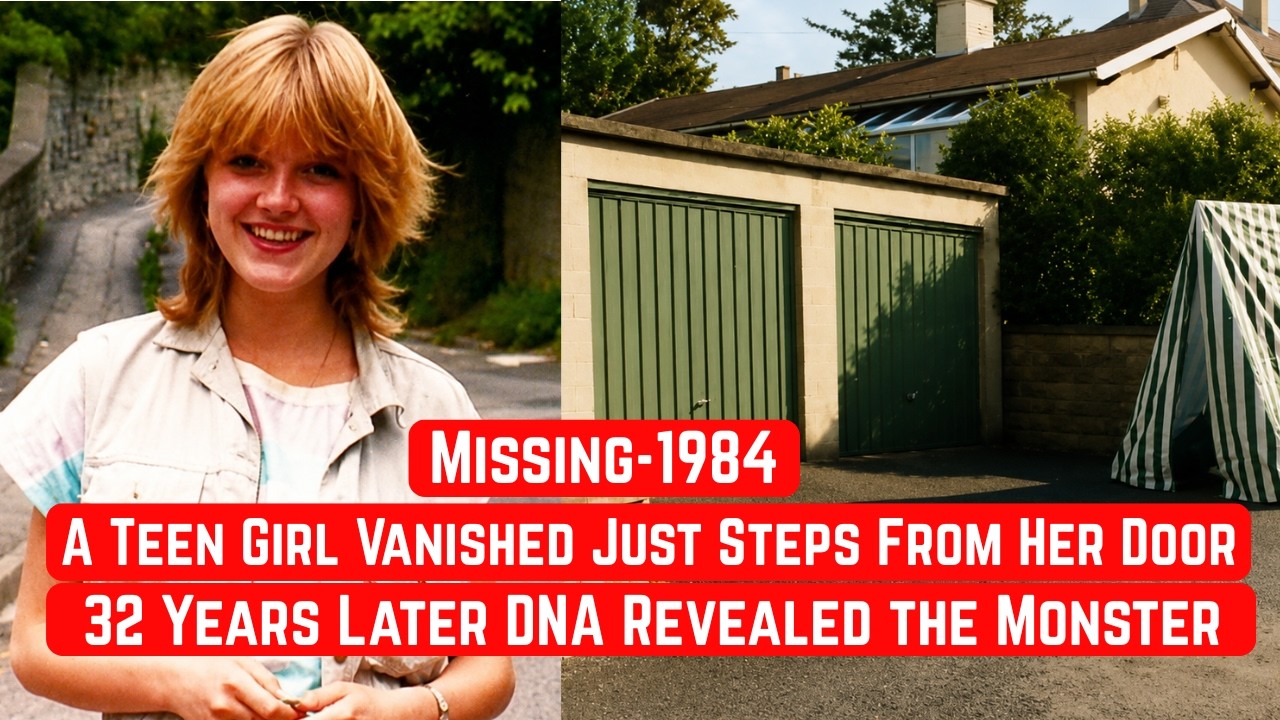
The judge told him he would very likely die in prison. Hampton gave no reaction. He had given none for three decades. Melanie Road was the youngest of three children, the daughter of Jean and Tony Road.
The family had moved often because her father worked for the Ministry of Defense, and Melanie had developed a reliable way of making friends at each new school: she baked flapjacks and handed them out to her classmates. It worked every time. She was a natural leader, voted deputy head girl, a straight-A student planning to study archaeology. On June 8, 1984, she was one week away from her final A-level exams.
That Friday afternoon, her father drove her into Bath city center. Her mother and her sister Karen were in the car, along with Karen’s six-week-old baby. They pulled up outside the Francis Hotel in Queen’s Square. Melanie noticed a red carpet laid out on the pavement for some event and smiled at her family through the car window.
Look, they’ve laid out a red carpet for me. What a way to go. Those were the last words her mother ever heard her speak. Melanie bought her mother a bouquet of flowers, went home briefly to change into navy trousers and a black cardigan, then headed back into town to meet her boyfriend, his brother, and a group of friends at a nightclub.
It was a perfectly ordinary, perfectly happy night. When the club closed at two in the morning, Melanie’s boyfriend offered to pay for a taxi to take her home. She refused. Bath was safe.
The night was warm. She kissed him goodbye and started walking. That was the last time anyone who loved her saw her alive. At 5:30 a.
m. , a milkman making his rounds on St. Stephen’s Court was flagged down by his eleven-year-old son, who had spotted someone lying in the road. At first, in the pale morning light, the milkman thought it was a mannequin.
It was a teenage girl. The crime scene was less than two hundred meters from Melanie’s own front door. She had almost made it home. The forensic evidence told investigators immediately that this was not a quick attack.
The killer had not panicked. He had taken his time. Melanie had been intercepted from behind, forced off the main road into a blind cul-de-sac, and attacked in stages. She fought back hard enough that the blade turned in the struggle and cut her attacker.
He bled heavily as he fled. Investigators mapped the scene with orange chalk dots for Melanie’s blood and green dots for the killer’s. The green trail led half a mile down stone steps before the bleeding stopped. Seventy-one swabs were taken.
In 1984, the forensic team had no idea what DNA was or what it would one day become capable of. They kept every sample anyway. That decision would become the most important choice in the entire case. Then came a detail that changed the investigation entirely.
The killer’s blood carried a rare protein makeup found in only three percent of the male population. Operation Rodeium was launched within days and became one of the largest murder manhunts in British history. Police swept every hotel and guesthouse in Bath, a tourist city where people arrived and left constantly. Advertisements ran on television and radio.
Inquiries were sent to police forces in Japan, the United States, and Canada. Over five years, investigators compiled 35,000 pieces of documented evidence, interviewed more than 10,000 people, arrested 94 men on suspicion, and took 2,500 DNA swabs. Not a single match. By 1989, the investigation was reduced to a skeleton team.
The leads had gone cold. The murder tore through the Road family. Karen’s breast milk dried up from shock. Adrien abandoned his exams at the nautical college in Glasgow and never went back to sit them.
Jean said the grief destroyed everything it touched. The killer had simply stepped back into the shadows of ordinary English life. For twenty-six years, he remained a ghost. In October 2010, a man named Ben contacted the cold case team.
On the night of the murder, Ben had been sitting in his camper van on St. Stephen’s Road and had watched a man arguing with Melanie, prodding her with a sharp object before chasing her into the cul-de-sac. When the street went quiet, Ben walked back along the pavement and passed the man walking away. They made brief eye contact and said hello.
Ben noticed the man’s left arm was dripping with blood. Ben had tried to report this the very next morning in 1984, but the door-to-door dragnet had stopped exactly two houses before his front door. His follow-up calls over the decades disappeared into bureaucratic filing systems. Ben is autistic and possesses an exceptional visual memory.
In 2010, he drew a precise map of every blood spot he remembered seeing that night. When the cold case team placed his hand-drawn map over the confidential forensic blood map from 1984—a document never released to the public—they matched point for point. For the first time in twenty-six years, investigators had a physical description of the killer: early to mid-thirties, normal build, dark hair, bleeding from his left arm. But a description without a database was an empty lead.
In 1995, Britain built the world’s first national DNA database. The team loaded the killer’s complete genetic profile and ran the search. No match. The killer had never been caught for anything.
He was living a completely quiet, legally invisible life. In 2009, a Crimewatch special on the twenty-fifth anniversary of the murder generated seventy-two new leads. One was a deathbed confession from a terminal cancer patient, but the DNA analysis crushed the lead entirely. The dead man had confessed to a crime he never committed.
That same year, the file landed on the desk of Detective Chief Inspector Julie McKay, a single mother of three with twenty years on the force. She had spent her career pushing against institutional indifference and emerged sharper for it. Looking at thousands of pages of empty leads, she felt a quiet gut certainty that the case was solvable. Her first visit to Jean Road stripped away any abstraction.
Jean was still living in the same house Melanie had walked out of in 1984 and never walked back into. Julie made no promises. She told Jean the plain truth: she was working on instinct, she could not guarantee a result, but she was not walking away. Julie’s strategy was precise.
If the killer had never been arrested, his DNA would never appear in the database directly. But DNA runs in families. A familial DNA search could find a relative, and from there investigators could build outward along a family tree. Julie filed the application and waited.
It was lost somewhere inside the system. She resubmitted and waited again. Then she was called into her superior’s office. The case was being officially decommissioned.
Julie was ordered to stop. She refused, keeping the resubmitted paperwork moving through the system on her own time. That administrative delay became the most important coincidence in the history of British justice. While the paperwork sat in a queue, an ordinary minor dispute broke out on a street in Bath.
In November 2014, a forty-four-year-old woman named Clare Hampton got into an argument with her boyfriend. His necklace broke during the dispute. Under British law, that constitutes criminal damage. Clare was cautioned, released, and as a matter of standard protocol, a DNA swab was taken.
The sample was uploaded to the national database. Clare went home. Her father, Christopher Hampton, a painter and decorator living in Bristol, had no criminal record, not a single arrest in his entire life. In May 2015, Julie McKay’s resubmitted familial DNA application finally came back.
At the top of the ranked list of partial matches was a new name: Clare Hampton. Her DNA had been uploaded in November 2014, during the exact window of time created by the lost application and the bureaucratic delay. If Julie’s original submission had been processed on schedule, Clare’s sample would not have existed on the system yet. The match was so statistically overwhelming that it pointed in only one direction: the immediate family.
Someone close to Clare Hampton had left their DNA on the body of Melanie Road. Detective Gary Mason contacted Clare directly. She was cooperative. She told him about her father, Christopher John Hampton, sixty-three, originally from Bath, now living in Bristol.
Mason called Hampton and asked for a voluntary DNA swab to eliminate him from the investigation. Hampton agreed without a pause. He met Mason in a car park near his workplace, shook his hand, made small talk, and stood calmly while the swabs were taken. Mason would later say that of the hundreds of men he had swabbed across the investigation, Christopher Hampton seemed more than almost any of them like a man with absolutely nothing to hide.
Five weeks later, the results arrived. Christopher John Hampton was an exact match to the forensic evidence recovered from the scene thirty-one years earlier. In 1984, Hampton wasn’t a tourist passing through Bath. He lived on Broad Street, the exact road Melanie had walked down on her way home that night.
On July 3, 2015, police cruisers pulled up outside Hampton’s house just as he returned from work. His wife watched in disbelief as officers read her husband his rights, convinced it was a mistake. He was taken to the station and handed a prepared written statement: I am not responsible for the attack and death of Melanie Road. He said nothing else.
In December 2015, he entered a not-guilty plea. His wife and daughter visited him in prison, certain the system had got it wrong. Then, one week before the trial was due to begin, Hampton changed his plea to guilty. No explanation.
His wife stopped visiting. His daughter stopped coming. In the courtroom, the Road family finally sat in the same room as the man who had taken Melanie from them. Karen spoke first, her voice measured and precise.
Melanie has died hundreds of times in hundreds of different ways in my mind. While I’m awake, while I’m asleep, I could tell you it’s like being in a nightmare. But you wake from a nightmare and life returns to normal. This is a nightmare I can’t ever wake up from.
She told the court about the last time she saw her sister, kissing her on the cheek outside the Francis Hotel before heading off to play tennis. I want to be able to remember her life rather than the focus being forever on her horrific last hour. Adrien spoke next. For thirty-two years, he said, he had walked down streets and looked at every man he passed and asked the same silent question: did you kill our little sister Melanie?
He turned toward Hampton. But now I know thankfully none of them killed Melanie. You did. Jean spoke last, at eighty-one years old.
She explained that she and Tony had drifted apart after the murder, and that Tony now lived in a severe haze of dementia she believed had been accelerated by grief. She read from her statement: Once asleep, I hoped I would never wake up so that I could be with Melanie and comfort her. And then the final line: Everything is seen through the prism of what happened. Hampton was led out to serve a minimum of twenty-two years.
He did not look back. Seven hundred police officers had touched the file across three decades. The case was recognized internationally as the DNA hit of the year, judged across sixty-one submissions from fourteen countries. But beneath the data and the historic protocols, the story belongs to a seventeen-year-old girl who loved to bake flapjacks to make friends at new schools, dreamed of studying archaeology, and bought her mother flowers on the very last afternoon of her life.
On a warm June night in 1984, she walked off down the pavement, happy, alive, the whole world opening up in front of her. She never made it home. But thirty-two years later, somebody came back for her.
