On May 13, 1943, in a dusty processing yard on the North African coast, the largest surrender of Axis forces in the war had just ended. Roughly 267,000 German and Italian soldiers laid down their arms across the Cap Bon Peninsula and the port cities of Tunis and Bizerte. Six months of desert fighting was over. Among the Afrika Korps men standing in the long, quiet lines was an 18-year-old private from Germany named Heino Ericsen.
He had joined the army believing what he had been told: that America was a spent civilization, its factories struggling, its people demoralized, its army a collection of conscripts who would break at first contact. He was about to sit down to lunch. An American soldier set a tin tray in front of him. On it was white bread, impossibly white, soft bread that pressed down under the thumb and sprang back up.
There was meat, real meat, not the compressed paste from a German field ration. And there was a drink he had never seen before, dark brown in a glass bottle with a red label. He had no category for any of it. What Ericsen felt, and what hundreds of prisoners described feeling in the weeks that followed, was not gratitude or relief.
It was confusion, because the food on that tray could not exist. Everything he had been told about this country said it could not exist. To understand why a German soldier was staring at a piece of white bread as if it had personally offended him, you have to go back to something built in German living rooms and schoolrooms through the 1930s, constructed so carefully that by the time the Afrika Korps surrendered, its men did not think of it as propaganda. They thought of it as common knowledge.
Joseph Goebbels took control of the Reich Ministry of Public Enlightenment and Propaganda in March 1933. He was 35, had a doctorate in literature, and understood mass communication with genuine sophistication. He grasped a fundamental principle: the most durable beliefs are not installed by force. They are the ones that feel like things a person already knew.
You do not need to convince people of something if you can arrange the world so that they arrive at the conclusion themselves. For more than a decade, Goebbels shaped what the German public knew through radio, cinema newsreels, the illustrated press, classrooms, libraries, and the suppression of foreign broadcasts. His America was a specific creation. It was a country still crippled by the Great Depression, its cities hollowed out by unemployment, its military an object of contempt, its economy shattered by speculation and drained by a war the American people did not want to fight.
The picture was not built from nothing. The Great Depression had been real. American unemployment in the early 1930s had been catastrophic. Goebbels worked from true material, selecting the facts that served his argument and discarding the decade of recovery that followed.
German soldiers going into combat after 1941 were not operating with fabricated information. They were operating with carefully curated information, which is more dangerous because it is harder to dislodge. The Afrika Korps had been fighting since February 1941 across one of the most unforgiving environments in which any modern army had campaigned. The desert gave almost nothing.
Water was rationed. Shade was rationed. The standard German field ration in the African theater included hard Kommissbrot, small tins of preserved meat, and Ersatz coffee brewed from roasted acorns or chicory. By the time the campaign collapsed in May 1943, the surviving troops had been running on diminishing supplies for months.
The 1929 Geneva Convention required the United States to feed its prisoners at a standard equivalent to its own troops at base camps. What the convention did not specify was that the American military standard was, by the measure of every other army in the war, extraordinary. American soldiers in the field received rations that included canned fruits, packaged meats, hard candy, real ground coffee, and a product that would become the single most documented item in German prisoner testimony: a chocolate bar. Not a rationed luxury available only through well-connected channels, as chocolate had become in wartime Germany.
A standard five-cent candy bar issued to every American private as a routine part of his daily field ration. The men standing in those processing yards were being handed, as a matter of course, things that had been presented to them their entire adult lives as the exclusive indulgences of a civilization in decline. The ships that carried German prisoners to the United States were Liberty ships making the return crossing after delivering supplies to European ports. They would otherwise have traveled west nearly empty.
The meals served on those ships were identical to the meals served to American military personnel. The historian Arnold Krammer documented through interviews and archival research that a number of prisoners arrived at American ports already heavier than they had been at surrender. After months on compressed desert rations, the Atlantic crossing had started adding weight to men who had forgotten what regular meals felt like. When the ships docked in New York Harbor or at Hampton Roads, the prisoners were loaded onto Pullman rail cars.
One former prisoner, Reinhold Pabel, wrote that the men had expected boxcars and found cushioned coaches with white-jacketed porters. He wrote that men called to each other from one end of the car to the other in disbelief. German officers who wrote memoirs after the war consistently described the rail journey as one of the more disorienting episodes of their captivity, not because it was harsh, but because it was the opposite. The country rolling past the windows was not the country Goebbels had described.
The towns were not broken. The farms were not stripped. The factories along the railway lines through the Midwest were operating at a scale no German soldier had been told to account for. At night, the towns were lit.
Every town. The lights ran to the horizon and kept going. A total of 425,000 Axis prisoners, roughly 370,000 of them German, eventually lived in camps distributed across 46 of the 48 American states. They were held in accordance with the 1929 Geneva Convention, which required housing, food, and medical care at the same standard provided to American troops at base.
In practice, this meant three meals a day, a camp canteen, recreational facilities, and a wage of 80 cents per day for those who worked, the approximate equivalent of an American Army private’s base pay. The wage was paid in camp script, but it was enough to make purchases. The purchases that generated the most documentation in prisoner letters and later testimonies were, consistently, food and drink. Of all the items on the American camp menu, the one that produced the most intense and well-documented reaction was not the canned fruit and not the coffee.
It was the bread. The standard military bread of the German Army was Kommissbrot, a dense, dark loaf built from roughly 80 percent rye flour and 20 percent wheat flour, sourdough leavened for shelf life rather than flavor, designed to survive weeks on a supply wagon without spoiling. German civilians in the same years were eating bread made with an increasing proportion of substitute fillers because the wheat supply was being redirected toward military use. Lightness, softness, and whiteness in bread had become markers of luxury.
Germany had introduced food rationing in August 1939. It covered bread, meat, dairy, fats, sugar, and eggs, issued through a coupon system. By the early years of the war, the average German civilian was receiving roughly 2,000 calories per day, survivable but with no margin for abundance. By 1943 and 1944, as Allied bombing increasingly disrupted the transport network, actual caloric intake fell below even the official rations.
Coffee had essentially disappeared as a civilian product. Germans drank substitutes made from roasted barley or chicory, officially called Ersatzkaffee. Sugar was rationed from the first day of the war. Meat appeared on most family tables once a week, not daily.
American Army kitchens served standard commercial white bread, soft, light, the kind sold at any grocery store for a few cents a loaf. To the German soldiers receiving it, it required explanation. One former prisoner held at a camp in Texas told a researcher that the first time he ate it, he thought something had been done to it. It was too soft.
It did not behave like bread. By the second day he had arrived at a conclusion he had not wanted to arrive at. Either this was simply what bread was supposed to taste like, and the bread he had grown up eating in Germany was something lesser, or the Germany he had grown up in was materially poorer than anyone had admitted. The harder explanation took longer to arrive, and it arrived differently for different men.
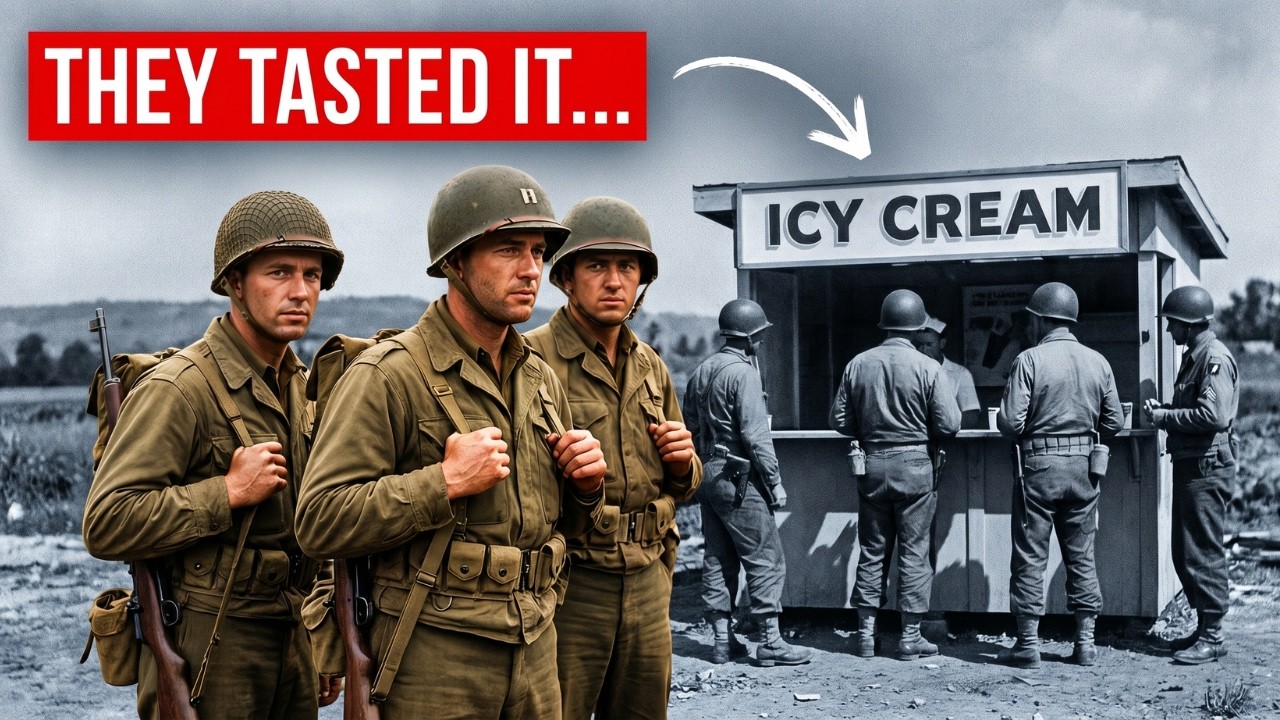
For many, it arrived with the ice cream. No item in the documented record produces a more consistent description of genuine cognitive disruption than ice cream. In wartime Germany, it had effectively ceased to exist as a commercial product by 1943. The dairy, sugar, and refrigeration infrastructure had all been absorbed into the war economy by 1941.
Ice cream was the kind of thing German parents told their children they would have again once the war was won. American prisoner of war camp mess halls served ice cream routinely, multiple flavors, on an ordinary weekday. Helmut Grau, a German soldier held at Fort Lewis in Washington state, wrote a first-hand account describing standing in front of the camp commissary in the summer of 1944, deliberating over what to spend his camp script on first. His choice was between ice cream and Coca-Cola.
He noted that he had never tasted Coca-Cola before his capture, and that the last time he had bought ice cream in Germany was years before the war began. Both were available to him that afternoon for a few cents each in the commissary of a prison camp, as a routine transaction. He was describing a Tuesday in the summer. The Coca-Cola itself deserves a moment.
The drink had existed in Germany before the war through a subsidiary operated by a businessman named Max Keith. When trade embargoes cut off the American syrup after the United States entered the war, Keith’s operation improvised a replacement from apple pomace, whey, and leftover fruit scraps. That product was called Fanta. The real Coca-Cola, the five-cent original served in American camps, was not available through any ordinary channel in Germany during the war years.
The prisoners tasting it in American camp commissaries were encountering the gap between what their country could provide and what the country holding them captive treated as a routine item. German military life had not typically included a canteen in the American sense, a place where a soldier could spend his own money on whatever he wanted. The American camp canteen sold beer, snacks, tobacco, writing materials, and newspapers. The existence of money, even script money, in the hands of prisoners changed the daily texture of captivity in ways easy to underestimate.
A man who can choose what to spend his 80 cents on is a different kind of person than a man who receives what he is given and has no other option. Hans Waecker, a young German soldier held at Fort Robinson in Nebraska who later became a physician, described the American camps as a vast improvement over the material conditions most prisoners had known at home. He had grown up in what he called a cold-water flat, the standard housing of a large portion of the German working class in the 1930s. He was describing a normal life, a life in which the things now being handed to him as a routine matter in a prison camp in Nebraska had never been a regular feature.
The gap between the America Goebbels had described and the America Waecker was eating his way through was not a gap that could be bridged by a different explanation. It required revising the premise entirely. The United States government understood, at least partially, what was happening. In the fall of 1944, a formal program was launched to channel the effect more deliberately.
It was called the Special Projects Division, directed by Lieutenant Colonel Edward Davison, a former professor of literature. The program produced a camp newspaper called Der Ruf, distributed books banned inside Germany under Nazi censorship, and organized lectures on American democratic history. It was, by most scholarly assessments, a limited success. Hardcore National Socialists were not converted by pamphlets.
The program also suffered from a structural problem: it began operations nearly a year after the first large prisoner waves arrived, by which time most men had already formed their impressions through the more direct medium of the dining table. But the point was never the newspaper. The point was the food. The food was not asking anyone to change their beliefs.
It was producing a daily material fact that existed independent of ideology. The body of a man who has been steadily gaining weight in an enemy prison camp is receiving information about that enemy that his political beliefs cannot block. By the time German prisoners had been in American camps for several months, the weight gain was documented and consistent. Prisoner letters and later testimonies recorded individual gains of 20, 30, sometimes more than 50 pounds over the course of captivity.
One documented case recorded a gain of 57 pounds over two years. These were men who had been ground down by months of desert rationing and were now rebuilding. The bodies were keeping a record that the minds had not yet fully processed. And the letters the men wrote home were translating that physical record into words that traveled across the Atlantic to households in Germany where daily reality was moving in exactly the opposite direction.
The censors removed anything of tactical value and forwarded the rest. What they could not remove was the cumulative picture the letters built of American conditions. Former prisoners and their families confirmed that these descriptions circulated beyond the individual households, passed from neighbor to neighbor in communities where the contrast with home front rationing was impossible to ignore. The German security services were aware of the problem.
The Sicherheitsdienst produced internal reports monitoring civilian morale. By 1943 and 1944, those reports noted with concern that letters from relatives in American camps were being shared beyond the immediate family. The specific content causing the most trouble was not ideological. It was material.
Letters describing the quantity and quality of food available to prisoners were reaching families who were calculating their ration coupons to the gram, and the contrast was creating questions the propaganda apparatus had no good answer to. Goebbels understood that the letters were a problem he could not solve with a counter narrative. A direct denial would invite the obvious reply: why would a son lie to his mother about what he was eating? The Ministry’s approach was to frame the American treatment as a calculated manipulation designed to win prisoner loyalty.
This framing had the advantage of being partially true and the disadvantage of implicitly acknowledging the abundance it was trying to explain away. You cannot warn people against being seduced by American prosperity without admitting the prosperity exists. The American military had understood from the beginning that a prisoner writing home to report decent treatment was a form of communication no official broadcast could replicate. A letter from a son saying he was healthy and gaining weight carried a credibility nothing produced by any government information office could manufacture.
It was also a form of indirect pressure on the treatment of American prisoners held inside Germany. The 1929 Convention operated on reciprocity. There were close to 94,000 American prisoners held in German camps during the war. The conditions those men endured were determined in part by the calculation their captors were making about how American camps were treating German prisoners.
American prisoners in Germany received food parcels from the International Red Cross that were often the difference between adequate nutrition and genuine starvation. Those parcels kept moving in part because Germany understood that the treatment of German prisoners in America would be measured against what Americans received in return. The food American camps spent on German prisoners was not purely an act of Geneva Convention compliance. It was also an investment in the survival of 94,000 American men held in German captivity.
The German prisoners who were sent to work on American farms encountered abundance at close range. They stood inside it, picking cotton in South Carolina, harvesting wheat in Kansas, processing vegetables in the canneries of Michigan, working the fruit orchards of California. They were inside the productive machinery of a country described to them for years as economically spent, and they could measure with their own labor how far that description was from what was actually there. By 1943, the United States faced a severe agricultural labor shortage because the men who had worked the farms had gone overseas or into war industries.
German prisoners filled that gap on a scale that surprised even the officials who had designed the program. At its peak, they worked in agriculture, canneries, lumber operations, and light industry across most of the country. The Geneva Convention prohibited work directly related to the war effort but permitted almost everything else, and almost everything else turned out to be most of what the American economy needed. Some farmers paid additional amounts through extra food and small gifts, which technically exceeded War Department guidelines, because the local reality of men working hard alongside your family made rules feel less important than ordinary human decency.
Many farmers invited them to eat at the kitchen table as workers who had put in a full day. Cecil Camlin was a boy on a farm in South Carolina when German prisoners arrived to work the land. Over the months they worked together, his family grew close to the men. When Christmas came, his mother cooked a full meal and invited the prisoners to share it.
By the end of the evening, the German soldiers were gathered around the family piano singing carols while the Camlins sang alongside them. Cecil told that story to a journalist decades later, still struck by it. No lecture on democratic theory and no banned novel could produce that evening. It happened because an American farm wife decided to cook Christmas dinner and invite the men who had been working her land.
The Reich Ministry of Propaganda attempted to address the growing body of prisoner correspondence. Its line was consistent: the American treatment was a psychological operation designed to undermine German morale. Do not be deceived. But the truth the ministry could not address was the one underneath the calculation.
If the United States had the productive capacity to feed its prisoners, the least important mouths in any wartime supply chain, while simultaneously supplying its own armed forces, its allies under Lend-Lease, and the civilian populations of liberated territories, then the picture of American economic exhaustion that had anchored German morale since 1941 was not a description of a real country. It was a story someone had told deliberately to keep people fighting a war they might otherwise have questioned. The man who had told that story killed himself on May 1, 1945, in a bunker beneath the Reich Chancellery in Berlin as Soviet forces fought through the streets above him. He had arranged the murder of his six children the night before and then died by cyanide alongside his wife.
The propaganda system he had spent 12 years constructing collapsed within days. But the system had been failing for longer than that final week. By late 1944, the gap between what official communications were describing and what German civilians could observe had become too wide to manage. The Allied bombing was visible in every major German city.
The food rations were visibly shrinking. The men who came home from the Eastern Front described conditions that bore no resemblance to the triumphant progress the newsreels still showed. The alternative to the official picture, for several hundred thousand German families, was arriving in the mail from American camps. Letters describing soft bread and ice cream and Coca-Cola and weight gained and health maintained.
When the war ended, many of the prisoners learned of the German surrender through American camp newspapers before any official notification reached them. Some learned it from the American farmers they were working alongside. Oskar Wagner, captured in Normandy in 1944 and held near Carthage, Indiana, was repatriated to Germany as required. He came back.
He settled in Muncie, Indiana, and lived there for the rest of his life, active in the local community for decades. He died on June 15, 2014, at the age of 97. He told an interviewer in 2008 that he had never felt so grateful in his life as he did in that moment. He was not speaking in the abstract.
He was speaking about the country that had held him prisoner and where he had chosen to build everything that came after. Alex Funke, a Lutheran chaplain who ministered to fellow German prisoners at Camp Algona in Iowa, returned to Germany after the war and became a minister. But he kept up correspondence for years with American officers who had run the camp. He wrote that the prisoners had been genuinely and positively impressed by what they found in America and that the experience had won them over to friendly relations with the country in a way no organized program could have produced.
His words carry weight because they were written in German from Germany after the war was over to former captors he no longer needed anything from. Many of the German prisoners who passed through American captivity came home to a country that confirmed in concrete terms what the American camps had begun to teach. The country they returned to was broken in the ways propaganda had promised America was broken. German rationing did not formally end until 1958.
The cities were rubble. The men who came back from American camps returned with a calibration their neighbors did not have. They knew what real abundance looked like. The returning prisoners also came back as political actors.
Germany in 1945 and 1946 was a country trying to decide what it was going to become. Among the millions of men who had been somewhere and seen things, several hundred thousand had spent one, two, or three years in American captivity. These men had seen American democracy operating not as a lecture subject but as a daily environment. They had watched the American press report on its government with a directness that would have landed a German editor in a concentration camp.
They had watched American women working in factories and on farms in roles German society had explicitly denied to women. They had observed the particular irony that German prisoners in many Southern towns were permitted to eat in restaurants that their own black American guards were not, a contradiction that quietly undermined the racial hierarchy the prisoners had been taught to accept as natural. These were not arguments. They were observed facts.
Facts do not always change minds immediately, but they accumulate. Several former prisoners wrote after the war that they had entered American captivity expecting to be treated as subhumans and found instead a system that, for all its contradictions and inequities, operated on principles of order and procedure that required them to be fed and housed and paid and allowed to complain to the camp commander if the food was inadequate. The complaints were sometimes acted on. That alone was a small revolution for men raised under a system where complaining to authority was not a category of behavior available to ordinary people.
Heino Eriksen returned to Germany after his repatriation as required. He returned to a country where the bread was darker than what he had eaten in Texas, where real coffee was still scarce, where cities he had known before the war were missing their centers. He had been told for years that America was the exhausted country. What he found at home was that the description matched Germany now and had never matched America at any point he had been able to verify directly.
He came back to the United States in the early 1950s. He brought his life with him: his marriage to Jean Nelson of Minnesota, his decades of work finding families for orphaned children across Latin America and Southeast Asia, his citizenship obtained in 1958. He had been 18 years old in a prisoner processing yard in Tunisia holding a piece of bread he did not understand. He spent the next seven decades in the country that had served it to him.
Goebbels spent 12 years building a picture of America in the German mind. He built it from a desk in Berlin using instruments that had never been inside an American mess hall or stood in a California fruit orchard or sat at an Indiana farmhouse table. He built it with considerable technical skill and almost complete factual inaccuracy. The prisoners built their picture from the inside.
From the plate in front of them. From the weight they were gaining. From the letters they wrote home. From the farms they worked and the kitchens they were invited into and the piano they stood around in South Carolina in December.
These two pictures could not both be true. Over the course of two years in American captivity, several hundred thousand German men worked out which one was. The peace that followed, the specific character of the relationship between Germany and America in the decades after 1945, the Germany that aligned with the West and rebuilt itself as a parliamentary democracy and became one of America’s most consequential postwar partners, was shaped in part by something that appears in no order of battle. It was shaped by the letters that came home from the camps, by the men who returned and described what they had eaten, by the slow, irreversible work that a plate of food does on a mind that has been carefully taught that the plate cannot exist.
The food was never the plan. There was no memorandum stating that the mess hall would carry the argument that lasted longest. But that is what it did.
