On September 16, 1998, a single statement went out to the press and closed a chapter more than a century old. Five hundred seventy stores were gone. No farewell sale, no goodbye campaign, just a terse announcement that the Kenny Shoe Corporation would no longer serve as the great American shoe store. The company that had once defined affordable family footwear in the United States was being shut down by its own parent, the Venator Group, to protect the very division that had been born inside it decades earlier.
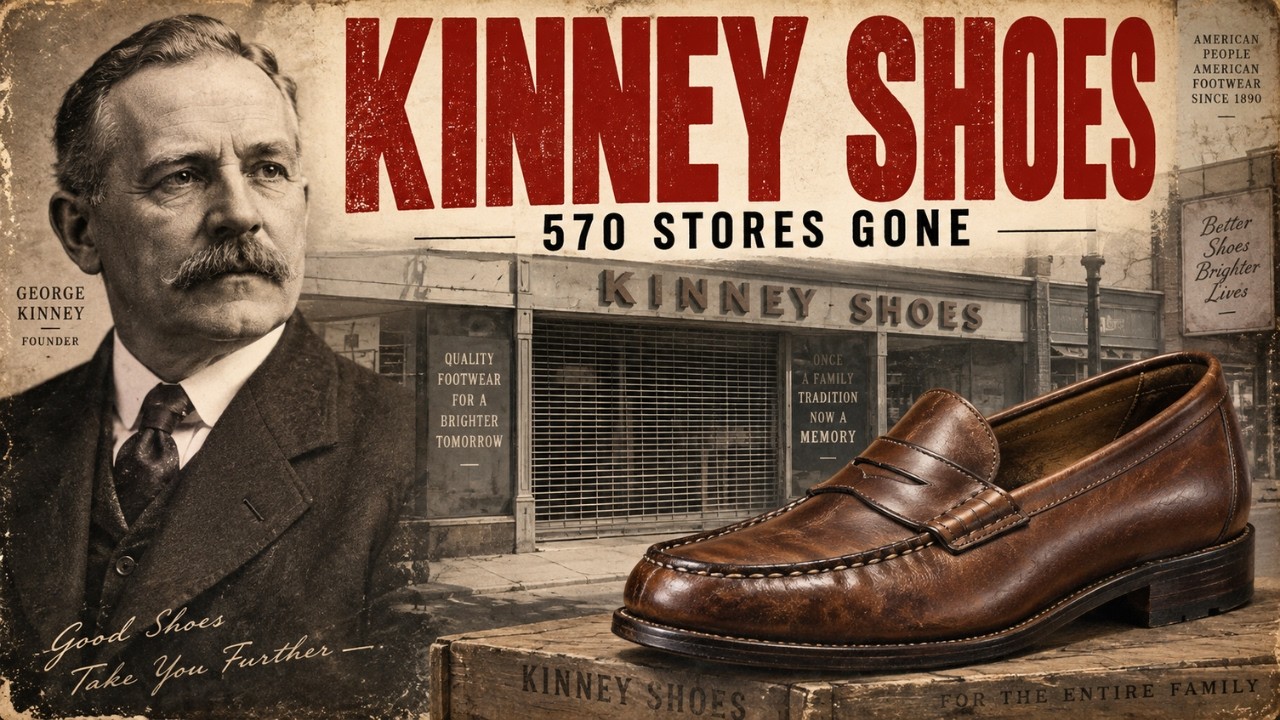
The story began in 1894, when a 28-year-old named George Kenny borrowed $1,500 to buy a struggling shoe store in Waverly, New York. He had no family fortune behind him, only a boyhood promise. His father, Jeremiah Kenny, had run a general store that extended credit to farmers and neighbors until the generosity became debt he could not repay. When Jeremiah died, George was nine years old, and he made a private vow to pay off what his father owed.
He kept it the hard way, working for more than a decade as a clerk for shoe firms in Binghamton, New York, learning the business one sale at a time. When he finally opened his own store, George ran it by a single unbending rule: no credit, no exceptions. He had watched what open credit did to his father and refused to repeat that mistake. He bought shoes directly from factories, skipping wholesalers who added their own markup, and sold for cash only.
His philosophy fit into one line that guided the company for decades: shoes on the shelf or money in the till. The approach worked. Within four years, George expanded beyond Waverly, opening stores in Corning, New York, Wilkes-Barre, Pennsylvania, Binghamton, Ithaca, and Reading, Pennsylvania, often keeping the names of the failing shops he had taken over. Rather than borrow heavily, he financed each new store as a separate partnership, bringing in managers he trusted and letting them buy shares in the new locations.
Every manager had a direct financial stake in keeping his own store honest and profitable. By 1916, the patient store-by-store approach had produced 56 locations stretching as far west as Illinois, making George Kenny’s small chain the largest footwear retailer in America. The following year, the loose network of partnerships was formally incorporated as a single company, G. R.
Kinney Co. , Inc. By 1919, combined annual sales had climbed to almost $14 million. That same year, George made a decision that would reshape the company for good: he acquired the first four shoe factories, each built to specialize in a different line of footwear, so the company would stop depending on outside manufacturers altogether.
He never saw what that decision would become. On June 17, 1919, George Kenny died at his home in Brooklyn at the age of 53. He was buried in Candor, the small town where his father’s debts had once defined his childhood. Leadership passed to Edwin Crowe, an old friend and longtime associate, who leaned into George’s original vision even harder.
Through the 1920s, the company expanded rapidly, and by the end of 1929 the chain had grown to 362 stores nationwide, making it the largest exclusive retail shoe business in the country. The stock market crash that October tested everything. Kinney stock collapsed to 50 cents a share almost overnight, but the underlying business held. The company kept its doors open through the worst years of the Great Depression, and by the start of 1936 it operated 335 stores and was once again confirmed as the largest family shoe retailer in the nation.
But size had become its own kind of problem. Running factories and hundreds of stores took enormous capital, and Kinney did not have deep enough pockets to modernize everything at once. Its manufacturing plants were aging, and competitors backed by larger industrial parents could outinvest it. The company that had once prided itself on independence now needed a partner with real capital.
In 1956, it turned to Brown Shoe Company, the fourth largest shoe manufacturer in the United States, and Brown acquired Kinney outright. The fit made sense on paper: Brown needed retail outlets to move its shoes directly to consumers, and Kinney needed capital and manufacturing muscle. Combined, the two companies represented something the American shoe industry had never seen before, a single company that could manufacture shoes and sell them through its own retail network, cutting out every independent retailer and wholesaler in between. That scale attracted attention in Washington.
In November 1955, even before the merger fully closed, the federal government filed a civil antitrust action arguing that the Brown-Kinney combination would substantially lessen competition in both the manufacturing and retail sale of shoes. The case moved slowly through the federal court system, landing in the United States District Court for the Eastern District of Missouri in St. Louis, where Brown was headquartered. The government argued that Brown was not simply buying a retail chain but guaranteeing itself shelf space in over 350 stores, locking out competing manufacturers.
Brown’s lawyers pushed back, arguing that the American shoe market remained deeply competitive and that thousands of manufacturers and retail outlets operated across the country. The district court was not persuaded. It found that the merger would increase concentration in an already consolidating industry, eliminate Kinney as an independent competitor, and create the kind of manufacturer-retailer relationship antitrust law was designed to prevent. The court ordered Brown to divest itself completely of every share of stock, every asset, and every interest it held in Kinney.
Brown appealed directly to the Supreme Court. The case, Brown Shoe Company v. United States, was argued on December 6, 1961. On June 25, 1962, Chief Justice Earl Warren delivered the decision, upholding the district court in full and finding that the merger violated federal antitrust law by threatening to substantially lessen competition both in manufacturing and retail.
The ruling would become one of the defining cases in American antitrust history, studied in law schools for generations. For Kinney, the ruling meant something far more immediate. The company was forcibly separated from Brown. The sale took over a year to arrange.
On August 31, 1963, Brown sold Kinney to F. W. Woolworth Company for $45 million in cash and promissory notes. It was Woolworth’s first acquisition since the variety store chain was formed in 1912.
Under the terms of the sale, the company was renamed the Kinney Shoe Corporation and continued operating as a wholly owned subsidiary of Woolworth, retaining its own 11-member board and management structure. The signs stayed the same, the shoes stayed the same, and the employees mostly stayed the same. But the company had just spent seven years fighting through American courts to prove it deserved to exist as an independent company, only to be handed off to a new parent almost twice as large as the one the courts had pulled it away from. Under Woolworth, Kinney settled into a strange kind of stability.
The parent’s backing let the company expand aggressively again. In 1967 it launched Stilco, and the following year it introduced Susie’s Casuals. Then in 1974, the company launched a new division that would prove far more consequential: Foot Locker. The first store opened near Los Angeles, stocked with shoes for running, hiking, track and field, basketball, bowling, golf, roller skating, and ice skating.
It was a bet on a new category entirely, athletic footwear, at a moment when jogging and organized youth sports were becoming a much larger part of American life. Inside Kinney, Foot Locker was treated as exactly what it appeared to be, one more division, smaller than the traditional Kinney stores, worth watching but not worth restructuring the company around. For the rest of the 1970s, that assessment looked correct. Foot Locker grew steadily but modestly, reaching roughly 70 stores and about $20 million in annual sales within five years.
The real engine of the company remained the family shoe stores and the factories that supplied them. By 1978, Kinney operated 14 manufacturing plants producing 53,000 pairs of shoes a day. Two years later, in 1980, the company passed $1 billion in annual sales for the first time, operating 2,115 stores plus 368 leased shoe departments inside other stores. It was the high point of its entire history.
But the numbers behind that record year were not quite what they appeared to be. Operating profit margins had peaked at 12. 9% in 1978, then slid to 10. 6% in 1979 and 9.
3% in 1980. The headline numbers looked like triumph; the trend line underneath looked like something else entirely. Through the 1980s, the traditional Kinney family shoe stores kept operating largely as they always had. Meanwhile, Foot Locker kept expanding into a retail landscape shifting rapidly in its favor.
Sneaker culture, professional sports marketing, and a national fitness boom were reshaping how Americans bought shoes, and Foot Locker sat directly in the path of all of it. By 1994, Kinney celebrated its 100th year in business. The corporation as a whole contributed $3. 5 billion in sales and 60% of the profits of the entire Woolworth organization, operating more than 4,500 stores across the United States.
But that number told a story George Kenny himself would barely have recognized. The empire now included Foot Locker, Lady Foot Locker, Kids Foot Locker, World Foot Locker, Champs Sports, Athletic Express, Foot Quarters, and Going to the Game alongside the original Kinney banner. Somewhere inside that sprawling multi-format machine, the original family shoe stores that had built the whole thing were no longer the center of anything. By the late 1990s, Foot Locker, the small athletic division launched almost as an experiment in 1974, was generating more than 70% of all sales inside Kinney Shoe Corp.
The traditional Kinney family shoe stores had become the smaller, shrinking piece of a company that still legally carried the Kinney name. Inside Woolworth’s broader business, the picture was even more precarious. The company’s flagship variety stores, the five-and-dime shops that had defined the Woolworth name for nearly a century, were struggling badly, and the last of them closed in 1997. Wall Street removed Woolworth from the Dow Jones Industrial Average that same year.
In June 1998, Woolworth Corporation officially changed its name to Venator Group Incorporated, an admission that the Woolworth name no longer represented what the company actually did. In April 1998, Venator quietly closed every Kinney store in Canada. Five months later, on September 16, 1998, it made the closure official in the United States. The company issued a formal statement announcing it was exiting its specialty footwear operations, a category that included 467 Kinney shoe stores and 103 Foot Quarters stores, 570 stores in total closing at once.
Retail analyst Kurt Barnard, president of Barnard’s Retail Trend Report, called the closures a last-ditch effort to save a faltering company. There was no liquidation event, no farewell sale, no coordinated sendoff. Signage came down, inventory was moved out or marked down through routine clearance pricing, and storefronts that had been part of the landscape for 20, 30, sometimes 40 years simply stopped opening one day. The same company that in 1994 had credited its success to ordinary people doing extraordinary things closed the division built by those same people with a two-paragraph statement.
What made the closures especially striking was what Venator chose to keep running in the exact same announcement. Foot Locker, Lady Foot Locker, Kids Foot Locker, and Champs Sports were all explicitly spared, treated as the core of the company going forward. Every one of those surviving divisions had been born inside Kinney Shoe Corporation. Now those experiments were the reason the parent company still had a business at all, and the original stores that had funded and sheltered them were the ones being shut down to protect them.
By the end of 1998, the Kinney name no longer marked a single storefront in the United States or Canada. Three years later, on November 2, 2001, Venator Group formally changed its name one final time. It became Foot Locker Incorporated. The company George Kenny had built from a $1,500 loan in 1894, the chain that had survived the Great Depression, a landmark Supreme Court antitrust ruling, and two separate corporate parents, had not failed because it stopped selling shoes to people who needed them.
It had been closed down deliberately by a parent company choosing to funnel its remaining resources into the very division that Kinney itself had created a quarter century earlier and had never stopped feeding until there was no longer room for both.
