At its peak, Bonanza Steakhouse stood at roughly 600 locations, one of the largest family steakhouse chains in America. It was a wood-paneled, cowboy-themed room where a family could order a sirloin at the counter for a few dollars and load a tray at the salad bar. For a generation, it was the affordable steak dinner, the special but not too special night out. Today, barely more than a dozen remain, most clustered in a few pockets of the country and in Puerto Rico.
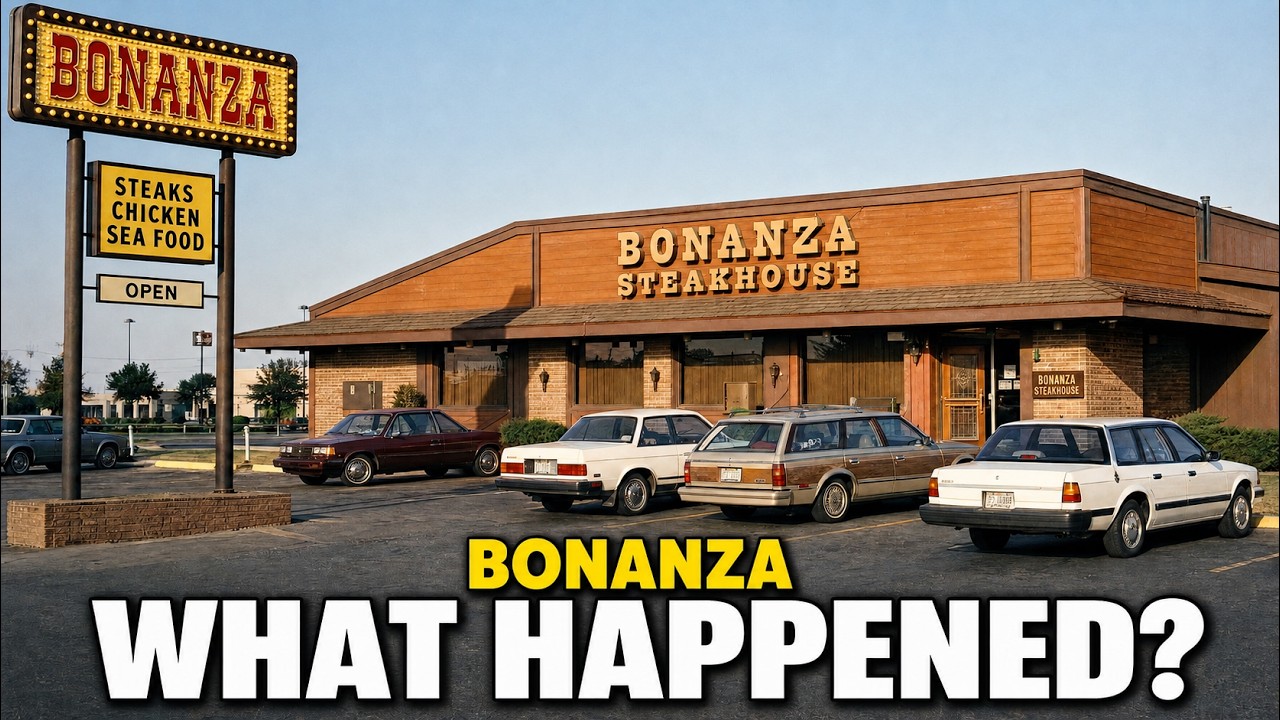
The rest are gone, their signs taken down, their buildings demolished or converted. The strangest fact of Bonanza’s fall is that it was born with an advantage almost no restaurant chain ever receives. It was founded by a genuine television star and named after one of the most popular shows in American history. It was built on the fame of a beloved cowboy character that tens of millions of people welcomed into their living rooms every week.
Bonanza was born famous, and it still lost everything. In the 1960s, America was in love with the Western. Television airwaves were flooded with cowboy dramas, and towering above nearly all of them was Bonanza. The show ran for 14 seasons and drew tens of millions of viewers weekly.
It told the story of the Cartwright family, a widowed father and his three grown sons running a vast cattle ranch called the Ponderosa near Virginia City, Nevada. Of all the Cartwrights, the most beloved was the middle son, Eric, known to everyone as Hoss. He was a giant of a man, physically enormous but gentle and warm-hearted, the emotional heart of the show. The actor who played him, Dan Blocker, was in real life much like Hoss.
He had been a schoolteacher before acting, and playing Hoss on one of the biggest shows in America made him a household name. In 1963, at the height of the show’s fame, Blocker opened a restaurant. It was a cowboy-themed steakhouse playing directly off the world of the show, and he called it Bonanza. The first location opened in Westport, Connecticut, built on a simple idea: an affordable steak dinner for the ordinary family in a warm, western setting, served fast.
It was the perfect marriage of the man and the moment. Here was Hoss Cartwright himself opening a cowboy steakhouse at the exact moment America was most in love with cowboys. It caught on quickly. Through good food and Blocker’s fame, the chain grew from that first Connecticut location.
By November 1965, just two years in, it had grown to more than 30 locations and was still climbing. The restaurant experience itself was what families remembered: the smell of grilled steak and baked potatoes, the cafeteria-style line where a cook slid sirloins onto plates with foil-wrapped potatoes and buttered Texas toast, and, most of all, the salad bar. In an age before salad bars were everywhere, Bonanza’s felt like abundance itself, a long spread of lettuce, cheese, croutons, bacon bits, creamy dressings, and on the best nights, cold boiled shrimp. The glorious rule was that a person could go back again and again, and nobody stopped them.
Right at that early, promising moment, Blocker made a decision that would shape the entire future of the chain. He was an actor, not a restaurateur, and he had a full-time job starring in one of the biggest shows on television. In the mid-1960s, he sold the chain to two Texas businessmen, brothers named Sam and Charles Wylie. Blocker agreed to stay on in a limited way to make public relations appearances, but the ownership and real control passed to the Wylie brothers.
In the short term, this was a great thing. The Wylies were talented operators who franchised Bonanza, spread it across the country, and built it from a few dozen locations toward the hundreds. But look at what had quietly happened: Bonanza had been founded on the fame and personal connection of Dan Blocker, and now the man himself had stepped back from ownership, kept on only as a friendly face. That connection was about to be severed in the cruelest way imaginable.
On May 13, 1972, Dan Blocker died suddenly at just 43 years old. He went in for what was supposed to be routine gallbladder surgery and died of a pulmonary embolism in the aftermath. It was a genuine shock to the nation. Hoss Cartwright, the big, gentle, beloved cowboy, was gone far too young.
His death changed the show itself. Bonanza never really recovered from losing Hoss and was canceled the following year in 1973 after 14 seasons. In the space of about a year, Bonanza Steakhouse lost both pillars of its identity. It lost its founder and famous face, and it lost the show that kept the name alive in tens of millions of homes.
The restaurant was named after a show that no longer existed and founded by a star who was no longer alive. A brand is not just food; it is a feeling, a meaning, a story that lives in the customer’s mind. Bonanza’s whole reason for being special was the Cartwright connection, and when the star died and the show ended, that glow began slowly to go out. The chain did not collapse overnight.
The Wylie brothers kept building it, and it kept growing all the way to that peak of around 600 restaurants by the late 1980s. But something essential had been hollowed out. Bonanza was now just a cowboy theme with no cowboy behind it. And here is where the second great force in its story comes in.
Bonanza did not exist alone. It had a twin, a nearly identical rival that had been shadowing it for its entire life. That rival was Ponderosa. In 1965, two years after Blocker opened Bonanza, three businessmen in Kokomo, Indiana, looked at what Blocker was doing and decided to build their own version of it.
Same idea exactly: an affordable cafeteria-style cowboy-themed family steakhouse. For the name, they reached into the very same TV show, taking the name of the ranch in the show. They called their chain Ponderosa. So two competing steakhouse chains, founded two years apart, both cashed in on the exact same hit western.
Nearly identical concepts, menus, and theming, spreading across the same American heartland, fighting for the same families and dollars. The rivalry was real and fierce. When Bonanza’s leadership heard that Ponderosa was planning to enter the affordable steak game, Bonanza actually moved to trademark the Ponderosa name themselves as a maneuver to block their new rival. These two were enemies from the very start.
They raced each other across the country, opening in the same towns, sometimes right down the road from each other. By the mid-1980s, both had grown into major chains, with Ponderosa somewhat larger and Bonanza right behind. Around 1984 and 1985, Bonanza, the smaller of the two, launched a takeover bid to buy its bigger rival. It made an offer reported at around $154 million, a premium over Ponderosa’s stock price.
It was an audacious move, the twin trying to devour its bigger sibling. But Ponderosa’s board rejected the offer and fought it off. Bonanza’s bid failed. The challenger had reached for the crown and missed.
The ending is the cruelest possible mirror of that failure. In the late 1980s, both chains ended up being bought by the very same outside company, a conglomerate called Metromedia. Metromedia purchased Ponderosa in 1988, and then in 1989, the Wylie brothers sold Bonanza to that same company. After 25 years of open war, the two bitter twins suddenly found themselves owned by one parent, forced under a single corporate roof.
In 1997, the parent company formally united them under one umbrella and ran them as essentially interchangeable brands. Unlike most companies that own two brands and keep them separate, this parent ran Ponderosa and Bonanza as effectively the same restaurant wearing two different names. Same menu, same salad bar, same everything, just a different sign out front. That arrangement was quietly devastating to Bonanza.
Once two brands are managed as interchangeable, one inevitably becomes the lesser, the afterthought. Bonanza, the smaller chain, the one that had failed to take over Ponderosa, became exactly that. Its distinct identity, already weakened by the loss of Blocker and the show, dissolved almost entirely into a generic shared steakhouse concept. Bonanza stopped being Bonanza.
Most beloved restaurants that die at least die as themselves. Bonanza didn’t even get that. It was slowly dissolved into its own rival. Bonanza came first, the original, the one Dan Blocker actually founded, named after the actual television series.
Ponderosa was the imitator, the copycat built by businessmen who saw Bonanza’s success and wanted a piece of it. And yet it was the knockoff that survived and prevailed. The imitation outlived the genuine article. Then the entire affordable family steakhouse category began to collapse.
Starting in the 1980s and accelerating through the 1990s, America grew more health-conscious, more worried about fat, cholesterol, and red meat. A big cheap steak with buttered toast and unlimited trips to a salad bar piled with creamy dressings started to feel less like a treat and more like a guilty indulgence. Competition squeezed from every side. Buffet chains like Golden Corral offered even more abundance for the money.
Casual dining chains like Applebee’s, Chili’s, and Outback Steakhouse offered a livelier, more modern experience. Fast food and fast casual kept getting cheaper and more convenient. Bonanza was caught in the deadly middle, not as abundant as the mega buffets, not as nice as the casual dining chains, not as fast or cheap as fast food. The economics underneath had always been fragile.
The whole model was built on selling cheap steak to price-sensitive families, which meant thin profit margins at the best of times. When beef prices rose, Bonanza couldn’t raise its own prices much because its entire identity was built on being cheap. The chain was permanently pinned between the cost of its main ingredient and the thriftiness of its own customers. When recessions hit, these thin-margin, aging, out-of-fashion steakhouses had almost no cushion to absorb the blow.
Sales declined steadily, and the closings came relentlessly through the 1990s and 2000s. Because Bonanza was the secondary brand, every wave of closures fell harder on it than on Ponderosa. When a company owns two nearly identical chains and needs to cut costs, it protects its flagship and sacrifices its afterthought. Bonanza wasn’t just declining alongside its twin; it was being actively pruned back to make room for its twin to survive.
The parent company itself struggled, changing hands and names and filing for bankruptcy in 2008 before reorganizing under yet another new corporate name. Through it all, the Bonanza count fell and fell, from 600 to a few hundred, to under 100, to a few dozen, to barely more than a dozen. In recent years, some of the very last surviving locations were finally closed and demolished, buildings that had stood for 40 or 45 years and served generations of families, torn down after nearly half a century. What killed Bonanza?
The first and most unique cause was that it was built on borrowed light, the fame of a star in a show, and that light went out. Dan Blocker died in 1972, and the show ended the very next year. A restaurant founded on a celebrity connection had that connection ripped away almost at the start of its national growth. The momentum carried it for a while, but the deep magic, the reason Bonanza was special rather than just another cowboy steakhouse, was gone and could never be replaced.
The second cause was being the swallowed twin, the secondary brand dissolved into a generic shared concept, erased rather than killed. The third cause was the death of the whole category, killed by a more health-conscious America, fiercer competition, aging dining rooms, and thin margins with no cushion. There is a deep irony that ties it all together. The word bonanza means a sudden stroke of great fortune, a windfall, a jackpot.
That is exactly what the chain seemed to have at its birth: the incredible good fortune of being founded by a beloved star, named after a smash hit show, launched at the peak of a national craze. And yet the very thing that made it lucky, its dependence on a star and a show, on fame and cultural fashion, was also the source of its fragility. Fame fades. Stars die.
Shows get canceled. Ponderosa, the rival, was built by ordinary businessmen with no star and no borrowed fame, just a concept, and Ponderosa outlasted and absorbed Bonanza. The one with the celebrity founder lost to the one without. The bonanza ran out.
There used to be 600 of these, 600 glowing signs carrying the name of one of the most beloved shows in television history, founded by one of its most beloved stars. Now there are barely more than a dozen. The show is a memory. The star is fifty years gone.
The rival that Bonanza once tried and failed to swallow ended up swallowing it instead. The great cowboy steakhouse that was born famous, born lucky, born with every advantage a restaurant could ask for, faded quietly into one of the most completely forgotten empires in American dining. A Bonanza that started with a jackpot and ended with almost nothing at all.
