For more than a century, Hollywood has taught audiences to picture the Old West as a lawless desert where gunfights erupt in the streets, outlaws seize entire towns, and death lurks behind every saloon door. The real frontier was far more complicated, and in many places far less violent than the legend suggests. Strict gun laws, orderly communities, and monotonous daily life rarely appear in western films, because the reality was often less dramatic than the myth. So just how wild was the Wild West, and how much of what we believe was invented later by dime novels and Hollywood?
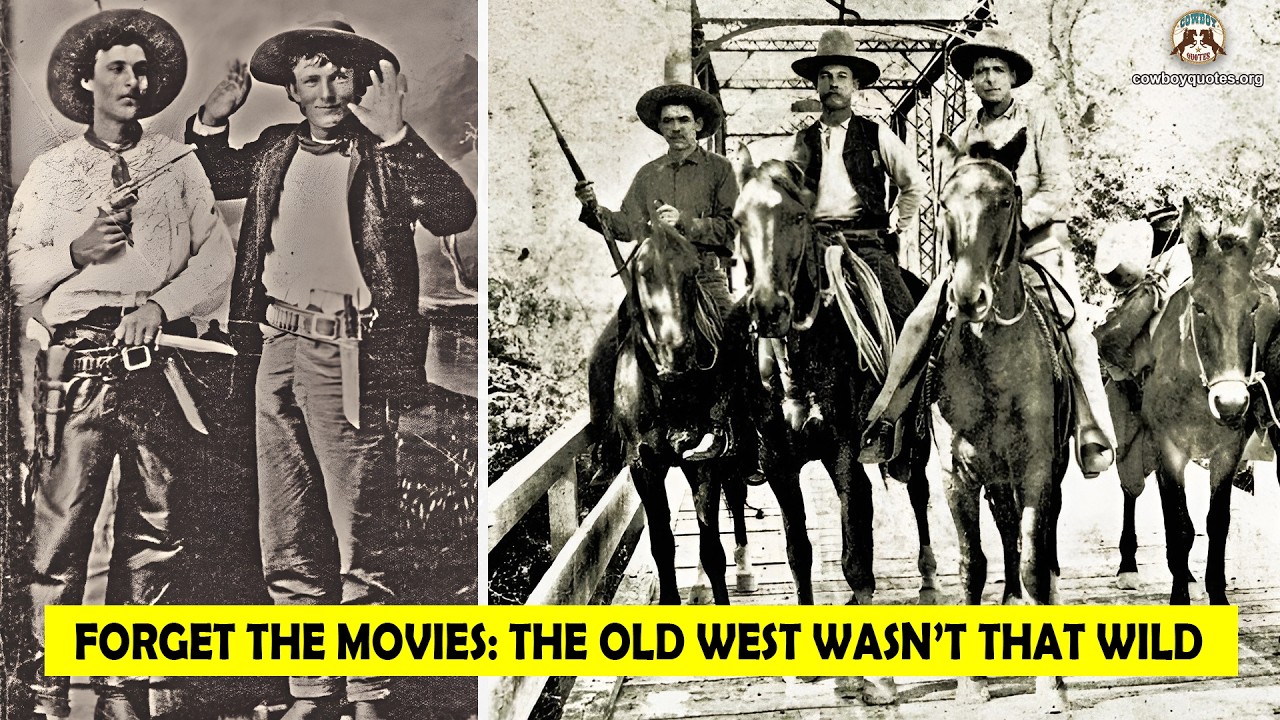
The legend of the deadly frontier begins with familiar imagery. A stranger rides into town, the saloon falls silent, and by the end of the picture, the showdown is settled in the street. Towns like Dodge City, Tombstone, and Abilene are remembered in popular culture as places where danger lurked around every corner and law and order barely existed. But when historians examined the town records, court files, and old newspapers of the late nineteenth century, they found something entirely different from the myth.
Historian Robert Dykstra studied five major cattle towns in Kansas—Wichita, Abilene, Caldwell, Ellsworth, and Dodge City—during the peak of the cattle drive era from 1870 to 1885. Even with thousands of cowboys passing through after long trail drives, these five towns together experienced only 45 fatalities over fifteen years. That amounts to roughly three incidents per year across all of them. Dodge City itself, often portrayed as the most dangerous town of the era, recorded only fifteen incidents over an entire decade as a booming cattle center, about one and a half per year, with some years completely free of any violent deaths.
Local newspapers reflected this reality. The Dodge City Times devoted its front pages to crop reports, railroad schedules, town meetings, and everyday problems like stray livestock rather than daily dangers. When a serious incident did occur, it was treated as major, shocking news precisely because it was so unusual. Tombstone tells a similar story.
Despite its reputation built on the shootout at the O. K. Corral, coroner’s records from 1880 to 1884 show that, aside from that famous incident, fewer than a dozen people died from violence in Tombstone during those years. Most recorded deaths actually came from mining accidents, disease, or illness, not from disputes.
Comparing homicide rates per 100,000 people between these frontier towns and larger eastern cities of the same era tells an even clearer story. Although a single incident in a town of only a thousand residents could produce a high statistical rate, the actual day-to-day numbers show that residents of places like Abilene or Tombstone were generally safer than people living in major eastern cities such as New York, Baltimore, or Chicago, which dealt with serious gang activity and the unrest of the industrial age. Most people who moved west were not looking for conflict. They were families, shopkeepers, and craftsmen hoping to build stable, quiet lives.
Constant disorder would have made it impossible for their communities and businesses to survive. So the next time a western film shows a town in chaos before the opening credits end, it is worth remembering that the real historical record portrays the Wild West as far calmer than its legendary reputation suggests. Close your eyes and imagine a classic frontier street, and you will likely picture every man, from the bartender to the traveling merchant, openly wearing a sidearm. Films and television have taught that carrying a gun on the frontier was not just common but necessary for daily survival.
The image of the armed frontiersman has become inseparable from how we imagine the American West. But if you stepped off a stagecoach into a real thriving western town in the 1870s or 1880s, you would find the opposite of what popular culture suggests. Many frontier towns actually had some of the strictest gun regulations in American history, in some cases stricter than many modern cities. The founders of these towns understood a simple fact.
Disorder was bad for business. Investors would not finance mines or railroads in towns that seemed unsafe. So once a settlement became an official town, local councils usually passed strict restrictions on carrying firearms within town limits. In Dodge City, Kansas, around 1878, a large sign near the center of town made the rule clear: carrying firearms was not permitted.
Local ordinances restricted anyone other than law enforcement from carrying weapons within city limits. Cowboys arriving after long cattle drives were expected to turn their guns over to the sheriff or a hotel clerk before doing anything else. They received a token to reclaim their gear only when they were ready to leave town. This was not limited to Kansas.
Tombstone, Arizona, issued a similar ordinance in April 1881 requiring a special permit to carry weapons within city limits. Historical accounts from local newspapers such as the Tombstone Epitaph show the rule was taken seriously. The famous event at the O. K.
Corral in October 1881 is often remembered as a personal grudge match, but it actually began as a law enforcement effort connected to that local ordinance. Officers moved to deal with individuals carrying weapons in violation of the rule. Newspapers of the time indicate many residents supported these restrictions. Editors frequently praised local officials for keeping order in their towns.
One Kansas newspaper in 1882 described carrying a gun in a settled community as a mark of bad manners rather than a sign of confidence. Being armed inside town was not seen as heroic individualism. It was usually viewed with suspicion. Those who violated these ordinances typically faced real consequences.
Fines could equal a worker’s wages for weeks, and those who could not pay might serve a jail sentence or work off the debt. So while popular media often portrays the frontier as a place of constant chaos, the historical record tells a different story. The people who built these towns relied not on continuous conflict but on clear rules, practical enforcement, and a strong desire for order and stability. A safe, orderly town square was seen as the true foundation of a community that could survive.
When we imagine legendary western outlaws like Butch Cassidy, the Sundance Kid, Jesse James, or the Dalton Gang, a familiar scene comes to mind. Masked riders storm into a quiet town, rush the local bank, fill sacks with gold, and vanish before the sheriff can act. It is one of the most repeated stories in western fiction. But historians who studied the financial and legal records of that era found that the classic bank robbery was actually extremely rare and rarely successful.
Historian Larry Schweikart conducted a comprehensive review of records across fifteen states and territories between 1859 and 1900. Over more than four decades and thousands of towns, he documented only about twelve confirmed bank robberies in the entire American West. By comparison, modern cities today might see more bank robberies in a single month than occurred during the entire frontier era. There were practical reasons for this.
Frontier banks were never easy targets. They were often built as sturdy brick or stone structures in prominent town locations, protected by heavy, sophisticated safes that were difficult to open quickly. Trying to force one open was neither quick nor simple. The layout of frontier towns made things even harder for would-be robbers.
Banks were typically located near the sheriff’s office, busy stores, or other occupied buildings, meaning any disturbance would attract attention almost immediately. In small towns where many residents had experience with firearms for hunting and protection, anyone trying to move fast would find the whole community responding quickly. The Dalton Gang’s attempt in Coffeyville, Kansas, on October 5, 1892, illustrates this well. The gang tried to rob two banks at once, but local citizens recognized them quickly, armed themselves, and moved to defend the town.
The attempt ended in disaster for the gang. Most members did not survive the confrontation, and the only survivor was seriously wounded before being captured. The community made clear it would not allow its resources to be seized without resistance. Because towns were so well defended, experienced outlaws usually avoided them.
Newspaper archives such as the Rocky Mountain News show that criminals mostly targeted isolated stagecoaches or passing train shipments in remote areas, where there were fewer people to stand in their way and escape into the wilderness was easier. The common image of frontier banks living under constant threat is a product of film and television more than history. In reality, these institutions were carefully protected, and communities took pride in defending the financial security they represented, making frontier banks among the most stable and guarded parts of western life. When films and television portray western towns and mining camps, they often rely on a familiar idea: total chaos, where the strongest take what they want and disputes are settled by force.
This works for dramatic entertainment, but it does not hold up as historical economic fact. If the frontier had truly worked that way, westward expansion would probably never have succeeded. Historians who studied the records of that period, camp regulations, and legal agreements found a more optimistic truth. The western economy was built largely on voluntary cooperation, mutual support, and organized agreements.
Long before federal courts or formal governments reached the territories, settlers had to find ways to manage resources fairly among themselves. They often did this by creating their own local governance systems. In the mining camps of California, Colorado, and Nevada during the mid-nineteenth century, strangers from diverse backgrounds quickly arrived at remote sites. Instead of resolving disputes through conflict, these communities often organized themselves around shared written rules.
Research by historian John Umbeck on the early California gold diggers found that prospectors formed districts, elected representatives, and adopted detailed rules covering claim sizes, required work, and how to settle disagreements. When disputes arose, such as over who had discovered a resource first, camps often held informal hearings with a jury of peers to reach a decision. Those who ignored community rules typically faced social and economic exclusion rather than confrontation, which was a severe consequence in an environment where cooperation was essential for survival. This spirit of mutual support extended to the overland trails as well.
Wagon trains operated like small moving communities, often organized under formal agreements before departure. These agreements covered travel order, guard duties, and basic rules of conduct. When equipment broke down or livestock was lost, travelers usually stopped to help with repairs and share resources, recognizing that cooperation was essential for survival on the road. The cattle industry reflected similar values.
Large cattle operations required careful coordination, and ranchers often organized groups such as the Wyoming Stock Growers Association to manage branding systems, grazing arrangements, and cooperative roundups, establishing order through organization rather than conflict. Water rights, one of the most important resources in the arid West, provide further evidence of this pattern. Rather than resorting to conflict over access, settlers developed formal water-sharing agreements and cooperative irrigation companies, working together to build irrigation systems and share resources under agreed terms. The true story of the American West was not written by isolated individuals working alone but by communities that valued order, fairness, and cooperation.
Even in the absence of a large formal government, many frontier communities found ways to build stable, functioning societies through shared effort and mutual agreement. When you hear the word cowboy, you might picture a tough, independent wanderer. A clean hat, a fine horse, evenings spent in saloons, always ready for dramatic confrontations. It has become a lasting symbol of American individualism.
But the real diaries, payroll records, and photographs from cattle drives between 1866 and 1886 tell a completely different story. The real cowboy life was hard, low-paid, and often routine, closer to farm labor than adventure. Start with the myth of the wealthy, glamorous cowboy. Most cowboys were young, often teenagers or men in their early twenties, driven into the work by a lack of other opportunities.
According to the National Cowboy and Western Heritage Museum, cowboys typically earned between 25 and 40 dollars a month, about the same as factory wages in the East, but without stable housing. They also had to buy their own equipment, such as saddles and boots, which often left them in debt to the ranchers. The demographics of cattle drives might surprise those who only know Hollywood stereotypes. Historians estimate that about a quarter of cowboys were Black, many of them former slaves seeking new opportunities after the Civil War.
Another large portion were Mexican vaqueros, who invented much of the profession’s tools and terminology. Words like lasso, chaps, and rodeo all derive from Spanish. Native American and white workers also labored alongside them. On the trail, practical skill mattered more than background, creating a level of diversity uncommon elsewhere in the country at that time.
Daily life on a cattle drive was exhausting routine rather than excitement. A trip from Texas to the Kansas railheads could take two to three months, with cowboys spending up to fifteen hours a day on horseback, often riding through the thick dust kicked up by the herds. This was the practical purpose of the bandana, not the dramatic effect often shown on screen. Even after sunset, the work continued.
Cowboys took turns guarding the herd through the night in shifts, often singing softly to help calm the cattle. The greatest danger they faced was not encounters with outlaws but sudden cattle stampedes, unpredictable movements that could be dangerous to anyone in the way, especially in the dark or over uneven ground. When cowboys finally reached towns like Abilene or Dodge City, their priorities were simple and practical. A haircut, a hot bath, clean clothes, and a decent meal after weeks of basic trail food.
Wages did not last long, and soon most cowboys were signing up for another drive out of necessity. Rather than a glamorous adventure, cowboy life was one of constant hard work that required endurance, cooperation, and patience. Everyone knows the image of the classic frontier lawman, that tall, quiet figure of complete integrity wearing the badge, standing firmly against wrongdoing, driven by justice alone. Names like Wyatt Earp, Wild Bill Hickok, and Bat Masterson have become part of American folklore.
They are often remembered as flawless heroes, but a closer look at court records, town council minutes, and newspaper commentary of that era reveals a far more complex picture. Many legendary lawmen were politically driven and business-minded, often blurring the line between upholding the law and bending it for personal gain. In the nineteenth century, working as a town marshal or county sheriff was not a purely civic calling. It was often a lucrative and politically charged position.
Lawmen usually did not receive a simple salary. Instead, they earned a share of collected taxes, fees for serving warrants, and a portion of fines from those they arrested. This fee system created real incentives for questionable behavior. Rather than focusing only on preventing wrongdoing, some lawmen profited more by allowing profitable businesses, saloons, gambling halls, and similar establishments to operate, because those businesses generated the fines and fees that funded their income.
In some cases, lawmen had financial ties to those very establishments. Wyatt Earp, perhaps the most famous lawman in American history, is often portrayed as a heroic figure who brought order to Tombstone. Historical records complicate that image. Before becoming a lawman, Earp faced legal troubles in Indian Territory in 1871 involving horse theft and left the area before the matter was resolved.
Later, while working as a police officer in Wichita, Kansas, he was fired following a dispute with a local political figure over town money. In Tombstone, Earp was involved in business interests related to gambling and saloons, and he had political ambitions that put him in direct competition with the county sheriff, Johnny Behan, for control of the lucrative tax collection responsibilities. The famous confrontation between the Earp faction and the Clanton-McLaury group is better understood not as a simple struggle between good and evil but as the result of a tense local rivalry involving political power and business interests. Wild Bill Hickok’s record is similarly complex.
Despite his reputation, he spent much of his time engaged in card games, social activities, and saloon affairs rather than actual law enforcement work. During his brief stint as marshal in Abilene, Kansas, in 1871, residents grew concerned about his harsh style, and the city council removed him from office after less than eight months. His departure came after an unfortunate incident in which he accidentally wounded his own deputy, Mike Williams, during a noisy disturbance in the street, an event that made the townspeople feel his presence was no less a danger than the disorder he was supposed to prevent. Bat Masterson, another prominent Old West figure, actually spent most of his life working as a gambler and later as a sportswriter rather than a lawman.
During his time as sheriff of Ford County, Kansas, opposition newspapers accused him of favoring certain gambling operations linked to his allies while targeting their competitors. The badges these men wore were not necessarily symbols of impartial justice. They often represented political influence and economic opportunity. Many residents viewed local lawmen with some caution, aware that these men might be as interested in collecting fines as in protecting the community.
Looking beyond the common image, the people who shaped law enforcement in the West were complex individuals working in a system where law enforcement and the pursuit of personal gain were closely intertwined. If the historical West was actually a place with low crime rates, strict local regulations, rare bank robberies, and daily cooperation, that raises an interesting question. How did the popular image of the turbulent frontier take hold of our imagination? The answer lies in the media, marketing, and entertainment of the early nineteenth century.
The dramatic version of the West that many of us grew up with was not really historical fact. It was a commercial invention shaped and sold to the public long before the era itself actually ended. This process began in the 1860s and 1870s with the rise of dime novels. These cheap, widely distributed booklets were similar to today’s pulp fiction.
They were popular among factory workers and city dwellers in the East. Publishers realized that urban readers, seeking escape from their daily routines, wanted exciting stories. Writers, most of whom had never traveled west, began composing wildly exaggerated tales about real and fictional characters from those regions. One notable example is Edward Judson, who wrote under the name Ned Buntline.
In 1869, he met a young scout named William F. Cody in Nebraska and turned him into a legendary character called Buffalo Bill through a series of dramatic stories. These tales were far removed from Cody’s actual daily work, but readers loved them. Soon many real western figures realized they could earn more money by adopting these exaggerated personas than by continuing their ordinary frontier occupations.
Cody went further by launching Buffalo Bill’s Wild West in 1883, an elaborate traveling show that toured the United States and Europe for decades, drawing huge crowds, including members of European royal families. The show featured dramatic theatrical scenes, simulated robberies, battles, and shooting exhibitions, shaping how many people, especially in eastern cities, perceived the West, since they had no other opportunity to see it. As the actual western era drew to a close at the turn of the twentieth century, the emerging film industry took up the torch where the traveling shows left off. Early films such as The Great Train Robbery in 1903 helped cement the genre’s enduring elements—masked characters, dramatic showdowns, and thrilling chases—that shaped western stories for decades.
Later filmmakers, including directors like John Ford and stars like John Wayne, built on these prototypes, transforming a relatively short historical period into a broader cultural mythology, often replacing the complex, cooperative reality of frontier life with a simplified narrative of conflict and individual heroism. The version of the Old West celebrated in cinema and television is a powerful piece of storytelling. But it was shaped primarily by the hands of writers, artists, and filmmakers, not historians. In reality, the people who settled the American West built those regions through continuous labor, cooperation, and a strong desire for stability and community.
An achievement that, though less dramatic on screen, reflects a truly impressive story of resilience and collective effort. The Old West we grew up with, with its armed men, lawless streets, and daily gunfights, turns out to be closer to myth than truth. The real history is quieter, but perhaps more remarkable. Towns were built not on chaos but on cooperation, contracts, and a shared determination to create something lasting from the heart of the frontier.
It is a reminder that truth is often more fascinating than myth, once you are willing to look for it.
