Elizabeth Carter was fifty-five years old and had spent twenty-three of those years cataloguing the past for the Chicago History Museum. On a gray November morning in 1960, she was sorting through a box of estate donations that had come from a deceased photographer named Isaac Solomon, who had once run a modest studio on Chicago’s South Side, serving the city’s growing Black community during the Great Migration. She worked methodically through the first box, making notes about date, subject matter, technical quality. Most of the images were typical studio portraits—families, weddings, businessmen.
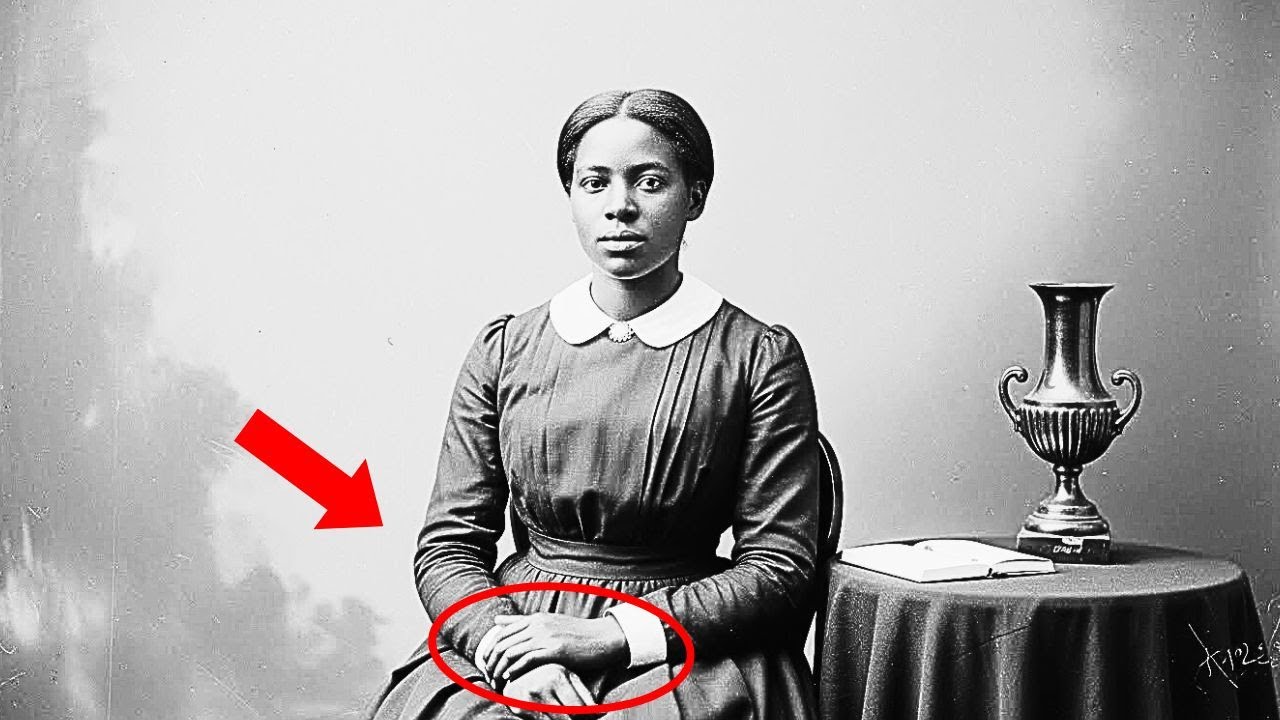
Then she unwrapped a photograph that made her stop. It showed a young Black woman, perhaps in her mid-twenties, seated in a formal studio setting. She wore a simple dark dress with long sleeves and a white collar. Soft lighting illuminated her face, which held an expression Elizabeth found difficult to interpret.
Not happiness, not sadness, but something more complex. Determination, perhaps. The technical quality was exceptional. Solomon had understood light and shadow, creating depth and emotion.
Every detail was perfectly focused. Elizabeth turned the photograph over. In faded ink, someone had written: *Rachel, October 14th, 1912. Free.
*
She studied the image through her magnifying loop, examining the woman’s upright posture, her rigid back, her deliberately folded hands. Everything about the portrait suggested it carried particular significance. Then her loop passed over the woman’s wrists, and she stopped breathing. At the edges of the sleeves, barely visible, were marks on the skin.
Even in black and white, even across forty-eight years, Elizabeth could see they were scars—raised, irregular, forming rings around both wrists. She adjusted her lighting and magnification. The scars were unmistakable. They looked like injuries from restraints, from metal cutting into skin repeatedly.
Elizabeth had seen similar marks before, in slavery research—photographs of formerly enslaved people showing physical evidence of bondage. But this was 1912, not 1862. Slavery had been abolished. The word *free* on the back suddenly took on an ominous weight.
Her historian’s instinct awakened. She had stumbled onto something significant, a story hidden beneath a simple portrait. She made careful notes and began searching Solomon’s collection for anything related to Rachel—any clue about who she was and what freedom she had gained. The boxes yielded two items.
The first was a receipt showing that Rachel had paid for the photograph herself. The second was a newspaper clipping from the *Chicago Defender*, dated October 20th, 1912, with the headline: *Woman Escapes Servitude. *
Elizabeth spent hours researching Chicago in 1912. The year fell during the early phase of the Great Migration, when hundreds of thousands of Black Americans fled the oppressive South seeking better opportunities in northern cities.
She read about the promises that had drawn people north: factory jobs, escape from Jim Crow laws, voting rights, better schools. But she also found darker stories rarely emphasized in historical accounts. Labor recruiters traveled through the South promising good wages and housing. Most were legitimate.
Some were fraudulent, luring vulnerable people north into exploitative situations barely distinguishable from slavery. Elizabeth found references to domestic servitude schemes in which young Black women were brought north with promises of housekeeping jobs, only to be trapped in households where they worked without pay, were not allowed to leave, and faced violence if they attempted escape. A 1913 National Urban League report documented fraudulent recruitment and forced servitude cases in Chicago. Authorities rarely investigated complaints from Black workers, particularly women, dismissing their claims as employment disputes rather than crimes.
Elizabeth built a picture of Rachel’s world. Coming from the South—likely Mississippi or Alabama—Rachel would have been desperate for escape. A promise of paid work in Chicago would have seemed like salvation. But something had gone terribly wrong.
Those scars told a story of imprisonment, of restraint, of someone held against her will. Having the photograph taken in Solomon’s studio, in the heart of the Black community, was Rachel’s way of documenting her freedom—creating visual proof that she had escaped and survived. Elizabeth needed to learn more about Solomon. Why had he photographed Rachel?
Had he helped her escape? She found his business ledger in the collection and flipped to October 1912. *October 14th, 1912. Portrait session.
Rachel. No surname provided. No charge. Subject requested documentation of physical evidence.
Photograph to be used for legal purposes. Additional prints made for Urban League and Protective Association records. *
Elizabeth’s pulse quickened. Solomon had photographed Rachel specifically to document evidence, providing copies to organizations that helped Black migrants.
This was not just a portrait. It was documentation for a legal case. She immediately called the Urban League’s Chicago office. After explaining her discovery, she was transferred to their historical archives, where a researcher named James confirmed they had records from that era.
“If this woman filed a complaint or sought help, there might be documentation,” he said. “Send me the photograph and date. ” Elizabeth promised to send everything the next morning. Before leaving, she studied Rachel’s face again.
The expression now made sense. Someone who had survived something terrible and was determined to ensure it was documented, recognized, never forgotten. Three days later, Elizabeth sat in the Urban League’s archive room with James, surrounded by file boxes from 1912. The organization’s meticulous record-keeping had preserved hundreds of case files documenting the challenges faced by Black migrants.
James pulled files from October 1912 and handed Elizabeth a folder marked *Rachel, Case No. 287*. Inside were intake forms, witness statements, medical records, and correspondence. The intake form provided the basics.
Rachel, surname withheld for safety, approximately twenty-four years old, from Greenwood, Mississippi, arrived in Chicago July 1912. She had reported to the Protective Association on October 10th, 1912, after escaping the residence of Mr. and Mrs. Charles Whitmore, 1847 North Lakeshore Drive.
Elizabeth recognized that address—one of Chicago’s most exclusive neighborhoods, home to the city’s wealthiest families. Rachel’s statement, recorded by a caseworker, detailed her recruitment. “I was approached in Greenwood by a woman representing a Chicago family seeking a housemaid. She promised twelve dollars per week, room and board, one day off weekly, and respectful treatment.
Having no prospects in Mississippi and facing violence there, I accepted. ”
Elizabeth read on. Upon arrival at the Whitmore residence, Rachel’s travel documents were confiscated. Mrs.
Whitmore informed her she owed fifty dollars for transportation that must be worked off before receiving wages. She would sleep in a basement storage room and could not leave unaccompanied. The statement detailed three months of escalating abuse. Rachel had been forced to work sixteen-hour days without pay.
When she asked about wages, Mrs. Whitmore threatened to have her arrested as a thief. When Rachel attempted to leave, Mr. Whitmore physically restrained her and locked her in the basement.
“In September, I tried escaping through a window. Mr. Whitmore caught me and installed locks on all basement windows and my bedroom door. He also placed iron shackles on my wrists at night to prevent further escape.
I wore these shackles for three weeks, removed only during daytime work. The metal cut into my wrists, causing bleeding and infection. ”
Elizabeth felt sick. This was torture, imprisonment—a young woman treated as property in twentieth-century Chicago.
The file included a medical report from a doctor who had examined Rachel after her escape. *Significant scarring on both wrists, consistent with prolonged restraint by metal shackles. Evidence of malnutrition. Multiple bruises in various healing stages.
*
James pulled out another document. “Here’s the police response. ”
Elizabeth read it, her anger growing. *Complainant’s allegations could not be substantiated.
The Whitmores maintain Rachel was employed as housemaid and left of her own accord after becoming dissatisfied. No evidence of wrongdoing found. Case closed. *
“They dismissed it entirely,” Elizabeth said, outraged.
“Standard practice,” James said bitterly. “Black women’s testimony wasn’t valued. Wealthy white families were believed automatically. ”
A colleague of Elizabeth’s mentioned Rachel’s case to a legal historian, who immediately recognized the name of attorney Katherine Everett.
She was one of Illinois’s first women lawyers, specializing in women’s rights and labor exploitation. Her papers were at Northwestern University Law School. The following week, Elizabeth traveled to Northwestern’s archives. The librarian led her to boxes of Everett’s case files from 1910 to 1920.
Elizabeth found a thick folder labeled *Rachel v. Charles and Margaret Whitmore, 1912–1913*. The file revealed that Everett had pursued a civil case against the Whitmores, arguing for damages based on false imprisonment, assault, and contract fraud. Her legal briefs were meticulously detailed, building arguments about how the Whitmores had lured Rachel north with false promises, then held her in conditions identical to slavery.
Everett’s strategy was sophisticated. She had collected testimony from other domestic workers who had escaped similar situations, showing a pattern. She had gathered medical evidence documenting Rachel’s injuries. She had commissioned expert testimony from doctors and social workers about the psychological and physical effects of prolonged captivity.
Most importantly, she had made Isaac Solomon’s photographs central to her case. A letter from Everett to Solomon explained: “The photographs you’ve taken are extraordinary evidence. They show not just a young woman, but a survivor who had the courage to document what was done to her. When juries see those scars, they cannot dismiss this as a mere employment dispute.
”
Elizabeth found depositions from the Whitmores that were chilling in their casual cruelty. Margaret Whitmore testified: “We provided Rachel with room and board, which she never appreciated. She was lazy and difficult, always complaining. When she tried leaving without repaying her debt, my husband had to take steps to ensure she fulfilled her obligations.
”
Charles Whitmore’s deposition was more revealing. “I installed locks for security. The shackles were necessary because Rachel had proven untrustworthy. This is simply how one manages unreliable help.
”
Reading these depositions, Elizabeth felt rage at how casually these wealthy people described enslaving another human being. The case went to trial in March 1913. Everett’s trial notes documented six days of testimony. The defense argued Rachel was lying, that she had been a willing employee, that her injuries were self-inflicted to create false claims.
But Everett was prepared. She had brought Rachel to testify and presented the photographs dramatically. According to Everett’s notes: “When I showed the jury photographs of Rachel’s wrists, several jurors reacted with visible shock. One woman began crying.
” The defense objected that the photographs were prejudicial, but the judge allowed them as evidence of injury. Elizabeth’s hands shook as she turned to the verdict page. The jury had found in Rachel’s favor, awarding her five hundred dollars in damages—approximately fifteen thousand dollars today. But it was the jury’s written statement that made Elizabeth’s heart race.
“We find that the defendant’s treatment of Rachel constituted involuntary servitude in violation of the Thirteenth Amendment. While criminal charges were not pursued, we note that this young woman was subjected to conditions indistinguishable from slavery, and that such practices appear more common than publicly acknowledged. ”
Elizabeth sat back, amazed. Rachel had won against tremendous odds—against a wealthy family, against a system that routinely dismissed Black women’s testimony, against cultural assumptions about domestic service.
Rachel had stood up in court, shown her scars, told her story, and been believed. The file included one final letter from Rachel to Katherine Everett, dated April 1913. “Dear Mrs. Everett, I cannot express sufficient gratitude for your representation.
The jury’s verdict gives me not just financial compensation, but something more valuable—validation that what happened to me was wrong, criminal, and worthy of legal remedy. I plan to use a portion of the settlement to help other women who’ve been trapped as I was. And I want that photograph Mr. Solomon took to be available to anyone who needs proof that slavery did not end in 1865, that it persists in new forms, and that we must continue fighting it.
My scars should serve as evidence and warning. ”
Elizabeth carefully photographed every document, her mind racing. This was not just one woman’s story. It was evidence of a systematic exploitation of Black women migrants that had been deliberately hidden from the historical record.
Determined to trace Rachel’s later life, Elizabeth returned to the Chicago History Museum and started with city directories from 1913 forward. In the 1914 directory, she found *Rachel Johnson, 437 South State Street, Seamstress*. The address was in Chicago’s Black community on the South Side. Elizabeth cross-referenced and found that 437 South State was a boarding house operated by the Phyllis Wheatley Home, an organization providing housing and support for Black women migrants.
She called the current Phyllis Wheatley Association. The director was enthusiastic. “We’ve preserved records going back to our 1896 founding. If Rachel lived with us, we’ll have documentation.
”
Two days later, Elizabeth sat in the association’s small archive room reviewing resident registers from 1913 to 1920. She found Rachel’s name listed from April 1913 through December 1919, with notes indicating she had worked as a seamstress and helped orient new arrivals from the South. A notation from 1914 caught her attention. *Rachel Johnson serves on advisory committee for employment protection program, counseling new residents about identifying fraudulent job offers and exploitative situations.
*
Elizabeth felt admiration surge. Rachel had transformed her trauma into service, using her experience to protect other women from similar exploitation. The Phyllis Wheatley Home records included monthly reports from the advisory committee, several written by Rachel herself. Her clear, determined voice came through in carefully penned reports.
“This month we counseled fifteen new arrivals about employment offers. Three situations showed warning signs—promises of unusually high wages, insistence on immediate departure from the home, employers refusing to provide references. We advised these women to decline and helped them find legitimate positions instead. Education and awareness are our best weapons against those who would exploit our people’s desperation.
”
By 1915, Rachel was giving talks at churches and community centers, warning new migrants about fraudulent recruitment schemes. In 1916, she testified before a city council committee investigating labor exploitation, using her own case as evidence of the need for stronger protections. A 1917 profile in the *Chicago Defender* described her as “a fierce advocate for migrant workers’ rights who speaks with authority born of personal suffering and survival. ”
Tracking Rachel beyond 1919 proved difficult.
She disappeared from the Phyllis Wheatley registers after December, with a notation: *moved to own residence*. City directories listed multiple Rachel Johnsons, making identification impossible. Elizabeth expanded her search to marriage records. She found a promising lead—a marriage certificate from June 1920 for Rachel Johnson and Thomas Wright, both South Side residents.
Following the Wright surname through directories, Elizabeth tracked the couple to a Michigan Avenue residence. The 1920 census showed Rachel Wright, age thirty-two, living with her husband Thomas, a postal worker. The household also included a young girl named Dorothy, listed as “ward”—possibly an adopted child or a relative’s daughter they were raising. By 1930, the census showed Rachel and Thomas with three children: Dorothy, now fifteen, and two younger children, James and Ruth.
Rachel’s occupation was listed as social worker. Elizabeth found Rachel Wright’s death certificate from 1958—just two years earlier. Rachel had lived to age seventy, dying of heart failure. The certificate listed surviving family: husband Thomas Wright, daughter Dorothy Wright, son James Wright, and daughter Ruth Wright Marshall.
Rachel’s children might still be alive. Dorothy would be about fifty-three, James around forty-five, Ruth around forty-two. They could remember their mother. They could share stories.
They could help Elizabeth understand the full arc of Rachel’s remarkable life. Elizabeth found Dorothy Wright Henderson living on the South Side, blocks from where Rachel and Thomas had raised their family. When Elizabeth called to explain her research, there was a long silence before Dorothy spoke, her voice thick with emotion. “My mother never spoke much about her early years in Chicago.
She said those memories were painful and she preferred to focus on the present and future. But I knew she’d survived something terrible. I saw the scars on her wrists when I was young and asked about them. She said they were reminders that she’d been strong enough to escape something evil.
”
They arranged to meet at Dorothy’s home the following Saturday. Elizabeth arrived with copies of all the documents—the photograph, the Urban League case file, the court records, the newspaper articles. She wanted Dorothy to see the full picture of her mother’s courage. Dorothy was a dignified woman in her early fifties, a school teacher with her mother’s determined expression.
She welcomed Elizabeth into a living room filled with family photographs. On the mantle was a framed portrait that made Elizabeth catch her breath: Isaac Solomon’s photograph of Rachel, documenting her freedom and her scars. “Mother kept that photograph her entire life,” Dorothy said. “She said it was the most important picture ever taken of her because it proved she’d survived and wouldn’t be silenced.
And when I was sixteen, she finally told me the full story. ”
Dorothy shared what Rachel had revealed. Her mother had come to Chicago believing promises of a better life, but found herself trapped in a nightmare. She was locked in a basement at night, shackled like an animal, worked until she could barely stand.
The physical pain was terrible, but worse was the psychological torture—being treated as property, as less than human. Dorothy’s voice trembled. “She told me that one night she’d heard the Whitmores discussing whether to sell her to another family. Sell her like she was furniture.
That’s when she realized she had to escape or die trying. ”
“How did she escape? ” Elizabeth asked. “A delivery boy—a young Black man who brought groceries—noticed her through the basement window.
She managed to whisper to him that she was being held against her will. He contacted the Urban League, and they arranged her escape. One afternoon, when Mrs. Whitmore left the house briefly, the delivery boy and two Urban League workers broke the basement window, cut her shackles, and got her out.
”
Dorothy showed Elizabeth more family photographs: Rachel in her twenties and thirties, her confidence growing over the years; Rachel with Thomas on their wedding day; Rachel with her children. “Mother dedicated her life to making sure what happened to her didn’t happen to others. She worked as a social worker for thirty years, specializing in helping migrant women find safe employment and housing. ”
Over the following months, Elizabeth worked with Dorothy, James, and Ruth to create a comprehensive historical exhibition.
They titled it *Scars of Freedom: Rachel’s Story and the Hidden History of Northern Servitude*. Isaac Solomon’s photograph of Rachel served as the centerpiece. Dorothy provided family documents, photographs, and Rachel’s own writings from her advocacy work. James contributed research he had done on labor exploitation during the Great Migration.
Ruth shared stories about their mother’s social work and the countless women she had helped escape similar situations. Elizabeth researched the broader context, finding evidence that Rachel’s case was far from unique. Dozens, perhaps hundreds, of Black women migrants had been trapped in forced servitude in northern cities, their situations dismissed or ignored by authorities. The exhibition opened in March 1961.
The timing was significant. The civil rights movement was gaining momentum, and Rachel’s story resonated powerfully with activists fighting against all forms of racial oppression. The photograph was displayed with careful lighting that emphasized both Rachel’s dignified expression and the visible scars on her wrists. Beside it, enlarged details made the injuries unmistakable, along with explanatory text telling the full story.
Additional displays showed the Urban League case file, court records from her successful lawsuit, newspaper articles about her advocacy work, and photographs of her later life. One particularly powerful display juxtaposed the 1912 photograph with a 1950 image of Rachel speaking at a civil rights conference, showing her transformation from victim to advocate. Dorothy, James, and Ruth attended the opening, standing together before their mother’s photograph. Several elderly women approached them, some with tears in their eyes.
“Your mother helped my aunt in 1918,” one woman said. “My aunt had been trapped in a similar situation, and Rachel counseled her, helped her find safe work, gave her courage to rebuild her life. Our family has told Rachel’s story for generations—how one woman’s survival and strength saved so many others. ”
Another woman, perhaps seventy years old, stepped forward.
“I’m here because of Rachel. In 1925, I arrived in Chicago from Alabama with promises of work. Rachel met me at the train station. She volunteered there, watching for young women traveling alone.
She warned me about fraudulent offers, helped me find legitimate employment, checked on me regularly. Without her intervention, I might have ended up like she did. Instead, I had a good life, raised a family, became a teacher—all because Rachel cared enough to protect strangers. ”
Over the next several hours, dozens more people shared similar stories.
Rachel’s advocacy had touched far more lives than even her children had realized. She had been a quiet force in Chicago’s Black community, using her experience and her scars as credentials to warn, protect, and empower other women. A young civil rights activist approached the family. “This story needs to be known nationally.
Rachel’s case proves that slavery didn’t end with the Thirteenth Amendment—it just took new forms. Her courage to document it, fight it legally, and then dedicate her life to protecting others is exactly the kind of resistance we need to honor and continue. ”
The exhibition’s success led to unexpected developments. News outlets across the country picked up Rachel’s story.
The combination of the powerful photograph, the legal victory, and Rachel’s lifelong advocacy made it compelling to audiences engaged with civil rights struggles. Major newspapers published features about Rachel and the hidden history of forced servitude in northern cities. The photograph appeared in national magazines, always with full context about what the scars represented and how Rachel had fought back. Historians and researchers from across the country contacted Elizabeth, sharing similar cases they had found in their own cities—Detroit, New York, Philadelphia, Cleveland.
Rachel’s story was not unique. It was part of a systematic exploitation that had been deliberately hidden from the historical record. Dorothy received a letter from the NAACP’s national office requesting permission to use Rachel’s photograph and story in their educational materials about the continuing struggle against all forms of slavery and exploitation. The family agreed, with one condition: that Rachel be remembered not just as a victim, but as a survivor and advocate.
Elizabeth published a scholarly article about Rachel’s case and its broader implications. The article was reprinted in history journals and educational publications, ensuring that Rachel’s story would be taught in schools and universities. The Phyllis Wheatley Association established the Rachel Wright Advocacy Award, given annually to individuals who work to protect vulnerable women from exploitation. The first recipient was a social worker who had spent decades helping trafficking victims and was directly inspired by learning Rachel’s story.
Ruth organized an oral history project interviewing elderly women who had known Rachel or been helped by her. The project preserved over thirty first-person accounts of Rachel’s impact, creating a rich archive of her advocacy work that had never been formally documented. James worked with legal scholars to analyze Rachel’s case and its implications for contemporary anti-trafficking laws. Her successful lawsuit became a case study in how civil litigation could achieve justice when criminal prosecution failed.
Six months after the exhibition opened, Elizabeth received a call from the Smithsonian Institution. They wanted to include Rachel’s photograph and story in a planned National Museum of African American History and Culture. Isaac Solomon’s portrait would be preserved and displayed nationally, ensuring future generations would know Rachel’s story. Dorothy, James, and Ruth traveled to Washington for the museum planning meetings.
Standing together, they discussed how their mother’s story should be presented—not with pity, but with respect for her courage, her resilience, and her dedication to protecting others. “Mother always said her scars were proof that she’d survived,” Dorothy told the museum curators. “She wanted people to see them, to understand what she’d endured—but more importantly, to know that survival was possible and that one person’s courage could make a difference for many. ”
The curators designed a display that honored that wish.
The photograph was central, with Rachel’s scars clearly visible and carefully explained. But surrounding it were images and documents from her advocacy work, showing how she had transformed trauma into purpose. The exhibition *Scars of Freedom* ran for two years at the Chicago History Museum, becoming one of their most visited displays. Over one hundred thousand people saw Rachel’s photograph and learned her story.
Elizabeth retired from the museum in 1965, but continued researching hidden histories of resistance and survival. She often spoke about Rachel’s case as the most significant discovery of her career—not because it was unique, but because it revealed how much history had been deliberately hidden or ignored. Dorothy, James, and Ruth became active in civil rights work, attributing their commitment directly to their mother’s legacy. Dorothy integrated Rachel’s story into her teaching, ensuring her students understood that resistance to oppression had always existed.
James became a lawyer specializing in labor rights. Ruth continued social work, focusing on helping trafficking victims. Isaac Solomon’s photograph of Rachel was eventually transferred to the Smithsonian’s permanent collection, where it remains on display. The placard beside it tells her full story—from the scars of forced servitude to her legal victory to her decades of advocacy.
But perhaps Rachel’s most profound legacy was the ripple effect of her courage. Researchers inspired by her story found dozens of similar cases in archives across the country, documenting a hidden history of post-slavery exploitation. Legal scholars used her successful lawsuit as precedent for contemporary trafficking cases. Advocates cited her example when arguing for stronger protections for domestic workers and migrants.
In 1975, Dorothy published a book about her mother’s life, titled *Scars of Freedom: One Woman’s Fight Against Modern Slavery*. The book became required reading in many universities, ensuring new generations would know Rachel’s story. When Dorothy passed away in 2005 at age ninety, her obituary noted that she had spent her life honoring her mother’s legacy. Attached to the obituary was Isaac Solomon’s photograph of Rachel—those scars visible on her wrists, her expression determined and unbroken.
The photograph that Elizabeth had found in a dusty museum basement in 1960 had traveled far beyond its origins. It had become evidence in legal cases, inspiration for activists, and proof that even the most brutal attempts to silence and exploit could be overcome by courage and determination. Rachel had understood this in 1912 when she sat for that photograph, deliberately positioning her wrists so the scars would be visible. She had known that documentation mattered, that her story needed to be recorded, that evidence could outlast individual lives and continue speaking truth long after voices were silenced.
Those scars, which had once marked her as property, became symbols of her freedom and her refusal to let her experience be erased. They proved that slavery had not ended in 1865, that new forms persisted and required constant vigilance to fight. And they showed that one person’s courage to speak truth, to document injustice, and to dedicate their life to protecting others could create change that echoed across generations. Elizabeth often thought about that November morning when she first unwrapped Rachel’s photograph, not knowing what she had found.
A simple portrait had become a window into hidden history, a testament to survival, and proof that the most important stories often wait quietly in archives, their significance invisible until someone looks closely enough to see what is truly there. Rachel’s scars had told a story that words alone never could—a story of suffering and survival, of exploitation and resistance, of one woman who refused to be silenced and whose courage continued inspiring others more than a century after that photograph was taken.
