On the morning of October 25th, 1957, Albert Anastasia sat down in chair number four at the Park Sheraton Hotel barbershop in midtown Manhattan. Two masked gunmen walked in. The barber dove to the floor. Anastasia was shot multiple times, and in the confusion, he lurched toward his own reflection in the mirror, apparently trying to attack his attackers, before falling dead on the floor.
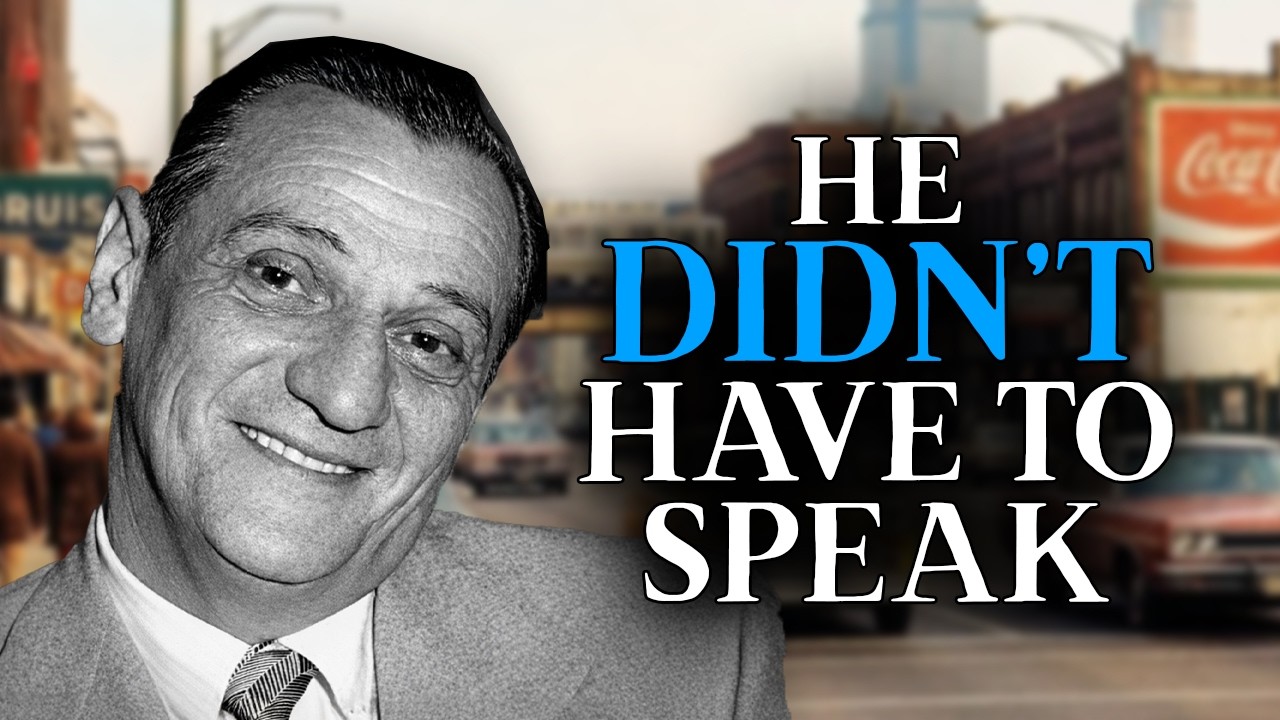
Carlo Gambino was nowhere near that barbershop. He was never charged. He was never seriously investigated for the murder. And within weeks, he was named the new boss of what would come to be called the Gambino crime family.
That was the move. That was the whole blueprint: find the problem, build the consensus, stay out of the room when it happens, and collect the result. Carlo Gambino ran that play for his entire career. To understand Carlo Gambino, you have to understand where he came from, and not just Sicily, but the specific kind of Sicily he came from.
The kind where you learned before you could walk that the loudest man in the room was usually the first man in the ground. Carlo Gambino was born on August 28th, 1902, in Palermo, Sicily. His family was not poor, exactly, but they were not comfortable either. What they were was connected.
The Gambinos had ties to the local mafia going back generations. Carlo did not stumble into organized crime. He was born inside it the way other kids are born into farming families or fishing villages. It was simply what the men around him did.
He was a small child, quiet and watchful, the kind of kid who sits at the edge of the adult table and listens to everything without appearing to listen at all. That skill, the ability to absorb information while projecting invisibility, would define the next 74 years of his life. In 1921, at nineteen years old, Carlo Gambino slipped out of Sicily and onto a merchant ship bound for Norfolk, Virginia. He entered the United States illegally: no papers, no declaration, no record.
He would spend the rest of his life making sure the government knew as little about him as possible. His entire American story started with the same strategy he had always used. Get in quietly, leave no trace, and let everyone else make the noise. He made his way to Brooklyn, where his cousins, the Castellanos, were already embedded in the local Italian community.
He went to work almost immediately, running errands for the mafia figures who controlled the neighborhood: liquor, numbers, favors. He was a natural, not because he was violent, though he could be, but because he was reliable. Quiet and reliable. In the mob, that combination is rarer than you would think.
When Prohibition hit in 1920, the American underworld was transforming. Overnight, bootlegging became the most profitable business in the country, and every criminal with ambition was scrambling to get a piece of it. Most of them got greedy. Most of them got loud.
Most of them eventually got dead or arrested. Carlo Gambino watched all of this and drew the correct conclusion. He moved liquor, of course he did. Everyone did.
But Carlo did not use Prohibition to build a personal empire or a personal legend. He used it to build relationships. Every deal he made, every shipment he moved, every favor he did, he filed it away. He was keeping score, not to cash in immediately, but to have chips on the table ten, fifteen, twenty years down the road.
By the early 1930s, Prohibition was ending and the American mafia was reorganizing itself after the Castellammarese War, a brutal internal conflict that had redrawn the map of organized crime in New York. Out of that war came the five families structure, the commission, the rules, and at the center of the new order in New York stood Lucky Luciano. Carlo Gambino aligned himself with the right people at the right time. He became a soldier in what would eventually be called the Gambino family, though at that point it was run by Vincent Mangano.
He kept his head down. He earned. He paid tribute. He did what he was told.
And he watched every single person above him with the patience of a man who knows that in this business, the top of the ladder clears itself eventually. Albert Anastasia was, by any reasonable measure, one of the most terrifying men alive. He was the head of Murder Incorporated, the mob’s dedicated killing operation. He had personally ordered or carried out so many murders that federal investigators lost count.
They called him the Lord High Executioner. This was not a complimentary nickname. The man genuinely enjoyed his work in a way that made even hardened mobsters uncomfortable. By 1957, Anastasia had taken over the family that Mangano once ran, after making Mangano disappear in 1951, which is one way to get a promotion.
But now Anastasia was boss, and he was becoming a problem. He was erratic. He was expanding recklessly. He was selling mob memberships to the highest bidder, which violated every protocol the commission had established.
He was, in the language of the streets, out of control. Carlo Gambino saw an opportunity. And here is what is important to understand about what happened next, the part the movies always get wrong. Carlo Gambino did not pick up a gun.
Carlo Gambino did not hire a hitman directly. Carlo Gambino had a series of quiet conversations with the right people, including crime boss Vito Genovese, who had his own reasons for wanting Anastasia gone. Together, they engineered consent. They got the commission to look the other way.
They made sure the men who pulled the trigger had protection from above. So when the gunmen walked into that barbershop, the killing had already been arranged in careful, unhurried conversations far from the scene. And when it was done, Carlo Gambino inherited the organization he had been quietly positioning himself to run for decades. One month later, in November 1957, the bosses of American organized crime gathered at a remote farmhouse in Apalachin, New York, for a national summit.
These were the most powerful criminals in the country, and they were meeting in rural upstate New York because they thought nobody would notice. A state trooper named Edgar Croswell noticed. Croswell had been watching the estate’s owner, Joseph Barbara, for years. When he saw the unusual volume of expensive cars arriving at the property, he set up a roadblock.
The mob bosses panicked. Dozens of them ran through the woods in their silk suits and leather shoes. Over sixty mobsters were identified and detained. It was, to put it gently, an organizational catastrophe.
The Apalachin raid blew the lid off something J. Edgar Hoover had been publicly denying for years: that a national organized crime network even existed. Hoover famously preferred chasing communists. After Apalachin, he did not have a choice anymore.
The mob was real. It was national. And now it had faces and names attached to it. Most of the bosses who attended spent years dealing with legal headaches, public exposure, and federal heat.
Carlo Gambino had also attended. But he was one of the ones who got away. Clean shoes, no arrest, no photograph. While other bosses were explaining themselves to grand juries, Carlo went home for dinner.
Whether that was luck or planning is a question for the record, but the evidence points toward planning. Through the 1960s, Carlo Gambino consolidated power in a way that was almost invisible to the outside world. He cemented alliances with other family bosses. He used his relationship with Vito Genovese, even after Genovese was sent to prison in 1959, to position himself as the senior statesman of the commission.
He was never officially named boss of bosses. That title had been retired after Lucky Luciano created the commission specifically to prevent any one man from holding too much power. But in practice, Carlo Gambino became exactly that. When families had disputes, they came to Carlo.
When the commission needed consensus, Carlo provided it. When someone needed to be removed, Carlo’s blessing was required. His family was the largest and most profitable in the country. Construction, garments, trucking, the waterfront.
The Gambinos had their hands in so many legitimate industries that untangling the criminal money from the business money was nearly impossible. That was the point. Carlo did not just build a crime family. He built a corporate structure with crime at its center and legitimacy wrapped around it like insulation.
He also had a rule that stands out even among mob bosses. Carlo Gambino reportedly banned his members from dealing narcotics. Not for moral reasons, let that be clear, but for strategic reasons. Drug cases brought mandatory sentences.
Mandatory sentences created informants. Informants destroyed families. Carlo had watched the Lucchese family and others get gutted by narcotics investigations, and he wanted no part of it. The irony is that plenty of Gambino members dealt drugs anyway.
But at least Carlo had the rule. Management sets the policy, employees do what they want. Perhaps the most remarkable fact about Carlo Gambino’s career is this: he ran the most powerful crime family in America for nearly two decades, and the federal government could not make a serious case against him. They tried.
Of course they tried. The FBI had surveillance on him. They followed him. They tapped phones.
They flipped associates and asked about him. And they got almost nothing, because Carlo Gambino operated on a principle so simple it is almost insulting. He did not talk on the phone. He met people in person, in places he trusted, during dangling brief conversations that could not be summarized by any witness, because Carlo never said anything directly that could be used against him.
He spoke in suggestions, implications. He would ask how someone’s family was doing, and the person across the table understood exactly what that meant. He communicated in the language of inference, and inference does not hold up in federal court. The one time the government did manage to get close.
In 1970, he was indicted on charges related to illegal entry and labor racketeering. Then Carlo had a heart attack. A genuine one. He spent years fighting extradition to Italy on those charges while his lawyers argued he was too ill to stand trial.
Whether the timing of that heart attack was convenient or not, the result was the same. Carlo Gambino never spent a meaningful day in prison. In 1972, Francis Ford Coppola released The Godfather. The film was loosely inspired by real mafia figures.
Vito Corleone, the aging patriarch played by Marlon Brando, bore more than a passing resemblance in style and reputation to Carlo Gambino. The quiet power, the family devotion, the preference for reason over violence, even the physical appearance, the jowls, the soft voice, it all tracked. Carlo Gambino reportedly hated the movie. He thought it glamorized the mob in ways that would bring unwanted attention.
He was furious that Hollywood was putting the organization on screen. And meanwhile, every Italian-American kid in the country was watching Marlon Brando and thinking it was the coolest thing they had ever seen. Carlo Gambino built a career on being invisible, and Hollywood made him a pop culture icon anyway. What the film did capture accurately, without intending to, was the fundamental operating philosophy of a man like Gambino.
The Corleone family’s power came not from brutality alone, but from the ability to make others feel that reason and business were preferable to conflict. That is Carlo Gambino, almost exactly. Except Carlo would never have let his own son run his mouth the way Sonny Corleone did. Sonny would have lasted about a week.
By the mid-1970s, Carlo Gambino was genuinely old and genuinely sick. His heart was failing. His wife, Catherine, whom he had married in 1926 and who was also his first cousin, had died in 1971, and by most accounts he never fully recovered from losing her. He spent his final years at his modest home in Massapequa, Long Island.
Not a mansion, not a compound. A regular house in a regular neighborhood where neighbors knew him as a quiet, polite old man who went to mass and kept to himself. Which was, of course, completely accurate, and also the most perfect cover story in the history of organized crime. On October 15th, 1976, Carlo Gambino died of a heart attack at his home.
He was 74 years old. He died in his own bed, surrounded by family, having never served a serious prison sentence and having never been convicted of a major crime, having run the most powerful criminal organization in the United States for nearly twenty years. The federal government had been trying to put him away for decades, and in the end, it was his heart that got him. Not the FBI.
Not a rival family. Not a barber’s chair. His heart. He had designated his cousin Paul Castellano as his successor.
Not his most capable lieutenant, not the most feared man in the family. His cousin. Because even at the end, Carlo Gambino was keeping it in the family. It was a decision with consequences nobody fully anticipated.
Carlo Gambino left behind the largest, wealthiest, most structurally sophisticated crime family in American history, and within a decade of his death, it was eating itself alive. Paul Castellano was a capable businessman, but not a street boss. He was cold, distant, and deeply unpopular with the men beneath him. He made decisions that felt more like corporate memos than mob rulings.
And while Castellano ran the family like a CEO, a captain from South Brooklyn named John Gotti was watching him the same way Carlo once watched Anastasia. On December 16th, 1985, Paul Castellano was shot dead outside Sparks Steak House in Midtown Manhattan. John Gotti took over the family, and everything Carlo had spent fifty years carefully building, the silence, the invisibility, the careful insulation from law enforcement, Gotti dismantled in about four years. He talked.
He preened. He became the Dapper Don, the tabloid mob boss, the man whose photo was on the front page of the New York Post so often they practically gave him his own column. In 1992, Gotti was convicted on murder and racketeering charges and sentenced to life in prison, largely on the testimony of his own underboss, Sammy the Bull Gravano. Gotti died in prison in 2002.
Carlo Gambino built an empire on silence. John Gotti destroyed it with noise. He never fired a gun. He rarely raised his voice.
He drove himself to work in an ordinary car, wore off-the-rack suits, and ate dinner at home with his wife every single night. While every other mob boss in America was screaming for attention, buying racehorses, and getting photographed with senators, this one man sat in the corner, said almost nothing, and quietly became the most powerful criminal in the history of the United States. He was not just a criminal. He was a strategist operating at a level that most legitimate executives would struggle to match.
He understood organizational structure. He understood information control. He understood that in any hierarchy, the person who controls the flow of decisions is more powerful than the person who makes the loudest ones. He terrorized industries.
He corrupted unions. He was responsible, directly or indirectly, for murders we will never fully account for. The silence was not innocence. It was technique.
But the technique worked. In an era when every other major mob boss ended up dead, imprisoned, or publicly humiliated, Carlo Gambino died at home of natural causes, having outlasted and outmaneuvered everyone around him without ever once appearing to try. That is the quiet boss. That is the whole story.
A man who understood that the most dangerous person in any room is the one you never see coming.
