On June 25, 1876, along the banks of the Little Bighorn River, known to the Lakota as the Valley of the Greasy Grass, Crazy Horse could already sense triumph as Cheyenne and Lakota warriors crushed George Armstrong Custer’s men. Swinging north along the ridge, Crazy Horse and his fighters cut off any path of retreat. When Custer’s troops tried to fall back across the uneven terrain, they were retreating straight into a deadly trap. What happened next is difficult to piece together, except for one undeniable truth: it was a massacre.
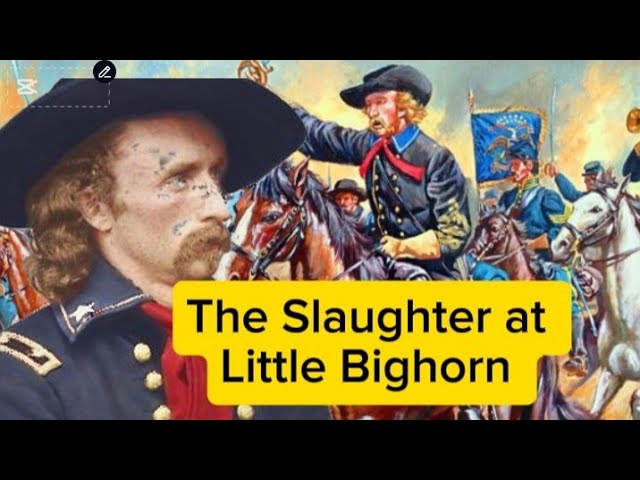
Custer and his men piled the bodies of their dead horses into crude barricades for a last line of defense. Their resistance did not last long. Within minutes, every one of the 210 soldiers under Custer’s command lay dead, struck down in the chaos on the hilltop or hunted through the surrounding ravines. Crazy Horse, Sitting Bull, Chief Gall, and some 2,500 Lakota, Dakota, Cheyenne, and Arapaho warriors had achieved a resounding victory.
The atrocities at Sand Creek and elsewhere had finally been avenged. For the moment, the Lakota had reasserted their claim to their lands, and the united tribes of the Great Plains had defeated the US Army. Yet in celebrating this triumph, they had unknowingly sealed their fate. The conflict had its roots in the late spring of 1876, when the Lakota and Cheyenne gathered for their sacred Sun Dance ceremony at Rosebud Creek in Montana Territory.
Around June 5, the Lakota spiritual leader Sitting Bull emerged deeply shaken from his own Sun Dance. During the intense ritual, he had fallen into a trance and experienced a vivid, alarming vision: enemy soldiers falling into his camp like swarms of grasshoppers from the sky. It was a haunting image, and receiving it during such a solemn ceremony left him disturbed. Yet how could it possibly come true?
Under the Treaty of Fort Laramie of 1868, this land had been guaranteed to the Lakota. It was legally theirs, even under US law. But the prophecy was already beginning to unfold. The Black Hills Gold Rush of 1874 had brought waves of settlers and miners flooding into Lakota territory.
Among the earliest arrivals were 1,000 troopers of the Seventh US Cavalry Regiment, led by Lieutenant Colonel George Armstrong Custer. Custer was equal parts soldier and showman, famous for his flamboyant style and long golden hair. He relished being the center of attention. Though he had proven his skill on occasion, notably at Gettysburg, his arrogance was legendary.
He wore an ostrich plume in his hat and wrote self-glorifying newspaper articles about his exploits. He held little respect for Native Americans, especially the Lakota and Cheyenne. He had every chance to understand them. In early March 1869, he met with the Southern Cheyenne, welcomed by leaders Little Robe and Medicine Arrows, who treated him with hospitality and trust.
But Custer betrayed that trust, taking four of their warriors captive. The betrayal was not new for him. The year before, at the Washita River, he had attacked the Cheyenne under Chief Black Kettle, killing warriors and massacring women and children, even using some as human shields. By 1876, Custer had become inseparable from the story of the Great Sioux War, a conflict that would ultimately claim his life.
Yet Custer was not the highest-ranking officer in the campaign. That honor belonged to Generals George Crook and Alfred Terry. General Crook launched the first engagement of the summer on June 17 at Rosebud Creek. His forces, supported by Crow and Shoshone allies, clashed fiercely with Crazy Horse’s warriors in a hard-fought battle.
Despite winning the battle, Crook was unsettled by the sheer number and intensity of the Lakota, Cheyenne, and Arapaho warriors he had faced. Fearing a counterattack, he retreated from the battlefield. From that moment, two things became clear to the US Army commanders: there were massive numbers of native warriors concentrated in the region, and there was almost certainly a large encampment nearby, most likely along the Big Horn or Little Bighorn River. For Custer, the second fact was all that mattered.
Ignoring the lesson of Crook’s cautious withdrawal, Custer pressed forward recklessly, supported by Captain Frederick Benteen and Major Marcus Reno. Determined to strike first, he declined the offer of Gatling guns, reasoning they would only slow his advance. It was the first of several fatal mistakes. Within days, Custer’s scouts spotted the Cheyenne and Lakota encampment.
When they returned, their faces were pale with fear. Mitch Boyer, a seasoned frontiersman, warned that it was the largest village he had seen in three decades. The Crow scout Half Yellow Face grimly told Custer, “You and I are going home today by a road we do not know. ” If those words disturbed Custer, he gave no sign.
Instead of waiting for General Terry’s column to arrive, he divided his force and began his assault. On June 25, Benteen was ordered to remain in reserve while Reno would cross the river and attack the camp from below. Custer himself led five companies along the ridge north of the river, intending to strike from higher ground. From there he saw the enormous village with his own eyes, stretching nearly three miles across and filled with thousands of lodges.
Custer scribbled his now-famous message to Benteen: “Benteen, come on. Big village, be quick. Bring packs. ” But instead of waiting for reinforcements, Custer made his second grave error, pressing forward along the ridge on his own.
According to reports, he shouted, “Hurrah, boys, we’ve got them. We’ll finish them up and then go home. ” It sounded arrogant, even for Custer, but it was in character. Newspaper correspondents accompanied him, eager to witness his next great triumph.
Meanwhile, Reno’s three companies began their own advance. Around 3 p. m. , they crossed the Little Bighorn River and moved along its southern bank.
As Reno rounded a small grove of trees near the riverbank, he caught sight of the native encampment for the first time and realized it was far larger than he had anticipated. Acting quickly, he dismounted his troops and formed a skirmish line, ordering them to fire volleys toward the eastern edge of the vast village. From his elevated position to the north, Custer likely saw Reno’s advance and the flashes of rifle fire. His immediate decision to ride west at full speed suggests he had spotted Reno’s line and was attempting to circle around the camp.
His apparent plan was to attack from the west, driving the warriors toward Reno’s troops, a classic hammer-and-anvil tactic. If that was his intention, it proved to be another deadly miscalculation. Reno’s thin line was not strong enough to hold. Unbeknownst to both officers, a large number of Lakota and Cheyenne warriors had already gathered on the hills to Reno’s left flank.
They suddenly charged over the ridge, crashing into the side of Reno’s position and quickly cutting off his retreat. Chaos broke out. Reno’s men fell back in confusion, retreating only as far as the dense brush near the river. The warriors chose not to chase them into the thicket.
Instead, they set it ablaze and fired into it from nearby. By this point, Reno, possibly under the influence of alcohol and showing signs of panic, was losing his grip. His Arikara scout Bloody Knife, well known and hated by the Lakota, was shot in the head as he stood beside Reno. The impact splattered blood and bone across the officer’s face.
The horrifying sight reportedly caused Reno to snap completely. In his confusion, he gave contradictory orders, telling his men to mount, then dismount, then mount again, while the warriors continued to fire relentlessly into the woods. Finally, Reno commanded a full withdrawal, and his rattled soldiers fled in disorder, racing northeast and crossing the Little Bighorn before scrambling for cover in a nearby ravine. Many of the wounded were left behind, and stragglers were cut down by pursuing warriors.
The Cheyenne fighters, now emboldened, closed in, dragging soldiers from their horses and beating them to death with clubs. As Reno and the survivors struggled up the ridge, they encountered Captain Benteen, who had been advancing under Custer’s earlier orders. Benteen was stunned by the sight. Roughly 40 of Reno’s 140 men were dead, and survivors were scattered along the route of retreat.
Before Benteen could fully grasp the situation, the distant roar of gunfire from the west made it clear that Custer was now heavily engaged in battle. The warriors who had been chasing Reno suddenly turned westward, eager to join the fighting. Why Reno and Benteen failed to move forward in support of Custer remains uncertain. Reno was mentally shattered and likely incapable of making sound decisions, while Benteen, despite having direct orders from Custer, chose not to advance, effectively defying his superior at a crucial moment.
No support ever reached Custer’s command, leaving his companies to fight and die alone. From Lakota and Cheyenne eyewitness accounts, the final battle unfolded as follows. Custer and one of his companies broke away from the main column along the ridge line and pursued a group of warriors down Medicine Tail Coulee, pushing all the way to the riverbank opposite the native camp. Meanwhile, Captain James Calhoun, Custer’s brother-in-law, held the high ground and continued advancing west along the ridge.
It is believed that Custer may have been attempting to capture women and children from the camp to use as human shields, a brutal tactic he had previously employed during the Washita River massacre. But this time it failed. As Custer’s men reached the river, they came under heavy fire from sharpshooters across the water. After regrouping, they likely attempted to charge across in an effort to break into the camp.
The assault nearly succeeded, as that portion of the village was lightly defended. A warrior named White Cow Bull later claimed he saw Custer himself leading the charge, riding beside a man resembling Mitch Boyer. Some witnesses reported that Custer may have been shot while crossing the river, and several troopers were certainly killed mid-stream. Accounts differ, but many agree that the attack was repelled and the surviving soldiers were driven back up the coulee toward the ridge.
The Northern Cheyenne woman Buffalo Calf Road Woman even claimed to have knocked Custer from his horse during this retreat. However, since Custer had cut his distinctive long hair and removed his decorated jacket before the battle, it is likely that many Native American witnesses misidentified him. His body was later found on a nearby hilltop, suggesting that some of these reports were cases of mistaken identity. What is certain is that the men who reached the river fell back in confusion, retreating across the rugged ground below the ridge until they regrouped with Calhoun’s troops on the crest.
By this time, Crazy Horse’s warriors, returning from the rout of Reno’s command, were circling wide to the west and north, closing in fast. Custer’s detachment was about to be completely surrounded. The final moments came swiftly. Custer’s force fragmented into at least three small groups.
One cluster of soldiers held by Captain Keogh made a desperate stand where they stood, fighting to the last man as they were overrun. The remaining men fell back further west toward the position now known as Last Stand Hill. There, Custer’s force divided once more. One company either tried to launch a desperate charge or retreat down the coulee on the western end of the ridge, racing toward the river.
Meanwhile, Custer, along with his two brothers, his young nephew, and roughly 40 soldiers, stayed behind on the hill’s crest to make their final stand. They piled the bodies of their dead horses into makeshift barricades, using them as crude cover while they fired back at the encircling warriors. Crazy Horse’s contingent had now taken up position to the north, attacking along the ridge line, while Chief Gall’s warriors pressed from the south. With both flanks collapsing, any hope of escape was gone.
Although Lakota and Cheyenne counts recall heavy casualties among their own fighters, the final struggle could not have lasted long. Amid the chaos, smoke, and dust, the warriors stormed the hill and showed no mercy. The wounded were executed, their skulls smashed, scalps taken, and bodies mutilated. It was later said that Custer’s brother Thomas had his heart cut out, a symbolic act of vengeance.
By about 3:30 p. m. , the Battle of the Little Bighorn was over for Custer’s men. Meanwhile, to the east, Lakota and Cheyenne bands turned their focus on Benteen and Reno’s surviving companies.
Through the night and into the next day, the two officers endured repeated attacks, essentially besieged until General Terry’s column arrived on June 27 to relieve them. Though Reno’s last defense alongside Benteen helped partly redeem his reputation, the label of coward followed him for years afterward, not entirely fairly. His career was marred by scandal and alcoholism, and he was eventually dishonorably discharged, dying in 1889. Benteen’s detachment, though somewhat stronger, would have struggled to reach Custer in time, as the colonel had ridden too far ahead, chasing glory instead of coordinating with his men.
Ironically, among all the US commanders at Little Bighorn, it was Custer’s reputation that emerged the most glorified. In the years following the massacre, George Armstrong Custer was transformed into an American icon, celebrated as a hero of courage and valor, despite the fact that his reckless ambition had cost over 200 men their lives. Much of this mythmaking can be credited to his wife, Libbie Bacon Custer, who became his chief publicist. Almost immediately after his death, she published a popular life of General Custer, the first in a series of works that would cement his legend for generations.
In 1885, she published Boots and Saddles, a work that helped shape the legend of the gallant soldier who led fearlessly from the front and died bravely beside his men. When Frederick Benteen condemned Custer’s recklessness, Libbie immediately fired back with a pamphlet defending her husband’s honor. The American public, moved by the grieving widow’s words, chose to believe her version of events over the criticism of a fellow officer. When it came to choosing between truth and legend, Americans at the time embraced the legend.
Another reason Custer became such a symbol of bravery lies in the fact that no one from his five companies survived. Even Mark Kellogg, the Bismarck Tribune journalist accompanying the expedition, was killed at Little Bighorn. With no survivors left to tell the story, the battle became shrouded in mystery, leaving space for mythmaking. Well into the 20th century, Hollywood films featuring actors like Errol Flynn and Robert Shaw helped to immortalize Custer as an icon of courage and sacrifice.
Even today, though his arrogance and vanity are widely recognized, many people still view his final stand as an act of heroic defiance rather than the disastrous misjudgment it was. But what of the Lakota and Cheyenne, the victors of the battle? Their triumph at Little Bighorn was their first and only major success in the Great Sioux War. By early 1877, the conflict had ended disastrously for them.
Custer’s defeat prompted the US government to act decisively to protect settlers from so-called native aggressors. The native warriors who were defending their lands were cast as villains standing in the way of America’s westward expansion. What few textbooks emphasize is that those settlers were there illegally. The Black Hills and surrounding territory had been guaranteed to the Lakota nation forever under US treaty law.
The native fighters were therefore defending what was rightfully theirs. Yet in 1876, such truths were largely ignored. Americans who read about the battle reacted not with empathy but with outrage. Reports that native warriors had taken scalps and trophies, a traditional practice of victory, only deepened the stereotype of the savage Indian who needed to be civilized.
Ironically, just 12 years earlier, Colonel John Chivington’s Colorado cavalry had massacred and mutilated peaceful Cheyenne and Arapaho people at Sand Creek in 1864, committing the very same acts they now condemned. Yet this atrocity was soon forgotten while Custer’s death was glorified for generations as a tale of noble sacrifice. There is no denying that Custer and his men met a horrific end. The Lakota and Cheyenne warriors fought fiercely, showing no mercy to enemies they knew would have shown them none in return.
But the way history was told made all the difference. The Lakota and Cheyenne preserved their past through oral tradition in stories, songs, and memory. The Americans, however, wrote theirs down, spreading it through newspapers and magazines, crafting narratives that echoed around the world. They twisted the truth, turning reality into myth, painting the native warriors as savages and declaring that the West needed to be civilized.
In the end, what should have been remembered as a remarkable victory for the Lakota and Cheyenne instead became the beginning of their downfall, the moment their triumph was rewritten into tragedy.
