The 1876 season had just ended for a cowboy named Frank, and he wanted a drink in Dodge City, Kansas. He pushed open the batwing doors of a saloon, walked to the bar, and reached into his pocket. The bartender waited. Frank had a choice to make—it was a choice every man in the West had to make several times a day, and most of them never stopped to think about it.
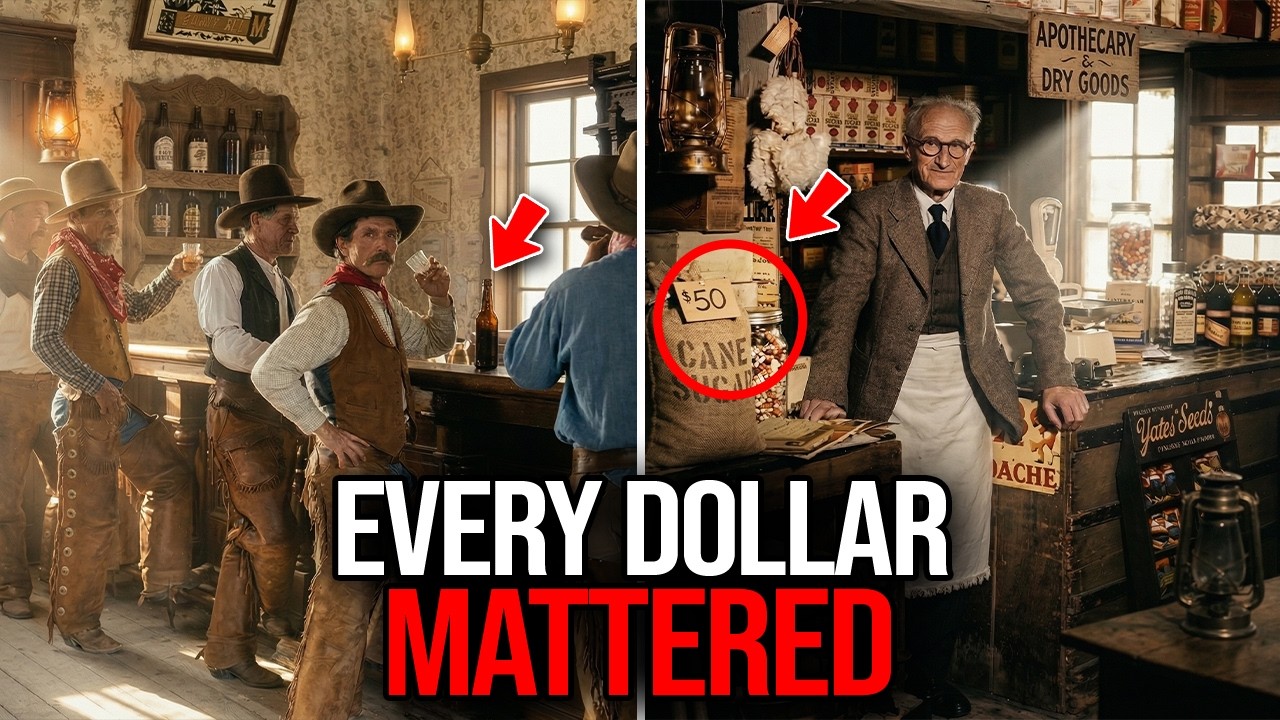
Would he pay with a dime or with a quarter? The difference was ten cents’ worth of whiskey, and it was no small matter. In the soddies and bunkhouses, men went broke over such arithmetic, one drink at a time. There is a classic image that defines the Hollywood version of the Old West: a dusty cowboy walks into a saloon, slaps a single silver coin onto the mahogany bar, and orders a whiskey.
Maybe he tosses a coin on the hotel desk for a room and a hot bath. It suggests a stable, universal dollar that worked the same in Dodge City as it did in New York. The reality was far more chaotic, volatile, and frankly, much harder to survive. If you were transported back to 1876 with a pocket full of paper money, you might find yourself starving because a merchant refused to take your cash.
You might find that a single egg cost the modern equivalent of $90. You would discover a world where a cowboy saddle was worth four times more than the horse he rode, and where the price of a beer depended entirely on what specific coins you held in your hand. The economy of the frontier was not a monolithic marketplace. It was a series of disconnected, predatory micro-economies where geography and logistics dictated the difference between poverty and survival.
To understand the real Old West, you have to look past the gunfights and at the ledger books. To understand what a dollar could buy, you first have to understand how hard it was to earn one. The post-Civil War era was flooded with men looking for work, which drove wages down in settled areas. But out on the frontier, the average wage was a myth because there were distinct economic castes.
The baseline for poverty was the United States Army soldier. A Union private during the Indian Wars was paid $13 a month. That was the standard—a poverty line enforced by the government—and even that $13 was misleading. Soldiers were rarely paid on time.
Regiments in remote outposts like Fort Laramie or Fort Hays often went four, six, or even eight months without seeing the paymaster. This delay created a trap known as the sutler’s debt. Since soldiers had no cash, they had to buy necessities like soap, tobacco, and needles from the post sutler, a civilian merchant with a government monopoly. The sutler charged sky-high prices because he knew the men had no other choice.
When the paymaster finally arrived, the sutler had the first claim on the soldier’s wages. A private might sign for $78 in back pay only to immediately hand over $50 to the merchant, leaving him with pennies to last the next six months. This cycle of debt was a huge reason why desertion rates were so high. Then there was the cowboy.
Hollywood romanticized him as a free agent, but economically, he was a seasonal laborer. His standard wage was $30 a month. While that sounds like double the soldier’s pay, it came with a catch. The work was seasonal.
A cowboy worked the spring roundup and the autumn drive, and he was often unemployed during the winter. A year’s wages usually amounted to only six months of actual pay, meaning he averaged out to $15 a month over the full year. He was effectively in the same economic bracket as the soldier. Compare that to a factory worker in Chicago or Pittsburgh during the same time, who was earning nearly 60% more than a cowboy and 300% more than a soldier, often with much greater safety.
The men who built the West were not doing it for the money, because the money was barely enough to keep them alive. Even if you had the money, you had to worry about what kind of money it was. The United States did not have a unified currency system during this period. There was a currency war happening between the East and the West.
During the Civil War, the Union issued greenbacks, paper money not backed by gold. In the East, this was standard. But in the West, particularly in California, Nevada, and Oregon, merchants rejected it. Westerners, flush with gold from the mines, viewed paper money as suspicious government promises.
They operated a yellowback economy, dealing strictly in gold and silver coins. This created a dual exchange rate. If you arrived in San Francisco with $100 in paper notes, you might find that merchants would only give you $70 or $80 worth of goods for it. A merchant in Sacramento might list a pair of boots for $5 in gold.
If you wanted to pay in paper greenbacks, he would do a mental calculation and charge you $7. 50. This effectively punished anyone arriving from the East who hadn’t converted their savings into hard metal. It was a major reason why Westerners historically developed a deep distrust of banks and paper currency, a sentiment that lingered for generations.
When you did make a purchase, you ran into another problem: the bit system. The frontier economy did not run on the decimal system of 100 cents to the dollar. It ran on the Spanish real, or the bit. A Spanish dollar could be physically chopped into eight pieces, or bits.
One bit was worth 12 and ½ cents. Two bits equaled a quarter. This caused constant friction because the United States did not mint a 12-and-½-cent coin. In a saloon, a glass of cheap whiskey or a beer usually cost one bit.
If you slapped a quarter on the bar, which was two bits, the bartender would give you a dime in change. That means you paid 15 cents for the drink. This was called the long bit. However, if you paid with a dime, some bartenders might accept it, meaning you only paid 10 cents.
That was the short bit. Many upscale saloons would refuse a dime, demanding the higher denomination. Savvy Westerners learned to pay with a quarter to receive the dime, then use that dime for their next purchase where it was accepted. The penny was completely irrelevant.
In many Western territories, the penny was considered trash. Prices were always rounded to the nearest nickel or dime. Copper pennies were often thrown in the mud or refused by merchants entirely. The cost of freighting goods was so high that the economy simply didn’t function at the granular level of a single cent.
We tend to think of the horse as the cowboy’s most valuable possession, but that is backward. Horses were everywhere. You could buy a gentle mustang for $15 to $20. An unbroken colt might cost you $10.
But a saddle? A saddle was a complex piece of manufacturing. It required a hardwood frame, skilled leather tooling, and heavy-duty rigging. A standard Western saddle cost $30 to $40.
A high-quality custom saddle could cost $50 or $60. This means a cowboy was often riding a $15 horse while sitting in a $50 saddle. The saddle was his true property. It was his workbench and his status symbol.
The horse often belonged to the ranch, but the saddle belonged to the man. If a horse died or broke a leg out on the range, the cowboy would unsaddle his horse and walk home carrying the saddle. He would leave the horse for the coyotes, but he would never leave the saddle. This gave rise to the old idiom of the $10 horse and $40 saddle, which described a man with skewed priorities.
The other major expense was firepower. The Winchester Model 1873 is known as the gun that won the West. But when it was introduced, it listed for $50. That represented nearly two months of total wages for a cowboy, or four months for a soldier.
It was a massive capital investment. In settled towns, prices were high but understandable. In boomtowns, however, the laws of economics completely broke down. When gold was discovered in places like Deadwood or the Klondike, thousands of men descended on a remote location that had no local food source.
This created hyperinflation that makes modern price hikes look like a joke. In the Klondike in 1898, a single fresh egg could sell for $3. Adjusted for inflation, that is roughly $90 for one egg. The egg was the ultimate luxury because it was so difficult to transport without breaking.
In Deadwood in 1876, eggs could fetch 50 cents each. The most desperate economic situation occurred in Dawson City during the winter. Scurvy was a deadly scourge in the mining camps because the men lived on a diet of salt pork and beans. They were dying for lack of vitamin C.
Fresh potatoes became more valuable than gold dust. Hospitals in Dawson City charged $10 per day for a treatment that consisted largely of eating raw potatoes. That is about $300 a day in modern money. The potato wasn’t sold as a vegetable.
It was sold as a life-saving drug. A miner might earn $15 a day digging for gold, which sounds like a fortune. But if a meal cost $3 and a bunk cost $5, he was barely breaking even. The people who got rich in the gold rush were rarely the miners.
It was the merchants who sold them the eggs and the potatoes. We also have to look at the trade economy with Native Americans, which reveals a system of massive exploitation. As the beaver hat market collapsed and was replaced by silk, the fur trade shifted to buffalo robes. These were tanned winter hides with the hair left on, used for coats and blankets in the East.
A prime buffalo robe sold in St. Louis for $4 to $6. But the native hunter who procured it didn’t get cash. He received trade goods.
Traders admitted to acquiring robes for about 25 cents’ worth of goods—a cup of glass beads, a few yards of calico cloth, or a cheap knife. This represents a markup of nearly 2,000%. The labor of tanning a robe was immense. It took native women days of scraping, brain tanning, and smoking the hide to make it pliable.
The traders effectively devalued this labor to pennies. By the 1870s, hundreds of thousands of robes were shipped East. This trade didn’t just decimate the buffalo herds. It stripped the ecological wealth of the plains and transferred it to Eastern bank accounts, leaving native populations with consumable goods like sugar and coffee that were gone in a week.
At trading posts like the one run by Lorenzo Hubbell on the Navajo reservation, a different system emerged. The Navajo economy ran on wool. Traders bought wool for 8 to 10 cents a pound and credited the amount to the weaver’s account. When wool was out of season, the Navajo would pawn their silver and turquoise jewelry for credit.
The trader held the item in a vault. If the debt was paid after the next shearing, the item was returned. If not, it became dead pawn and was sold to tourists. Traders also issued their own money: brass or aluminum tokens called seco, stamped with values like 5 cents or $1.
These tokens were only redeemable at that specific trading post, which locked the customer into a closed economic loop. We also have to talk about the gun control tax. We tend to think of the West as a place where everyone carried a six-shooter on their hip. But in cattle towns like Dodge City, Tombstone, and Abilene, carrying a weapon was strictly illegal within city limits.
The town councils wanted to curb violence to encourage business investment. The fines were severe. In Dodge City in 1878, the fine for carrying a concealed weapon or firing a gun in town ranged from $10 to $100. For a cowboy earning $30 a month, getting caught with a gun didn’t just mean a night in jail.
A $100 fine represented more than three months of labor. It was financial ruin. These laws acted as a revenue engine for the towns. The police dockets show steady income from these fines.
Since the cowboys rarely had that kind of cash, they would be put to work on city chain gangs or forced to sell their expensive saddles and horses to pay the court. The legal system effectively criminalized the transient workforce to pay for civic improvements. Frank laid his quarter on the bar. The bartender slid a glass toward him and dropped a dime in change.
Frank pocketed the dime, drank his whiskey, and left the saloon without saying a word. The dime would be his next drink somewhere else, or perhaps part of a 50-cent saddle payment, or maybe the seed of a $50 Winchester. Out on the range, a 15-dollar horse carried a 50-dollar saddle on its back, and a dead horse meant a man walking home under the weight of his livelihood. The Old West was not a land of easy riches.
It was a land of expensive survival. The dollar was a tool, and like any tool in the West, if you didn’t know how to use it, it would break you. Whether it was navigating the short bit at the saloon, paying $90 for an egg to avoid scurvy, or handing over half your pay to the company store, the financial reality of the frontier was a brutal game of math.
