The bases fit together. That was the thing nobody expected. You bought the Allosaurus and put it on a shelf, and that was fine. But then you got the cave bear for your birthday, and when you set it next to the Allosaurus, the bases clicked together like puzzle pieces.
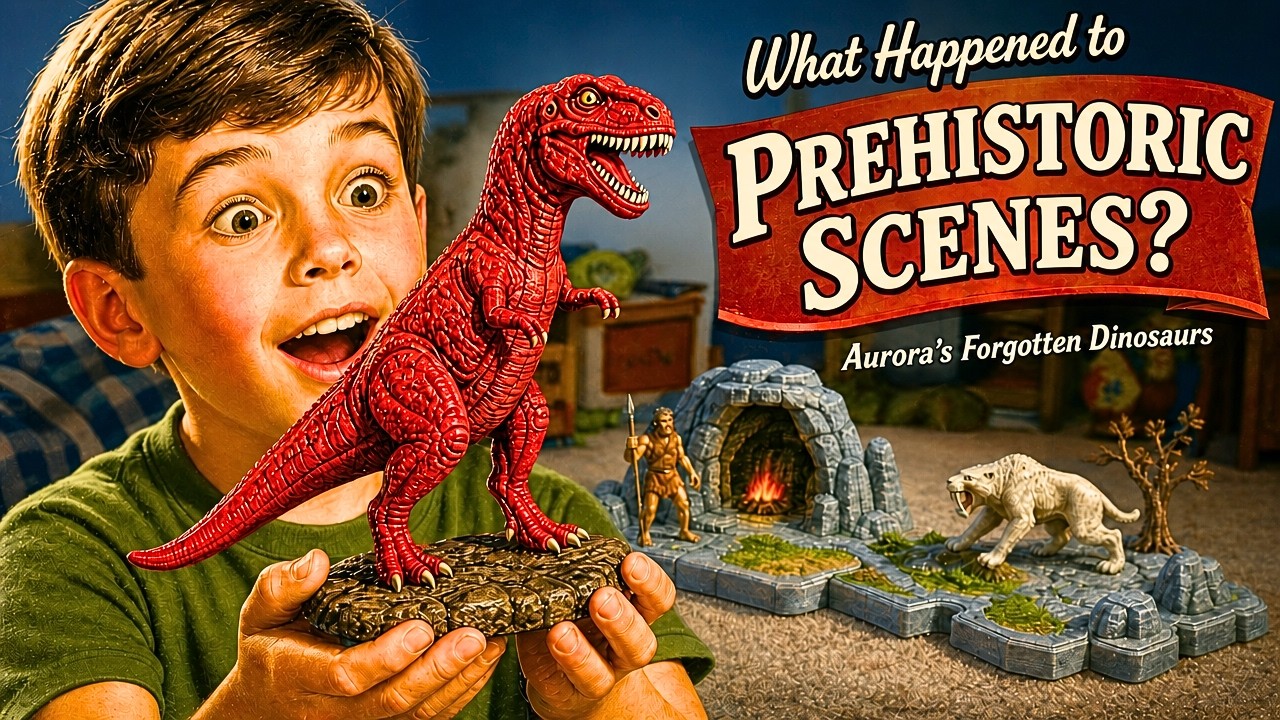
The edges matched, the ground connected, and suddenly you were not looking at two separate model kits on a shelf. You were looking at the beginning of a world. Aurora Prehistoric Scenes came in bright boxes with paintings of dinosaurs and cavemen on the front. Inside were plastic parts in colors so vivid you almost did not need to paint them: green for the Allosaurus, brown for the Neanderthal, gray for the cave bear, white for the saber-tooth tiger.
You snapped them together without glue, no cement, no fumes, no waiting overnight for anything to dry, just plastic clicking into plastic. A satisfying snap told you the leg was in place or the jaw was set or the tail was locked. For a child of seven or eight who did not trust himself with a tube of cement, this was everything. You could build a dinosaur in an afternoon and have it standing on your dresser by dinner.
But it was the bases that brought you back. Every kit came on a sculpted piece of prehistoric ground, rocks, dirt, ferns, bones, and every base had edges shaped to interlock with the bases of other kits. The cave was the centerpiece. You put the cave in the middle of your floor and built outward.
The tar pit connected to one side, the jungle swamp to the other. The Cro-Magnon man stood at the entrance with a spear, the Neanderthal crouched nearby, the cave bear reared up on its hind legs behind them. The pteranodon hung from a string above it all. Every kit made the world bigger.
Every birthday, every Christmas, every report card that earned a trip to the hobby shop, the world grew. By the time you had eight or nine spread across the bedroom floor, you had something no other toy could give you: a complete prehistoric landscape you had built yourself, one kit at a time, over months or years. Your mother stepped around it. Your father told visitors to watch where they walked.
Your little brother was forbidden from entering without permission. The Tyrannosaurus Rex was three feet long. Eighteen inches high, with jaws that opened and closed and teeth that looked like they could actually do damage. When you set it at the edge of your diorama, it towered over everything else, the caveman, the other dinosaurs, even the cave.
It was the crown jewel of the line. If you had one, you were the kid whose bedroom floor was a museum. Other kids came over just to look. In the early 1970s, before Star Wars replaced every obsession with spaceships and lightsabers, dinosaurs ruled the toy aisle, the book section, and the bedroom floors of America.
And Aurora gave you the best dinosaurs anyone had ever made. Christmas 1972, or maybe 1973, you got three kits at once: the cave, the Neanderthal man, and the saber-tooth tiger. You went straight to the floor and started building. By the time the football game came on television, all three stood in a row on the carpet with their bases locked together.
Your father said something about how when he was a kid, they just had tin soldiers, and you thought that was the saddest thing you had ever heard. The kid next door had the woolly mammoth. You did not. This was a problem.
It was the biggest animal in the line next to the T-Rex, a massive gray beast with curved tusks and fur you could almost feel just by looking at the plastic. Every time you went to his house, there it was, standing on his dresser. You needed that mammoth. You negotiated with your mother, offered to mow the lawn, offered to clean the garage.
And when you finally got it, set it on the base next to your cave bear and watched it lock into place, the world on your floor was complete in a way it had not been before. The mammoth was the piece that filled the gap, the piece that made the diorama feel like a real place instead of a collection of kits. What most people did not know was how these kits came to exist. Aurora Plastics Corporation, the company that made the famous monster kits and the slot cars that took over every basement in America, had just survived the worst scandal in toy history.
In 1971, Aurora released a line called Monster Scenes. These were not the classic Frankenstein and Dracula kits. These had a torture chamber, a pendulum, a figure called the victim. Aurora marketed them as rated X for excitement and aimed them at children.
The National Organization for Women protested outside the headquarters. Rowan and Martin’s Laugh-In made jokes about them on national television. The governor of California, Ronald Reagan, signed a law banning them. After nine months, Aurora recalled the entire line.
Remaining stock was shipped to Canada and sold for a quarter apiece. Aurora needed to make things right. What they came up with was Prehistoric Scenes. No torture, no victims, no controversy, just dinosaurs and cavemen and a world that was 65 million years old and safe for a child’s imagination.
It was redemption, the company saying, we hear you, here are dinosaurs instead. It worked. Kids loved them. Parents trusted them.
The hobby shop put them front and center, right where the Monster Scenes had been. The hobby shop itself was part of the experience. The wall of boxes behind the counter, the model kits stacked three rows high, the Aurora boxes with those incredible paintings on the front: the Allosaurus lunging at a caveman, the woolly mammoth charging through snow, the cave bear with its mouth open ready to fight. You stood in that aisle and planned your next purchase like a general planning a campaign.
Do I get the saber-tooth tiger or the Styracosaurus? Which one connects to the base I already have? The man behind the counter knew, because he had sold a hundred of them to a hundred kids just like you. He understood this was not just a model kit.
It was a piece of a world you were building. Some built them with fathers at the Sunday afternoon kitchen table, the instructions spread out between them, dad snapping the larger pieces while the child handled the small ones. Some built them with uncles, grandfathers, older brothers. One man wrote that his uncle, not known for generosity, bought six kits at once for his birthday and then sat down and helped assemble two of them.
Some built them alone, bedroom door closed, radio on, the snap of plastic pieces one after another, building something from nothing. The colors were part of it. Aurora molded these kits in plastic so bright it almost glowed. The Allosaurus was a green you could still see with your eyes closed.
The cave bear was brown like coffee. The T-Rex was red, not subtle or realistic, but a Saturday morning cartoon red that told you this animal was dangerous and magnificent and absolutely the most important thing on your bedroom floor. You could paint them, and some kids did, careful coats of enamel trying to make the Neanderthal skin look real. But most did not bother.
The colors Aurora chose were loud and proud and unapologetic, and they made the diorama look like a world that was alive. And then they were gone. Not all at once. The oil crisis of 1973 made polystyrene, the plastic Aurora used for every kit, expensive and hard to get.
Profit margins collapsed. Aurora’s owner, Nabisco, had never fully recovered from the Monster Scenes embarrassment and was looking for an exit. By 1977, they sold Aurora’s kit business to Monogram, and the Prehistoric Scenes line disappeared from the hobby shop shelves. No announcement, no farewell.
The boxes just were not there anymore, and the space they left was filled with something else. Star Wars models, electronic games, things that beeped and flashed and ran on batteries. George Lucas had replaced the Mesozoic era with the Galactic Empire, and every kid in America followed him there. If you still have yours, you know what happened to them.
The bases are chipped, the snap fits are loose, the pteranodon lost a wing sometime in the early eighties, and you never found it. The T-Rex has a crack down his jaw from the time your little brother finally got into your room without permission. The Cro-Magnon man’s spear broke off decades ago. They are in a box somewhere.
The attic, the garage, a storage unit you keep meaning to clean out. Some were burned on a summer afternoon because you wanted to see what melting plastic looked like. You were eleven. It seemed like a good idea at the time.
A few years ago, a company called Atlantis began reissuing some of the old Aurora Prehistoric Scenes from the original molds. The same steel tools that stamped out your childhood cave bear in 1972 were stamping out new ones in 2023. You could buy a brand new kit in a box with the Aurora logo on it, build it at your kitchen table, and feel the same snap-fit click you felt fifty years ago. Some did, sitting with grandchildren and building a cave bear together, halfway through having to stop because the click of the plastic puts you right back in that bedroom, right back on that floor.
The floor is still in your memory. The bedroom carpet, the bases all connected, the dinosaurs standing in their places, the cave in the center with the firelight painted inside. A world built with your own hands, one kit at a time, one birthday at a time, one trip to the hobby shop at a time. No batteries, no screen, no instructions on how to play.
Just 65 million years of history laid out on the floor of a bedroom in 1973, and a boy who knew every creature by name. Aurora tried to sell children something terrible. America said no. So they gave us dinosaurs instead.
And for a few years before the company died and the hobby shop closed and Star Wars changed everything, those dinosaurs were enough. More than enough. They were a world.
