In the late autumn of 1854, in a tavern room in a small valley town no map would ever record, a surveyor sat facing a man in grey. The stranger had entered without a sound, walked the length of the public room without a footfall on the boards, and stopped at the surveyor’s table. He was perhaps fifty, his hair a pale grey, his face slack in a way that suggested it had not moved in a very long time. He opened his mouth.
“Tell Bessie I didn’t mean what I said to her on the porch that day,” the man said, in a low, ordinary voice. “Tell her I was tired. Tell her I loved her all along. ”
He closed his eyes and stood there, waiting.
The surveyor—Ambrose Ketring, thirty-eight, six feet two, a land surveyor who had mapped eleven counties across three states—sat perfectly still. He had been told what to do. He had been told, more than once, what happened to men who answered in words. The man in grey had been dead a long time.
The surveyor understood that without being told. He understood, too, that Bessie had been dead a long time, and that the message would never reach her. He understood that the message was not for Bessie at all. It was a sentence the man had needed to say aloud to another living soul, once, before the thing that held him in the woods let him go.
Ambrose did not answer with words. He placed his open hand flat on the table between them. The man in grey opened his eyes. He looked at the hand.
He looked at Ambrose’s face. Then he did something that, in seventy years of the book, no one had ever recorded a silent one doing. He smiled—a small, tired smile, the smile of a man who has walked an impossibly long road and finally sees the fence. He nodded once.
Then he turned, walked back across the room, opened the front door, closed it softly behind him, and was gone. Upstairs, in that same moment, Absalom Marshbanks died. His wife Ferely was holding his hand. She said later that he opened his eyes in his last breath and looked past her toward the door, as if he had seen someone standing there.
She said he smiled a little. His last word was “Oh. ” As if he had just remembered something he had meant to do long ago. Ambrose Ketring sat alone in the public room with his hand still flat on the table, understanding that something had passed between him and that silence, and not knowing yet what it was, or what it would cost him, or whether it had just bought him the rest of his life.
The place was called Harrow Crossing. It sat in the mountains of eastern Kentucky, on no map that has ever been drawn. It had a name once. For years, the people who lived there put that name on their letters, on the small painted board above the general store, and on the letterhead of the little four-page newspaper the county clerk had tried to keep alive.
Then, in the winter of 1854, the name faded quietly, the way certain words fade when no one wants to be the one to speak them aloud. Ambrose Ketring rode into Harrow Crossing on Saturday, October 8, leading a packhorse with his instruments wrapped in oilcloth and his good suit folded in a leather satchel he had bought in Baltimore for the trip. The company that had hired him was called Elk Horn and Big Sandy Turnpike, and they intended to cut a serviceable road through a certain pass east of the settlement so timber and iron could be hauled down out of those mountains without breaking wagon axles between the high ground and the river. He had six weeks to survey the ground, fix the angles, mark the trees, and deliver a set of drawings the office in Frankfort could certify.
He had done this kind of work in eleven counties across three states. By every standard of his profession, he was a precise man. He said later, in letters that would survive him, that his first impression of Harrow Crossing was of a town that had forgotten how to grow. There were no more than forty houses along the two crooked streets, each one old but well kept, as if the residents had long ago decided against any new building and chosen instead to keep the old ones from falling down.
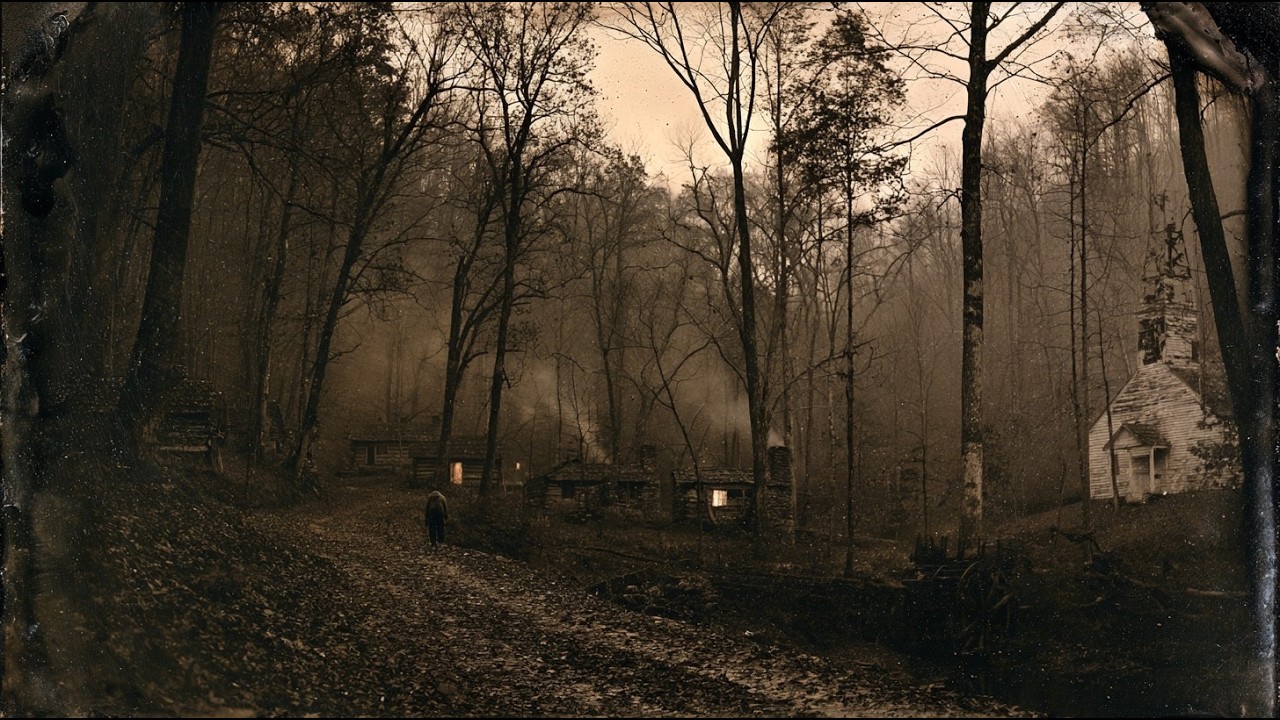
The general store sat where the two streets met. The tavern faced it from across the way. The church stood a little higher on the slope, painted white, with a small graveyard behind it and a bell that rang the hour in a soft, slightly cracked tone. There was a mill on the creek at the north end, still turning, and a smokehouse behind the tavern.
Beyond all of it, the mountain rose so close that a man could not walk fifteen minutes in any direction from the store without finding himself under the trees. He took a room at Marchbanks’ tavern. The innkeeper was Absalom Marchbanks, sixty-one, broad-chested, slow of gait, with a beard the color of old rope and pale eyes that looked bleached. His wife Ferely was three years younger and much smaller, fine-boned, aging handsomely, and given to tucking her lower lip under her upper when she was lost in thought.
They kept four upstairs rooms for travelers and a public room downstairs where the fire was always lit, even in September, because the wind came down off the high ground in the evening and brought cold into the boards. Ambrose chose the room at the back, overlooking the yard and the smokehouse and the beginning of the forest. He put his instruments in the corner. He laid his good suit over the chair.
He put his watch on the side table by the bed. Then he went downstairs to eat. Six men were in the public room that first night. Two were wagoners passing through with a load of salt for a depot in Prestonsburg.
Three were locals sitting at the long table by the fire, playing checkers with the slow deliberation of men who measure time by the glass rather than the hour. The sixth was a minister, a lean man named Cassandra Renshaw, fifty-two, in a plain black coat and a white collar. Ambrose introduced himself to the room, as was his habit—his name, his profession, his employer, his purpose. The wagoners nodded and returned to their food.
The three locals raised their heads, looked at one another, then looked at the board. The minister watched Ambrose for a long, slow moment and said, in a polite but not warm voice, “Welcome to Harrow Crossing, Mr. Ketring. I hope your work here is quick.
”
A silence followed, the kind that has a physical weight. Ferely brought his supper—a stew, cornbread, a small cup of buttermilk. She set it down, and instead of leaving, stood by the table with her hands folded on her apron and said something softly, almost apologetically. “If you’d take advice from an old woman, you’ll do your walking by day and be back inside these walls when the light goes.
”
Ambrose looked up. “And why is that? ”
She tucked her lower lip under her upper. “Because in this valley, dusk is not what it is in other valleys.
And there’s no need for a man to learn that the hard way. ” Then she was gone. He ate his stew. It was very good.
He looked at the checkers players and at the minister, and the minister looked back and did not smile. He slept well that night. He had been in strange towns before. He did not pay it much mind.
He would think about it a great deal later. On Sunday, October 9, he did not work, respecting the town’s custom. Instead, he walked. He walked to the mill and back.
He went up the slope past the church. He followed the creek where it entered the town from the north, and in his notebook recorded an observation about how the water settled against the rocks in certain deep places, even where the current ran strong. He met a man named Otway Sprinkle at the blacksmith shop, forty-five, broad-shouldered, cheerful, missing a lower tooth, and talkative about the weather and the price of iron. He met a woman named Beulah Greer, sixty, at the general store, who sold him a small tin of tobacco and asked him three times to confirm his name and his business.
He met an old man named Ferny Dollish, seventy-one, sitting on a stump outside his door in a warm patch of sun, who raised his hand and said, “You must be the road man they been expecting. ” Ambrose said he supposed so. Old Ferny nodded and said, “Walk small steps, son. Not slow.
Small. ” Then he went back to his whittling. Ambrose took this as strange advice. He wrote it in his notebook because he wrote most strange things there.
Then he returned to the tavern, ate his supper, and went to bed. On October 10 he began his work in earnest. He went out east along the old wagon track that followed the hollow creek up to the high ground. He set his first stake at the mile mark where the creek took its first sharp bend.
He worked with his assistant, a young man named Renn Corbett, hired locally to hold the far end of the chain and carry the rod. Renn was twenty-two, quiet, slender, with pale eyes like his uncle Absalom and a way of moving through brush that did not disturb the leaves. Ambrose took to him. They worked all day and made good progress.
When the sun went behind the western hills, Renn stopped, looped the chain over his shoulder, and said, “We need to head back now, Mr. Ketring. ”
Ambrose looked at the sky. “We still have an hour of light.
”
“No, sir,” Renn said. “We don’t. In this valley, it gets dark early because of the hills, and you don’t want to be past the third bend of the creek when it does. ”
Ambrose looked at him.
“Why not? ”
Renn only said, “Please, sir. ”
Ambrose, who had learned in eleven counties to respect the man who knows the ground, packed his tools and turned back. That night at the tavern he asked Absalom Marchbanks directly what was special about the third bend of Hollow Creek.
Absalom was drawing beer for the two wagoners, who had passed back through on their return trip. He did not look up from the tap. “After the third bend, the ground changes,” he said. “The trees change.
The air changes. And after certain hours, there are folk who wander there who don’t like to be seen. ”
“What folk? ” Ambrose asked.
Absalom set the beer down in front of the second wagoner and wiped his hands on his apron. “The ones who don’t speak,” he said, and moved along the bar to the next customer. Ambrose understood, as clearly as if it had been written on the boards, that the conversation was closed. He waited until Ferely came to gather his empty plate.
Low, he asked, “Ma’am, what did your husband mean, the ones who don’t speak? ”
Ferely set his plate on her tray and looked at him a moment longer than a polite woman looks at a boarder. “Mr. Ketring, this town has kept old traditions regarding a certain matter, and one of those traditions is that we do not speak of them under this roof after dark.
If you come sit with me in the kitchen tomorrow morning while I make biscuits, I will tell you what I can. ”
He thanked her. He went upstairs. He lay awake a long while listening to the wind in the eaves of the smokehouse.
In the morning he came down early, and Ferely was already at the kitchen table with flour, buttermilk, and a lump of lard in front of her. She nodded. “Close the door, please, Mr. Ketring.
” He closed it. He sat across from her. She began to work the biscuit dough. “They call them the Silent Folk,” she said, without raising her eyes.
“The Silent Folk have been in this valley since before my grandfather’s time, and my grandfather was born in 1769. They live in that hollow behind the end of the road, in a place none of us dare go, above what my father used to call the drag. That’s where our town got its name. There’s an old logging road up there, cut by an ox-drawn drag more than a hundred years before there were saws for that kind of work.
The ruts of that road are still in the ground, though nothing has passed over it in longer than any of us have been alive. The Silent Folk live above the drag. ”
She paused, folding the dough over on itself. “They don’t speak,” she said.
“That’s the first thing you should know. They don’t speak to us and they don’t speak to each other. Not one word. Not a greeting, not a whisper, not a hum, not a curse.
They move through the woods at dusk and dawn, and if you see one you’ll know them because they make no sound at all. Not even the rustle of clothing a person makes when they walk. But that’s not the story. The story is what they do when they finally do speak.
”
Ambrose waited. Ferely pressed the dough flat with her palm. “They only speak to a person who is going to die that night,” she said. “That’s all there is to it.
They come out of the trees at dusk. They walk to that person’s door. They stand on the porch. They wait for the person to come out or open the window.
And they say one thing. One sentence. Then they turn and go back to the hollow and don’t speak another word until it’s the next person’s turn. That person the Silent One spoke to—they die before sunrise.
Every time. ”
She was quiet for a moment, folding the dough. “My grandfather could count every visit that happened in his life. His father could count every visit in his.
We keep a book. My husband has the book. ”
Ambrose sat very still. “What do they say?
”
Ferely looked at him then, for the first time. Her pale eyes were wet—not quite tears, but the shine that comes into old eyes when they have looked at a hard thing for a long time. “They say different things to different people,” she said. “Sometimes it’s a warning.
Sometimes it’s comfort. Sometimes it’s something the dying person did long ago and never told anyone. And the Silent One says it plainly, like a name read off a page. Some of the sentences my grandfather wrote down are so gentle they could be a hymn.
And some are so cold I will not repeat them in this kitchen. ”
She began cutting the biscuits, round shapes onto the floured board. “They don’t choose who dies,” she said. “That’s important.
They don’t cause it. They only know—the way an old dog knows a storm is coming. They come and they say what they have. And what has always been wondered in this valley, and never answered, is why they do it, and where they were before they went silent, and what keeps them from saying one word to any living soul who is not about to leave this earth.
”
Ambrose thanked her. “Just one more question,” he said. “What harm could come to me from walking my line up beside the creek in daylight? ”
Ferely set the biscuits on the tray.
“In daylight, no harm,” she said. “The Silent Folk are where they go when the sun rises, and no one has ever discovered where that is. It’s the coming back that catches men, Mr. Ketring.
” She pointed a flour-covered finger at him. “If you feel a change in the air around you and you’ve passed the third bend, turn. Turn that very moment, and walk back. Not later.
Not ten steps later. That very moment. ”
He said he would. He meant it.
He went out and worked. And here is something about Ambrose Ketring that his letters make clear: he believed her. He was not a superstitious man. He was a man of angles and mathematics and printed tables.
But he had walked eleven counties and learned that every valley has its story, and the wise surveyor does not mock any of them aloud, because sometimes the story is the map if you know how to read it. He believed her about the Silent Folk the way he believed the old miners who told him where the ground was weak. He kept in his mind the picture of the third bend and that change in the air. He worked five more days at the creek and saw and heard nothing strange.
On the fifth night, Ferny Dollish died. Ambrose came back to the tavern at dusk on October 14, tired, mud on his boots, a good day’s work in his notebook. Ferely met him at the door. Her face was pale and drawn.
“Mr. Ketring,” she said. “Old Ferny passed last night. ”
Ambrose had liked the old man.
“I’m sorry to hear that,” he said. “But he was old. Was it his heart? ”
Ferely shook her head slowly.
“His heart was fine,” she said. He was found sitting in his chair with the window open and a candle burning beside him, and a look on his face his sister could not wipe from her memory. And Ellery Vaughn, coming home late by the road, saw someone standing on Ferny’s porch at last light. Standing there talking.
Not loud. Talking softly, the way you talk to a friend. And when Ellery got close enough to see who it was, the porch was empty, and Ferny’s door was still closed. Ambrose set his tools down slowly.
“One of them,” he said. Ferely nodded once. She did not say the word. “Come sit at your table,” she said.
“I’ll bring you something. ”
That was the first death he witnessed with his full understanding of what it meant. It would not be the last. The town buried Ferny on the sixteenth.
Ambrose went. The whole town went. The minister, Cassandra Renshaw, gave a short, careful sermon in which she did not use the word silent once, but used the word waiting more often than seemed accidental. Afterward, at the tavern, Ambrose stopped Absalom Marchbanks in the hallway.
“Sir,” he said, “may I see the book? ”
Absalom looked at him a long moment. “Why? ”
“Because I am a man who trusts what he can measure,” Ambrose said, “and I was told a thing tonight I cannot measure, and I want to see if it has a shape when it’s written out whole on paper.
”
Absalom said, “Come with me. ” He led Ambrose to a small room off the kitchen, opened a chest at the foot of a bed, and brought out a dark leather-bound book, thick as a family Bible, with a small brass clasp polished by use to a soft gold. He set it on the table. “This is the Book of Visits,” he said.
“It dates to 1782. My wife’s family has kept it. I keep it now. You may look.
You may not copy from it. You may not take it out of this room. ”
Ambrose sat and opened it. Each entry was short.
Each had the same shape—a date, a name, a place, one sentence quoted without quotation marks, underlined only with a thin brown line, and sometimes a note beneath in a different hand: died before dawn, or died at cockcrow, or died at the third hour of the night. He read for a long time. He did not speak. Absalom stood at the door watching him.
Some sentences were as Ferely had described—some gentle, some horrifying. He read one from 1817 in which the silent one said only: “Your father waited for you a long time at the well, and no one told him you had gone. ” He read one from 1839: “I forgive you about the miller. It wasn’t your fault, and I always knew it.
” He read one from 1844: “Don’t open your eyes when you hear the footsteps. ” Don’t open your eyes. Don’t open your eyes. That one was written three times, once for each repetition.
There were more than two hundred entries—two hundred visits, two hundred adults over seventy-two years in a town that had never been larger than forty houses. He closed the book. “Thank you,” he said. “Don’t read it again,” Absalom said.
“Once is enough for any man. And you have your work to do. ”
Ambrose went to his room and sat on the edge of the bed a long time in the dark. He continued his work.
A weaker man would have packed his tools and gone south the next morning. But Ambrose stayed. He had a contract and a schedule. He also, as his letters make plain, wanted to see.
He wanted to see one of them. He was afraid of it. He was also curious in the way a man who has spent his life measuring the unmeasurable becomes curious about the one thing that resists measurement. So he stayed.
On October 17 he worked the line up to the third bend. He set his stakes at the second bend and did not pass the third. Renn Corbett watched him carefully, the way you watch a man on a ladder. When they turned to go home, Ambrose said aloud, mostly to himself, and Renn heard it: “I’d sure like to see one of them from a safe place.
”
Renn was quiet for a long while as they walked. Then he said, “Sir, I don’t think there is a safe place to see one of them from. ” He paused. “My mother’s brother saw one from twenty paces once, across a pasture.
He was fine that night and the next day and the day after. He was fine for eleven years. Then one morning he sat down to his breakfast and never got up again. The doctor said his heart stopped.
But my mother knew the truth. She said the mountain had been keeping his name on a list all those years. She said it does that. ”
Ambrose thought about this for a long time.
He wrote it in his journal. And he went on with his work. It rained on the eighteenth and nineteenth. He did not go up to the creek.
He sat in the tavern and copied his notes out clean. He talked to the wagoners when they passed through. He talked to the minister, who came for supper and stayed an hour after without once saying the word silent. He met a woman named Amaryllis Peck, forty-one, a widow who ran the small store next to the blacksmith shop.
Without his asking, she told him that her husband had been visited on a rainy November night in 1851, and that the silent one had said only: “The horses in the west field are hungry. ” And that her husband had gone out to check the horses in such rain and had not come back. And that she had found him under the fence in the morning, and the doctor said his neck was broken—could have been a fall, or the horse, or anything else. But she thought about that sentence every night, and she could not decide whether it was a warning, or a lie, or a simple truth.
The horses were hungry. She had checked. She could no longer remember now whether she had fed them that morning. She could not remember.
That was the part that haunted her. On Friday, October 20, Ambrose saw one for the first time. He was walking back to town along the wagon track. It was late afternoon, still an hour of light, and he had quit early because he wanted to review his clean copies by lamplight.
Renn was ahead of him on the road by about twenty paces, carrying the chain. Ambrose was watching Renn’s back, which is why he did not at first see the figure standing between two poplar trees on his right, about forty feet back in the trees. When he did see it, he stopped walking. Renn did not notice and kept going.
The figure was a man, or man-shaped, about Ambrose’s own height. He wore what looked like simple grey clothing a farmer might wear for work, but the clothing had a strange stillness to it, as if it were a photograph of a man rather than a man. His arms hung at his sides, hands down. He was not looking at Ambrose.
He was looking at the wagon track—not at Ambrose specifically, but at the track, as if he were waiting for someone or something to come along it. Ambrose did not move. He did not breathe, or so he wrote later. He stood in the road and watched the figure watch the track, and the figure did not move at all.
Not even a blink. Not even a shift of weight from one foot to the other. Ambrose looked long enough to see that the figure’s mouth was slightly open, the way a man opens his mouth when he is about to speak but has not yet decided with which word to begin. Then Renn called from ahead: “Sir, are you coming?
” Ambrose turned his head toward the sound. When he turned back, the figure was gone. It had not run. It had walked, with its usual gait.
Ambrose did not tell Renn anything. He reached the tavern. He went upstairs to his room. He sat on the edge of his bed and noticed that his hands were trembling.
He placed them flat on his knees and forced them still. He sat there until the trembling stopped, then went down to supper and did not tell Ferely either. He wrote it in his notebook that night—the height, the clothing, the stillness, the open mouth. He wrote a small note at the bottom of the page: “Seen about half a mile from the town limits on the west side of the wagon road at approximately half past four in the afternoon, in full daylight.
” He underlined in full daylight. He thought about what Ferely had said about the Silent Folk being where they go when the sun rises, and how no one had ever discovered where that was. He thought about how Ferely was either wrong or the rules were changing. Neither thought was comfortable.
The next day was the twenty-first. He worked. Nothing happened. The day after that was the twenty-second.
He worked. Nothing happened. On the twenty-third, Amaryllis Peck died. Otway Sprinkle found her in the yard behind her house in the early morning, sitting on the little bench she used to hang laundry, a wooden clothespin still in her hand.
Her eyes were closed. Her face was calm. The wet sheet she had been about to hang was folded carefully in her lap. The doctor came over from the neighboring town, examined her, said her heart.
Otway Sprinkle told Ambrose quietly, over a beer at noon, that Ellery Vaughn had seen a person standing at the back gate of Amaryllis’s house the previous evening, standing there with the last of the daylight on its face, and that Ellery had turned and gone home by another road because he had seen enough of that in his life. Ambrose did not go to the funeral. He had a fever. It came on him in the afternoon and lasted two days.
Ferely brought him tea and said little. When it had passed, on the twenty-sixth, he was thinner and had a cough. He returned to work on the twenty-seventh. He was not the same.
His letters home changed. His wife Elmira, who kept every letter and is the reason we know what we know, wrote later that she read those letters and knew her husband was in trouble long before he wrote the word trouble. In a letter of the twenty-eighth, he asked her whether she remembered a picnic they had taken along the Patapsco River four years before, and whether she remembered a certain wooden bridge they had crossed. She wrote back that she remembered.
She wrote that they had crossed it together, and that it had been a beautiful afternoon, and that she did not understand why he asked. He did not answer her question. Instead, in a letter of the thirtieth, he wrote that he was fine, that the work was going well, that she should not worry. She worried.
On October 31, he went farther up the creek than he had ever been. He did not mean to. That was what he wrote. He was following a line of chestnut oaks he thought would bring him to the road more directly than the old track.
And so he left the wagon road and went into the woods, and the ground was easy, the leaves fallen, the light good. He walked and walked and did not check his compass enough because the day was so bright and the trees were spaced so evenly. When he stopped and looked around, he was in a place he did not recognize. The trees around him were larger than the trees along the creek.
They were older. They stood farther apart from one another. There was no underbrush between them at all. The ground was smooth and soft, the leaves deep brown and level, as if no one had walked on them in years.
And yet no branch had been allowed to fall on them either. He stood in the middle of this place and felt what Ferely had told him he might feel. He felt a change in the air. It was not quite cold.
It was still. Too still. The kind of stillness that fills a room after everyone in it has stopped talking mid-sentence and turned to look at the door. He remembered her warning.
He turned. He did not run. He walked fast and steady, back the way he had come. He counted his steps.
He checked his compass twice. He came out on the wagon track a quarter mile above the third bend. Above the third bend. He stood on the track and realized he had crossed the drag without meaning to.
He walked home. He told no one. That night at supper, Ferely looked at him and said softly, so the other tables could not hear, “Mr. Ketring.
Did something happen today? ”
“No,” he said. “Are you sure? ”
“Yes.
”
She looked at him a long time. “Well,” she said. She did not believe him. He knew she did not believe him.
He went to bed. He slept badly. He dreamed of the man standing between the poplars. But in the dream the man was closer, standing at the edge of the room, and his mouth was open wider, as if the word he was trying to say was nearly out.
In the morning, Ambrose felt something in his throat. It was not a pain. Not the start of a cold. It was something else.
It felt like there was a word at the back of his tongue that he could not remember and could not swallow. He tried to say his own name aloud in front of the mirror. He could. His voice was normal.
He tried to recite the alphabet. He could. He drank a glass of water. The thing in his throat did not go away.
He went out to work. He worked. He spoke little. Renn noticed and said nothing, because Renn was that kind of man.
In the evening they walked back, and Ambrose felt the thing again. The word, if it was a word, now seemed to have a shape—not sharp, but rounded, as if a small smooth stone had been slipped under his tongue while he was not paying attention. After supper, he went to Ferely in the kitchen. He closed the door.
“Ma’am,” he said. “Sit down, Mr. Ketring,” she said. She said it before he had done anything but stand in the doorway.
He sat. “Tell me,” she said. He told her. He told her about the place behind the poplars where the trees stood too evenly.
He told her about the stillness. He told her about the shape under his tongue. She listened with her hands clasped on the table. When he finished, she rose and poured him a small glass of cider.
She set it in front of him. “Drink this slowly,” she said. He drank. “Mr.
Ketring,” she said, “in the Book of Visits, over the seventy-two years my family has kept it, there are seventeen entries for a person from this town who went up and crossed the drag and then came back. And every one of those seventeen was visited by one of the Silent within the year. And every one of those seventeen died on the night of the visit. ” She said, “I’m not telling you this to frighten you.
I’m telling you because the seventeenth was my sister, and I would rather there not be an eighteenth if it can be avoided. ”
Ambrose said, “Is there any remedy? ”
Ferely was silent for a long time. She said there was one thing that had been tried.
She said, “The man who will visit you—when he comes, he will say one sentence to you. Every adult in this valley knows you must not answer. Answering is worse. Answering fixes the thing in place.
” She said, “But there is a story from my grandmother that a man once answered. Not with words. With a question. He said, Why?
That was all. And according to the story, the Silent One closed his mouth and turned and walked away. And the man lived until morning, and then the next morning, and then a year after that. And when he died, on an ordinary afternoon in his fifty-eighth year, he was found sitting at his kitchen table, his mouth open as if he was about to say something—but he never said it.
”
Ambrose said, “Why don’t we answer with words? ”
“Because the story tells us that the man who answers with words joins them,” Ferely said. “He does not die that night. He goes up to the hollow and never comes back, for as long as any living soul remembers.
And when he does come back, he comes back to stand on someone’s porch at dusk. ” She looked at him. “Do you feel a word in your mouth now? ”
He nodded.
She said, “That is what happens to the ones who join them. They carry their last words for a long time, and they cannot say them until they stand at the door of another dying person and get rid of those words. ” She said, “I don’t know what this is. I don’t know if it is a curse or a kind of grace.
But I know that no one in this valley, in living memory, has stood on a porch at dusk, said their sentence, and then left that porch a free man. ” She said, “They die that night, Mr. Ketring. The Silent One and the visited one—both of them, the same night.
That is the pattern written in the book. ”
She said, “I don’t know why we have not told you this before. I suppose we did not want to make it real. ”
Ambrose said, “Are you telling me that everyone who comes to my door has been carrying their words for years, and will die that night as well?
”
“Yes,” Ferely said. “That is what I am telling you. ” She said, “And I am telling you because you have crossed. In a few days or weeks you will begin to feel that shape in your mouth grow heavier, and your voice come and go.
And then you will know that a night is coming when your words will be gathered, and you will walk a road one way or the other, and you will stand on a porch you do not know, and a person you have never met will open a window, and you will say what you have been carrying, and you will both be gone before cockcrow. ”
Ambrose sat still. “What will I say? ” he asked.
Ferely shook her head. “No one knows his words until he stands on the porch,” she said. “That’s the mercy in it. I would tell you if I knew.
”
He sat with her a long time. Then he went upstairs and wrote a letter to his wife that he never sent. It was kept. It is short.
It begins: “My dearest Elmira. If you are reading this, I have done something I did not intend to do, and I want you to know that it was carelessness and not choice, and that I have loved you as I have loved you every day since that afternoon when you put your hand on my sleeve on your father’s porch. ” It ends: “Do not look for me in the mountains. Look for me at your own doorstep on an evening when the light is low and strange.
I do not know if I will come. I hope I do not. ”
He worked five more days. He did not pass the third bend.
He did not go into the woods far from the wagon road. He stayed to the path, counted his steps, and came back before the light failed. He did not tell Renn. He told no one but Ferely.
He wrote ordinary letters to Elmira about the weather and the work. He ate. He slept. He did not sleep well.
On November 5 he saw a second one. This one was in the back yard of the tavern at dusk, standing by the smokehouse. Ambrose was at his window, looked down, and there she was. A woman—he knew it from the shape of the dress and the way the hair was arranged.
She stood exactly where the fence line met the smokehouse wall, her face lifted toward his window. Not toward his face—toward his window generally, as if she were not entirely sure where to look. He stepped back from the glass. When he came forward again, she was gone.
He did not sleep that night. On November 6, old Absalom Marchbanks caught a chill from the wet weather and took a fever. By evening the doctor from the next town said his lungs were filling. By midnight it was plain he would not last until dawn.
Ferely sat with him. Renn sat with her. Ambrose sat in the public room below because he did not know what else to do. He heard the small sounds a house makes when someone is dying in it.
The kettle over a low fire. The scrape of a chair being put back. The constant low voice of a woman talking to her husband. He heard nothing else.
He was about to get up and go to his room when the front door of the tavern opened and closed, very softly. A man came in. Ambrose looked up. It was not a local.
It was a man in simple grey clothing, wrapped in stillness, his mouth slightly open, looking directly at Ambrose from the door. Ambrose did not move. The man walked across the public room. His feet made no sound on the boards.
He stopped at Ambrose’s table. Ambrose saw now that he was in his fifties—or perhaps the age of a man who had been in his fifties when the thing happened to him. His hair was pale grey. His eyes were pale grey.
His face had the softness of a face that had not moved in a long time. He stood before Ambrose. He opened his mouth. And Ambrose, in the moment that followed, remembered everything Ferely had told him.
Do not answer in words. Answer with a question if you must answer at all, but do not answer with words. He also remembered something she had not told him. If this man was here, he was carrying his last sentence for years, perhaps decades.
Ambrose looked at the man’s face and saw what he had not been able to see between the poplars or in the yard. He saw the exhaustion. The kind a man carries when he has stood alone in a small room for a very long time and finally hears footsteps in the hall. The man closed his eyes.
He opened them. And he said his sentence. Then he closed his eyes and stood there, waiting, as if he had finished what he had come to do and now only waited for whatever came next. Ambrose sat still.
He did not answer with words. But in the space of a single long breath, he understood something. The message had never been for Bessie. It had been for the man himself.
It was the sentence he had needed to say aloud to another human being, once, before whatever had held him in the woods would let him go. And Ambrose did what he did without deciding to do it—the way a man reaches out to steady a neighbor who has stumbled. He placed his open hand flat on the table between them. The man opened his eyes.
He looked at Ambrose’s hand. He looked at Ambrose’s face. And he did something no one in seventy years of the book had ever seen a Silent One do. He smiled.
It was a faint smile. It was tired. It was the smile of a man who has walked too far and has finally seen the fence. He did not sit.
He did not raise his hand. He nodded once. Then he turned, walked back across the room, opened the front door, closed it softly behind him, and was gone. In that same moment upstairs, Absalom Marchbanks died.
Ambrose never knew for certain what he had done in that room, whether he had interrupted something that was meant to happen or finished something that should have ended long ago. The shape under his tongue, he wrote, seemed smaller after that night. He thought it had begun, very slowly, to shrink. He was not sure.
He did not know if he would come home. He said he would come home as soon as the road company let him go. He did come home. He left Harrow Crossing on November 9, having handed his notes to a young clerk from the road company who had come to replace him.
He traveled south. He reached Baltimore on the twenty-second. He entered his house and hung his hat on the peg by the door, and his wife came into the hall and stopped and looked at him and said, “Oh, darling. ”
He did not answer at first.
He stood in the hall. He put his hand on her shoulder. He opened his mouth. He closed it.
He tried again. Very slowly, he said, “Hello, Elmira. ” That was all. Just her name.
His voice was rough. He cleared his throat. “I have come home. ”
She said afterward that his voice was not quite his own.
It sounded like a man who had been sick for a long time and was just beginning to remember how to use his mouth. She thought he would return to himself. She thought he needed rest. He was tired—so tired.
He slept a great deal in the first week home. He would sit in his chair in the front room with a book open on his lap and not turn a page for hours. When she asked gently what he was thinking, he would look at her and smile and say, “Nothing, dear. Only glad to be here.
”
In the second week he began to talk more. He told her a version of what had happened at Harrow Crossing. Not everything. Enough.
She listened and did not laugh. She was that kind of woman. In the third week he began sleeping well again. In the fourth week he said the thing under his tongue, which had been there when he left the valley, had almost faded.
He was not certain. It was still there—but smaller. He had come to believe that what he had done in the tavern that night had done a kind of work for him too. By offering a small human gesture to a silent man in his final moment, he had taken some weight from his own throat.
He began to think of it as a kindness repaid. He did not know if he was right. He wrote to Ferely in mid-December and asked whether there had been any visits since Absalom’s death. She answered quickly.
No, she said. The town was quiet. And then came the sentence he would keep folded in his book for the rest of his life: “Mr. Ketring, I do not know what you did in that public room the night my husband died, but I have felt the valley change since then, and I want to thank you for whatever it was you did.
” She said, “We are still cautious. We have not gone past the third bend. We have not left the wagon track. But dusk feels like dusk again.
I had forgotten what that was like. ”
Ambrose Ketring lived twenty-nine more years. He never returned to survey the mountains of eastern Kentucky. He did not refuse work there on principle.
He simply did not take a contract in that direction, and no one asked him why. He and Elmira lived in a house. They kept dogs. They read to each other in the evenings.
He worked. He enjoyed excellent health until the last years of his life. He died in Baltimore on March 11, 1883, at the age of sixty-seven. His doctor said his heart.
Elmira said his heart. There is only one thing in the account of his death that does not fit the ordinary story of an old man passing quietly. It is a thing the doctor mentioned in a letter to a colleague a week later—a letter that survived, and which is the reason this story can be told at all. The doctor wrote that on the afternoon of the day Ambrose Ketring died, he was called to the house at three o’clock, and when he arrived, Ambrose was sitting up in bed talking to Elmira—weak, but calm.
The doctor examined him. He gave the usual instructions. He stepped into the hall to speak with Elmira. And as he was leaving, he glanced back into the bedroom and saw, standing in the far corner of the room, a man he had not noticed when he entered.
A man about Ambrose’s age, in simple grey clothing, whose face he did not know, and who was not looking at him—who was looking at Ambrose. The doctor wrote that this man in grey opened his mouth and said one sentence, very softly. The doctor could not hear the words from the hall. He saw Ambrose in the bed close his eyes and nod slowly, once.
And when he looked into the room again a moment later, no one was in the corner. And Elmira, who was still in the hall with him, had seen no one pass. The doctor wrote in the letter that he did not know how to explain it. He wrote that he was setting it down before he could persuade himself otherwise.
And he wrote: “I think what a man hears last is a private thing, and I will not speculate on what was said to Mr. Ketring. But I noticed, in the two hours between that moment and his death, that Mr. Ketring himself moved his mouth from time to time, as if he were practicing a sentence.
As if he were making sure he had it right. ”
Elmira was with him when he died. She said afterward that his last movement was to open his mouth, as if to speak, and then close it, and then smile very faintly, as if he had decided not to say whatever it was. And what are we to make of it?
Did he carry a sentence in his throat for twenty-nine years, and did another silent sentence finally come to relieve him of it? Was he, all along, one of them from that walk between the two even trees—so that the death of Absalom Marchbanks granted him a very long deferral of the visit, but not a full pardon? Or did a tired doctor in Baltimore in 1883 see, in the corner of a room, a shape that was not there? I do not know.
What I know is that Harrow Crossing itself disappeared within a year of Absalom Marchbanks’ funeral. It did not disappear the way towns fade, slowly, over decades, one boarded window at a time. It disappeared the way a candle goes out. In the spring of 1855, the people of that valley gathered what they could carry, left what they could not, and left.
All of them. Ferely Marchbanks went to live with her sister in Lexington. Renn Corbett went west and never wrote home. Cassandra Renshaw took a small parish in eastern Tennessee.
Otway Sprinkle set up his shop in a new town in Ohio. The general store closed its doors. The mill wheel was left to turn in empty water. The small painted sign above the store came down in a high wind in the autumn of 1856, and no one put it back.
Within twenty years, the grass had covered the wagon track and the tavern roof had fallen in. Within fifty, only the outline of the foundations remained under the trees. No printed map shows Harrow Crossing. The road Ambrose was sent to survey was never built.
The Elk Horn and Big Sandy Turnpike company went bankrupt in the panic of 1857, and its papers were lost. If you go looking for that valley today—and I am told a few have gone looking—you will find no road leading to it. But there is a place miles east of a small town in Floyd County where a creek bends sharply three times in a single mile. And on the west bank of that creek, past the third bend, the trees are enormous and very old, and they stand strangely far apart, and the ground between them is smooth and clean, with no undergrowth growing and no birds singing.
That is what a man who walked there in 1912 wrote down. I have read his account. He turned around and went home. He said the air had changed.
He said he did not cross the tree line. He was a sensible man. That is the story of Harrow Crossing, and of a surveyor named Ambrose Ketring, who crossed something without knowing he was crossing it, and of a valley that finally emptied itself because its people grew tired, in the end, of hearing footsteps on their porches at dusk. Consider that for a moment.
And then, if you want to tell me one thing—if a man in simple grey clothing stood on your porch tonight, and opened his mouth to say one sentence, and you had one second to decide—would you listen, or would you close the door? I am not sure I know my own answer. I have thought about it a long time.






