In the autumn of 1210, a woman in her fifties and her grown son were locked in a room in one of King John of England’s castles. Their only food was a sheath of oats and a side of raw bacon. The door was shut behind it, and nobody came back. The woman, Matilda de Briouze, was the wife of a baron who had once been the king’s close companion.
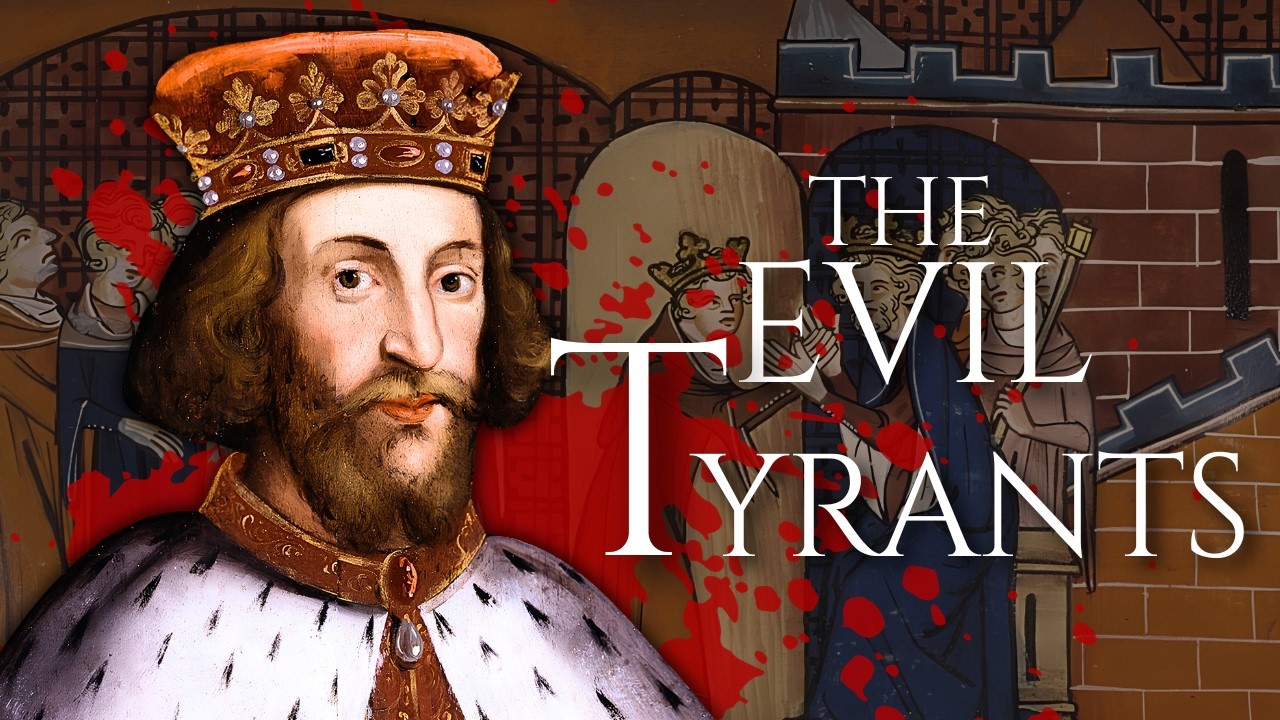
She was there because she had said aloud, in front of the king’s own messengers, that she would not hand her children over to a man who had murdered his nephew. Eleven days later, the door was opened. A French writer moving in the circles of the king’s knights described what the men found. Matilda was dead, sitting upright on the floor between her son’s knees, her back against his chest, her head fallen back.
Her son was dead behind her, leaning on the wall. Her mouth was bloody because, at some point in those eleven days, out of hunger or madness, she had eaten the flesh of his cheeks. John was the first of four men in recorded history who so thoroughly frightened the people around them that the fear outlived them by centuries. The second was an Italian warlord who packed the prisons of Padua and Verona so full that when they were finally emptied, the survivors were counted in the hundreds and the dead in the thousands.
The third was a Byzantine emperor, tall and silver-haired, past sixty, who had a boy strangled with a bowstring and then married the boy’s widow, a French princess of twelve. He died two years later in a way witnessed and recorded in minute detail. The fourth was a lame conqueror out of central Asia who built towers of severed heads from India to the Mediterranean. John came into the world on Christmas Eve, 1166, the fifth son and last child of Henry II and Eleanor of Aquitaine.
Henry had already parceled out his empire among his older sons, and when this final son arrived, the king joked that nothing remained. The nickname Lackland stuck for eight centuries. John was short, thick through the chest, with a reddish beard, and a complexion that changed color when he was angry. He swore constantly, gambled at backgammon, took baths more often than most kings, and liked hunting, jewels, fine clothes, and other men’s wives.
By his middle thirties, he had also developed a taste for watching people who had crossed him die slowly. His first serious mistake came in the summer of 1200, and it was about a girl. John married Isabella of Angoulême, a girl between twelve and fourteen who was already betrothed to Hugh de Lusignan, the most powerful lord in Poitou. The Lusignans appealed to Philip of France, John’s feudal overlord.
John ignored the summons to appear at court, and Philip declared John’s French lands forfeit, giving them to John’s nephew, Arthur of Brittany. Uncle and nephew finally met at a small fortified town called Mirebeau in July 1202. John rode eighty miles in forty-eight hours, and at dawn his men came through the one gate the besiegers had left open and took them at breakfast. Arthur was caught.
Over two hundred knights were caught. Arthur was sent to the castle of Falaise and then to the great tower of Rouen. Around Easter 1203, Arthur of Brittany vanished. Nobody at the time wrote down what happened because nobody who knew was talking.
One chronicle says John, drunk and possessed by the devil, killed Arthur with his own hand, tied a heavy stone to the body, and threw it into the Seine. What is not in dispute is that from the spring of 1203, a sixteen-year-old duke of Brittany, the king’s own nephew, ceased to exist, and his uncle never once offered anyone an explanation. While Arthur was disappearing, Normandy was going with him. Philip of France spent the rest of 1203 taking castles along the Norman frontier.
The fortress that decided everything was Château Gaillard, Richard’s great castle on its rock above the Seine. Philip sat down in front of it in September 1203 and starved it out. The castle fell on 6 March 1204. Rouen surrendered on 24 June.
Eleanor of Aquitaine had died on 1 April, aged about eighty-two, and with her went the last living link between the empire her husband built and the man who had lost most of it. John’s years in England after that were not simply a matter of cruelty. He worked constantly, moving faster than any English king before him, hearing cases in person, checking on sheriffs, building up a navy. He founded Liverpool.
He also raised money in ways that his barons never forgave, levying taxes eleven times in seventeen years, demanding ruinous fines from heirs, and requiring hostages from his own barons as a condition of continued friendship. The court he ran was a frightened place. Nobody could be sure of the king’s favor from one day to the next. In 1208, the king’s men came to collect hostages from William de Briouze, a marcher baron on the Welsh border.
William’s wife, Matilda, answered in front of everyone that she would not hand her children over to a king who had murdered his own nephew. From that moment, John treated the family as enemies of the crown. They fled to Wales, then to Ireland, then to Scotland, where they were caught and brought back to England in chains. William escaped to France and died there.
Matilda and her eldest son were taken to a castle, put in a room with the oats and the bacon, and the door was shut. The same year, John turned on the Jews of England. He ordered every Jew in England arrested on the same day and imposed a collective demand of 66,000 marks, a figure so large it may have exceeded the total wealth of the entire community. People were held in castles until their families paid.
Many were tortured. Some were hanged. Some were blinded. A wealthy man of Bristol was assessed at 10,000 marks and refused or could not pay.
John ordered his torturers to extract one of the man’s molars each day until he agreed. On the eighth day, with seven teeth gone, he paid. Two years later came the hangings the Welsh have never forgotten. John was holding twenty-eight hostages from the princes of Wales at Nottingham Castle.
They were boys, some no older than twelve. That summer the Welsh rose, and the news reached John at dinner. The chroniclers say he swore by the teeth of God that he would not eat until he had his revenge, and he rode straight to Nottingham. The boys were fetched out of wherever they had been playing, and the king had them hanged from the castle walls, one after another in front of him, before he sat down to his meal.
By the spring of 1213, John was excommunicate, at war with Wales, unable to trust his own army, and facing a French invasion. He did the cleverest thing of his reign. On 15 May, he handed England and Ireland to the Pope and received them back as a papal fief at a rent of a thousand marks a year. This turned the pope from John’s worst enemy into his most powerful protector and took the ground out from under Philip’s invasion.
Two weeks later, John’s fleet burned most of the French invasion fleet in the harbor at Damme. In 1214, John built a grand alliance against Philip, sending his nephew, the emperor Otto, against him from the north while John struck up from Poitou in the south. His own campaign fizzled when the Poitevin barons refused to fight. Three weeks later, the northern army walked into Philip at Bouvines, and Philip smashed the coalition in an afternoon.
The whole strategy of the reign, the fifteen-year plan to buy back Normandy, died in a field on a Sunday. When John came home to England in October, he had spent every penny and had nothing to show for it, and the barons who had paid were waiting. In the spring of 1215, they renounced their homage and marched. London opened its gates to them.
On 15 June, in a meadow at Runnymede, John sealed the charter, sixty-three clauses of it, including the promise that no free man would be taken or imprisoned or destroyed except by the lawful judgment of his equals and by the law of the land. He had no intention of keeping any of it. Within weeks he had written to the pope, and by the end of August Innocent had annulled the charter and excommunicated the barons. By September, the country was at war.
The first target was Rochester Castle, where a rebel garrison had shut itself into the great square keep. John sat down in front of it on 13 October and battered it for seven weeks. When the stonethrowers failed, he set miners to work under the southeastern corner of the keep. Then he ordered forty of the fattest pigs sent to him.
The pigs were slaughtered, the fat packed into the tunnel around the timber props, and the whole thing set alight. The corner of the keep came down. The garrison surrendered at the end of November. Then he took his mercenaries north.
The winter campaign of 1215 and 1216 is the part of John’s reign that comes across in the chronicles like an invasion rather than a civil war. Towns were sacked and set alight. Soldiers dragged men out of hiding and tortured them for their money. Churches were no protection.
John won that winter. By the spring of 1216, the rebels held nothing outside London and Lincoln Castle. Then the barons went abroad for a king. They offered the crown to Louis, the son of the king of France, and on 21 May 1216, Louis landed in Kent with a French army.
More than half the barons of England did homage to a French prince, and the king of Scotland came down to join them. Louis’s claim to the throne was thin, but the argument his envoys made at Rome that spring was the last place in the story where Arthur of Brittany turns up. Louis’s envoys told the pope that John had no right to the crown at all because he had been condemned to death by the court of the king of France for the murder of his nephew Arthur. Innocent rejected the argument out of hand.
But in 1216, thirteen years after the boy vanished from the tower at Rouen, the heir to the French throne was invoking his death as a matter of public record, and nobody on John’s side offered an alternative account. John’s last campaign began in September. He struck out from the west, relieving Lincoln and harrying the rebels in the Fenland. By 9 October he was at Lynn on the Wash, where he fell ill with dysentery.
On 11 October he set out northwest across the marshes toward Lincolnshire, and his baggage train went by a different road across the tidal flats of the Wash. The wagons went out onto the sands at low tide, and the tide came in faster than they had judged. The king lost his chapel, his relics, his household goods, and, according to later writers, the crown jewels of England, the regalia, the coronation sword, all of it, somewhere under the mud. John rode into the abbey of Swineshead that night, a sick man who had just lost most of what he owned.
While he was there, ill as he was, he gorged himself on peaches and new cider, and the fever came on worse. He left on 14 October and could not stay on a horse. They put him in a litter and carried him to Newark, where he was put to bed in a tower room. He dictated his will, the earliest surviving will of an English king, asking that his body be buried at Worcester and that help be sent to the Holy Land.
On the night of 18 October 1216, a storm came up over the Trent Valley so violent that the people in the town thought the world was ending. In the middle of it, King John died. His son was crowned ten days later at Gloucester because Westminster was in French hands, and because the crown of England was somewhere under the mud of the Wash, the nine-year-old was crowned with a plain gold circlet that belonged to his mother. William Marshal, seventy years old, took the regency, and within a year he had beaten the French at Lincoln and driven Louis out of England.
The war had been about John. When John was gone, it stopped. The reputation was already made. Matthew Paris, a monk writing a generation after the death, set down the sentence that has never come off: foul as it is, hell itself is made fowler by the presence of John.
The Barnwell Chronicler, a fairer witness, wrote that John was certainly a great prince but hardly a happy one, generous to foreigners and a despoiler of his own people. The sheer number of stories, the two cellars at Corfe, the boys at Nottingham, the tooth a day at Bristol, accumulated into something historians have argued about ever since. What none of them argue about is the eleventh day at Corfe.
