In December 1905, a British princess sat in a cold palace in a country she barely knew and wrote a letter home. A month earlier she had been the wife of a naval officer, living quietly in the shadow of Europe’s greatest royal family. Now she was a queen. “Look, I have become a queen,” she wrote.
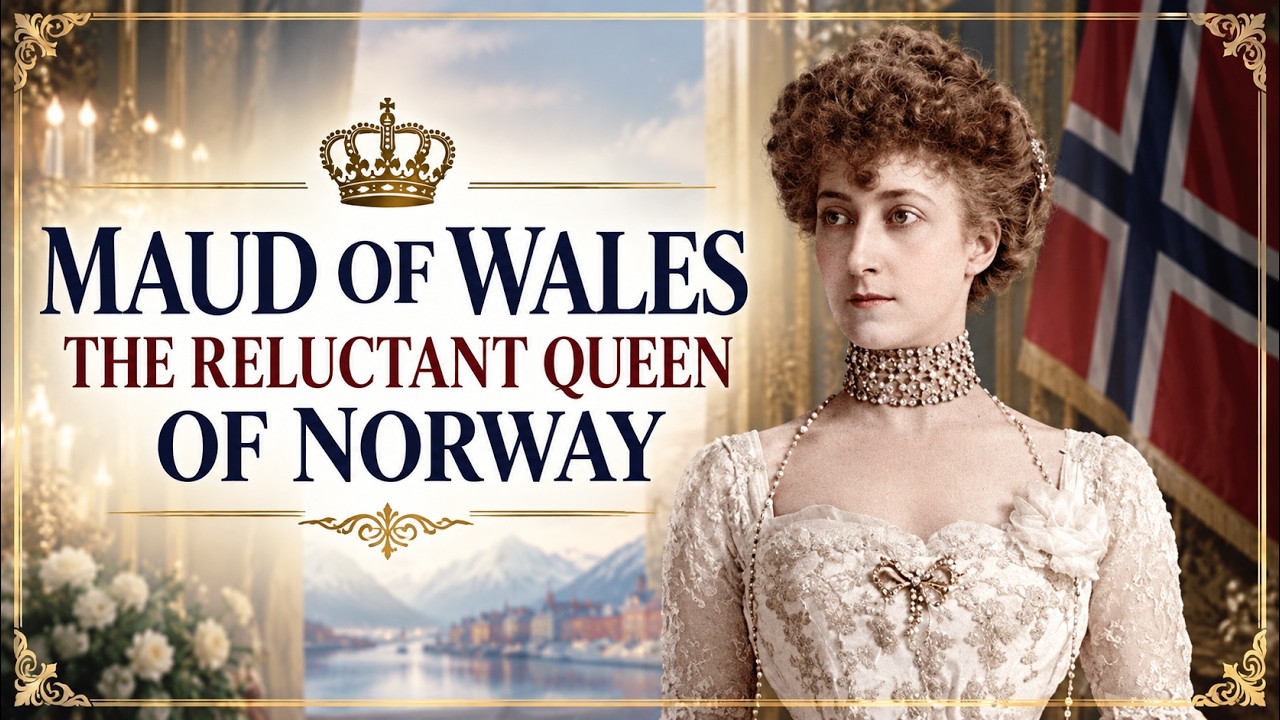
“Who would have imagined it? And I, the last person who could ever be put on a throne. ” The words were light. The situation was not.
Norway had just broken away from Sweden. It had no royal family of its own. The new nation had chosen a Danish prince to be its king. With him came his English wife, a woman her own family called shy, who had spent years trying to stay in England and had never once asked to rule anyone.
Her name was Maud. She was the youngest daughter of King Edward VII, a granddaughter of Queen Victoria, and a sister of King George V. For more than thirty years she would be Queen of Norway. And throughout all those years, part of her never stopped looking back toward England.
This is the story of the princess who became a queen almost by accident, and what wearing the crown cost her. Maud Charlotte Mary Victoria was born just after midnight on 26 November 1869, at Marlborough House in London. Her father was Albert Edward, Prince of Wales, known to his family as Bertie. He was the eldest son of Queen Victoria and heir to the British throne.
Her mother was Alexandra of Denmark, the celebrated beauty who had married Bertie in 1863. Through her mother, Maud was also a granddaughter of King Christian IX of Denmark, a monarch whose children married so widely across Europe that he became known as the father-in-law of Europe. Maud was the fifth of six children. Her eldest brother, Prince Albert Victor, stood second in line to the throne after their father.
Then came George, then two sisters, Louise and Victoria, and then Maud herself. A final brother, Alexander John, was born in 1871 but lived only one day. And so Maud remained the youngest surviving child of the Prince and Princess of Wales. She was christened on Christmas Eve 1869.
From almost the very beginning, she stood apart from her sisters. Maud was cheerful, lively, and bold. She was the tomboy of the family, and her relatives gave her a nickname that suited her perfectly. They called her “Harry,” after Admiral Henry Keppel, a naval officer and friend of the family.
It was not the sort of name usually given to a princess in the Victorian age, and it says a great deal about the girl who earned it. The children spent most of their early lives at Marlborough House and at Sandringham, the family’s country estate in Norfolk. Their mother was closely involved in their upbringing. Alexandra was affectionate and protective, and she always kept her children close.
Maud was especially close to her brother George, the future King George V. Those who knew her in those years described her as a good-natured, cheerful girl, with bright eyes and intelligent features. Years later, in 1895, her aunt Victoria, the Empress Frederick, wrote of her: “She looked so pretty and fresh, like a little rose. ” But the cheerful girl at home was a very different person in public.
Maud and her sisters, Louise and Victoria, grew up under constant public scrutiny. As daughters of the Prince of Wales, they were expected to attend events, smile, be admired, and eventually marry suitably. None of them found this easy. The sisters were known for being reserved in public, and friends and family gave Maud the nickname “Her Royal Shyness.
” Among themselves, in their own private family world, the sisters were playful and full of banter. Before strangers, they tended to withdraw. That shyness mattered, because the primary task of a Victorian princess was to marry. And the Wales daughters married late.
In 1889, Louise, the eldest, married the Earl of Fife, a Scottish nobleman later created a duke. It was an unusual choice because he was a subject, not a foreign royal. Victoria, the middle sister, never married at all. The family also suffered a crushing blow.
In January 1892, Maud’s eldest brother, Prince Albert Victor, died at Sandringham at the age of 28. He had been engaged to Princess Mary of Teck. With his death, George became the future heir to the throne, and in 1893, George married Mary himself. Mary became Maud’s sister-in-law.
Maud’s heart, for a time, had been set on someone else entirely. The man she wanted was Prince Francis of Teck. He was a distant relative and the younger brother of Mary of Teck, the future Queen Mary. Francis was attractive, but he was also poor and burdened by gambling debts.
Maud was infatuated with him. She wrote to him, but he never replied. In September 1895, she confided in Mary: “Fancy, I wrote to (F), and he never answered me. ” Francis never returned her feelings.
By autumn 1895, Maud was twenty-five, unmarried, and rejected by the man she had hoped for. But another suitor had been waiting patiently in the background. Prince Carl of Denmark was born on 3 August 1872, making him about three years younger than Maud. He was the son of Crown Prince Frederick of Denmark, a brother of Queen Alexandra.
That meant Carl and Maud were first cousins. They had known each other since childhood. Alexandra regularly took her children to Denmark to visit her family, and the royal cousins spent long summers together at Danish family gatherings. King Christian IX and Queen Louise gathered their children and grandchildren from across Europe at Fredensborg Palace.
Future kings, queens, emperors, and empresses played there together as children. Among that group of royal cousins were a young English princess nicknamed “Harry” and a Danish boy named Carl. Carl grew up to be an officer in the Danish navy. In 1895, Carl began courting Maud.
In October of that year, their engagement became official, announced on 29 October 1895. On 22 July 1896, Maud and Carl married in the private chapel of Buckingham Palace. Maud wore a white satin dress with a silver-embroidered belt and a wedding veil given to her by her grandmother, Queen Victoria. Her father gave the couple a wedding present that would shape the rest of Maud’s life.
It was Appleton House, an estate on the Sandringham grounds in Norfolk. It was intended as a home for the couple whenever they visited England. The couple’s future home was supposed to be in Denmark. Carl was a Danish prince with a career in the Danish navy, and the wife of a Danish prince was expected to live in Copenhagen.
But Maud did not want to leave. After the wedding, the newlyweds stayed at Appleton House for five months because Maud was so reluctant to leave England. It was the first sign of a pattern that would follow her for the rest of her life. When Maud finally moved to Denmark, she and Carl established a home in Copenhagen with rooms furnished to reflect English taste.
From the outside, it was a comfortable life. Carl had his naval career. Maud had her husband, Danish relatives, and the privileges of being a royal princess. But she was not happy there.
Maud was often homesick. She preferred English customs, and she described her conversation, interests, and hobbies as resembling those of English county society. She found Denmark’s cold winters so difficult that she returned to England whenever she could. Appleton House became her refuge.
Again and again, she went back to Norfolk, to the familiar world of Sandringham and to her family. In January 1901, Queen Victoria died after a reign of more than sixty-three years. Maud’s father became King Edward VII, and Maud became the daughter of the reigning British monarch. His coronation was planned for June 1902, but just days before the ceremony, he fell seriously ill with appendicitis and needed emergency surgery.
The coronation was postponed, and he was finally crowned in August 1902. Two years later, in 1903, came the most significant event of those quiet years. On 2 July, at Appleton House in Norfolk, Maud gave birth to a son. He was named Alexander Edward Christian Frederick.
He would be the couple’s only child. By 1905, Maud was thirty-five. She was a British princess married to a younger son of the Danish royal family. Carl was not in line for the Danish throne, and neither was his son.
Their most likely future was a life of naval postings, family visits, and quiet royal duties on the margins of Europe’s royal houses. Then, in the summer of 1905, a country in the north decided to separate from its neighbour, and everything changed. To understand why a crown was suddenly offered to a Danish prince and his English wife, one must understand Norway. For centuries, Norway had been ruled from Copenhagen as part of a union with Denmark.
In 1814, at the end of the Napoleonic Wars, that arrangement ended, and Norway was placed in a union with Sweden instead. Norway kept its own parliament, the Storting, and its own constitution, but it shared a king with Sweden, and that king lived in Stockholm. Throughout the nineteenth century, tension between the two countries grew. Many Norwegians wanted full independence.
The final crisis came over something surprisingly ordinary: consuls. Norway was a great shipping nation, and it wanted its own consular service abroad to look after its merchants and sailors separately from Sweden. In 1905, the parliament passed a law to create that service. King Oscar II refused to ratify it.
The Norwegian government resigned in protest, and the king could not form a new government. Parliament then declared that since the king was unable to provide a government for Norway, he had ceased to function as King of Norway. On 7 June 1905, the parliament took a dramatic step. It declared that the union with Sweden, which had lasted ninety-one years, was dissolved.
Sweden did not accept this at once. Throughout a tense summer, there was real fear that the dispute could lead to war between the neighbours. To show the world that the separation was the will of the people and not merely of politicians, Norway held a referendum in August 1905 on the separation itself. The result was overwhelming.
368,208 Norwegians voted to end the union. Only 184 voted against it. Negotiations followed, and in the autumn of 1905, Sweden agreed to let Norway go. Norway was now independent.
But that raised an immediate question. What kind of state would it be? A republic or a kingdom? And if a kingdom, who would be king?
The old king, Oscar II of Sweden, had lost his Norwegian crown, and he would not allow a prince of his own family to take it. So the Norwegian government looked elsewhere. It turned to Prince Carl of Denmark. He was an attractive choice for several reasons.
He was descended from earlier kings who had ruled Norway. He already had a son, which meant the new royal dynasty would have an heir from the start. And his wife was Maud, the daughter of King Edward VII. Her place in the British royal family was part of the reason Carl was chosen.
For a small new nation facing a powerful neighbour, a close connection to Britain was valuable. So Maud was not just accompanying her husband. She was part of what made him suitable. But Carl did not accept immediately.
There was a strong republican movement in Norway, and he did not want to take a throne the people did not want. He insisted on one condition. The Norwegian people must vote on whether they wanted a monarchy at all. On 12 and 13 November 1905, Norway held a referendum.
More than 331,000 votes were cast. The result was decisive. 259,563 voted in favour of keeping the monarchy, and 69,264 voted against. Nearly 79 percent said yes.
On 18 November 1905, the Norwegian parliament, the Storting, formally elected Carl as King of Norway. He accepted. For Maud, the anxiety was real. She was leaving the life she knew, moving farther from England and from her sister Victoria, to whom she was very close.
The woman who had struggled to leave England for Denmark was now being asked to go to Norway, not as a princess, but as a queen. The new king had to take a new name. Carl chose Haakon, an ancient Norwegian royal name used by medieval kings of Norway. He became King Haakon VII.
The last Norwegian king to bear that name, Haakon VI, had died in 1380, more than five hundred years earlier. Their two-year-old son, Alexander, was renamed Olav, another name from Norway’s royal past, and became Crown Prince. The choice of names was itself a message. This new family was not being presented as a foreign import, but as an extension of the old line of Norwegian kings.
On 25 November 1905, the new royal family arrived in Norway, landing at Vippetangen in the capital, then called Kristiania and now known as Oslo. They were greeted by the prime minister, Christian Michelsen, with the words: “Today, a young king of Norway comes to build his future in the capital of Norway. ” Haakon adopted a motto that summed up his promise to his new country: Alt for Norge, all for Norway. For Maud, the day of her arrival was also the day before her thirty-sixth birthday.
Within weeks, she was writing her letter home. Look, I have become a queen. Who would have thought it? And I, the last person who would ever want to be put on a throne.
The joke concealed a real anxiety. Maud had never been comfortable with the public side of royal life, and now there was no escape from it. A new country was watching her, and the new monarchy depended in part on how she was received. The greatest test came the following summer.
As the coronation approached, Maud was filled with dread. She wrote of her fear of being alone on her throne, of having a crown placed upon her head. On 22 June 1906, Haakon and Maud were crowned in Nidaros Cathedral in Trondheim, the ancient heart of Norwegian Christianity and the burial place of Saint Olav, Norway’s patron saint. It was a solemn ceremony of crowning and anointing, designed to link the new royal family to the country’s medieval kings.
Maud’s coronation gown took six months and thousands of hours of work, a collaboration between Norwegian and English fashion houses. The dress was made of gold silk and decorated with embroidered gemstones, metal sequins, and imitation pearls. It was a magnificent occasion. It was also the last coronation of its kind.
In 1908, the requirement for coronation was removed from the Norwegian constitution. It proved to be the last coronation ceremony in Scandinavia. When her son Olav ascended the throne half a century later, he was not crowned. Instead, in 1958, he received a blessing in the same cathedral where his parents had worn their crowns.
The new king and queen understood something important. They were foreigners, and they had to show that they belonged. In their first years in Norway, photographs were taken of Haakon and Maud wearing Norwegian folk costumes. They appeared in pictures enjoying winter sports, including skiing, so the public would see them as true Norwegians.
Maud, who had been a tomboy in her youth and called Harry, learned to ice skate. She also took an interest in the practical side of royal life. She insisted on modernising the stables of the Royal Palace in Kristiania. She personally supervised the project and drew its design inspiration from the royal stables in London.
Maud was an excellent horsewoman, and horses remained one of her greatest passions. The monarchy that Haakon and Maud established was less formal than the grand royal courts of Britain or Germany. Maud was known to go shopping in the city herself. Yet she never fully let go of England.
She oversaw the creation of English gardens at Kongsseteren, the royal lodge overlooking the capital, and at the royal summer residence at Bygdøy. She continued to regard England as her true home even after arriving in Norway. She never mastered the Norwegian language. And most importantly, she returned to England every year.
Her destination was always Appleton House in Norfolk, the wedding gift from her father. This was the central tension of Maud’s life as queen. In public, she adopted Norwegian dress, Norwegian sports, and Norwegian duties. In private, her heart remained attached to that house on the Sandringham estates.
Maud’s public role was reserved, but behind the scenes she was not passive at all. Within the court and within the family, she played a strong and influential part. Her principal lady-in-waiting was Mary Magdalena Rustad. On a personal level, Maud was lively and fond of jokes.
As a public figure, she remained reticent. She was the same woman once nicknamed Her Royal Shyness. That reserve did not stop her from leaving a clear mark. Maud was known for her modern elegance and influenced fashion style in Norway.
Her wardrobe was later considered important enough to be exhibited at the Victoria and Albert Museum in London in 2005, and published in the catalogue Elegance and Splendour: The Wardrobe of Queen Maud of Norway 1896–1938. She supported charitable causes, especially those involving children and animals. She encouraged musicians and artists. She raised money for charity by selling photographs.
Some of her support was bold for its time. In 1906, she supported a home for unmarried mothers founded by the Norwegian feminist Katti Anker Møller, a cause considered radical then. Møller fought for the rights of unmarried mothers and children born out of wedlock at a time when both faced deep social stigma. A queen associating herself with such work was a striking choice.
When the First World War broke out in 1914, Norway remained neutral. But the war brought hardship nonetheless. Maud founded the Queen’s Relief Committee, known in Norway as Dronningens Hjelpekomité, to help people left in difficult circumstances by the war. The war also cut her off from England, and throughout the conflict she was unable to visit Appleton House.
Her fundraising work during those years helped increase her popularity in Norway. In 1921, she designed furniture for a children’s exhibition in Norway. The decade brought losses as well. In May 1910, Maud’s father, King Edward VII, died after a reign of only nine years.
Her brother George became King George V. The brother she had been close to in childhood was now king of Great Britain, while she was queen of Norway. On 20 November 1925, her mother, Queen Alexandra, died at Sandringham. That same year, the Norwegian capital changed its name from Kristiania to Oslo.
There was happiness too. On 21 March 1929, her son Olav married his cousin, Princess Märtha of Sweden, in Oslo Cathedral. Maud became a grandmother. Granddaughter Ragnhild was born in 1930, and a second, Astrid, in 1932.
Then, in February 1937, Olav and Märtha had a son, Harald. For the first time, the new Norwegian royal house had a third-generation heir. That boy would one day become King Harald V. Maud’s family in Britain was shrinking.
In January 1936, her beloved brother George, King George V, died. Before the year ended, her nephew Edward VIII had abdicated. In May 1937, Maud attended the coronation of her nephew, King George VI, and Queen Elizabeth, at Westminster Abbey. She sat in the royal box beside Queen Mary, her brother’s wife to whom she had once written about Francis of Teck, and beside her niece, Princess Mary, the Princess Royal.
It was her last public appearance in Britain. Apart from the years of the First World War, Maud had kept up her visits to England throughout her reign. In October 1938, at the age of sixty-eight, she travelled there once more. She stayed first at Sandringham, then moved to a hotel in London.
There she fell seriously ill. She was taken to a nursing home at 18 Bentinck Street in Marylebone. On 16 November 1938, surgeons performed abdominal surgery. They found advanced ovarian cancer that had spread throughout her abdomen.
Four days later, on 20 November 1938, Queen Maud of Norway died of heart failure. She was sixty-eight. She died on the thirteenth anniversary of her mother’s death, and six days before her own sixty-ninth birthday. She was the last surviving child of King Edward VII and Queen Alexandra.
The news was so significant in Norway that newspapers were allowed to break Sunday publication laws to announce her death. The woman who had spent her life trying to return to England died there. But she would be buried in Norway. Her body was carried across the North Sea on the British battleship HMS Royal Oak.
On 8 December 1938, Queen Maud was laid to rest in the royal mausoleum at Akershus Fortress in Oslo. Maud did not live to see the greatest crisis of her husband’s reign. On 9 April 1940, Germany invaded Norway. The Germans demanded that King Haakon appoint a government led by the Norwegian collaborator Vidkun Quisling.
Haakon refused, saying he would rather abdicate than do so. As German forces advanced, the king, the crown prince, and the government retreated north. In June 1940, they left Norway for Britain. For five years, Haakon lived in exile in Britain.
From London, he became a symbol of Norwegian resistance. On 7 June 1945, exactly five years after leaving, he returned to Norway. He reigned until his death in 1957. Then their son became King Olav V.
Maud’s name still lives on far from the palace, in some of the most remote places on earth. In 1911, the Norwegian explorer Roald Amundsen led the first expedition to reach the South Pole. On that journey, he named a mountain range in Antarctica after his queen. It is still known today as the Queen Maud Mountains.
A few years later, Amundsen named a ship after her as well. The polar ship Maud was launched in 1916 and later carried his expedition into the Arctic ice. In January 1939, only weeks after her death, Norway claimed a vast area of Antarctica and named it Queen Maud Land. Far in the north, Queen Maud Gulf in the Canadian Arctic also bears her name.
In her private letters, Maud left behind two lines that capture her reign better than any official portrait. The first, written in the month after her arrival, was a joke about her new title. The second, written before her coronation, was an admission of dread at the crown about to be placed on her head. Between those two lines lies her whole story.
She never wanted to be queen. She was shy in public, homesick for most of her life, and more comfortable in a country house in Norfolk than in a royal palace. By her own account, she was the last person who would ever want to be put on a throne. Yet the monarchy she helped found, in a country that voted to keep it, has endured to this day.
Her grandson, Harald, became King of Norway. The reluctant queen, it turned out, had helped build something that lasted.
