On the morning of October 3rd, 1887, Vernon Caulfield received a telegram that would pull him into a valley that should not have existed. The message had come from Marcus Holloway, the regional supervisor in Little Rock, and it was brief and clipped: the telegraph line through Harrow Valley was down, and Vernon was to investigate and repair it. Supplies were authorized. He was to report daily if possible.
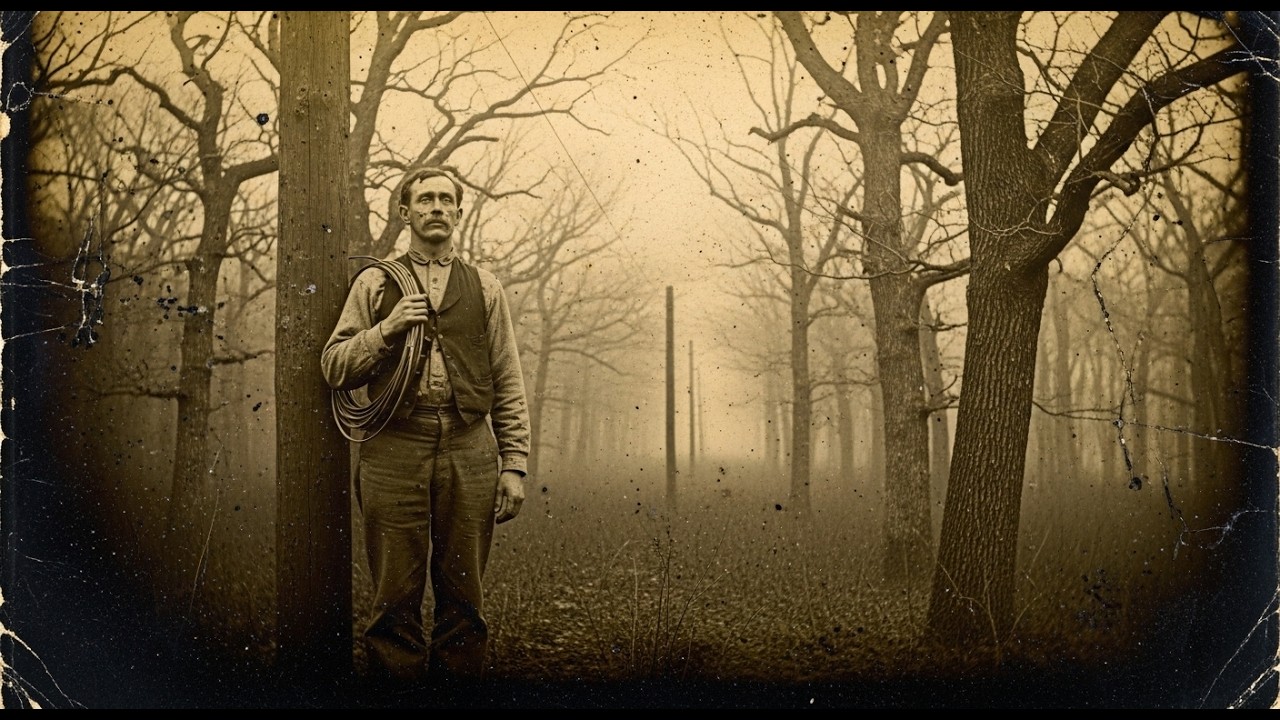
The word “urgent” sat at the end like a weight. The station operator, Silas Pemberton, had walked three miles to deliver the message to Vernon’s cabin, which told him something was wrong. Silas stood on the porch, shifting his weight, pale-faced. When Vernon asked if he knew the valley, Silas said he’d never been there and didn’t know anyone who had.
The old-timers talked about it, he said. A settlement had stood there before the war, a small mining operation of fifty or sixty families. Then one winter, everyone left. Packed up and walked away, leaving tools, furniture, personal belongings behind, as if they couldn’t get out fast enough.
Nobody knew why. Hunters avoided it, Silas said. The animals wouldn’t go near it, and the forest went silent when you got close. His uncle had stumbled on the edge of the valley once by accident, and the wrongness of it sent him back the way he’d come without even thinking.
His instincts were screaming at him that he wasn’t supposed to be there. Vernon was thirty-eight years old, a tall man of nearly six foot three, with steady hands scarred from years of stringing wire through rough country. He’d come to the Ozarks from Missouri three years earlier, following the railroad work, and he lived alone in a one-room cabin near the town of Thorngrove, a settlement of maybe two hundred souls clustered where the railroad met an old wagon trail. He’d tried marriage once, but his wife left him after two years, saying she couldn’t live with a man more comfortable with silence than conversation.
Vernon hadn’t argued. He found his peace in the rhythm of his work, in the vast quiet of the wilderness, in the simple satisfaction of fixing something broken. He spent the morning packing methodically: tools, wire cutters, pliers, insulation tape, spare wire, insulators, climbing spikes, food, salted pork, hardtack, coffee, sugar, dried apples, cornmeal, a bedroll, canvas tarp, tin cup and plate, a cooking pot, his Winchester Model 73, a hunting knife, rope, matches, a compass, and a map showing the telegraph line’s route. He loaded everything onto his mare, Bess, a sturdy, sure-footed animal with a calm temperament that had carried him through thunderstorms without panic.
He left Thorngrove around three in the afternoon, following the railroad tracks east for about five miles before turning north onto an old logging road. The weather was clear and cool, with that sharp quality to the air that comes before the leaves turn. The forest was thick with oak and hickory, the canopy so dense in places that the trail fell into shadow even in the middle of the day. He made eight miles before the light failed, camping in a clearing beside a creek.
Bess grazed near the water; he built a small fire for coffee and beans. The night was quiet, almost too quiet, but he told himself that was just how these mountains were sometimes. The second day started wrong. Vernon woke just before dawn, pulled from sleep not by light or sound, but by the absence of sound.
The forest was utterly silent. No birds greeting the morning, no insects chirring, no wind in the leaves. Then Bess whinnied, a sharp sound of distress. She was pulling at her hobble, ears flat against her head, eyes showing white.
He’d never seen her like that in two years. He scanned the camp for whatever had spooked her, but there was nothing: no tracks, no scat, no claw marks, no scent of predator. The mare stood trembling, staring at something Vernon couldn’t see. He spent twenty minutes calming her, speaking low and steady, and she settled enough to saddle, but she stayed tense all morning, starting at sounds he couldn’t hear, shying from shadows that held nothing.
The logging road narrowed as he climbed, becoming little more than a deer trail. The trees pressed close, thick and gnarled, their branches interlacing overhead. Moss hung in long gray strands, and in marshy places the smell of rot was thick enough to taste. The forest changed as he went deeper.
The trees grew closer together. The undergrowth became sparser, as if plants struggled in the soil. The light took on a strange greenish dimness, and the silence persisted. No birds, no squirrels, no woodpeckers.
The only sounds were Bess’s hooves and the creak of leather. Around midday, he stopped to check his compass and orient himself against the map. He held the brass instrument flat in his palm and watched the needle with growing unease. It was spinning.
Slowly, lazily, refusing to settle on north, rotating in endless circles as if magnetic north had ceased to exist. He tapped it, shook it, held it away from his body. The needle kept spinning. His pocket watch had stopped too, the hands frozen at 11:23, though he’d wound it that morning.
Equipment malfunction, he told himself. Coincidence. But his gut twisted anyway, because two instruments failing at once wasn’t coincidence. It was warning.
An hour later, he found the first telegraph pole. It stood beside the trail at a slight angle, about ten degrees off vertical, as if something had pushed against it. The wire hung slack, severed completely. Vernon dismounted and examined the break.
The wire had been cut. Not frayed by weather, not snapped under tension, but cut cleanly, as if someone had taken heavy shears to it. The severed ends were only slightly tarnished, suggesting the damage was recent. He looked around, suddenly very aware of how alone he was.
The second pole had been cut. So had the third and the fourth. Someone or something had systematically severed the line for what was beginning to look like miles, each cut clean and precise, made with care. The trail began to descend into a broad valley.
The trees thinned, allowing more light through, but that didn’t make him feel better. He should have been able to see wildlife, deer, squirrels, birds. There was nothing. Just empty forest and the telegraph poles marching down the slope.
By late afternoon, Vernon crested a final ridge and the valley spread below him. He knew it immediately, not from any landmark, but from the way his body reacted. Every hair on his arms stood up, his stomach clenched, his heart accelerated. And Bess planted her feet and refused to take another step.
The valley was roughly circular, perhaps three miles across, surrounded by steep ridges. The forest stopped abruptly at the valley’s edge, as if an invisible line had been drawn beyond which trees would not grow. What covered the valley floor was vegetation, but the color was wrong: not green, not brown, but various shades of gray, from light ash to dark charcoal. Thick banks of mist hung low to the ground despite the afternoon sun, pooling in the valley like water, motionless.
The telegraph line cut straight through the middle, the poles visible as dark vertical lines disappearing into the mist. Vernon sat his horse for a long time. A part of his mind whispered that he should turn around now, ride back to Thorngrove, tell Holloway the line was irreparable. But the practical part said he’d come this far and he had work to do.
He couldn’t turn back on a feeling. Bess refused to go farther. He tried coaxing, tried firm commands, tried urging her forward, but the mare would not be moved. Her eyes rolled white and she trembled so violently he could feel it through the saddle.
Finally he dismounted, unsaddled her, and hobbled her near grass at the ridge top. He’d have to go down on foot. He shouldered his pack, took his rifle, and started descending the steep switchback trail. With each step, the temperature dropped.
By the halfway point his breath was misting, though it had been nearly seventy degrees up on the ridge. His hands grew numb, and he paused to pull on leather gloves. The descent took nearly an hour, and the entire time he fought the urge to turn around. Something about the valley pulled at him wrong, like fingers hooking into his chest.
But he kept going, because turning back meant admitting fear, and Vernon Caulfield had never been a man who admitted fear. When he stepped off the trail onto the valley floor, the first thing he noticed was the vegetation under his feet. It looked like grass, grew like grass, but it was colorless, a uniform gray that seemed to absorb light rather than reflect it. He crouched and touched it with his gloved hand.
It felt wrong, too stiff, too brittle, more like wire than plant matter. When he pressed down, it made a faint crackling sound, like dry paper being crumpled. The mist curled around his boots, cold and damp, carrying a smell of ashes and rust. Visibility was perhaps fifty feet before everything dissolved into gray.
The telegraph poles emerged from the mist like sentinels, each one visible from the last, providing the only landmark in this featureless landscape. He followed them because his job was to repair the line, and the line led forward. So forward he went, even though every instinct screamed at him to climb back up to where Bess waited. The silence in the valley was absolute.
Not just the absence of sound, but something more profound. His footsteps made almost no noise, muffled by the strange grass and mist. His breathing sounded loud in his own ears but seemed to die within inches of his mouth. He called out once, experimentally.
“Hello. ” The word fell flat, absorbed by the mist within feet, leaving a silence that felt heavier than before, expectant, like something was listening. He didn’t call out again. He walked for what felt like an hour, though without his watch he couldn’t be sure.
Time felt elastic, unpredictable. Then he saw the first structure. It emerged from the mist slowly, a building of some kind, low and long. A barn, or had been once.
The wood was weathered to the same gray as everything else, and part of the roof had collapsed inward, but what made him stop were the doors. They hung open, both of them, perfectly parallel, as if someone had carefully positioned them. The darkness inside was absolute, a black so complete it seemed to extend far beyond where the back wall should have been. Vernon stared and felt something stir in his chest, something primal and old.
He gave the barn a wide berth, keeping thirty feet to his left. As he drew even with it, he heard something. Not a distinct sound, just a sense of movement, of shifting, as if something large had adjusted its position in that darkness. His hand found his rifle without conscious thought.
He kept walking, not looking at the barn. The sound didn’t repeat. More structures appeared as he walked. Houses, shells of houses.
A building that might have been a church, its steeple leaning at a severe angle. What looked like a general store, its windows intact but completely black. A blacksmith’s shop with the forge still visible, the anvil sitting where it had been left. Vernon realized with a cold shock that he was walking through a town, or what remained of one.
A town that wasn’t on any map he’d ever seen, sitting in a valley that people avoided without quite knowing why. The town revealed itself slowly. Rocking chairs on porches, positioned as if someone had just stood up. Windows with curtains pulled aside, as if someone had been watching the street.
A hitching post with a rope still tied to it, the end frayed as if something had chewed through it. Laundry hanging on lines behind houses, garments that should have rotted decades ago but looked merely faded, as if hung out to dry just last week. Everything arrested in a moment, preserved but rotting. Against every instinct, he climbed the steps of a modest single-story house and pushed the open door wider.
The interior was dim, but enough light filtered through the windows. A table was set for a meal that had never been eaten. A Bible lay open on a side table, the pages yellowed but readable. In the bedroom, the bed was made, the blankets pulled tight.
In the kitchen, pots hung from hooks, a pump stood over a dry sink. Everything neat, everything in place, as if the occupants had simply walked out intending to return. But they never had. He backed out, feeling like he was violating something.
The telegraph line continued through the center of town. He passed a schoolhouse with a slate board still bearing chalk marks. A doctor’s office with the sign still legible. A saloon with the bar intact, bottles standing on shelves, tables arranged as if waiting for customers who would never come.
At what he guessed was the center of town, he found a well. It was made of stone, clean, as gray as everything else. An iron crossbar spanned the top with a rope hanging down, a wooden bucket attached. The rope looked new.
Vernon approached slowly, every nerve screaming at him not to look over the edge. But he couldn’t help himself. He gripped the stone edge and looked down. The well opened onto nothing.
Not darkness, not water, not an empty shaft. Just nothing. An absence so complete that looking at it hurt, that made his eyes water and his head spin. It was like staring at a hole punched through reality itself.
He jerked back, heart hammering, bile rising in his throat. He stumbled back several steps and took all his willpower not to run. The telegraph line led him to a building larger than the rest, two stories with a porch running the full width of the front. A sign hung above the door: Harrow Valley Hotel.
The door stood wide open, as if inviting him in. Every rational part of his brain told him to turn around. But something else, something he couldn’t name, pulled him forward, not curiosity exactly, but a terrible compulsion, as if the valley had been waiting for him specifically. He climbed the steps.
The boards didn’t creak. He crossed the porch, and stepped inside. The interior was darker than it should have been. What light filtered through the windows seemed to die a few feet from the source, swallowed by a gloom that felt almost solid.
Gradually shapes emerged: a front desk, a staircase with carved banisters, chairs around tables, a grandfather clock in the corner, its pendulum still, its face showing 3:14. And books, everywhere. They covered the floor, scattered as if someone had thrown every book in the place off the shelves in a frenzy. Vernon bent and picked one up.
It was bound in leather, the cover unmarked. He opened it, tilted it toward the weak light. The pages were blank. Pristine white paper, no text, no illustrations.
He checked another. Also blank. He moved through the room, checking book after book, and every single one was empty. Hundreds of books, all blank, all scattered across the floor as if in rage or despair.
Someone had filled this hotel with blank books. His hands were shaking. The wrongness of the place was pressing down on him, making it hard to breathe. He needed to leave.
But before he could move toward the door, he heard it. A sound from upstairs. Footsteps, slow, measured, deliberate, walking back and forth across the second story directly above his head, the same path repeated with mechanical precision. Vernon froze.
The footsteps continued, and he realized they were moving in time, left, right, left, right, but the rhythm was subtly wrong, as if the thing walking up there had legs that bent at different angles than human legs. He wanted to call out, but his throat had closed. The footsteps continued for perhaps thirty seconds, then stopped. The silence rushed back, heavier than before.
He counted to ten, then twenty, barely breathing, his eyes fixed on the ceiling. Nothing. He backed toward the door, and that’s when he saw them. Handprints on the walls.
Everywhere. Covering every surface he could see, pressed into the wallpaper, the wood paneling, overlapping each other in a mad profusion that suggested panic or obsession. But they weren’t right. The fingers were too long, the proportions wrong, and the number of fingers varied from print to print: five here, seven there, six, eight.
And they were all pointing. Every single handprint, regardless of where it was, pointed in the same direction: toward the staircase, toward the second floor, toward whatever was up there walking back and forth in the darkness. Vernon ran. He burst out of the hotel, stumbled down the porch steps, and ran down the main street of that impossible town.
His pack bounced against his back, his rifle clutched in both hands, his breath coming in ragged gasps that misted in the cold air. The mist seemed to clutch at him, to slow his movements, but he forced himself forward, past the buildings, past the well, following the telegraph line in reverse because it was the only landmark he trusted. His lungs burned and his legs ached, but he didn’t stop until the buildings fell away behind him and he was in open valley again. Only then did he slow, doubling over with his hands on his knees.
When he’d recovered enough to stand, he looked back toward where the town should have been. The mist had grown thicker. He couldn’t see the buildings anymore. They were there, he knew they were there, he’d just been walking through them.
But now, looking back, there was only mist and gray grass and the telegraph poles marching into the distance. The town had vanished. Not hidden by the mist, but gone, as if it had never existed. The light was failing.
The sun was dropping toward the ridge tops, and Vernon realized with a sick horror that he was going to have to spend the night in this valley. He couldn’t make the climb back up to Bess in the dark. He had to find shelter, had to survive until morning. He saw, maybe two hundred yards to his left, a telegraph pole still standing straight.
He made his way toward it and sank down with his back against the rough wood, his rifle across his lap. He drank from his canteen, forced himself to eat some hardtack. As true darkness fell, he realized he could see things moving in the mist. Not clearly, just shapes that seemed to form and dissolve, that approached and retreated, never quite coming close enough to identify.
Vague human-sized forms that moved with that same wrong gait he’d heard in the hotel. They circled him like sharks circling a drowning man. All he could do was sit there, finger on the trigger, watching them. The night lasted forever.
Vernon didn’t sleep, didn’t dare close his eyes for more than a second. The shapes grew bolder as the hours passed, coming closer, and sometimes he could swear he saw features: a face pale and elongated with eyes that were just dark holes, hands reaching, a figure that stood upright but seemed to have too many joints in its limbs, bending in ways that made his stomach churn. He fired his rifle once at something that came within ten feet, something that had looked almost human until it opened what should have been its mouth and revealed rows of teeth that seemed to spiral down into its throat. The shot was swallowed by the mist without echo.
Whatever he’d aimed at melted away, but others took its place, pressing closer. He realized firing again would be pointless. His bullets couldn’t hurt these things. They weren’t physical, or they were physical in a way he didn’t understand.
His pocket watch, forgotten in his coat, had stopped entirely. When he pulled it out, he found the hands had fallen off, lying loose inside the case, and the glass face was cracked. Time became meaningless. He existed in a permanent present, trapped between heartbeats, watching the mist and the things that lived in it.
And gradually, as the night wore on, he began to understand something fundamental about the Harrow Valley. It wasn’t empty. It had never been empty. It was crowded, swarming with things that used to be people, or that had never been people at all.
Things trapped here the same way he felt trapped, caught in a place where the normal rules didn’t apply, where reality was thinner than it should be, where something else could bleed through. He could feel them pressing against the boundaries of his perception, trying to make him see them fully. If he let them, if he looked too closely at any one shape, he had the terrible certainty that understanding would break something fundamental in his mind. So he kept his eyes moving, never focusing, never allowing any single figure to resolve into clarity.
And a theory began to form. Someone had discovered this valley, had seen what lived here, and had tried to contain it. The town wasn’t a real town. It was a construct, a trap meant to draw the things in the mist to one place where they could be studied or controlled or destroyed.
The buildings were bait. The telegraph line was a warning system, a way to alert the outside world if something went wrong. But something had gone wrong, catastrophically. Whatever had been done to control the place had failed, and the valley was waiting.
Dawn came eventually. The shapes retreated as visibility improved, sliding back into whatever holes they crawled from when the sun was in the sky, but he could still feel them nearby, watching. Vernon stood on legs that barely held his weight, stiff from a night of sitting motionless. He had one thought: get out now while there’s still light.
He knew with absolute certainty he wouldn’t survive another night. He started walking toward the ridge, not following the telegraph line, not caring about the job, just putting distance between himself and this valley. He struck out in what he hoped was the right direction, using the angle of the weak morning sun. The mist was thinner now, and he could see the dark line of normal trees at the valley’s edge, maybe half a mile away.
He walked quickly, not quite running. Behind him he heard something, a sound that might have been laughter, high and thin and utterly inhuman, or might have been the wind, or his imagination. He didn’t look back. The ground began to slope upward.
The gray grass gave way to dead leaves and bare earth and rocks. Then he was in the trees, real trees with bark that looked right, and he wanted to weep with relief. He climbed the switchback trail, breath burning, legs screaming, but he didn’t slow. When he reached the ridge top, he found Bess exactly where he’d left her, grazing peacefully.
She raised her head and whickered softly, as if greeting him after a normal absence. His hands shook so badly he could barely manage the saddle, but he got her tacked up and mounted. He rode hard, pushing the mare faster than he should have, not caring about trail or terrain, only putting miles between himself and the Harrow Valley. He rode until the sun was high and the forest looked completely normal, until he could hear birds singing and wind in the leaves.
Only then did he slow. He dismounted and sat on a fallen log with his head in his hands for a long time. He reached Thorngrove four days after he’d left, coming in from the west. His clothes were torn, his face haggard, his eyes hollow.
Silas Pemberton saw him first. “Good lord, Vernon, what happened to you? ”
Vernon looked at him, trying to find words. Finally he just said, “The line’s down.
It can’t be repaired. Recommend abandonment. ”
“But—”
“It can’t be repaired. ”
He went to the telegraph office and sent a message to Little Rock: “Harrow Valley line irreparable.
Recommend permanent abandonment. Do not send anyone else. Request immediate reassignment. ” Marcus Holloway’s response came within the hour, filled with questions and thinly veiled threats about Vernon’s continued employment if he didn’t provide a full report.
Vernon ignored all of it. He went to his cabin, packed his belongings, sold Bess to a local farmer for half what she was worth, because he couldn’t stand to see her again. He bought a ticket on the next train heading east. Before he left, he went to the town’s small library, a single room above the general store with maybe two hundred books and a collection of old newspapers and documents.
He found a survey from 1862 that showed the valley clearly marked on a hand-drawn map. Beside it, in faded ink, someone had written: “Site of settlement. Population est. 83.
Abandoned autumn 1861. Cause unknown. Area considered dangerous. ”
He found a journal entry from a circuit preacher who’d traveled through the region in 1857.
One entry stood out, dated October 12th: “Passed near a valley the locals call Harrow today. They say it’s cursed. That it once held a thriving community until something happened one winter. The few hunters brave enough to approach it say the animals avoid it, that the forest goes silent when you get close.
One old-timer told me he’d gone in looking for deer 20 years ago and had seen things he couldn’t explain. Shapes moving in the mist that looked human but weren’t. He said he ran and that he could feel something chasing him. Could hear footsteps that matched his own but were just slightly off rhythm.
He barely made it out. I believe him. There are some places in this world that aren’t meant for human habitation. Places where the barriers between what is and what shouldn’t be have worn thin.
The Harrow Valley is one such place. ”
Then he found a letter dated April 6th, 1883, from someone identified only as J. Mordecai, Chief Engineer, Department of the Interior, to Colonel Ashford Thorne, War Department. The letter discussed the containment measures enacted at Site Seven, colloquially known as Harrow Valley.
It mentioned the construction of structures meant to attract and centralize the anomalous entities and described the installation of a telegraph-based early warning system to alert proper authorities should the containment fail or the entities attempt to expand beyond the designated area. It noted that initial results were promising, with entity activity showing measurable decrease in outlying regions and concentration within the constructed settlement, but cautioned that long-term viability remained uncertain and continuous monitoring was essential. It ended with a recommendation that the site be classified, that under no circumstances should civilian access be permitted, and that any accidental intrusions should be handled with appropriate discretion. Vernon sat holding copies of these documents, his hands trembling.
Someone had known. The government had known. They’d built that fake town as a trap or a cage. And then the warning system had failed, and Vernon had been sent to repair it without any idea what he was walking into.
He left Thorngrove on a Tuesday morning in mid-October. As the train carried him away from the Ozarks, he stared out the window at the mountains rolling past. Somewhere in that vast expanse, there was a valley where time moved wrong and things that shouldn’t exist pressed against the edges of reality. He ended up in St.
Louis, finding work as a telegraph operator for a shipping company. He took a room in a boardinghouse on Delmar Avenue, kept to himself, tried to forget. But he never really could. Some nights, especially when the mist rolled in off the Mississippi River, he would stand at his window and watch the way it moved through the streets below.
And he would remember the Harrow Valley. He would wonder if he’d really escaped, or if the valley had simply let him go, the way a predator releases wounded prey just to see where it would run, just to see if it would tell others, just to see if more would come. The years passed. Vernon aged, his hair going fully gray, his body stiff with arthritis.
He never married, never formed close friendships, never spoke of what had happened. What could he say? Who would believe him? In 1902, fifteen years after his experience, something broke through his careful routine.
A telegram came through addressed to him personally. It was unsigned, sent from a telegraph station in Little Rock, and it contained only six words: “The wire has gone silent again. ”
Vernon stared at the telegram for a long time. He knew what it meant.
The telegraph line through the Harrow Valley, the line he’d abandoned, had stopped transmitting. The early warning system had failed again. Somewhere in those mountains, something was no longer contained. He burned the telegram in the ashtray on his desk.
That night, he pulled out the notes he’d made in the Thorngrove library all those years ago, the notes he’d kept despite telling himself he should throw them away. He read through them again, looking for something he’d missed. But there was nothing. Just fragments.
Over the following weeks, Vernon became obsessed with tracking news from Arkansas. He found a few things. A small item in the Arkansas Gazette about hikers who’d gone missing near the Ozarks. A report about livestock disappearing from farms near the mountains, vanishing without a trace.
An account from a surveyor who’d abandoned his job after experiencing what he called unnatural phenomena while mapping a remote valley. Nothing concrete, nothing that couldn’t be explained as coincidence. But Vernon knew. He could feel it in his bones.
The valley was growing. And there was nothing he could do except watch and wait and remember. Vernon carried that weight until he died in 1923 at the age of seventy-four. He died in his sleep in his room at the boardinghouse.
The doctor said heart failure, a peaceful end for a quiet man. But those who found him said his face was twisted in terror, and his eyes were open, staring at something in the corner that no one else could see. Among his belongings, the boardinghouse owner found maps. So many maps, covering the walls of his room, layered over each other, each showing the Ozark Mountains with certain areas circled in red ink.
In the center of all those circles, drawn by hand onto every map, was a valley. The Harrow Valley. The owner thought they were the confused scribbles of an old man losing his mind, and she burned them, along with the pages of notes covered in Vernon’s careful handwriting. Descriptions of things that couldn’t exist.
Warnings that made no sense. She had no way of knowing she’d just destroyed the only remaining detailed record of a place the government had been trying to erase from official documents since 1883. The Harrow Valley still exists if you know where to look. If you can find the old maps from before the area was reclassified, you can locate it.
But you won’t be able to reach it. The entire region was purchased by the federal government in 1938 under the auspices of the National Park Service and declared a protected wilderness area permanently closed to all public access. The official reason was conservation. But if you could access the classified files, you’d find a different story.
Reports from park rangers stationed at the boundary, filed quarterly, written in flat bureaucratic language. Reports of signal disruptions that can’t be explained by weather or equipment failure. Reports of entire sections of forest where wildlife refuses to go, where the trees grow in unnatural patterns, their branches reaching toward the center of the valley as if drawn by some invisible force. Reports of mist that pools in the valley floor even on the clearest days, mist that moves against the wind.
Incident reports about hikers who ignored the warnings and crossed the boundary, hikers who came back changed, waking up screaming for months afterward, hikers who in a few documented cases simply walked back into the woods weeks or months later and were never seen again. A memo from 1987, exactly one hundred years after Vernon Caulfield’s visit, recommended that the protected area be expanded, that the exclusion zone be tripled in size, that aerial surveillance be increased, and that under no circumstances should the containment boundary be approached by unauthorized personnel. The memo doesn’t explain what necessitated these measures. But the timing is significant.
One hundred years. As if whatever lives in that valley operates on a different time scale, as if it measures time in centuries while we measure it in years. Now, in 2025, we are thirty-eight years past that expansion, approaching another potential cycle. Are the measures still holding?
Is the valley still contained? Or is it growing slowly, patiently, waiting for the right moment, the right weakness in the barrier between what is and what shouldn’t be?
