On September 4, 1882, at approximately three in the afternoon, John Lieb, Thomas Edison’s chief electrician at the Pearl Street station in lower Manhattan, threw the master switch on the world’s first commercially viable central power station. Underground cables carried 110 volts of direct current from six massive coal-fired dynamos, each weighing about 27 tons, to 82 customers in a quarter-square-mile area of the financial district. About 400 incandescent lamps flickered to life. Edison himself was on hand, personally connecting lamps in the offices of one of his major financial backers, the banker J.
P. Morgan. A reporter for the New York Herald described the moment: in a twinkling, the area bounded by Spruce, Wall, Nassau, and Pearl Streets was in a glow. Eighty-two customers and 400 lamps might not sound like a revolution, but it was.
Edison had demonstrated not just a new kind of light, but a system: a complete, scalable, commercially viable system for generating, distributing, and selling electrical power. The Pearl Street station was a proof of concept for an entirely new way of living. By 1884, just two years later, the station served over 500 customers with more than 10,000 lamps. The electric age had begun, and its impact was immediate and profound.
Electric light didn’t just make things brighter; it remade the entire structure of daily life. For the first time in human history, the night became optional. You could work at any hour, read without straining your eyes, walk through a brilliantly lit street and see everything as clearly as if it were midday. Factories could run 24 hours.
Shops could stay open long past dark. The ancient rhythm of waking with the sun and sleeping with the moon, a rhythm that had governed human life for thousands of years, was shattered in a single generation. But the transition wasn’t instantaneous, and it wasn’t uniform. Electricity spread through American cities relatively quickly, but rural America was a different story.
For decades after Edison threw the switch at Pearl Street, millions of Americans on farms and in small towns continued to live by candlelight and kerosene lamp, their nights still governed by the old rhythms. It wasn’t until the 1930s, when President Franklin Roosevelt’s Rural Electrification Administration began stringing power lines across the countryside, that electric light finally reached the majority of rural Americans. More than 50 years after Edison’s Pearl Street station, there were still vast stretches of the American landscape where the night looked exactly as it had a century before: dark, quiet, lit by nothing more than a flickering flame. And when electricity did finally arrive in these communities, the reaction was often one of stunned disbelief.
There are accounts from the rural electrification era of families who had never seen an electric light before, gathering around a single bulb and staring at it in wonder. Children who had grown up doing homework by kerosene lamp discovered what it felt like to read by a light that didn’t flicker, didn’t smoke, didn’t smell, and didn’t threaten to burn the house down. Farmers who had spent their entire lives going to bed at sundown found themselves awake at ten at night, listening to a radio for the first time. The arrival of electricity in rural America was not just a technological upgrade; it was a transformation of consciousness.
It changed what people thought was possible. And in the span of that transformation, something was lost. Not just the darkness itself, but everything the darkness had created. To understand what American nights were really like before electricity, you first have to forget almost everything you think you know about how time works.
Today, we structure our lives around the clock. We wake at six or seven in the morning because that’s when the alarm goes off, not because the sun told us to. We stay up past midnight scrolling through phones or watching television because artificial light has made the hour irrelevant. The clock on our wall is a suggestion at best.
But for the first two and a half centuries of American life, from the colonial settlements of the 1600s all the way through the 1870s, the sun was not a suggestion. It was the law. Everything in daily life orbited around sunlight. Farmers, who made up the vast majority of the American population well into the 19th century, planned their entire existence around the solar cycle.
You woke at dawn because that was when you could see. You worked the fields, fed the livestock, repaired the fences, and hauled the water during the precious hours of daylight. And when the sun began to dip, you didn’t keep working. You couldn’t.
The work literally became invisible. So you came inside, ate whatever had been prepared, said your prayers, and went to bed. Not because you were necessarily tired, but because there was nothing else you could do. This wasn’t just a rural phenomenon.
Even in the growing cities of the eastern seaboard—Boston, New York, Philadelphia—daily life was overwhelmingly dictated by sunlight. Shops closed at dusk, markets packed up, streets emptied, courts adjourned, churches locked their doors. The entire machinery of civic life shut down when the sky turned dark, because operating in the dark wasn’t just inconvenient. It was dangerous.
The experience of darkness before electricity wasn’t like what we think of as dark today. When we say it’s dark outside, we usually mean it’s dimmer. There are still streetlights, the ambient glow of a city reflecting off the clouds, the pale blue light of a phone screen or the green glow of a digital clock. But in colonial and early America, darkness meant darkness.
Imagine stepping outside your front door on a cloudy, moonless night in, say, 1770. What you would see is nothing. Absolutely nothing. Not the outline of a tree, not the road, not your own hand in front of your face.
Historians who have studied the period describe a darkness so thick and so total that it disoriented people within steps of their own front door. People got lost walking across their own property. They fell into ditches, stumbled into fences, walked off bridges, and drowned in rivers they couldn’t see. In cities, the situation wasn’t much better.
In the late 1700s, New York City installed whale-oil street lamps spaced about 114 feet apart, but these lamps were little more than yellow specks swallowed by the surrounding blackness. They didn’t illuminate the streets; they barely illuminated themselves. You could walk between two of them and lose sight of both. The night became something to be feared, not in an abstract philosophical way, but in a real, physical way—you might die tonight.
Nighttime in early America was genuinely dangerous, not just because of the darkness itself, but because of what the darkness concealed. The night belonged to criminals long before it belonged to anyone else. In colonial America, darkness provided near-perfect cover for every kind of wrongdoing imaginable: theft, assault, robbery, arson. These weren’t just risks after dark; they were expectations.
Cities like Boston recognized the problem almost immediately. As early as 1631, Boston established what they called a night watch: a group of men, usually volunteers, tasked with patrolling the streets from about nine or ten at night until sunrise. They carried wooden rattles and blew whistles to alert citizens when trouble was brewing. They enforced curfews.
They looked for fires, which were devastatingly common in an era when every building was made of wood and every light source involved an open flame. And they were supposed to stop suspicious characters from prowling under the cover of night. But the night watch was, by most accounts, a joke. The men who served were often the dregs of society: people trying to avoid military service, or petty criminals themselves looking for easy cover.
Reports from the era describe watchmen who drank on duty, fell asleep at their posts, or simply didn’t show up at all. Wealthier citizens who were supposed to take their turn on patrol routinely paid someone else to do it, usually the least qualified person they could find. The constables who were supposed to oversee the watchmen were often just as unreliable. The entire system was reactive, not proactive.
The watchmen didn’t prevent crime; they occasionally stumbled across it. In the vast stretches of unlit streets between their patrols, the night was lawless. This created a cultural reality that’s hard for modern Americans to fully appreciate. The night wasn’t just dark; it was hostile territory.
Respectable people did not go out after dark unless they absolutely had to. If you saw someone walking the streets at night, your first assumption wasn’t that they were going for an evening stroll; your first assumption was that they were up to no good. The suspicion was so deeply embedded in the legal system that there were actual laws, carried over from English tradition, called Nightwalker statutes. These laws empowered watchmen to arrest anyone found on the streets after dark who couldn’t give a satisfactory explanation for why they were out.
Being outside at night was in itself treated as suspicious behavior. You were essentially guilty until proven innocent simply for being awake after sundown. And the fear of nighttime wasn’t just about street crime. Fire was an ever-present terror.
In an era when every home was heated by a wood-burning fireplace, when every room was lit by a candle or an oil lamp, when curtains, bedding, and clothing were all made of highly flammable materials, the risk of catastrophic fire was constant. A single knocked-over candle could destroy an entire household. In densely packed cities, one house fire could easily become a city-wide inferno. This is one reason why curfew was taken so seriously in early America.
The word curfew itself comes from the French huver, which literally means “cover the fire. ” The original purpose of curfew wasn’t about controlling behavior; it was about making sure people extinguished their flames before going to sleep, so they didn’t burn the whole town down. Amidst all this danger and darkness, people still needed to see. They needed some form of light to navigate their homes, prepare food, tend to sick children, and carry out the hundred small tasks that didn’t stop just because the sun went down.
The story of how Americans lit their nights is in many ways a story of class, economics, and survival. For most of early American history, the primary source of artificial light was the candle. But calling a candle “light” is generous. A single tallow candle, the kind made from rendered animal fat, the cheapest and most common type available to ordinary Americans, produced roughly the equivalent of about 13 lumens.
For comparison, a modern 60-watt light bulb produces around 800 lumens. Imagine trying to live your evening life with about one-sixtieth of the light you’re used to. That’s what a tallow candle gave you: a small, guttering yellowish flame that barely illuminated the table it sat on, produced an acrid smoke that smelled like burning fat, and had to be constantly trimmed and tended to keep it from going out. Even these cheap, sputtering candles were not free.
For poor families, especially on the frontier, light was a luxury. Many households couldn’t afford to burn a candle every night. Some families went to bed as soon as the sun set—not out of preference, but because they literally could not afford to stay awake. The cost of illumination was a real economic burden.
This is why so many Americans, well into the 1800s, simply adapted their lives to the rhythm of the sun. You woke with the light. You worked by the light. And when the light went away, so did you.
Wealthier Americans had slightly better options, but not dramatically so. Beeswax candles burned cleaner and brighter than tallow, but they were expensive, reserved for churches, wealthy households, and special occasions. Spermaceti candles, made from a waxy substance found in the head of the sperm whale, were even better. They burned longer, gave off a brighter light, and produced no offensive smell.
They were, in many ways, the premium lighting product of the 18th and early 19th centuries, but they came at a premium price, and their production depended on an industry that was hunting certain whale species nearly to extinction. Then there were oil lamps, which represented a significant step up from candles but still fell far short of what we would consider adequate illumination. The most common fuel was whale oil, which by the early 1800s had become enormously popular. Whale-oil lamps burned more brightly and lasted longer than candles; they were a genuine improvement.
But whale oil was expensive. At its peak, it could cost the equivalent of close to $200 a gallon in today’s money. For ordinary working families, burning whale oil every night was simply out of the question. And then there was the Argand lamp, invented by the Swiss chemist Aimé Argand in 1784.
This was the first truly scientific advancement in lighting technology. The Argand lamp used a cylindrical wick and a glass chimney that created a draft, allowing the flame to burn more efficiently and produce significantly more light than a traditional candle or oil lamp. It was a revelation. When it appeared on the American market, it became enormously popular among those who could afford it.
But again, it ran on whale oil or expensive vegetable oils, and its price put it out of reach for most Americans. The economics of illumination created a stark divide in American society. The wealthy could afford to extend their days into the evening hours. They could read, write, entertain guests, and conduct business after dark.
The poor could not. Darkness enforced a kind of invisible class barrier. If you couldn’t afford light, you were locked out of the evening world entirely. You went to bed, stayed in bed, and waited for the sun.
But here’s where the story gets truly fascinating. The way Americans slept before electricity was fundamentally different from how we sleep today. In 2001, a historian named Roger E. Ekirch at Virginia Tech published a groundbreaking paper that revealed something hiding in plain sight for centuries.
After 16 years of research, sifting through hundreds of diaries, court records, medical texts, and personal letters from the pre-industrial era, Ekirch discovered that our ancestors did not sleep the way we do. They didn’t go to bed and sleep for a solid eight hours straight. Instead, they practiced what Ekirch calls segmented sleep, or biphasic sleep. They slept in two distinct chunks.
The pattern worked like this. You would go to bed shortly after nightfall, usually around eight or nine in the evening. You would then sleep for three to four hours. This was called “first sleep,” or sometimes “dead sleep.
” Then, sometime around midnight, you would naturally wake up—not because of a noise or disturbance; your body simply woke up—and you would be awake for an hour or two, sometimes more, in a period that was sometimes called “the watching. ” During this interval of quiet wakefulness, people did all kinds of things. Some got out of bed and tended to chores. Some checked on livestock or added wood to the fire.
Some visited neighbors. Some prayed. Some simply lay in bed and reflected on their dreams or thought about the day ahead. A 16th-century French physician noted that manual laborers were known to engage in intimacy with their spouses during this interval, remarking that after the first sleep, they reportedly had greater enjoyment and did it better.
After this period of wakefulness, people would drift back to sleep for another three to four hours. This was called “second sleep,” or “morning sleep,” and it would carry them through to dawn. Ekirch found over 500 references to this pattern in historical documents, spanning centuries and crossing social classes. It wasn’t a quirk or an outlier; it was the dominant way that people in Europe and North America slept before the industrial age.
The pattern was so deeply embedded in daily life that people didn’t even think about it. They no more questioned the concept of first and second sleep than they questioned the concept of breakfast and dinner. It was just how things were. When artificial lighting became widespread in the 19th century, this ancient sleep pattern began to disappear.
As gas lamps and then electric lights extended the usable hours of the day, people started going to bed later. The quiet interval of midnight wakefulness was squeezed out. The two-phase sleep cycle was compressed into one continuous block. Within a few generations, the entire concept of first and second sleep was forgotten.
So completely forgotten that when modern people wake up in the middle of the night, they think something is wrong with them. They diagnose themselves with insomnia. They take sleeping pills. They worry.
But according to Ekirch’s research, waking up in the middle of the night might not be a disorder at all. It might be the oldest and most natural sleep pattern in human history, a pattern that artificial light erased from our collective memory. The darkness of pre-electric America didn’t just affect how people slept. It transformed every dimension of social life after sundown.
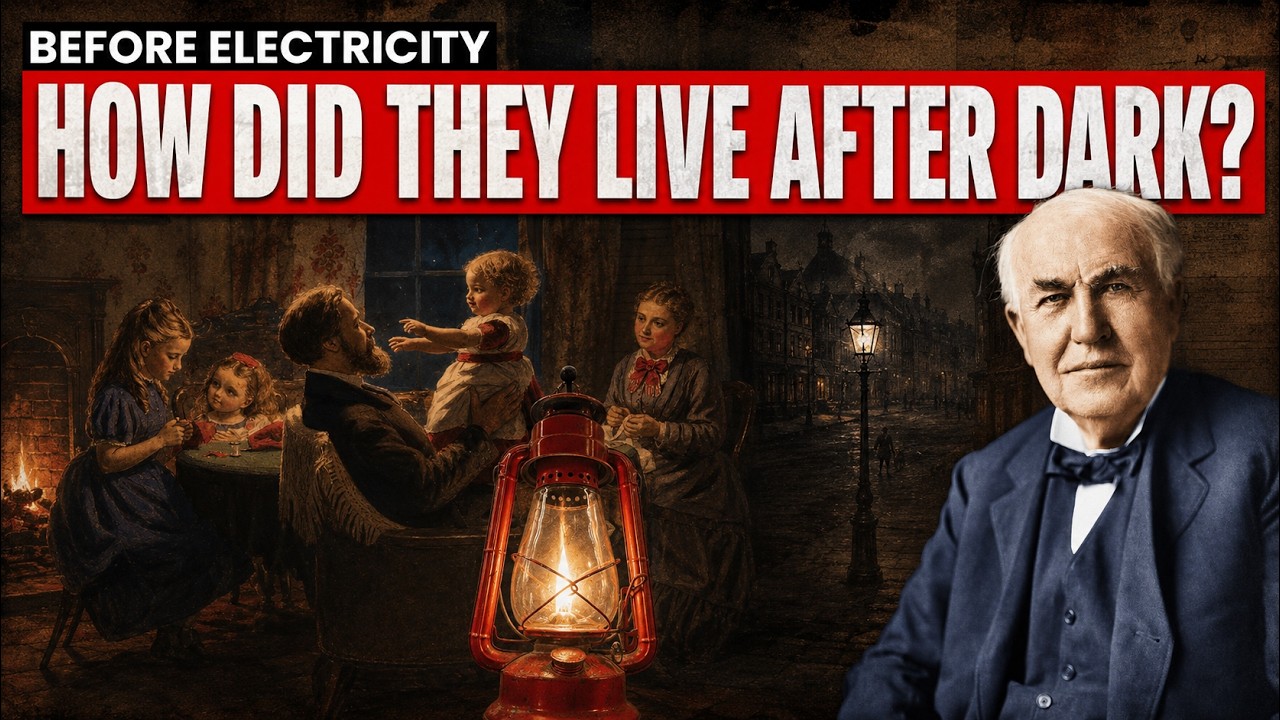
One of the most interesting transformations was what happened inside the home once the candles were lit. The evening hours, limited as they were, became intensely communal. Families gathered in a single room, usually the room with the fireplace, because that’s where the warmth was and where the only significant source of light flickered. There was no retreating to separate rooms the way we do today.
There was no private space. The entire family, sometimes spanning three generations, occupied the same few square feet of dimly lit space for the duration of the evening. And what they did in that space was remarkably consistent across class and region. They talked.
Conversation—real, sustained conversation—was the primary form of evening entertainment for most Americans for most of the country’s history. Parents told stories. Grandparents shared memories. Children asked questions.
News from the wider world, which traveled slowly by letter or word of mouth, was discussed and debated around the fire. These were not casual conversations; they were the social glue that held communities together. In an era without newspapers, radio, television, or the internet, the evening conversation around the fire was how culture was transmitted from one generation to the next. Songs were taught.
Prayers were memorized. Family histories were preserved. The moral frameworks that governed daily life were reinforced night after night in the dim glow of a tallow candle. Women, in particular, used the evening hours for productive work.
Sewing, knitting, spinning, and mending were all tasks that could be done by the feeble light of a single flame, because they relied more on the sense of touch than on sight. A skilled seamstress could work by feel alone, her fingers navigating the fabric while her eyes barely registered the flickering shadows on the wall. This wasn’t a hobby; it was an economic necessity. Clothing was expensive and difficult to replace.
Every garment was patched, mended, altered, and repaired until it literally fell apart, and a lot of that repair work happened after dark when the day’s other chores were done. Reading was another evening activity, but it was far more limited than we might imagine. Books were rare and expensive. Most households owned a Bible and little else.
And reading by candlelight was physically punishing. The dim, unsteady light caused eye strain, headaches, and long-term damage to vision. Many Americans in the pre-electric era developed serious vision problems by middle age, in part because of the years they spent squinting at text by the light of a guttering flame. Benjamin Franklin, that great American inventor and polymath, was famously disciplined about his evening hours.
He reportedly went to bed at ten in the evening and rose at five in the morning, a schedule that maximized his daylight hours and minimized his reliance on artificial light. But Franklin was exceptional. Most Americans simply couldn’t afford to be reading and writing by candlelight the way he could. For those with slightly more means, the evening could expand into something approaching what we’d recognize as social entertainment.
Taverns, which served as the social hubs of colonial and early American communities, stayed open after dark. They were places of conversation, debate, political organizing, and of course, drinking. Lit by fireplaces and a handful of candles, taverns were dim, smoky, raucous places where men gathered to exchange news, settle disputes, make deals, and escape the monotony of home life. But even taverns operated on a shortened schedule compared to modern bars.
Most closed relatively early by our standards, partly because the light ran out and partly because the customers had to be up at dawn. Theater was another form of evening entertainment, but it came with its own extraordinary challenges. Before gaslighting reached the stage, theaters were illuminated entirely by candles. Not a few elegant tapers placed here and there, but thousands of candles.
They were mounted on massive chandeliers that hung over the stage and the audience. They lined the front of the stage, what we’d call footlights. They were placed in brackets along the wings. The sheer quantity of candles required to light a single performance was staggering.
But there were problems, big ones. All those candles generated enormous amounts of heat. A packed theater with thousands of burning candles became unbearably hot. And the candles burned down.
A standard candle would last about an hour before it guttered out and needed to be replaced. This is one of the reasons why plays and operas of the era included intermissions and lengthy pauses between acts. It wasn’t just for the audience’s comfort; it was so the stagehands could climb the chandeliers and replace the candles before the next act began. And then there was the fire risk.
A theater full of burning candles, with an audience of women in long flowing dresses and men in heavy wool coats, sitting in a building made entirely of wood, was a disaster waiting to happen. And disasters did happen. Theater fires were common and catastrophic. A single toppled candelabra could turn a packed playhouse into an inferno.
Outside the home, beyond the taverns and theaters, the American night had its own distinct geography, and the contrast between rural and urban darkness was two very different experiences. On the American frontier and in rural farming communities, nighttime brought a silence so complete and a darkness so absolute that it bordered on the surreal. There were no streetlights, no gas lamps, no illuminated windows glowing in the distance. There was nothing but the land and the sky.
On clear nights, the stars provided a faint ambient light that allowed you to see the general outlines of the landscape. On cloudy nights, you could see nothing at all. The isolation was profound. If you lived on a remote farm in, say, 1820, you might be miles from your nearest neighbor.
If something went wrong after dark—if someone fell ill, if a fire broke out, if a stranger appeared at your door—you were on your own. There was no way to summon help, no way to get anywhere. There was nothing to do but wait for morning. Animals were another concern entirely.
The American frontier was still, in many areas, genuinely wild. Wolves, bears, mountain lions, and other predators were not abstract threats; they were real dangers that became more active after dark. Livestock had to be secured before nightfall. Doors had to be barred, and the sounds of the night—the howling, the rustling, the breaking of branches—were a constant source of anxiety.
People who romanticize pre-electric rural life tend to forget this part. The pastoral quiet of the countryside was not peaceful; it was tense. The night was a time of vigilance, not relaxation. In the cities, the experience was different but not necessarily better.
Urban nights brought their own brand of chaos. As American cities grew throughout the 1800s, the nighttime streets became increasingly populated by a cast of characters who thrived in the darkness. Prostitutes, pickpockets, gamblers, drunks, and con artists all did their best work after dark. The cities, especially rapidly growing ones like New York, had entire districts that transformed after sundown into what contemporary writers called the netherworld, a shadowy parallel society that operated by its own rules.
In 1850, a journalist named George Foster published a series of sketches called New York by Gaslight, which attempted to document the city’s after-dark underworld. What he described was a world that most respectable New Yorkers never saw and didn’t want to know about: dark alleyways where stolen goods changed hands; basement taverns where the city’s poorest and most desperate gathered to drink cheap liquor and fight; dance halls where the line between entertainment and exploitation was paper thin. Foster painted a picture of a city that in many ways had two separate identities: one that operated in daylight under the rules of polite society, and another that emerged after dark, ungoverned and ungovernable. This brings us to one of the most significant transitions in American history: the gaslight era.
Because before Thomas Edison and his electric bulb changed everything, there was an intermediate step—a technology that partially conquered the night and, in doing so, created an entirely new kind of urban culture. Gas lighting arrived in America in the early 1800s. Baltimore became the first American city to install gas streetlights in 1816, a few years after the technology had been pioneered in London. The system was relatively simple.
Coal was heated in large ovens, producing a combustible gas that could be piped through underground mains to individual street lamps and eventually into homes and businesses. The light produced by a gas flame was significantly brighter and more reliable than a candle or oil lamp. For the first time, it was possible to illuminate an entire street, not just a single room. The impact was transformative.
Cities that installed gas lighting saw an immediate change in the rhythm of nighttime life. Shops stayed open later. Restaurants extended their hours. People began walking the streets after dark, not because they had to, but because they wanted to.
The gas-lit street became, for the first time, a space of leisure rather than a space of fear. In cities like New York, Philadelphia, and Chicago, the gaslight era gave birth to something that hadn’t really existed before: nightlife. Not just the shadowy underworld that had always lurked in the darkness, but a legitimate, middle-class, socially acceptable culture of going out after dark. Theaters flourished under gaslighting.
The technology replaced the thousands of candles that had previously illuminated the stage and the audience, creating a brighter, safer, more comfortable experience. Restaurants and cafes that had previously closed at sundown now stayed open into the evening, their windows glowing warmly onto the street. And the gas-lit street itself became a kind of public theater, a place to see and be seen, to promenade, to window-shop, to people-watch. But gaslighting had its limitations and its dangers.
Gas was expensive; only wealthier neighborhoods could afford comprehensive street lighting, which meant that the divide between lit and unlit streets often corresponded to the divide between rich and poor neighborhoods. And gas was volatile. Leaks were common, and a gas leak in a confined space could cause a devastating explosion. Gas also produced a continuous low-level haze of fumes and soot.
In enclosed spaces, it consumed oxygen and replaced it with carbon monoxide, making poorly ventilated gas-lit rooms genuinely hazardous to health. People regularly suffered headaches, nausea, and respiratory problems from prolonged exposure to gaslighting. In theaters where hundreds of gas jets burned simultaneously, the heat and fumes could be nearly unbearable. Still, gaslighting fundamentally altered the American relationship with the night.
It didn’t eliminate the darkness, but it pushed it back. It carved out pockets of light in the urban landscape, and in doing so created new social spaces, new economic opportunities, and new cultural possibilities. It was the bridge between the old world of candles and darkness and the new world of electric light and perpetual illumination. Today, most Americans live in environments so saturated with artificial light that they’ve never seen a truly dark sky.
Light pollution has erased the Milky Way from the view of roughly 80 percent of the American population. The stars that guided our ancestors, that inspired their myths and religions and navigation, are invisible to most of us. We’ve traded the darkness for convenience, and in doing so, we’ve lost something that our ancestors had in abundance: a direct, unmediated relationship with the night. This isn’t nostalgia.
Nobody in their right mind would want to go back to the era of tallow candles and Nightwalker statutes and theater fires. The electric light is one of the greatest inventions in human history, and the world it created is, by almost every measurable standard, better than the world it replaced. But it’s worth pausing just for a moment to remember what it felt like before. To remember that the night was once a place, not just a time.
That darkness was once a presence, not just an absence. And that the way we live now—bathed in perpetual artificial light, connected to screens that never go dark, awake at hours that would have baffled our great-grandparents—is a very recent experiment in human history. We’re the first generation to live this way, and we’re still figuring out what it costs. The American night before electricity was terrifying, beautiful, dangerous, and deeply human.
It was a world where fire was precious, where darkness was absolute, where sleep came in two acts, and where the simple act of staying awake after sundown was a luxury that most people couldn’t afford. It was a world that shaped the culture, the economy, the psychology, and the physiology of everyone who lived in it, and it vanished in the span of a single lifetime, replaced by a world so bright that we’ve forgotten the dark was ever there at all.
