The letter arrived with a Houston postmark, written in block letters, and it made a demand that was almost too strange to believe. “If you want to know who killed C. Henry and A. Atkinson, it will cost you $100,000.
”
The year was 2001. For eleven years, the murders of Cheryl Henry and Andy Atkinson had gone nowhere. No arrest. No named suspect.
Only the DNA of a killer no one could identify. The note asked investigators to publish a response in the classified section of the Houston Chronicle. They did. They printed a simple message: “We want to know what you have.
Here is a phone number. ” Then they waited. No second letter came. No phone call.
No demand for money. The person who sent it simply vanished. Now, twenty-five years later, there was a name attached to the case at last. On March 2026, police in Nebraska arrested a 64-year-old man and charged him with capital murder in the deaths of Cheryl Henry and Andy Atkinson.
His name was Floyd William Barrow. Thirty-six years had passed. Thirty-six. And the most striking part was that this man had never been among the more than one hundred people investigators had examined over the decades.
He was not a famous suspect argued about on internet forums. His name came out of nowhere. But once investigators started pulling at his record, the strangest details of the case began to look less strange. To understand how they finally reached him, it helps to go back to the beginning, back to 1990, and look at the case the way the investigators did.
On August 22, 1990, in west Houston, Texas, Cheryl Henry was twenty-two years old, home from college for the summer, the oldest of six siblings. Andy Atkinson was twenty-one, just days from turning twenty-two, a newcomer to Houston living with his grandmother while working at a Gold’s Gym; his father lived in the city. The couple had been together for less than three weeks. According to Cheryl’s family, she was already smitten.
That night, Cheryl and Andy went out to dinner with Cheryl’s sister at a restaurant called Bayou Mama. They parted ways around eleven. Cheryl and Andy left together. It was the last time their families saw either of them alive.
The following night, a security guard for Sysco Foods was making his rounds at an undeveloped commercial area in west Houston where the company had a building. Empty fields, trees, industrial property. At the end of a dead-end street sat a white Honda. The spot was so isolated that locals had nicknamed it “Lovers Lane,” a place people went specifically for privacy.
The security guard had seen the car earlier that day and paid it no mind. A few hours later, he came back. Same car, same place. This time he looked more closely and realized something was wrong.
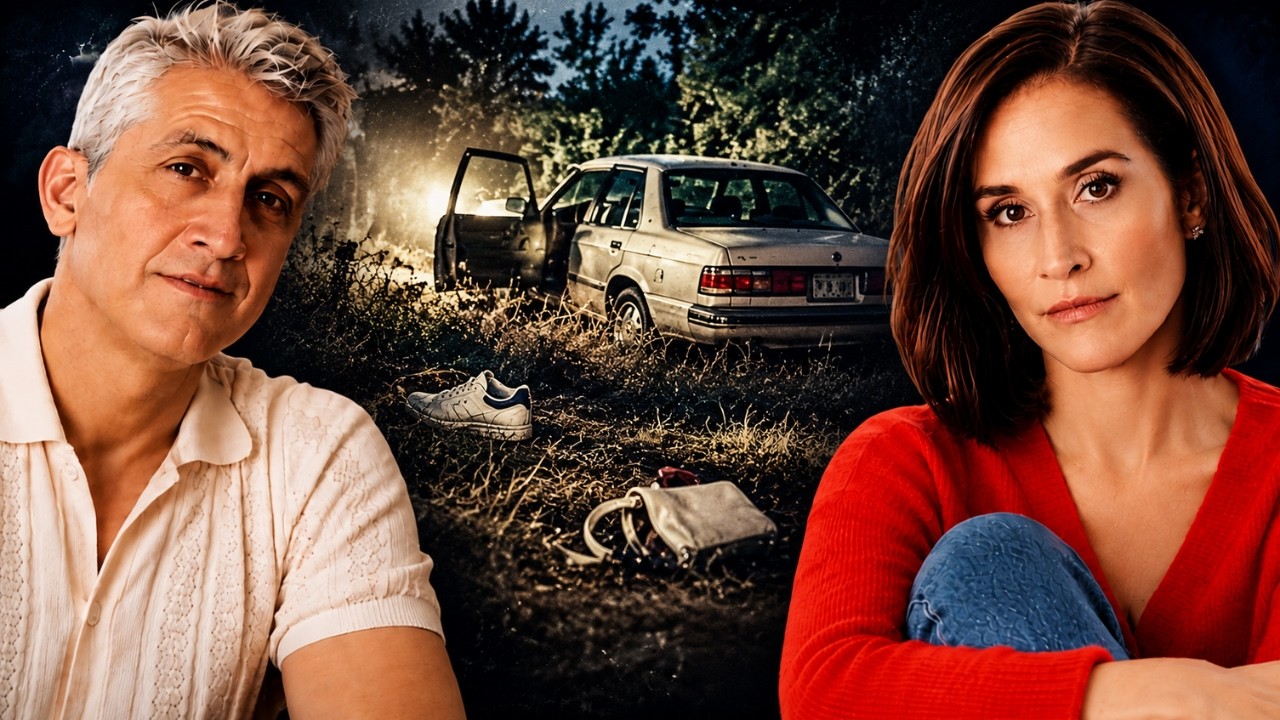
The windows were open. The front seats were reclined. The battery was dead, but the key was still in the ignition, as if someone had been listening to the radio until it ran out. There was blood inside the car.
Cheryl’s purse was still there, her shoe on the floor, and pieces of men’s and women’s clothing were scattered outside. Whatever had happened, they had not simply parked and walked away. Police quickly learned the car belonged to Andy. Both he and Cheryl had been reported missing.
The security guard had called Cheryl’s mother after finding the purse with her number inside; she had been searching all day. The family rushed to the scene, and it was they who alerted the authorities. Officers arrived with search dogs. Shortly before midnight, the dogs led them about two hundred yards into a treeline.
There they found Cheryl. She was lying face down, her hands behind her back. Her dress and underwear were torn. She had been sexually assaulted.
Her throat had been cut, and someone had covered part of her body with old wooden planks. The next morning, as more light filled the scene, it became stranger. Beyond the treeline, in the field leading to it, investigators found a golf club and three golf balls arranged in a way that seemed to point toward where her body lay. The items had come from a Bandit brand truck.
A twenty-dollar bill lay on the ground near her body. And hanging from a nearby tree were four balloons, nearly deflated. No one knew why. No one even knew whether they were connected to the crime.
Then came the worst discovery of that morning. Andy was found fully clothed, about two hundred yards from Cheryl. He was tied to a tree, his hands bound behind his back. His throat had also been cut, but the wound was so deep it nearly severed his head from his body.
Nothing had been stolen, so robbery was ruled out. The medical examiner found the killer’s DNA during Cheryl’s autopsy. One might have thought the case would be solved quickly. But this was the early 1990s, and DNA testing was not what it is today.
Still, investigators were careful with what they had. They entered the profile into CODIS and compared it against known offenders. The security guard who found Andy’s car had to be excluded, along with everyone else they could reasonably suspect. The DNA did not match any of them.
The murders shook the city. Cheryl and Andy were young, attractive, well known in their circles. The crime was brutal beyond comprehension. There was enormous pressure to close the case.
The FBI was brought in. So were criminal profilers, who concluded the killer likely knew Cheryl or Andy, or perhaps both. They believed he was probably close to their age, intelligent, someone police might have already spoken to without realizing it. Years passed.
Then, in 2001, came the extortion letter that raised everyone’s hopes, and the person behind it vanished without explanation. The police were left with a pile of details that all seemed significant: the balloons, possibly a serial killer’s sick signature; the golf balls arranged like an arrow; the twenty-dollar bill left beside the body; the letter. But none of it led anywhere. Then investigators got something far better than a letter: a DNA match.
Two months before Cheryl and Andy were murdered, another woman had been attacked in Houston. Her rape kit had been collected and then sat unexamined for seventeen years. Seventeen years. It was a shocking example of how kits piled up in some cities.
How many cases might have been solved if every kit had been tested? Lovers Lane was a perfect illustration. The case stayed cold for seventeen years before this single thread emerged. The DNA from that 1990 assault matched the DNA of the man linked to Cheryl’s murder.
That meant the woman who survived the attack had come face to face with the man investigators believed had killed Cheryl and Andy. Unlike those victims, she could tell police what happened. She had been working as an exotic dancer. She finished her shift around two in the morning and went to the home of her boyfriend, Randy, a pilot who was out of town.
She was alone, eating takeout in the basement, relaxing, then went upstairs. Suddenly, a man came out of the bedroom. He had been inside the whole time, waiting for her. He wore a fishnet stocking over his face, black gloves, a dark shirt, and dark pants.
He carried a long-barreled revolver. The first thing he said was: “Where is Randy? ”
He knew her. Or at least he knew her boyfriend’s name.
That told her this was not random. He put the gun to her head, cocked it, then uncocked it. He was toying with her. He bound her hands behind her back, took a few hundred dollars from her wallet, taped her eyes and mouth, put a bag over her head, and sexually assaulted her.
She survived. Despite the stocking over his face, she remembered a great deal about him, enough to help police produce a sketch. She said he was about six feet tall, roughly two hundred pounds, with brown hair and possibly a mustache. She also remembered the way he moved, the way he stood.
He seemed military to her. During the assault, he told her she was not very observant and claimed he was wearing a military uniform. Investigators wondered whether he was deliberately trying to make her think he was military rather than something else, like a security guard, since his dark clothing strongly resembled a uniform. Before he left, he ordered her to lie on the floor and not move.
He told her he might stay inside for five minutes or an hour. He was making sure she was terrified enough to remain still for a long time. Only later did she realize he had unplugged the phone and hidden the handset under the mattress. He had planned everything.
Now police had his DNA and a living survivor. And still they could not identify him. She did not know him, and neither did they. They had a DNA match without a name.
That would matter later. There was another connection that made the whole case stranger. The survivor had worked as a dancer in a nightclub, and Andy’s father managed a club. Some sources said she worked at the very club he managed.
Others, more recent, suggested she worked at the club but the connection remained strong. Andy sometimes worked as a bouncer at his father’s club, and Cheryl may have briefly worked as a waitress at another nightclub. Police came to believe the killer might have been a patron of these clubs, or worked at one or more of them. That could have been how he targeted them.
It was a thread, but no proof. Investigators kept coming back to the twenty-dollar bill found beside Cheryl, almost like an extravagantly generous tip, as if he had thrown it there. It was a grotesque gesture. Remember that detail.
Now comes the man police arrested. His name was Floyd William Barrow, and until late 2025, he had not been a suspect in the murders of Cheryl and Andy, according to investigators. Then someone reported his name to police, and a detective began looking into it. They found a 1996 sexual assault case.
Floyd Barrow had been the suspect. The woman said she had been assaulted; Barrow claimed it was consensual. The grand jury declined to indict him. But the evidence from that case still existed.
Investigators obtained the DNA sample. It matched Cheryl’s. The reading takes several passes to confirm. The male DNA from the 1996 case, tied to Floyd Barrow, matched the DNA collected from the sexual assault examination performed on Cheryl after her death.
And that same DNA matched the DNA from the June 1990 rape survivor’s case. Three samples, one genetic profile. And one of those samples carried a name: Floyd Barrow. That was how they got him.
Then they started looking at his life in 1990. Remember how the survivor thought her attacker behaved like a security guard or military man? In 1988, Floyd Barrow was arrested for impersonating a police officer. He was arrested again in July 1990 for the same offense, just weeks before Cheryl and Andy were killed.
Records showed he was out on bail for that impersonation charge when the murders occurred. He was pretending to be a cop at the exact time these crimes took place. Here is the next detail. Exactly one week after the murders, Floyd appeared in court for that impersonation case.
He pleaded guilty and was sentenced to two years in prison. Remember the long-barreled revolver the survivor described? Police records showed Barrow had previously been arrested while carrying a blue steel revolver. Later, the gun was returned to him.
Investigators noted it matched the general description survivors had given. Whether a weapon should be handed back to a man like that is its own question. Then there was his workplace. Lovers Lane was extremely remote in 1990.
But investigators went back to an old arrest report for Barrow, found his work address, and mapped it. It was just over a mile from the crime scene. His history did not stop in 1990. In 1996, he was convicted of impersonating an officer yet again.
According to reports, he posed as a police chief and pulled over a driver, then took a hundred dollars in exchange for not issuing a ticket. When authorities searched his car and home, they found various badges, fake identification, an emergency light for his vehicle, and police radios. He was sentenced to twenty years for that offense but served only a fraction of that time. The deeper journalists and investigators dug, the stranger it became.
Barrow used different identities and worked various jobs. He described himself at different times as a sailor, a private investigator, and a nightclub or strip club manager. Authorities now believe there may be other people he encountered, possibly other victims. It made one wonder how many people thought they were dealing with a real police officer when they were not.
Pulled over at night with that emergency light flashing, most people would stop and roll down the window. If a stranger approached a parked car at Lovers Lane, one might lock the doors or drive off. But if someone looked and acted like a policeman, a young couple might roll down the window without thinking twice. Investigators have not publicly proven that is how Barrow approached Cheryl and Andy.
But given his repeated arrests for impersonating an officer, it seems far from coincidence. In March 2026, Houston police and the FBI arrested Floyd Barrow in Lincoln, Nebraska. He was sixty-four. He was charged with capital murder.
At the time of the murders, he had been about twenty-eight years old, close to the victims’ age, exactly as the FBI profiler had predicted. The district attorney’s office released photos of the car Barrow had used while impersonating an officer and asked anyone who recognized him or the vehicle to come forward. Reports began flowing in from across the country. People claimed they had been victimized by this man.
Investigators also began looking at an old unsolved murder in Louisiana they believed might be connected. They kept the details quiet, saying only that it was a homicide. Then, in April, a month after his arrest, Floyd Barrow was found dead inside a Nebraska jail. He had committed suicide.
His extradition hearing had been scheduled for two days later. There would be no trial. Barrow had been charged, and a grand jury had indicted him. Investigators said DNA linked him to Cheryl, Andy, and the 1990 survivor.
But he died before a jury could hear the case. Legally, he was never convicted of killing Cheryl Henry and Andy Atkinson. And now he never will be. The investigation, however, will not end with his death.
Investigators believe he moved between Texas, Louisiana, Florida, and Nebraska, and they are actively checking cold cases, hoping to connect him to that Louisiana murder. They still want to hear from anyone who believes they may have been his victim. Because the biggest unanswered question is not simply what happened at Lovers Lane in August 1990, but what else happened during all those years when no one knew Floyd William Barrow’s name was connected to any of it. There may be families who still do not know their case could be linked to him.
For thirty-six years, police had the DNA of the man they believed attacked Cheryl and Andy. How many other cases are out there waiting for the same name to surface? The survivor of the June 1990 assault had waited seventeen years for her kit to be tested. The thought is difficult to shake: had it been examined sooner, Floyd Barrow might have been caught before Cheryl and Andy were killed.
The tragedy of that delay is compounded by the outcome. Cheryl’s mother and Andy’s father both died before the arrest. They never knew. The case has a strange, hollow ending.
The man is dead, the mystery of his name solved, but full justice never came. The questions remain open, scattered like those three golf balls in a field, pointing nowhere.
