Operation Ten-ichi-Go began as a secret, so it was fitting that its end came from the shadows. On March 26, 1945, American naval intelligence intercepted and decrypted Japanese radio signals mentioning the operation, whose name meant Heaven Number One. In the days that followed, more intercepts filled in the picture. By April 5, senior American commanders in the Pacific, including Admiral Raymond Spruance of the Fifth Fleet, knew the operation’s timing, order of battle, and plan of action.
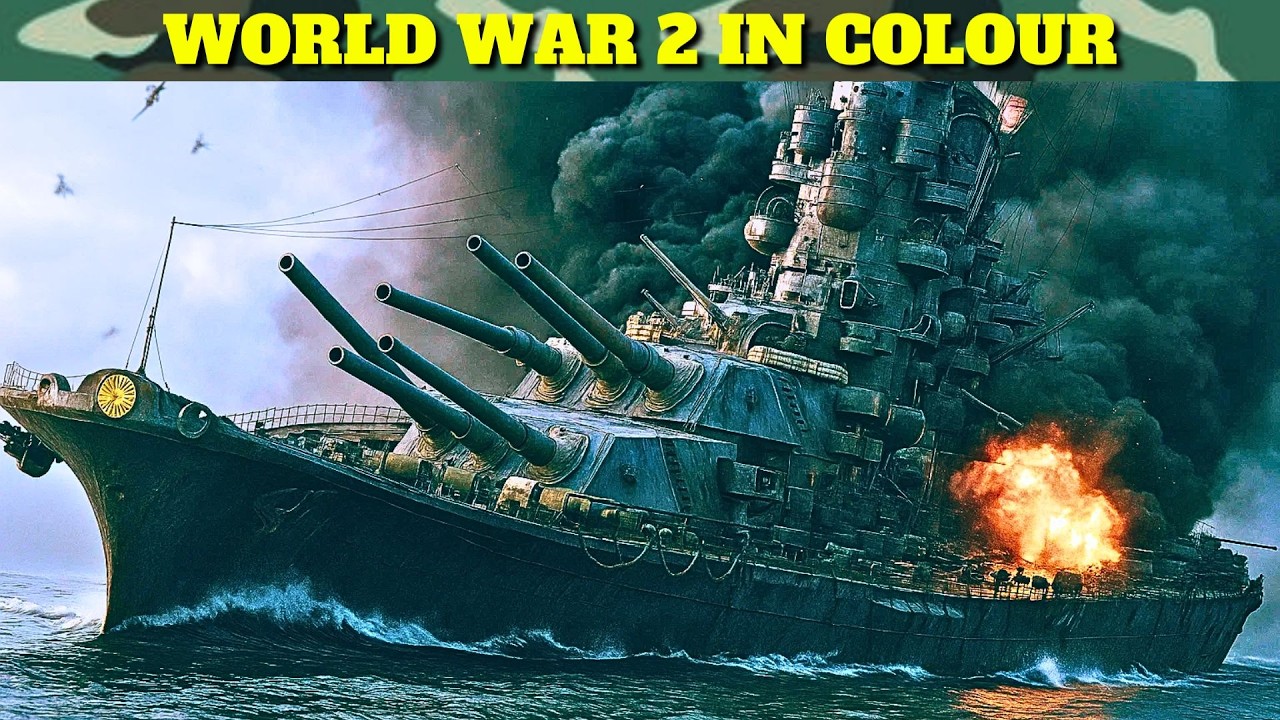
The plan was extraordinary. The battleship Yamato, the largest warship ever built, would lead the light cruiser Yahagi and eight destroyers on a one-way voyage to Okinawa. There, the fleet would drive through American lines, sink as many troop transports as possible, then run the ships aground and fire their guns inland until they were destroyed. Survivors were expected to abandon ship, join the army ashore, and fight to the death.
Before dawn on April 6, fifteen hours before Yamato sailed, Spruance ordered his fleet to prepare. He stationed two submarines near the Japanese departure port with strict orders to report rather than attack. He intended to let the Japanese fleet sail into a trap he was laying, and to destroy every ship in it. The Japanese commanders themselves had no faith in the mission.
Vice Admiral Seiichi Ito, who commanded the force, opposed it from the start, seeing it as a pointless waste of men and matériel. On April 5, he briefed the ship captains who would execute the plan, and the result was the nearest thing to mutiny the Imperial Japanese Navy had ever seen. The captains unanimously objected, convinced the fleet would never get within sight of Okinawa. Many argued for a more sensible use of the ships: independent raids against America’s overstretched supply lines.
Vice Admiral Ryunosuke Kusaka, chief of staff of the Combined Fleet, flew from Tokyo to ensure compliance. He summoned the senior officers and captains aboard the Yahagi for a tense meeting. None of them feared death. They objected to the folly of attacking the entire United States Navy in broad daylight without air cover.
One captain compared the mission to throwing an egg against a rock. Kusaka listened. Then he played his ace. He told the officers, falsely, that the mission was the emperor’s will and was to proceed in his name.
Against a living god’s command, there was no room for further argument. The officers accepted, though they extracted one concession: every sailor would be allowed to stay behind. Before departing, Ito tried to save as many lives as he could. He emptied the sick bay, sent ashore the trainees and the men nearing retirement, and ordered sixty-seven naval cadets off the battleship, some of whom had to be dragged away while begging to stay.
The crews were assembled, told the nature of the mission, and given the option to remain ashore. None took it. Sailors finished their shore leave and said goodbye to wives and children they knew they would never see again. At four in the morning on April 6, Yamato and her escorts left Tokuyama Harbor and set out on a one-way course.
Spruance reacted swiftly when the submarine USS Hackleback sighted the Japanese fleet and reported its position. He ordered Rear Admiral Morton Deyo, commander of the battleship bombardment force, to deploy six old battleships to a blocking position northwest of Okinawa. Six modern battleships would join them. Deyo planned for a surface engagement the following evening, and on the morning of April 7 held a planning conference aboard his flagship, the USS El Dorado.
The American force was overwhelming: twelve battleships, seven cruisers, and twenty-one destroyers. For the battleship commanders, this was a chance to reclaim lost glory. Since Pearl Harbor, their ships had been reduced to shore bombardment and anti-aircraft escort duty while carriers dominated the naval war. The upcoming battle against the largest battleship in history offered a final vindication.
But the carriers would not let it happen. At eleven that morning, Vice Admiral Marc Mitscher, commanding Task Force 58, launched an aerial strike from fifteen carriers directly at the Japanese fleet without informing Spruance, his immediate superior. When Spruance asked what was going on, Mitscher claimed to have misunderstood his orders. The planes were already on their way, he said, so he might as well let the strike continue.
If it failed, Deyo’s surface force could still finish the job. Spruance conceded and informed Deyo of the new plan. Deyo knew from experience that once the carrier planes were finished with a target, there was nothing left to shoot at. He was furious, but he had no choice but to comply.
Once again, in his view, the fly boys would take all the glory. By the time of Operation Ten-ichi-Go, American aviators had learned exactly how to kill a super battleship. The lesson had been paid for six months earlier, when Yamato’s sister ship Musashi sank in the Sibuyan Sea during the Battle of Leyte Gulf. Musashi, the same class of massive vessel, had absorbed nineteen torpedoes and twenty bombs over the course of a full day before capsizing.
Her loss had served, in effect, as a live-fire training exercise for American carrier pilots. The Americans analyzed every detail. They learned that torpedo hits distributed evenly on both sides kept a ship upright for a long time, since minimal counter-flooding could correct the list. They learned that against a ship this heavily armored, the improved Mark 13 torpedo was more effective than armor-piercing bombs.
And they developed a new doctrine: focus all torpedo hits on one side of the ship. This created a severe list, drowned the low-mounted anti-aircraft guns, and forced the crew to counter-flood the opposite side. That consumed the ship’s reserve buoyancy and set it up to roll over past the point of recovery. Mitscher’s aircraft followed that doctrine perfectly against Yamato.
Fighters and dive bombers went in first, not to sink the ship but to suppress anti-aircraft fire, rattle the gun crews, and rattle their nerves. The Avengers followed into a defensively shocked environment, no longer facing an unbroken wall of flak. The torpedo planes concentrated their attacks on one side and kept piling them in. What had taken the Americans all day against Musashi took about two hours against Yamato, with far fewer hits.
Yamato’s own defenses were not what they appeared to be on paper. Her anti-aircraft battery had grown steadily throughout the war and, by 1945, boasted twenty-four 5-inch dual-purpose guns and one hundred thirty-two 25mm cannons. But the heavy guns used time fuses because Japan, unlike the United States, lacked proximity fuses, which made them far less effective against maneuvering aircraft. The 25mm guns were outdated, with poor sights, slow traverse, severe vibration, a tendency to jam, and small magazine boxes that limited their rate of fire.
American ships had radar-directed gunfire and proximity-fused shells. Yamato’s fire control was antediluvian by comparison. Her armor had a hidden weakness as well. Japanese shipbuilders had lacked the tools and techniques to weld 16-inch armor plates, so Yamato’s belt had been riveted.
Riveting required holes drilled through the armor, compromising the seams. When torpedoes struck, the armor plates held, but the rivets sheared off, and water poured in around the joints. Still, Yamato gave a lengthy fight. Her captain handled her superbly, throwing the great ship into violent zigzags, swerving away from torpedo tracks, turning into threats to narrow her profile and spoil the drops.
She dodged several early attacks that way. Then her luck ran out. A torpedo struck, and she took on nearly three thousand tons of water. Counter-flooding corrected the list, but the weight slowed her down and made her hard to steer.
She was less able to avoid the next wave, which scored more hits and slowed her further. It was an irreversible downward spiral. The end came quickly after that. The overwhelming air attack from fifteen American carriers pounded the largest battleship ever built until she could no longer stay afloat.
Yamato capsized and sank on April 7, 1945. Her escorts went down with her or were crippled and finished off. Spruance’s planned surface battle never happened. Deyo’s battleships never fired a shot.
The last major Japanese naval operation of World War II ended where so many Japanese operations had ended by then, at the bottom of the Pacific, hours after it had begun.
