In the spring of 1758, the peace that had held for sixteen years along the Virginia frontier shattered. George Painter, a German immigrant who had come from the Palatinate in 1742 and helped build the settlements of Paintersville and Mill Creek, found his home turned into a slaughterhouse. A raiding party of fifty Shawnee warriors and four French soldiers swept down the canyon of Mill Creek, about nine miles south of Woodstock, and descended on his large log house. The Germans of the Shenandoah Valley had lived in coexistence with the native peoples for over a decade, but in 1753, those natives had withdrawn west over the mountains, a bad omen the settlers understood.
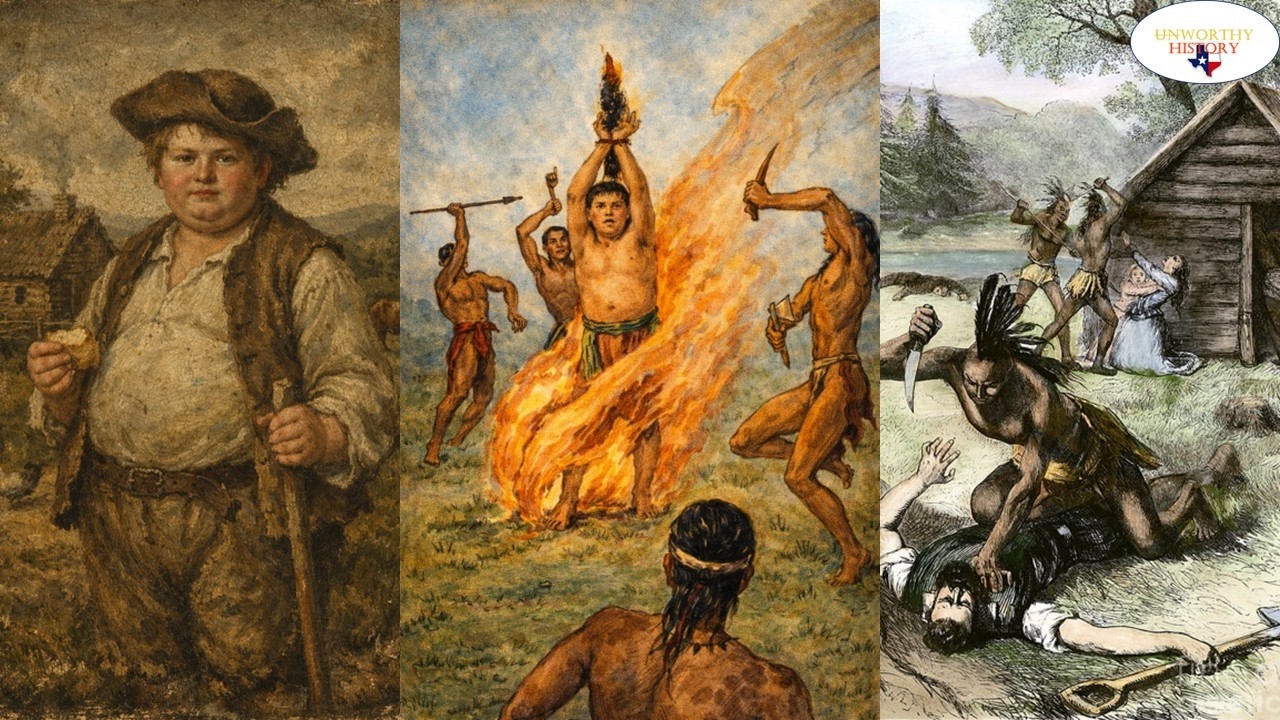
With the outbreak of the French and Indian War, the warriors had now returned, and they came to kill. When the alarm was raised, George Painter gathered his family of nine into his cellar, and roughly forty terrified neighbors crowded in with them. His two sons ran for the ridge to find a better hiding place. The attack came late in the afternoon and was swift and brutal.
George Painter attempted to flee and was shot through the body with three balls, falling dead on the spot. The others surrendered. The raiders dragged his corpse back to the house, threw it inside, plundered the dwelling of anything worth taking, and set it on fire. While the flames consumed the building and the body of George Painter, the warriors wrenched four infant children from the arms of their mothers, hung them up in the trees, and used them for target practice in a savage marksmanship contest, shooting them dead and leaving them hanging.
They then set fire to a stable containing sheep and calves and moved off with their prisoners. The raiders took forty-eight captives, among them Mrs. Painter, five of her daughters and one of her sons, a Mrs. Smith with several of her children, and a Mr.
Fisher with several of his. Among Fisher’s children was a lad of twelve or thirteen, a fine, well-grown boy, and remarkably fleshy. That boy would be singled out for a special cruelty. Two of Painter’s sons and a young man named Jacob Myers had escaped.
That night, one of the Painter boys and Myers ran barefoot in only shirt and trousers over at least fifteen miles to Powel’s Fort and Keller’s Fort to seek aid. A small party of armed and mounted men set out early the next morning and reached the ruined house by midday, but when they learned the strength of the Indian raiding party, they declined to pursue, judging themselves too weak to follow. The prisoners were marched west for six days until the war party reached their villages. A council was held, and the decision was made to sacrifice the helpless young Fisher boy.
They ordered him to collect a quantity of dry wood. The boy shuddered, burst into tears, and told his father they intended to burn him. His father replied that he hoped not and advised him to obey. When the boy had gathered enough wood, the warriors cleared and smoothed a ring of ground around a sapling and tied him to it by one hand.
They formed a trail of wood around the tree and set it on fire, forcing the boy to run around the ring until his rope wound him up against the sapling, then back out until he came into contact with the flames, all while his tormentors drank, sang, and danced around him with horrid joy. The torture continued for several hours. As the warriors became beastly drunk and fell to the ground, their squaws kept the fire going, piercing the boy with long, sharp poles whenever he slowed, until the helpless child finally fell and died in excruciating agony while his father and brothers were forced to witness the heart-rending tragedy. The captivity of the survivors stretched on for years.
After an absence of about three years, Mrs. Painter returned with her son and two of her daughters, as did Mrs. Smith, who had presented her husband with a son by a distinguished Indian chief during her captivity. Smith received his wife without maltreating her over the child, though he held a bitter aversion to the young chief.
The boy grew to manhood, showing the appearance and disposition of his father, resisted all attempts at education, enlisted in the Continental Army during the American Revolution as a common soldier, and never returned. Fisher and his surviving sons also came home. Three of Mrs. Painter’s daughters remained with the Indians.
One returned after many years of captivity, but the other two married and spent the rest of their lives among their captors. The same year brought catastrophe to another settlement. In May 1758, a party of Shawnees invested Seybert’s Fort, a small frontier post on the South Branch of the Potomac about twelve miles west of the present town of Franklin in Pendleton County. The rude log enclosure, cut out of the heart of the forest, was strong enough to have resisted any attack if those inside had held firm.
The fort served as a place of refuge for the surrounding settlements, and thirty people were within its walls when the Shawnees arrived and demanded surrender. For two days, the Indians found that neither threatening words nor bullets could move the defenders, so they resorted to strategy. They offered various propositions: surrender and their lives would be spared; refuse, and the siege would continue until every soul was massacred. The promise of safety lured the besieged from their line of duty, and they yielded quiet possession of the fort.
The whites immediately realized the horror of their situation. The Indians secured all thirty prisoners, and of the whole number, all were massacred but eleven. The most reliable account holds that ten whom the warriors wished to save were removed from the fort, while the others were tied hand and foot and seated in a continuous line upon a log. Behind each victim stood a stalwart savage, and at a given signal each sunk his tomahawk through the skull of the man before him.
The work was quickly finished, and the fort was destroyed. A youth named Dyer was spared and taken to Logstown on the Ohio, then to the Shawnee towns on the Scioto. After nearly two years of captivity, he escaped and made his way home. Of the other ten prisoners, nothing satisfactory is known.
That same fall, an incident occurred near the present village of Petersburg in Hardy County that stood without a parallel in the history of single-handed combat. A man named Bingaman lived with his family in a remote cabin. He had been cautioned against the Indians, but he was a man of determined resolution and Herculean strength, and he laughed at fear, declaring that no cutthroat savages would drive him from his home. Late one night, a party of eight Indians forced the door while the family slept.
Mrs. Bingaman was shot through the left breast but not dangerously wounded. Bingaman thrust his parents, wife, and child beneath the bed and prepared for battle. A hired man was called down but refused to come.
In the dark room, Bingaman discharged his gun, then commenced beating about at random with his heavy rifle, fighting with the desperation of a giant. One after another, he beat down the raiders before him, until of the eight only one remained, and that one, terror-stricken, fled the house to tell his tribe he had met a man who was a perfect devil. Bingaman had killed seven of his foes with his bare hands and the butt of his rifle, an achievement never surpassed. During the fight he had pulled off his shirt, and the Indians frequently grappled with their powerful antagonist but could not keep him down.
In the morning, enraged at the cowardice of the hired man, he would have killed him had his wife not interposed to save the man’s life. The elder Bingaman later moved to Natchez, where his son Adam had already settled, and there he died. The account was derived personally from the venerable William Darby of Washington City, who knew the Bingamans at Natchez and heard from each of them the recital of that terrible fight. Bingaman’s courage showed itself again in a later pursuit of retreating Indians.
A party of whites overtook the enemy late at night, and the captain ordered Bingaman to remain with the horses while the rest made the attack. Bingaman refused and followed the company. When a young man fired too early and the Indians sprang to their feet and fled, Bingaman singled out a warrior of giant-like size, threw aside his rifle to increase his speed, passed several smaller Indians in the chase, came up with his man, and with a single blow of his hatchet cleft his skull. When he returned, the captain sternly rebuked him for disobeying orders.
Bingaman replied with equal sternness, calling the captain a rascal who intended to disgrace him, and warned that one more insolent word would see the captain share the fate of the slain Indian. The captain quailed under the menace and held his peace. The Indian depredations of 1758 were particularly fatal along the frontier settlements of Virginia, and many families suffered severely and terribly.
For the settlers of the Shenandoah Valley, the brutal raids marked the end of the peaceful coexistence they had known with the native peoples, and the trust that had once existed between the two peoples would never be rebuilt.
