For nearly three decades, a 25-year-old woman’s murder remained a deliberate, silent fixture in the lives of those who loved her. Her son, only five at the time, kept her class ring, her pictures, and her death certificate as painful anchors to a question that defined his existence: who killed his mother? In the final weeks of 1997, Fort Wayne, Indiana, was deep in the holiday season. Snow lined the streets and shoppers packed the malls, but for Angela Sacco, a mother originally from Van Wert, Ohio, the season was about work and stability.
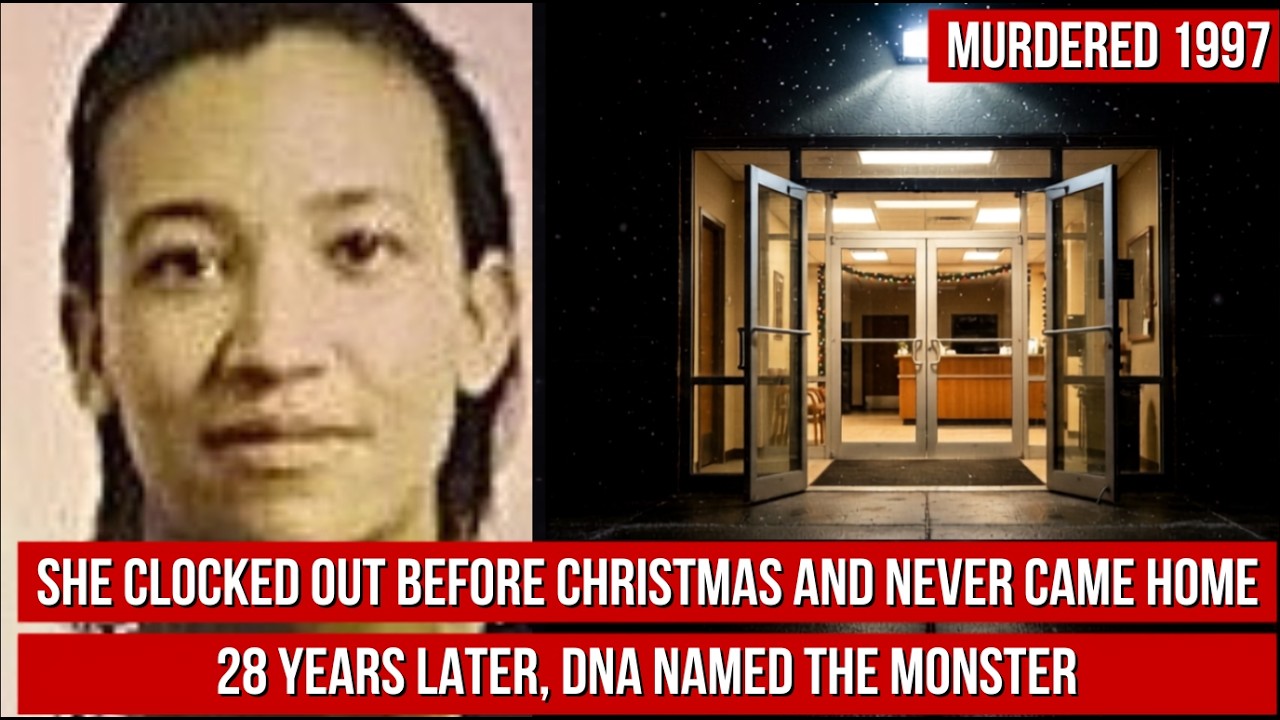
Friends remembered her as cheerful, fiercely independent, and meticulously punctual, especially when it came to returning home to her boy. On the night of December 20th, she left her apartment for a late shift at her job in downtown Fort Wayne. In the early morning hours of December 21st, she clocked out, walked through the exit doors, and vanished into the bitter Midwestern darkness. When she failed to come home, panic spread through her small circle.
Angela would never intentionally leave her son, especially with Christmas days away. That afternoon, a park ranger patrolling the isolated grounds of the Huntington County Reservoir made a grim discovery near an embankment. The property, north of County Road 100 South, was a vast, desolate expanse largely deserted in winter. The scene instantly transformed a quiet Sunday into a criminal investigation.
Angela Sacco had been found. Her life had been violently taken, and her body left in the snow. The Huntington County Sheriff’s Department and the Indiana State Police mobilized immediately. Detectives combed her background, interviewed friends and co-workers, and checked every route between Fort Wayne and the reservoir.
They spoke to anyone awake in the pre-dawn hours of December 21st. Over the first year, they conducted ninety-eight formal interviews, cataloged everyone present at her workplace, scrutinized local delivery drivers, and cross-referenced regional criminal registries. Yet every path led to a dead end. No suspicious vehicles had been spotted.
No motive could be established. The investigation ran into a wall of silence. The culprit was living completely undetected in a small neighboring town, going about his daily life as an ordinary community member, eventually taking his secret to the grave. To understand why the case remained unsolved, one must consider the technological limits facing law enforcement in the late 1990s.
Investigators had no digital surveillance, no traffic cameras, no cellular triangulation, and no instant data sharing. Forensic science was even more constrained. The autopsy confirmed that Angela’s cause of death was severe trauma from a sharp blade, consistent with a close-quarters violent encounter. But the reservoir’s geography compounded the challenge.
Accessible only by unlit county roads and deserted in winter, the location suggested the perpetrator either knew the landscape or had chosen it at random. The fundamental barrier was DNA profiling, which was in its infancy. The primary method, polymerase chain reaction testing, required large, pristine biological samples to produce usable results. Even then, DNA was only useful if detectives already had a suspect’s name.
They needed to physically obtain a comparative sample from a specific person and run a direct one-to-one laboratory comparison. If the perpetrator’s name was never generated through an interview, tip line, or physical clue, his DNA profile was meaningless. Because the encounter between Angela and her attacker appeared entirely random, no tip ever pointed toward the actual culprit. There were no eyewitnesses.
Eventually, the task force was reassigned to newer cases, and the physical evidence, including biological material recovered from Angela’s clothing, was carefully packaged, sealed, and moved into the climate-controlled vaults of the Indiana State Police evidence storage facility. For nearly three decades, those boxes remained untouched. In 2024, the Indiana State Police formed a dedicated cold case unit with one mandate: systematically review decades-old files and apply modern technology to preserved evidence. When detectives pulled Angela’s file, it was immediately identified as a prime candidate for forensic genetic genealogy.
The responding officers from 1997 had inadvertently saved the future investigation. Their meticulous handling, drying, and sealing of the biological evidence without contamination had preserved the DNA perfectly inside its sealed packaging for twenty-eight years. The cold case unit engaged Identifinders International, a California-based forensic genealogy firm specializing in cold case homicides. Their methodology differs fundamentally from standard police DNA matching.
A conventional investigation runs DNA through CODIS, which only contains profiles from individuals convicted of specific felonies or arrested for qualifying offenses. If a perpetrator commits a violent act but is never arrested again, he remains permanently invisible to the system, what investigators call the offender blind spot. To bypass it, Identifinders used single nucleotide polymorphism testing, or SNP analysis. Where traditional police DNA testing examines just twenty locations on a DNA strand to find a direct identity match, SNP testing analyzes over eight hundred thousand distinct genetic markers.
This volume of data allows geneticists to build a comprehensive map of a person’s ancestral heritage. The resulting profile was uploaded to public genealogy databases, GEDmatch and Family Tree DNA, the same platforms millions of people use to trace their family trees. Within hours, the algorithm identified several distant relatives of the unknown attacker, second and third cousins who shared common ancestors but were not themselves suspects. From there, the painstaking human work began.
Genealogists spent months constructing sprawling family trees, working backward through Indiana and Ohio public records, birth certificates, marriage licenses, obituaries, and census data. They traced lineages from the 1800s forward, tracking how families migrated and settled across northern Indiana. The objective was to find the exact point where those distant branches converged on a single male relative who was alive and present in the area in December 1997. In early 2026, after hundreds of hours of research, the family tree converged on one man: Steven L.
Schleiter. With the name finally in hand, detectives immediately began a deep examination of his background, and what they found explained precisely why he had evaded the original investigation entirely. In the mid-1990s, Schleiter had been convicted of a non-violent federal extortion offense and sentenced to incarceration in an out-of-state federal facility, completely removed from the local law enforcement networks of northern Indiana. In the spring of 1997, he completed his sentence and returned to the region.
He had been a free man for exactly five months when his path crossed with Angela Sacco. At the time of the crime, Schleiter was fifty years old, more than double Angela’s age. Having reentered the community from an out-of-state federal facility, his name appeared in no local sheriff registries. He had no personal relationship with Angela, no shared workplace acquaintances, and no connection to her social circle.
It was a completely random encounter born from proximity and opportunity, executed by a man who had stayed off the radar of all ninety-eight interviews. To legally cement the identification beyond genealogy, detectives obtained biological samples from Schleiter’s immediate lineage and ran a traditional short tandem repeat comparison against the 1997 evidence. The laboratory result was unambiguous. The probability that the DNA belonged to anyone other than Steven L.
Schleiter was virtually nonexistent. But the breakthrough arrived with a deeply bitter reality. Schleiter would never face a courtroom, never sit in an interrogation room, never hear a judge read a guilty verdict. Following December 1997, he had settled in Markle, Indiana, a quiet community just a short drive from the very reservoir where Angela’s body was found.
He lived out the remainder of his life completely unbothered, working ordinary jobs, known to neighbors as a quiet older resident, aging into his senior years without ever raising suspicion. Steven L. Schleiter died peacefully in 2021 at the age of seventy-four, carrying his secret to a local cemetery. Huntington County Prosecutor Jeremy Nix held a formal press conference to announce the resolution.
Nix stated plainly that had Schleiter been alive at the time of the DNA match, his office would have filed immediate murder charges. The case was officially closed, solved not by confession, but by the relentless march of science. For Angela’s family, particularly the five-year-old boy who had to grow into a man carrying a permanent void, the breakthrough delivered something irreplaceable. He had lived with corrosive, unanswerable questions.
Was his mother targeted by someone she knew? Was there a hidden secret in her past? Was her killer still walking the streets of Fort Wayne? The definitive identification of Steven L.
Schleiter dismantled those questions permanently, proving that Angela was an entirely innocent victim of a random encounter, and placing responsibility on a single, specific name. The case also stands as a textbook example of why evidence preservation is the most critical duty of first responders. Had the deputies at the Huntington County Reservoir been careless in 1997, contaminating the clothing, failing to dry the biological samples, or allowing moisture to degrade the materials in storage, the genetic profile would have been lost to history. The procedural discipline of those anonymous officers created the exact biological bridge that allowed scientists in 2026 to look backward through time.
Angela Sacco’s name is no longer attached to an open file. Her story has been completed by the intersection of human persistence and molecular science. A killer could hide, age, and escape into the grave, but the truth survived the decades, waiting patiently beneath a plastic seal until it was finally ready to speak.
