On a December morning in 2015, Brian Houseman was outside the Cook Funeral Home in Byron Center, Michigan, decorating a tree for Christmas when his eye caught something wrong in a nearby body of water. A large hunk of metal, shaped unmistakably like a car, sat submerged below the surface. “All of a sudden, it’s like, whoa, there’s a car out there,” he later recalled. It was no surprise, he added, that it had gone unnoticed for so long.
The water was murky, and things moved around. No one could ever see it. Alarmed, Houseman contacted the Kent County Sheriff’s Department. Investigators looked at the exact spot on Google Maps, and an overhead satellite image confirmed what Houseman had spotted: a vehicle had been sitting in the water for years, plainly visible from above.
Authorities sent a dive team down for a closer look, and shortly afterward the car was pulled from the water. The windows were so caked with algae and grime that investigators could not see inside. They could not open the doors either, so they broke the driver’s side and passenger side windows. Inside, they found the remains of a human body.
A wallet had survived alongside it. The car matched the vehicle of Davy Lee Niles, a 72-year-old man who had vanished almost a decade earlier. DNA testing confirmed that the skeletal remains were his. For the family, it was the end of a long and painful search.
His son-in-law, Scott Haway, said, “For us today, it’s a closure of a long search. Why God waited 9 years, I have no idea, but we’re happy. It’s good to have him home. ” An investigator added that there were no tracks in the grass that would have indicated an accident, but the family, he said, had long realized the man was deceased.
“My understanding is that they are relieved to have closure and to know that the body has been found. ”
Davy Lee Niles had been enduring a difficult period when he disappeared. Recently diagnosed with cancer and depression, he was last seen on October 11, 2006, parting ways with a friend at Jake’s Bar in Byron Township, Michigan. He got into his vehicle and drove away.
He was never seen again. For nearly a decade, the investigation into his disappearance turned up little in the way of positive leads. The case quickly went cold, leaving his family with nothing to hold on to. They eventually published an obituary for the elderly man, describing his passing as something of which only God knows the time and place.
A memorial was held for him in 2013, seven years after he was last seen. It was only two years later that a man decorating a Christmas tree happened to glance at the water and solve the mystery. In January 2009, nine-year-old Natalie Maltes was taken away for the weekend by her 52-year-old grandmother, Rose Maltes. The girl’s guardians became alarmed when Rose made comments that they would never see Natalie again.
Authorities later said that Rose stated she was not going to return the child, and then she left the state. She failed to answer phone calls from police and from the girl’s guardians, who lived with Natalie in Athel, Massachusetts. Investigators issued an arrest warrant for the grandmother and set about tracking the nine-year-old down. Fortunately, Natalie had her own mobile phone.
Authorities were able to reach her on the device, and her grandmother was present for the call. Law enforcement later stated that the pair were at an undetermined location in Rhode Island. Police told the press that they had been made aware Ms. Maltes might be taking the child to Rhode Island, where she had relatives, or to Louisiana, where the child’s biological mother, Marina Santos, lived.
Tracking mobile phones was still a relatively new method of investigation at the time, but law enforcement decided to give it a shot. Legislation making it possible to track the devices had only been introduced in 2005. Every time Natalie’s phone was activated, police were notified of the new GPS coordinates. Deputy Fire Chief Thomas Loia was brought in to help with the search, as he was reportedly more familiar with GPS technology than the police at the time.
He tracked the movements to an intersection on Virginia Route 11 near Interstate 81 in Natural Bridge, Virginia. To narrow down the exact place the pair might be, Loia decided to search the nearby area on Google Maps. The satellite view showed the intersection and an open field. Over the other side of the field, however, was a long building with a red roof, resembling a motel.
Loia believed it was likely that Maltes was hiding her granddaughter in one of the motel’s rooms. Massachusetts police contacted their colleagues in Virginia, who arrested Maltes at the motel, the Budget Inn. She was later extradited to Massachusetts to face charges. On the night of November 7, 1997, 40-year-old William Malt, a mortgage broker, spent time at a local nightclub with friends in Lantana, Florida.
Because he had work the next day, he could not stay out as late as the others, and he parted ways with his friends at around 9:30 p. m. Witnesses last saw him driving away in his white 1994 Saturn sedan. At some point before or during the journey, he called his girlfriend to let her know he was heading back.
William never arrived. He was reported missing the following morning, but the search was short-lived, hampered by a lack of strong leads. His vehicle was never recovered, and investigators were never able to find anything that indicated what had happened. Foul play, abduction, and an accident were all strong possibilities.
For decades, the disappearance of William Malt remained a mystery. His family, friends, and girlfriend were left with no explanation and forced to move on with their lives without closure. It was not until 2019, 22 years later, that a break finally came, at the hands of a former resident of the Grand Isle neighborhood of Wellington, Florida. While browsing satellite images on Google Maps, he spotted something odd in a lake near the 3700 block of Moon Bay Circle.
It looked sort of blocky, but zooming closer, he realized it could be a sunken white car. It was submerged in the water behind a row of homes that were built after William’s disappearance. Curious, the former resident reached out to a homeowner in the area, who used his drone to inspect the hunk of metal in the water. There they confirmed that it was indeed a sunken vehicle.
Police were called to the scene a short time later and removed the car from the water. It was an old white Saturn sedan, and a skeletal body was contained inside. Days later, on September 10th, investigators confirmed that the body was that of William Malt. It turned out that the submerged car had been visible on Google Maps since 2007.
At the time of William’s disappearance, the area had been a building site. The Palm Beach Sheriff’s Office noted that the vehicle’s exterior was heavily calcified and was obviously in the water for a significant amount of time. They concluded that it was likely William had lost control of the vehicle and crashed into the water. Although friends said he was not drunk when he left, it was possible he swerved or misjudged a section of the road.
Authorities also noted that the car had not been visible in the water back in 1997 and that it was a shift in the pond’s waters that had led to its current position. In the Belgian town of Aalden, 83-year-old Plett Landeroo was last seen on November 2, 2020. Suffering from Alzheimer’s disease, she was particularly vulnerable, but well cared for by her husband, Marcel, at their home. On the day she was last seen, Marcel stepped out into the back garden to hang up the couple’s laundry on the washing line.
He left her sitting in front of the TV with a freshly made lunch. He had no idea it would be the last time he would see his wife. When he stepped inside the house a few minutes later, she was gone. Immediately, Marcel searched the rest of the house.
There was no trace of the 83-year-old. He then frantically began knocking at neighbors’ doors, asking if anyone had seen her. They had not. He contacted the police and alerted them to the situation.
In the following hours, a search and rescue helicopter was dispatched, flying around the area equipped with thermal vision, while officers on foot scoured the surrounding streets, aided by drones and scent dogs. Despite the efforts of law enforcement, Plett remained missing as night fell. Authorities issued a missing person’s appeal, noting that the elderly woman was potentially confused and was known to knock on the doors of neighbors in a muddled state. The weeks turned into months, and the months into years.
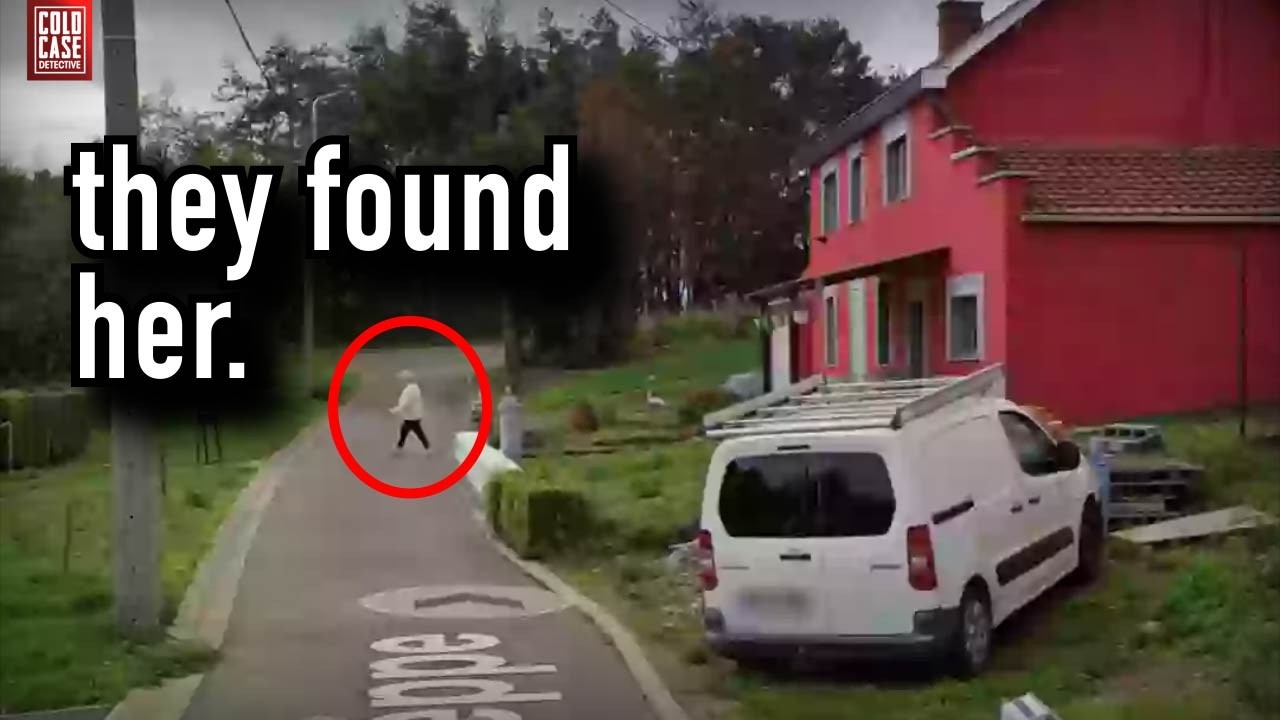
Marcel came to acknowledge the fact that he might pass away without ever knowing what became of his wife. Then, in 2022, a crack in the case emerged. A neighbor of the couple was browsing the local area on Google Maps when they came across an image of an elderly woman walking away from the Landeroos’ red-painted home. It turned out that on the day of Plett’s disappearance, Google’s Street View camera had visited the neighborhood and seemed to have captured the moment the 83-year-old left her house.
For two years, Plett’s family had theorized that she had fallen into the river close to their home. Following the discovery of the Google Maps image, police decided to reinvestigate the area, where they found answers to the case. Plett had not in fact fallen into the water, but she had sadly perished. Her remains were found at the bottom of a hill below her neighbor’s garden, amongst thick bramble.
Investigators concluded that she had fallen from an open section of the garden and taken a tumble that resulted in her death. She was likely still alive as the search for her ensued, but tragically was unable to communicate.
