On the twenty-ninth of April 1986, the Queen Mother sat in St George’s Chapel at Windsor Castle. She was eighty-five years old, and she had come to attend the funeral of Wallis Simpson. Yet for nearly half an hour of prayers, no one mentioned Wallis’s name. There was no eulogy.
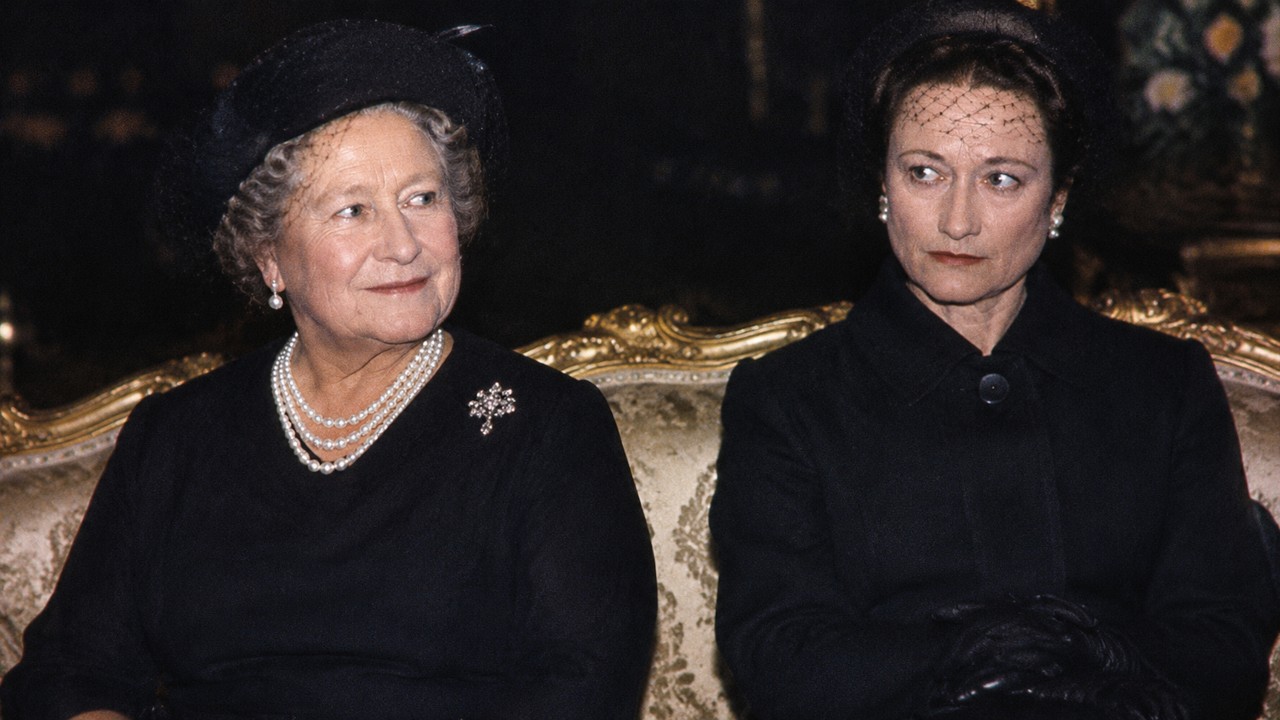
The plaque fixed to the coffin read: “Wallis, Duchess of Windsor. ” Nothing more. The style denied her by the King and Queen in 1937, “Her Royal Highness,” was still missing even now. And when the coffin was taken to the grave at Frogmore, the Queen Mother did not follow it, on the advice of the Queen.
Fifty years had passed since the abdication. What had this American done that was so unforgivable, even at her own funeral? This is the story of two women, one crown, and a feud that outlived most of those who lived through it. Two women were born four years apart.
One in a small town in Pennsylvania to a family of modest means. The other into an old Scottish aristocratic family. Neither was born into the royal family. Between them, they would shape the British monarchy for most of the twentieth century.
The gap between them remained for the rest of their lives. The story began with the American girl. Bessie Wallis Warfield was born on 19 June 1896 in Blue Ridge Summit, Pennsylvania. Her family roots were in Baltimore, a respectable family but not wealthy.
Her father died while she was still an infant. She married young. In 1916, she became the wife of Earl Winfield Spencer Jr. , a US Navy aviator.
The marriage failed and ended in divorce in 1927. One year later, she remarried. Her second husband was Ernest Simpson, an Anglo-American shipping businessman. With him, she crossed the Atlantic to begin a new life in London.
The Scottish girl had a very different beginning. Elizabeth Angela Marguerite Bowes-Lyon was born on 4 August 1900. Her father was Claude Bowes-Lyon, the 14th Earl of Strathmore and Kinghorne, and her mother was Cecilia Cavendish-Bentinck. To American ears, an earl sits in the middle of the British peerage, below a marquess and a duke.
But the Strathmore family were old Scottish nobility, seated at Glamis Castle in Angus. Still, she spent much of her childhood in a quieter English home, St Paul’s Waldenbury in Hertfordshire. Set the two lives side by side and the personalities look like two different countries. One was the ninth of ten children in a family that owned a castle and an earldom.
The other lost her father before she could know him. By the end of the 1920s, the American had married twice, in 1916 and 1928, ending the first marriage by divorce in 1927. The Scotswoman had married once, in 1923, after refusing the man at least twice. One of the women had learned that marriages could end.
The other was about to learn what a marriage could cost. The man she refused was Prince Albert, Duke of York, the second son of King George V. The family called him Bertie. He was shy and stammered.
He had not been prepared to take the throne; his older brother was the one who would be king. Elizabeth was wary of royal life and wanted a private life first. She said no. And when she finally said yes, they married at Westminster Abbey on 26 April 1923.
Two daughters followed. Princess Elizabeth was born on 21 April 1926, and Princess Margaret on 21 August 1930. The Duke and Duchess of York formed their small family inside a large and very formal one. Here lies the first clue to what happened later.
The woman who hesitated to join the royal family, once inside it, wanted something very simple from it. She wanted it kept above any controversy. Her husband was not prepared for the throne, and she feared any pressure that might fall on him. In the meantime, in London in 1931, Wallis was introduced to Edward, Prince of Wales, heir to the throne.
His family called him David. Within three years, Wallis would become the woman at his side. The first meeting between the two women came on ice. According to one account, Wallis may have first met the Duchess of York at an ice-skating party near Fort Belvedere in January 1933.
The Fort was the Prince of Wales’s country retreat in the Great Park at Windsor. Royal Lodge, the York family’s country home, stood nearby in the same park. Wallis wrote about that evening in a letter, as quoted by a modern historian of royal women. “The weather is cold for England now,” she wrote.
“Since we arrived, we have been skating with the Duke and Duchess of York. Isn’t that too funny? ”
The Duchess left her own record of that year, and the weather was colder. On 1 August 1933, she wrote to her mother-in-law, Queen Mary.
She said that Papa had mentioned hearing that a certain person was at the Fort while she and Bertie were there. Then came the lines that historians still argue about. “Relations get a little difficult when tiresome ladies are brought in,” she wrote. “So far, we have not met this lady at all.
And I should like to remain quite outside the whole business. ”
Who was that lady? It is not as clear as it seems. In the summer of 1933, the Prince’s favourite was still Thelma Furness, and the dates fit her better.
One modern historian of royal women reads the letter as a reference to Wallis and suggests the Duchess had already met her on the ice. The letter itself is genuine. But what it meant remains guesswork either way. What the letter shows is the Duchess’s first instinct.
She did not want to be part of it. She wanted to stand aside with her husband and daughters, and let the Prince’s private life stay private. In 1934, Wallis replaced Thelma Furness as the Prince’s companion. Standing aside was no longer possible.
Long afterward, Wallis wrote that all her husband wanted from his family was a simple thing: to be received just once. The Duchess of York would be remembered for a different phrase. The world says that all her life she refused to speak Wallis’s name, calling her only “that woman. ” Whether those words were ever really hers is one of the questions this story must answer.
In 1933 she wrote that she wished to remain quite outside the whole business. Within two years, the business was waiting for her in the sitting room of the Fort. Fort Belvedere stood in the Great Park at Windsor, near Royal Lodge, and from 1934 the two women met there from time to time. The Fort was the Prince of Wales’s country retreat, the house where he gathered the company he chose.
From 1934, the woman at the centre of that company was Wallis Simpson. The Yorks were part of the Prince’s world because he was family and because he had been kind to them. Elizabeth would later remember that kindness warmly in a letter to him. In the early years of her marriage, David had helped her and Bertie.
He was the brilliant brother, and they were the quiet couple next door. That arrangement worked until the brilliant brother brought an American married woman into the middle of it. Wallis saw the Duchess on several occasions during those years. Two decades later, she recorded her impressions with great care in her own memoirs.
“I had seen the Duchess of York on several occasions before, at the Fort and at York House,” she wrote. “Her much-talked-of charm was very evident. I also noticed the fineness of her skin and the almost startling blueness of her eyes. ” It is a kind passage.
It is also a careful one, written by a woman who knew that its subject had by then become the Queen Mother, and much loved. What Wallis said in the privacy of the Fort’s sitting room was reported by others quite differently. The most famous story dates from early 1935. According to the writer Greg King, the Duchess of York entered the sitting room at the Fort to find Wallis imitating her.
The Duchess stood silently at the door. Then she left. The same accounts say she replied in kind, and is said to have responded some time after with a skilful imitation of Wallis’s American accent. Every word of that scene is second-hand.
It appeared in King’s book, and before that in a book called Royal Feud, published by Michael Thornton in 1985. That book has a mixed reputation. When it appeared, the writer Brian Masters reviewed it in The Spectator and was sharply critical, objecting to the use of anonymous private information whenever the Duchess was shown in a bad light. His verdict was blunt: the failure to distinguish reliable sources from weak ones is what separates the popular journalist from the historian.
In Thornton’s account, as Masters summarised it, Wallis mocked Elizabeth’s modest taste in clothes and her affected manner. So the imitation is only a story. It may be true. But it is told on the word of people who were not in the room.
Other people who met Wallis in those years left first impressions, and they were not always kind either. Henry Channon, the Conservative MP whose diaries became famous, first described her as a nice, quiet mouse of a woman with enormous startled eyes and a very large mole. Society watched her closely and recorded what it saw. The same caution applies to the nicknames.
Greg King writes that Wallis privately called the Duchess a “fat Scottish cook,” a “vulgar Duchess,” and the “Monster of Glamis. ” Those three phrases rest on a single source, so they should be treated on that basis. They have a legendary ring, the kind of thing people wished Wallis had said. Another story, told by the historian John Van der Kiste, has the Duchess being told that Wallis joked in February 1936 that she had not worn black stockings since she stopped dancing the can-can.
It is gossip about gossip, a joke passed on to a woman who was not there to hear it. Behind all these stories lies something simpler and more constant. Two very different women were placed in the same rooms again and again by a man who loved one of them and had once been a help to the other. One was a Scottish earl’s daughter who married into the royal family and wanted it kept above controversy.
The other was an American who had married twice and had no place in that family at all except the standing the Prince gave her. From the Duchess’s side of the sitting room, her point of view can be imagined from what she wrote later. She would have seen the heir to the throne, the man who would one day be Supreme Governor of the Church of England, infatuated with a woman who had a living ex-husband and a current husband at her side. She would have seen her own husband, the shy second son, standing next to the brother whose choices would shape his life.
The Duchess’s fear went beyond Wallis herself to what Wallis might do to the institution that supported her husband. Bertie stammered. He smoked heavily. He had not been raised to carry the crown.
But scandal at the top of a family does not stay at the top. It rolls downhill onto the people who have to stand beside it in public. For Wallis, the view across the same sitting room looked different. She was a guest in a world with rules she had not been raised to.
The Duchess of York was the smiling face of those rules. To imitate her, if Wallis did, was to mock an entire system that was quietly judging her and finding her wanting. And to be imitated in return, if she was, was to learn that the system could laugh too. Neither woman left a full record of those evenings.
What remains of them is thin. Each, in different ways, knew exactly what the other represented. Long afterward, the Duke of Grafton offered a kinder reading of her view. He said she never said anything bad about the Duchess of Windsor, except that she did not really know what she was dealing with, if he remembered correctly.
That was the heart of it from the Duchess’s side. For her, according to that account, Wallis was not so much evil as a woman who had no idea what she was dealing with. Then on 20 January 1936, King George V died. The Prince of Wales became King Edward VIII.
The man who had been at the Fort became the man on the throne, and the woman at his side became the King’s companion. That spring, the new King bought an American station wagon, and one afternoon he decided to show it to his brother. In 1936, such a car was almost unknown in Britain. Wallis told the story herself twenty years later in her memoirs.
It is the only real portrait she ever painted of the Duchess, and every line of it is worth hearing. “That spring,” she wrote, “David bought a new American station wagon, a type of motorcar almost unknown in Britain at that time. One afternoon, David said, ‘Let’s drive over to Royal Lodge. I want to show Bertie the car.
’” One account dates the visit to April. The party set out from the Fort, Wallis and three other guests with the King. At Royal Lodge, the Duke of York examined the car. Wallis remembered him as quiet and shy, and quite obviously suspicious of this new American innovation, until his brother explained its merits as a shooting car, to carry guns and beaters on a day’s shooting.
Then Bertie began to take to it. The King wrote warmly about his brother’s wife in his memoirs, published years later. In A King’s Story, published in 1951, he wrote that in 1923 his brother Bertie had married the daughter of a Scottish earl, Lady Elizabeth Bowes-Lyon, who brought to the family a quality of invigorating freshness. That was the woman Wallis was taken to meet.
It seems he expected that invigorating freshness to embrace his companion as he had. The two little princesses came to tea. Wallis wrote that they were blond, with beautiful manners, and had such fresh and bright looks that they seemed to have stepped straight from the pages of a picture book. Their governess, Marion Crawford, was at the tea as well.
Then came the passage that would haunt Wallis for the rest of her life. “David and his brother’s wife kept up a conversation with his brother, exchanging only occasional words,” she wrote. “It was a pleasant hour, but I left with the distinct impression that while the Duke of York had been won over to the American station wagon, the Duchess had not been won over to David’s other American interest. ”
It is an accomplished sentence, and it is cruel in a very precise way.
Wallis knew exactly what she had seen. In Wallis’s account, the Duchess was charming, and the conversation flowed between her and the King. Wallis published that in 1956, when the Duchess was the mother of the Queen, and the English-speaking world could read it. In memoirs that were cautious toward the Duchess, that sentence was the only one with a sharp edge.
The governess who had been at the tea had her own story to tell. Marion Crawford later wrote a book about her years with the princesses, titled The Little Princesses, published in 1950. In 1949, the Queen objected to it, partly because it revealed her coolness toward Wallis Simpson. Summer brought another public evening.
Wallis wrote that David decided to give another dinner party at York House, his London residence, on 9 July. The Duke and Duchess of York were there, as were the Churchill and Hor families. Wallis recorded what happened next with great coolness. The Court Circular listed all the guests, and no one who read it could miss the absence of Ernest.
To an American reader, the Court Circular was the official daily record of the royal family’s engagements, printed in the newspapers. To have your name in it without your husband was a statement to the whole nation. The dates of that summer read like a slow drawing of the lines of division. On 20 January, the old King died.
In April, by most accounts, came the tea at Royal Lodge. On 9 July, the dinner at York House with the Churchill and Hor families, and the printed record of Ernest Simpson’s absence. Three months, two houses, one dinner table, and a list of names in the newspapers that told everyone who read it where the King’s heart lay. According to John Van der Kiste, after Edward came to the throne the Yorks no longer visited Fort Belvedere.
That short drive through the Great Park was no longer made. The reasons were never recorded that spring, but the position was easy to understand. The man who had helped her and Bertie in the first years of their marriage was now King, and a married woman was taking a place beside him that the Court Circular itself recorded. To be friendly with Wallis would have looked like approval.
To be cold risked a breach with the King. According to Wallis’s account, what she met at Royal Lodge was a charm that stopped at the borders of herself. Not everyone in society shared the Duchess’s view. Henry Channon, who had once called Wallis a quiet mouse, had changed his mind by 1936.
He now saw her as a woman of charm, tact, poise, and intelligence. He went further. She would have made an excellent Queen. He was much less generous about Bertie, whom he once described as utterly uninteresting, featureless, and terribly dull.
To a diarist like him, the Yorks were dull and Wallis was dazzling. In later years he would call her a slightly vulgar little American. So even her admirers could turn on her. In 1936, at least one shrewd observer in London looked at Wallis and saw a possible Queen.
The Duchess of York, as her letters would soon show, saw something else. Wallis, for her part, was good at reading a room. She saw the Duchess’s charm and saw where that charm ended. Years later she would sum up what she saw in that single sentence about a station wagon.
By the end of that summer, the Yorks had stopped visiting the Fort. The King was planning a holiday in Scotland. He would spend September at Balmoral, the royal castle in the Highlands, and Wallis would accompany him. On 23 September 1936, the Duke and Duchess of York opened the new buildings of a hospital in Aberdeen.
It was a civic occasion, and British Gaumont News cameras were there to film the royal couple at the opening. Aberdeen got its royal visit. But it did not get the King. The invitation had been offered to him first.
Wallis explained in her memoirs why he refused. Some months before, the Aberdeen authorities had asked him to open some hospital buildings, but he refused, being still in deep mourning for his father, and delegated the task to his brother, the Duke of York. It was a reasonable excuse. His father had died that January.
It was natural for a king in mourning to hand such duties to his brother. But what he did that day instead was not reasonable at all. The King was staying at nearby Balmoral. On the same day his brother and sister-in-law stood before the crowds at the hospital, the King drove himself to Aberdeen, to the railway station, to meet a train.
On that train was Wallis Simpson. She told the story in a tone of wronged innocence. The next day, we all took the train to Aberdeen, she wrote, and David was waiting for us at the station. A courteous act on his part that was to drive another nail into the structure of growing public misunderstanding.
She added that it was unfortunate luck. By another of those unfortunate coincidences, my arrival in Aberdeen was on the very day of the ceremony. Aberdeen did not see it as a coincidence. Two months later, the American magazine Time reported that Aberdeen’s citizens were annoyed that King Edward, instead of opening their new hospital, had met Mrs Simpson at their railway station.
A private secretary, never named in the accounts, is said to have put it more sharply. It did him more harm than anything else, and lost him Scotland. According to one report, graffiti appeared reading “Down with the American whore. ”
For the Duchess of York, no record survives of any words she spoke about that day.
She performed her duty in place of the King before the cameras on the same day he went to the station. He had refused the ceremony months before on the grounds of mourning. But the day he chose to appear in Aberdeen was the day Wallis’s train arrived. Then everyone went on to Balmoral.
Wallis loved the place. “I enjoyed every minute of my stay,” she later wrote. Her memoirs list the great names at the castle that September: the Marlboroughs, the Buccleuchs, the Sutherlands, the RoseBerrys. Among them was a married American woman who had not yet divorced her second husband.
The Duke and Duchess of York were not staying at the castle. They were at Birkhall, their own house within the Balmoral estate. It was a small detail, but it meant a great deal. On that estate and in that September, the Duchess was the first lady.
The King had no wife. Many later writers say Wallis took over that role. The historian Lucy Moore put it plainly in an Observer article in 2002: Mrs Simpson even acted as hostess at Balmoral. Brian Masters, in his review of Royal Feud, said she took over the role of hostess at Balmoral with arrogance.
To an American ear, the hostess at a great house is more than a woman who pours tea. She is the one who receives the guests. At dinner, she sits in the place of honour. When the meal ends, she rises first and leads the ladies out of the dining room.
To act as hostess is to act as the lady of the house. At Balmoral in 1936, the lady of the house should have been a Queen. From this came the most famous story of all. It comes in two versions, and they do not match.
In the first version, told by Lucy Moore in 2002, the Duke and Duchess of York came to dinner at the castle. Elizabeth walked past Wallis without stopping and said sharply, “I have come to dine with the King. ” She sat at his right. After dinner, it was she who rose to lead the ladies out, not Wallis.
In the second version, told by Greg King in his 1999 biography of Wallis, the scene is shorter and sharper. Wallis extended her hand. Elizabeth refused the greeting and said loudly, “I have come to dine with the King. ” King writes that the Yorks were the first to leave.
A woman passing another. A woman refusing a handshake. In one version, the Duchess controls the evening; in the other, she leaves it early. Both versions were written more than sixty years after the dinner, and neither names a guest who witnessed it and spoke of it at the time.
Wallis’s memoirs do not mention the evening at all. So this story belongs for now to the anecdotes the family told about itself. It may be true in substance. A woman who stood in for the King at an Aberdeen hospital while he met Wallis’s train had every reason to be cold at his table.
But the exact words, the passing by, the refused handshake, the early departure — all of these are hearsay. If you add up the numbers of that September, the scale of the insult is clear. One hospital opened by the brother who was asked as second choice. One railway station where the King was instead.
One castle housing the Marlboroughs, the Buccleuchs, the Sutherlands, and the RoseBerrys under its roof. A smaller house, Birkhall, on the same estate, where the senior royal lady was staying. And two versions of a single sentence written sixty years after the night they describe. What is beyond doubt is the nature of that month.
On the day of his brother’s public duty, the King went to meet Wallis’s train. And in his Highland castle, by more than one account, he allowed her to stand where a Queen stands. Her letters, as later published, continue the story a few weeks later when the private relationship became a crisis of state. A month after Balmoral, in a courtroom in Ipswich, Wallis Simpson’s second marriage began to end.
On 27 October 1936, an Ipswich court granted Ernest Simpson’s wife a decree nisi. To an American ear, the decree nisi was the first preliminary stage of an English divorce. Once it became final, Wallis would be free to marry again. The problem was that the man was the King.
And the King’s position made that marriage nearly impossible. He was Supreme Governor of the Church of England. In 1936, that Church did not permit the remarriage of divorced persons while a former partner was still living. Wallis had two former partners still alive.
Prime Minister Stanley Baldwin would not accept her as Queen. Nor would the Dominion governments — the self-governing states of the Empire that shared the King as sovereign. In mid-November, Bertie brought her the news of the crisis. Around 17 November, the Duchess of York wrote to Queen Mary.
Her letter still exists, published later by her official biographer. “Bertie has just told me what has happened, and I am overwhelmed with horror and emotion,” she wrote. “My first thought was for you. ” Then came a line that left no doubt how she saw the predicament.
“One feels so helpless against this obstinacy. ” And finally, a prayer. “May God help us all to be calm and wise. ”
She called it obstinacy.
In the weeks that followed, the King chose Wallis over the crown. A compromise was floated that November. It was called a morganatic marriage. To an American ear, a morganatic marriage is one in which the wife does not take her husband’s rank, and her children have no right to the throne.
Wallis would be the King’s wife, but not Queen. But Baldwin and the Dominion governments would not accept that either. It was rejected. The Duchess of York had no doubt about it.
On 6 December 1936, she wrote to her sister, May Elphinstone. This letter is among the clearest statements about Wallis in her published correspondence. And it is much more about the crown than about Wallis as a person. “I feel so deeply for him,” she wrote.
“But the point is so clear. If Mrs Simpson is not fit to be Queen, she is not fit to be the King’s wife in a morganatic marriage. The Crown must come above everything. ”
Note the opening words.
“I feel so deeply for him. ” There is no triumph in the letter, no rancour. It reads like the letter of a woman who has reached a hard conclusion and does not enjoy it. Then she states it without softening a single word.
Before Bertie’s crown, before his illness, before all the slights that came later, she had a principle. The Crown must come above everything. A woman with two living ex-husbands could not stand beside the Crown under any circumstances. If she was unfit for the front door, she was unfit for the side door too.
The rules of psychology ask their question here. Why would a woman who twice refused a royal marriage, who was wary of royal life, defend the Crown with such ferocity now? Her private letters suggest an answer. She had married into the royal family.
She had given the monarchy two little princesses. She believed the Crown must remain above controversy. And she saw one man’s obstinacy dragging it toward scandal. If the King left, the Crown would fall on her shy, stammering, unprepared husband.
In the final days of the crisis, she was confined to bed by illness. Her private letters confirm it. The sources do not name the illness. She could not be at the centre of events.
She watched them come to her in her room. It was, and remains, the only voluntary abdication in British history. The end dates came quickly. The decree nisi at Ipswich on 27 October.
The horrified letter to Queen Mary around 17 November. The letter to her sister on 6 December. Four days later, on 10 December, the King signed the instrument of abdication. On the 11th, it took effect.
Less than four weeks separated the letter of horror from the morning she woke up as Queen. Before he left, she wrote to him. It is an exceptional letter, warm from its first words. “Dear David,” it begins.
“I am so miserable at not being able to come to Royal Lodge because of my illness in bed, as I did so want to see you before you went away to say: God bless you from the bottom of my heart. ” “We are all so miserable and can only pray that you will find happiness in your new life. ” Then she looked back. “I often think of the old days and how you helped Bertie and me in the early years of our marriage.
” In the published lines, Wallis’s name does not appear. The letter blesses him and ignores her completely. When Edward reached France after the crossing, he sent a telegram to his brother, the new King. “Crossing was good.
” “I hope Elizabeth is better. ” “Best wishes and good luck to you both. ” It is a cheerful message from a man who had just handed his brother the heaviest burden in the kingdom. And it asks after the brother’s wife who had been confined to bed.
Years later, she looked back at that December with a strange mixture of sadness and fairness. “It was an awful shock to everyone when he decided he must go,” she said, in words published later by her official biographer, William Shawcross. That shock changed everything for her. The woman who twice refused a royal marriage was now Queen Consort.
Her elder daughter, Princess Elizabeth, would one day be Queen too. Her husband, who stammered, would now have to reign for the rest of his life. He was shy. His health was not strong.
He smoked heavily. He had never been trained for the work that suddenly fell on him overnight. And his wife knew better than anyone how much it would demand of him. For Wallis, that same December was a catastrophe of a different kind.
She had lost any hope of becoming Queen and gained only the man. And the new Queen had already written in a private letter the reason she was wholly unfit. The coronation was set for May. By then, a question reached the Home Secretary’s office that would turn the new Queen’s principle into law.
What exactly should Wallis be called? In late April 1937, the Home Secretary sat down to write to the Prime Minister about the style of address. His name was Sir John Simon. The question before him looked small, the kind of thing genealogists argue over.
What should the wife of the former King be called once she married him? To an American ear, the answer seems obvious. By ancient custom, the wife of a royal duke shares his rank. By that custom, when Wallis married the Duke of Windsor, she would become Her Royal Highness, the Duchess of Windsor.
Later, Wallis described the decision that followed as a defiance of all conventions. But “Her Royal Highness” is a courtesy style, not an official one. It does not come automatically with marriage. It is granted by the Sovereign through a formal document called letters patent.
And the Sovereign who can grant it can, in principle, withhold it. Here the monarchy revealed itself as a machine. The family’s private feelings were about to pass through the Home Secretary, the Cabinet, the Prime Minister, and the official gazette of the realm, and come out the other end as law. Sir John Simon’s letter still survives in the Home Office files.
Its date is uncertainly written as 26 April, with a question mark beside the day. In it, he told the Prime Minister exactly who wanted this barrier. “You know how strongly the King and Queen desire to establish this position,” he wrote. He added a second name.
“I think the Queen Mary also has strong views that it should be done, if possible. ” The King and the Queen. The Queen in that sentence was Elizabeth. That single line is the best documentary evidence of her role in what followed.
When the decision reached the Duke, it was presented to him as advice from the ministers. The Home Secretary’s own words named the new King and his wife first. On 12 May 1937, George VI and Queen Elizabeth were crowned. The decision about Wallis was still being drafted.
Not everyone thought it wise. On 24 May, the Duke’s adviser, Walter Monckton, wrote to the Home Secretary with a warning. “I think there is a real risk of a complete family breach, which can be neither easily mended nor kept quiet. ” Time would test that warning.
The matter went before the Cabinet on 26 May. It was Stanley Baldwin’s last Cabinet as Prime Minister. Afterwards, as the file records, the Prime Minister made the formal recommendation to the King. The letters patent were dated the next day, 27 May.
On the 28th, they were printed in the London Gazette, issue number 34402. The language is dry and legal, and it is devastating. The text said the Duke was entitled to hold and enjoy for himself only the title, style, or attribute of Royal Highness. But his wife and descendants, if any, were not to hold the said title, style, or attribute.
Count the steps in that machine and the dates fall one after another like closing doors. A letter from the Home Secretary dated 26 April with a question mark. A coronation on 12 May. A warning on the 24th.
A Cabinet on the 26th. Letters patent dated the 27th. A Gazette on the 28th. Issue 34402.
Six steps in just over a month. At the end of it, a married woman who would not share her husband’s rank. Walter Monckton brought the news to the Duke. He carried with him a letter from the King explaining that he had received advice from the Prime Ministers of Britain and the Dominions.
Wallis recorded the Duke’s reaction in her memoirs. “I know Bertie. I know he would never have written that letter by himself. Why in heaven’s name are they doing this to me at this time?
” He was right that Bertie had not acted alone. The Home Secretary’s file names the King and Queen together. Wallis wrote about the decision with great self-control. “The effect of this decision was to debar me, in defiance of all conventions, from taking my place at the side of my royal husband,” she said.
Then she claimed not to care. “This distinction did not seem to me particularly important. ” But she knew what it did to him. Nothing hurt David more in the aftermath of the abdication than that unprovoked stab.
And she saw where it would lead. The barrier remained, and as long as it remained, David would never be reconciled. Why did the King and Queen want it? No document fully explains their reasons, but one reading infers them from what Elizabeth had already written.
A woman unfit to be Queen is unfit to be a King’s wife under any circumstances. Calling Wallis “Her Royal Highness” would have accepted her, in the language of the court, into the family. There may have been a second, more private reason. When the official biography of the Queen Mother by William Shawcross was published in 2009, a critic in the Washington Times summarised one of its findings.
The critic wrote that King George and Queen Elizabeth remained strongly opposed to recognising the Duchess of Windsor as a Royal Highness, not least because King Edward VIII had lied to them about his personal wealth. The details of the settlement between the brothers were not set out in that review. But if the summary is correct, the barrier was built partly from a sense that they had been deceived. A week after the Gazette, on 3 June 1937, the Duke married Wallis at the Château de Candé near Mons in France.
No member of the royal family attended. Not his brother, not his mother, not the sister-in-law he had once helped in the early years of her marriage. Even the date was offensive. 3 June was the birthday of King George V.
Queen Mary, in a letter to Queen Elizabeth on 21 May, is said to have considered the choice of that day a deliberate insult. The two Queens, old and new, were corresponding with each other about Wallis in the very weeks the barrier was being built. That line would be watched for the rest of Wallis’s life. Decades later, in 1965 and again in 1967, the accounts still recorded precisely to whom she curtsied and to whom she did not.
The curtsy was a small movement. It defined who was royal and who was not. So the wedding came, and the bride entered her new life as Duchess of Windsor — a duchess by marriage, a noblewoman, but not of the royal family. In the eyes of the court, she was a woman the family did not know.
Monckton had warned of a family breach that could not be hidden. The breach was now written into law, signed by the King and printed in the Gazette. Two years later, as Britain entered the war, the Duke brought his wife to England for the first time since the abdication. The family had to decide whether to meet her.
On 12 September 1939, HMS Kelly waited at Cherbourg to carry the Duke and Duchess of Windsor across the Channel. Britain had been at war with Germany for nine days. Nearly three years had passed since the couple had last been in England. The journey began with an offer.
When war broke out, his brother the King wanted him back in Britain quickly. According to Greg King’s account, the Duke was offered a choice between two posts. He could be Regional Commissioner for Wales, or he could join the British Military Mission at French General Headquarters at Vincennes. But there was a painful condition.
He was told that he and the Duchess could not stay in a royal residence in England. At first, he refused the whole offer. A close friend lost patience with him. “You two think only of yourselves,” the friend said, according to King’s account.
“You don’t realise that there is a war on at this moment. ” The Windsors packed. At Portsmouth, someone made sure they were not entirely ignored. Winston Churchill arranged a naval guard of honour on the quay, and a Royal Marines band played as the couple came off the ship.
That was Churchill’s welcome. The family’s welcome was another matter. The Palace refused their request for somewhere to stay. It refused to provide a car.
They spent their first night in England with Sir William James, the Commander-in-Chief at Portsmouth. After that, they went to stay with friends, Fruity Metcalfe, the Duke’s former equerry, and his wife Lady Alexandra. An equerry, to an American listener, is an officer serving in the royal household, part aide and part companion. The former King of England was now a guest in the house of his old equerry.
Lady Alexandra Metcalfe watched it all and felt the pain on his behalf. “I do think the family could have done something,” she said, as King records. “It just seems as though he does not exist at all. ”
On 14 September, the Duke met his brother.
He told the King he wanted the post in Wales. By then, the King was aware of the press coverage of the return, and he withdrew the choice. Instead, the Duke was given the post in France, and learned of it from someone other than the King. He met no other member of the royal family during that visit.
According to the King’s account, they all stayed away. The Duchess was not received at all. The same account records Queen Elizabeth asking what to do about Mrs “S,” though those words in the accounts have never been verified as hers. No meeting with Wallis is recorded.
If you put the visit in numbers, it looks painfully small. Nearly three years of absence. A crossing on the 12th. A guard of honour at Portsmouth, arranged by a politician rather than a brother.
One night with a naval commander. A borrowed house. A single meeting with the King on the 14th. No royal residence, no royal car, no other royal face.
By the end of September, the Duke and Duchess were back in France. He to the Military Mission at Vincennes, she to Paris. The Queen’s own view appears in those weeks in a letter she wrote in September 1939. The published sources do not name its recipient.
Its lines are harsh. “The people will not forgive quickly what he did to this country, and they hate her,” she wrote. She underlined the word “hate. ” Then she closed with a phrase that could have come from any aggrieved aunt in any family in Britain.
“What a curse to have a ‘black sheep’ in the family. ”
The letter gains its importance from its date. Bertie had been King for barely three years. The long burden of war awaited him, and so did his early death.
The anger was already set. She believed the people had not forgiven the abdication, and that they hated Wallis. It is possible she was describing her own feelings as much as theirs. The war deepened the suspicion.
In 1937, the Windsors had visited Nazi Germany. In 1940, an incident occurred in Lisbon. Those events are a story of their own. For this story, what matters is what they did to the King’s confidence.
In 1942, George VI wrote to Winston Churchill in words later quoted by the biographer Anne Sebba: “I do not trust the Duchess’s loyalty. ” He added that he had consulted his family, and that they shared his views. It is very likely that family included his wife. In 1940, the Duke became Governor of the Bahamas.
He held the post until 1945. The Queen’s view of that appointment survives in another letter mentioned by Shawcross, though its recipient is unverified. “A very difficult situation will arise because of his wife,” she wrote. “A woman with three living husbands will not be acceptable to the good people of the islands.
” The three husbands were Earl Winfield Spencer, Ernest Simpson, and the Duke himself. It is a sharp phrase, and it is entirely her own voice. From Nassau, Wallis tried a different door. She wrote to Queen Mary, her mother-in-law, a woman who had never received her.
The letter took a careful route through the Bishop of Nassau. Wallis later printed the letter in her memoirs. “It has always been a source of sorrow and regret to me that I have been the cause of any breach that exists between a mother and her son. ” It is a humble letter.
It asks for nothing but understanding. The only reply was a single line included in a letter Queen Mary wrote to her son. “Send a nice message to your wife. ” The message was addressed to his wife without naming her.
Wallis included that reply in her memoirs too. This, then, was the shape of exclusion in its early years. The barrier of 1937 was the withholding of the title. The barrier of 1939 was a door closed in wartime.
A car refused. A family drawing away. The barrier of the 1940s was distance. An island in the Atlantic, and an American wife, in the Queen’s own words, with three living husbands.
Each step was quiet. Only the first was printed for the public. Each one told Wallis the same thing. By the end of the war, the family had made her the woman who stood between the Duke and his country.
When peace came, the Duke began making the journey to London again and again. Each time, he came alone. In the year immediately after the war, the former King made several trips to London, and each time his wife stayed behind. Wallis described those trips in her memoirs with unusual sadness.
She understood exactly what he was doing. “In a subtle way, he was reminding the Government and his brother that he was available and willing to continue to serve,” she wrote. But these hints fell on barren ground. The Queen had her own view of where that ground ended.
According to her official biographer, her opinion of the Duke after the war was that he could not live here permanently because of his wife. It is a short phrase carrying a great deal. The Duke was her husband’s brother, a former King, a man she had once loved as family. He could visit, but he could not come home, because the woman he married could not accompany him.
Wallis was the stated reason. Whether she was the only reason is another matter. Here is the fourth reason in the story, and the most personal. Many years later, the Queen Mother looked back on the abdication and said something revealing.
She said he could not come back, in words published by Shawcross. “You cannot have two Kings. ” The historian Philip Ziegler recalled that she said almost the same thing to him in the form of a question. “You can’t have two Kings, can you?
”
Oddly, the same woman could speak of his marriage with something like generosity. “The only good thing is that I think he was very happy with her,” she said once, in another sentence published by Shawcross. In that sentence at least, she seems to have granted Wallis something. But it did not change her view of where they could live.
Two Kings. That was the fear behind the policy. Edward was a charismatic man and a familiar face, and he had worn the crown. If he came back to live in England with the woman for whom he had given up the throne, he would form a rival court.
Every dinner party they gave would be compared to the King’s. Every smile in the newspapers would be a reminder of the man who had held the crown first. And Bertie, shy and stammering, would have to reign in his brother’s shadow. The rules of psychology now turn to Wallis, because her side of the story is the mirror image.
What did she want? Her memoirs, published in 1956, are careful about almost everything. But they are frank about this. “The Duke’s one wish was modest,” she wrote.
“All he specifically asked was something very simple. That I be received just once by the King, his brother, and the Queen, so that by that single gesture of hospitality I might wipe out the stigma of never having been received since our marriage by the royal family, his family. ” To be received, in the world of the court, meant to be accepted. The woman the King and Queen received had been seen, acknowledged, accepted.
The woman never received was, socially, a woman the family did not know. Wallis was a duchess. She was the wife of a former King, and she was a stranger to his family. She did not pretend to be above caring.
“To pretend that I did not want this recognition would be hypocrisy,” she wrote. “I felt almost as strongly as David that I deserved it. ” Then came the sentence that explains her whole life after the abdication. “I was afraid of being condemned to spend the rest of our lives together as the woman who had come between David and his family.
”
That is the woman who said in the same book that the title “Her Royal Highness” did not seem particularly important to her. Both statements can be true at once. The title itself, three words on an envelope, may not have mattered. But what it stood for mattered enormously.
It was the family’s judgement on her, written and printed in the Gazette. The King, for his part, felt he had already been generous. In 1949, according to the writer Anna Pasternak, he wrote to his brother in words that sound weary and wounded. “I made your wife a Duchess in spite of what happened in 1936.
You should be grateful to me for that. But you are not. ” In the same year, according to another report, Queen Mary gave her view on the question of the title. “To give her this title would be disastrous,” she was quoted as saying.
Queen Mary had not changed her mind since 1937. There was still the matter of money, the reason raised in 1937. The reviewer of Shawcross’s book pointed to a lie about the former King’s private wealth told to his brother and sister-in-law. Whatever the sums, the records do not document them, and so must this story.
But if the review is correct, the Queen’s coldness carried a memory of being deceived. And so the reasons pile up one on another. There was the Crown, which had to be kept above controversy. There was Bertie, who had to be protected from a rival court.
There was the money and the sense of a lie. And beneath it all, there was the man himself, her brother-in-law, whom she had once loved as family and could no longer allow to come home. The Duke’s feelings surfaced in two very different voices. In public, he remained polite.
In 1951, he published his memoirs, A King’s Story, said to have earned him a million pounds. In it, he wrote warmly of his brother’s wife, who had brought a spirit of invigorating freshness to the family. In private, in undated letters later published by Michael Bloch, he is said to have called his relatives “a hateful bunch of snobs. ” The public book praised the Queen.
The private letters cursed the family. It cost the Duke the life he wanted. It cost Wallis the one thing she asked for. After the war, the former King went to London alone, hinted at what he wanted, and came back empty-handed.
Wallis waited for an invitation that never came. Then in September 1951, the King entered hospital for an operation on his lung. The operation was for cancer. He had less than five months to live.
On the night of 5 February 1952, King George VI died in his sleep at Sandringham. He was fifty-six. His wife was fifty-one. In one night, she turned from Queen to widow, and her elder daughter became Queen Elizabeth II.
The medical record is clear. The King died of a coronary thrombosis — a clot in the arteries of the heart — with cancer of the lung as an underlying factor. In September 1951, he had undergone surgery on his lung. He was a heavy smoker.
His health had never been strong. Bertie’s reign had been short and hard. He came to the throne unprepared, in the shadow of his brother’s choice. He reigned through a war.
And he did it all while stammering. His wife stood beside him through all of it, and she saw with her own eyes the price he paid. But a widow’s grief does not read a death certificate. Over the years that followed, the conviction settled into every biography of her that the burden of the Crown had shortened his life.
And the Crown came to him because his brother chose Wallis. This is the second reason. It is the one most people know. The biographer Greg King wrote that she continued to blame the Duchess for her husband’s early death.
In 2011, a report on American National Public Radio put it the way the world had long repeated it. “She has always been said to have blamed Wallis for the early death of her husband Bertie. ” King goes further and writes that she considered Wallis “the woman who killed my husband. ” There is no letter, no diary, no witness that dates or places those words.
It is a belief passed on by biographers. It must be treated as such. The 1939 letter is the useful reference here. The Queen’s anger was already fixed thirteen years before the King’s death, before the long wear of war had exhausted him.
Death turned a feeling that already existed into a permanent one. From the night of 5 February, the old quarrel had a grave at its heart. Wallis seems to have understood that at once. As the Duke prepared to leave for his brother’s funeral, she warned him, according to King.
“Don’t mention or ask for anything about my recognition. ” It was not the moment, and she knew it. She did not go to the funeral. An Associated Press photograph, dated 8 February 1952, carried a caption: “Sad journey alone.
” The caption spelled it out. The Duchess, never accepted by the royal family, would remain in the country. The Duke’s own statement was quieter. “It is all the sadder for me because I am making it alone.
The Duchess is staying here awaiting my return. ”
The numbers of that winter mark a turning point in the story. An operation in September 1951. A death on the night of 5–6 February 1952.
A King at fifty-six. A widow at fifty-one. A photograph on the 8th. And only a year later, on 24 March 1953, the death of Queen Mary, who had held strong views against Wallis since 1937.
At the funeral, the Duke saw his sister-in-law, now the Queen Mother. What passed between them reaches us mainly through his letters to Wallis, quoted later by Shawcross. “Cookie,” he wrote, using the Windsors’ pet name for her, “was sweet as I told you. ” According to one formulation, he also told Wallis that the Queen Mother listened without comment, and that it was good to talk about Bertie with someone who had known him well.
Sweetness on the surface, silence beneath. In the same letters, his bitterness surfaced. “It is hell to be dependent even to this extent on those icy-blooded women,” he wrote. One historian of royal women reads that phrase as directed at Queen Mary and the Queen Mother.
A newspaper in 2022 did not name the targets. Either way, it shows what the Duke felt when he looked at the women of his family. He felt cold. The Duke had a phrase for his mother too.
In the letters Bloch later published, he described her as “hard as nails. ” A year later, she died. He wrote about her in harsher terms. “My grief was mixed with disbelief that any mother could be so cruel and so harsh to her eldest son,” he wrote, according to King.
Those words, and his other icy phrases of that spring, were about Queen Mary alone. He wrote of his mother: “Ice instead of blood in the veins must be a good preservative. ” That phrase, too, was about Queen Mary alone. The Queen Mother should never be held responsible for it.
But it reveals the atmosphere in which the Duke and Duchess of Windsor lived. The family was, for them, a wall of ice. Then came the coronation. On 2 June 1953, the Queen Mother’s daughter was crowned.
The Windsors were not invited. They watched the ceremony on television in Paris, at the home of Margaret Biddle. A Press Association report, decades later, said the main reason was the young Queen’s wish that they not be there. The report did not mention her mother’s feelings, and no one should guess them.
But the young Queen had grown up in her mother’s house through the abdication, the war, and the long exclusion. This is the climax of the feud. And it is a quiet climax. No one shouted.
At least not in any surviving record. A King died. His widow believed what she believed. A Duchess stayed behind while her husband went to bury his brother.
A new reign began without them. The exclusion that began as a principle in 1936 had, by 1953, become a matter of grief. From now on, whatever Wallis did, she would remain the woman whose marriage had placed a fragile man on the throne. The Queen Mother had her grief, and a reason that no argument could change.
Three years later, Wallis published a book. In it, she settled a small account of her own. In 1956, a London publisher, Michael Joseph, issued memoirs titled The Heart Has Its Reasons. Its author was the Duchess of Windsor.
The book became a bestseller. It is remarkably restrained. It names no nicknames. It omits the Balmoral dinner entirely.
It does not mention the death of George VI or the death of Queen Mary. The biographer Charles Higham later called it a work of self-beautification. Wallis smoothed every phrase that could have made the family look cruel, and every phrase that could have made her look bitter. Except one.
The station wagon at Royal Lodge, and the Duchess who had not been won over to David’s other American interest, appeared in print for everyone to read. One sentence in a long memoir. The woman it described was by then the Queen Mother. Wallis kept her claws sheathed for almost the whole book and showed them in a single line.
In private, the claws showed more. The Windsors’ letters, published by Michael Bloch in 1988, two years after Wallis’s death, used code names for the family. The Queen Mother was “Cookie. ” She was also called “Mrs Temple.
” Her daughter, the young Queen, was “Shirley Temple,” or simply “Shirley. ” The Duke used “Cookie” as much as Wallis did, and most of the documented uses come from letters of the 1950s. Why “Cookie”? The common explanation, repeated by writers ever since, is that it mocked her plump figure and likened her to a Scottish cook.
That explanation is itself hearsay, and should be treated as such. But it fits the other stories: the alleged mimicry, the whispered mockery of her clothes and her gentleness. It was the laughter of two people exiled to the outside, aimed at the woman who held the key. It was never recorded whether the Queen Mother ever saw those letters.
They were published in 1988 when she was still alive. Wallis was not. So here is the third reason, and it worked on both sides. The Queen Mother’s coldness was met with mockery, and that mockery, had she known of it, would only have made the cold harder.
Each side had its weapons. Hers were absence and silence. Wallis’s were humour and mocking nicknames. For years, neither side laid down its arms.
Other visitors to the Windsors in those years left their own impressions. Between 1955 and 1958, the writer James Pope-Hennessy was researching the official life of Queen Mary, and he went to see them. He found Wallis baffling. He described her as “one of the strangest women I have ever seen.
It is impossible to assess what makes her tick or why. ” He also judged her, on the whole, a stupid woman with a fierce capacity for concentration. He described her as flat and angular, a woman who could have been designed for a medieval playing card. The Duke told him his mother was a cold woman who never “talked to me about this thing.
” The records do not say precisely what that thing was. In 1963, Wallis was asked in an interview whether she would ever become a Royal Highness. Her answer, as quoted by Greg King, was one word: “Never. ” Then she offered her own theory of why.
“I think the refusal to give me rank equal to my husband was perhaps intended to make things difficult for us. ”
The first sign of change came in 1965. In February, the Duke underwent surgery in London for a detached retina. Wallis stayed at Claridge’s hotel.
The family came to visit him. On 15 March, the Queen visited, and Wallis curtsied to her. The Queen stayed half an hour. On the 17th, the Princess Royal came for forty-five minutes.
On the 25th, the Queen returned and agreed that the Duke and Duchess would one day be buried at Frogmore, the royal burial ground at Windsor. Three days later, on 28 March, the Princess Royal died, eleven days after her visit. Princess Marina came too. When Wallis curtsied to her, Marina embraced her.
“That was one of the most moving moments,” Wallis later said. “It meant so much to David because George had meant so much to him. ”
The numbers of that spring are a small record of kindness. Half an hour from the Queen on the 15th.
Forty-five minutes from the Princess Royal on the 17th, eleven days before her death. A second royal visit on the 25th, and with it a promise of a burial plot. An embrace from Marina. The Queen Mother was not recorded among the visitors.
Two years later, the two women finally stood in the same room. On 7 June 1967, the Queen unveiled a memorial plaque to Queen Mary on the wall of Marlborough House, on the centenary of her birth. Unusually, the Duke and Duchess of Windsor were invited. It was the first public royal occasion to which they had been invited together.
According to Greg King, the Queen Mother initially refused to attend if Wallis was invited. She relented, perhaps because the Duke of Gloucester would not have attended otherwise. That day, Wallis curtsied to the Queen. But she did not curtsy to the Queen Mother.
The two women shook hands. “How nice to see you,” the Queen Mother said, and moved on. At the end of the ceremony, as she was leaving, the Queen Mother turned toward Wallis with a perfect curtsy, the kind she had practised all her life. “I do hope we meet again,” she said.
Wallis replied with one word. “When? ” The Queen Mother made no further answer. A Daily Express report that day, as quoted by King, described it as the first meeting since 1936 between Wallis and her sister-in-law.
Thirty-one years had passed since the abdication. No source has been found to record any kiss between the two women that day. So the cold, brief handshake at Marlborough House was the first thaw, five years before the funeral that most people remember. It was a simple thing.
A handshake without a curtsy. A courtesy. And a question left hanging in the air. Wallis asked the only question that mattered.
The Queen Mother had no answer for it. Five years later, the answer came in the form of a death. On 18 May 1972, the Queen sat for about half an hour with her dying uncle in Paris. Two years earlier, in January 1970, the Duke and Duchess had given a television interview with the BBC journalist Kenneth Harris.
Asked about regrets, Wallis answered lightly: “Oh, about certain things, yes. I wish things could have been different. ” Then she waved it away. “We have had some difficult times, but who hasn’t?
” She made no direct comment about the Queen Mother. Now the difficult times were nearly over. She was on an official visit to France. The Duke was very ill.
By the King’s account, he weighed less than six stone — about eighty-four pounds. Still, he rose to greet her and said, “I am not too bad. ” Wallis was not comforted. After the visit, she said the Queen’s face showed no sympathy.
The Duke of Windsor died at about 2:20 in the morning of 28 May 1972, at his home in Paris. He was seventy-seven. The Queen sent a telegram saying, “I am so glad I was able to see him in Paris 10 days ago. ” Now the family had to do what it had avoided for thirty-five years.
It had to receive Wallis. On 2 June, she flew to England on a Royal Fleet Auxiliary aircraft. Lord Mountbatten, according to one account, helped her down the steps. She was taken to Buckingham Palace and stayed there as a guest.
After a lifetime of waiting to be received, she was finally received — as a widow, for a funeral. She was in no state to enjoy it. She was suffering from mental confusion caused by arteriosclerosis, and she was anxious about one meeting above all others. Hugo Vickers recorded it in his biography of the Queen Mother.
Wallis was nervous about meeting the Queen. Mountbatten tried to reassure her. “Your sister-in-law will receive you with open arms,” he told her. The Queen Mother did not quite open her arms.
According to Vickers, Wallis met her only once during her stay, on the day of the funeral. The Queen Mother had a mild case of shingles, and she was absent from a dinner that Wallis attended with the Queen and Prince Charles. One lady-in-waiting said she was perfectly all right about meeting the Duchess. The writer Elizabeth Longford described the funeral as a great ordeal for her.
Meanwhile, the Duke’s body lay in state in St George’s Chapel at Windsor. The accounts differ on how long, with one saying two days and another three. The Times reported the queue barriers stretched half a mile down the castle hill. Add up the numbers of those two weeks and you see how much of the man was left and how many came for him.
A body weighing less than six stone. An old man of seventy-seven, dead at 2:20 in the morning. A royal visit of about half an hour. Lying in state for two or three days, with a queue half a mile long.
And finally, a burial attended by only about fourteen people. The funeral took place on 5 June 1972, in St George’s Chapel. The service was conducted by the Dean of Windsor, Lancelot Fleming. “Wallis was tense and distracted throughout,” wrote Andrew Morton.
Beside her, the Queen was kind. Clarissa, Countess of Avon, watched the Queen show a tenderness like that of a mother or a nurse, putting her hand again and again on the Duchess’s arm or glove. That hand belonged to the Queen alone. Wallis noticed what the Queen Mother was wearing.
According to King’s account, she said something oddly touching about it. “I really must copy that outfit,” she said. Then she thought of how David would have laughed. After the service, at the reception, came the moment toward which the whole long story had been moving.
The Queen Mother sat down beside Wallis on a sofa. She had been a widow for twenty years. Wallis had been a widow for only eight days. According to Greg King, the sole source for this moment, the Queen Mother said, “I know how you feel.
I have been through the same experience. ” It is a perfect sentence. It is a kind sentence. It is a true sentence.
And it reveals nothing. One widow comforting another, as any decent woman would. Yet the husband she had lost, by her own settled belief, had died young because of the woman sitting beside her. If the sofa sentence is accurate, it may have been the wisest and most careful thing she ever said.
The burial at Frogmore was private, with about fourteen people at the grave. That was the grave the Queen had promised seven years earlier beside a hospital bed in London. A small piece of England where the Windsors were finally promised a place to rest. Then Wallis returned directly to Paris the same day, without a royal escort to the airport, according to King’s account.
Her own verdict on the visit was quiet and devastating. “They were polite to me. Polite and kind, especially the Queen. But they were cold.
David always said they were cold. ”
There is another theory about that sofa, and it is only a theory. In 2011, the biographer Hugo Vickers said on American radio: “My theory is that the Queen Mother was actually in love with the Duke of Windsor. ” He was not the first to think it.
On the day of the funeral, 5 June 1972, Diana Mosley wrote a letter saying that “Kick,” the Mitford family’s name for the Queen Mother, had been somewhat in love with him. Lord Lexden, writing about Vickers’s work, put it more delicately. She kept a special place for the Duke in the depths of her heart. This may be true.
A woman who had once addressed him as “Dear David” and remembered how he helped her in the early years of her marriage may well have felt more than she could say. But nothing she wrote proves it. This theory explains a great deal, but it rests on very little. It must remain a theory.
The Duke was gone. Wallis had fourteen years to live, and the family’s last courtesy was waiting for her at the end. The house in the Bois de Boulogne grew very quiet after 1972, and a lawyer took charge of it. Her name was Suzanne Blum, and after the Duke’s death she obtained power of attorney to manage Wallis’s affairs.
What followed is told in the accounts as a long, slow fall. Wallis broke her hip at the end of 1972, then broke ribs again in 1973. In February 1976, she collapsed and was taken to hospital. Vickers says they thought she was certainly dead.
From 1980, she was in a wheelchair and fed by spoon. Later, she lost her sight. By early 1984, she was paralyzed and being fed intravenously. Hugo Vickers described the house as a kind of living grave, and described Blum as a diabolical figure wearing a cloak of good intentions to hide her inner evil.
The writer Caroline Blackwood, who wrote a book called The Last Duchess based on those years, described something cruel and mad in the lawyer’s frantic, glittering eyes. The Countess Mountbatten said simply, “The lawyer took over all those beautiful things. ” In Blackwood’s words, Blum warned her, “I won’t sue you. I’ll kill you.
” Pamela Hicks remembered that her father, Lord Mountbatten, struggled endlessly to make Wallis return the royal possessions in her keeping, and never succeeded. Pamela Hicks said Wallis had dementia and a terrible lawyer controlling her life. There is a story from those years about flowers. One historian of royal women writes that in 1976, on a visit to Paris, the Queen Mother was told Wallis was too ill to receive her, and sent a large bouquet of roses with a card conveying her best wishes.
This story has no reference, and the visit itself has never been independently confirmed. The wording attributed to the card often comes only from a review of a dramatised television series. If the roses were sent, they are the kindest thing in this story. If not, they are the legend people wanted.
Wallis died on 24 April 1986, at her home in Paris. She was eighty-nine. Diana Mosley spoke with startling frankness. “It wasn’t a life at all.
I am glad to hear she is dead. I wish she had died years ago. ”
When the Burkes Peerage foundation demanded that Wallis be posthumously granted the title “Her Royal Highness,” the Guardian reported that the Palace received the request coldly. The same paper reported that her friends in Paris believed she had been obsessed with a desire to find more understanding or sympathy from the family.
All that was offered was the right to be buried at Frogmore. And so the story returns to the chapel. On 29 April 1986, about 175 mourners filled St George’s Chapel. The Queen was there with Prince Philip, Prince Charles, the Princess of Wales, and Princess Anne.
Princess Alice, Duchess of Gloucester, the other surviving sister-in-law, attended. Margaret Thatcher came, and so did Neil Kinnock. Lady Alexandra Metcalfe was there, the woman who had hosted the Windsors in her home in 1939 when the family refused to. The Duke and Duchess of Marlborough attended, a name on the Balmoral guest list of fifty years before.
And the Queen Mother, eighty-five years old, sat in her place. The memorial service lasted about half an hour. It was conducted by the Dean of Windsor, Michael Mann. There were no eulogies and no direct reference to the Duchess.
The only personal words were a prayer for “our sister. ” The plaque on the coffin read: “Wallis, Duchess of Windsor, 1896–1986. ” The Archbishop of Canterbury gave the final blessing. Then the coffin was taken to Frogmore.
About fifteen people stood at the grave. The Queen was among them, with Prince Philip, Prince Charles, the Princess of Wales, and seven members of Wallis’s household from Paris. The Queen Mother was not there. She stayed away from the graveside on the advice of the Queen.
At the grave, according to Ingrid Seward’s account, the Queen wept, and Diana later said it was the only time she had seen the Queen cry. The numbers of that day are the last record of the enmity. One hundred and seventy-five mourners in the chapel. About half an hour of prayer, with no eulogy.
About fifteen people at the grave. A widow of eighty-nine in the coffin. A widow of eighty-five in the pew. Fifty years since the abdication.
Fifty-three since the ice-skating party. Did she hate her? The world has always said so. Her Reuters obituary said she harboured a grudge against Wallis.
Ingrid Seward wrote that her attitude toward the Windsors amounted to a grudge. Yet those close to her said the opposite. Her lady-in-waiting, Frances Campbell-Preston, spent years trying to persuade people that the Queen Mother did not hate the Duchess of Windsor. The Duke of Grafton remembered her saying simply of the Duke, “We loved him.
”
The historian Philip Ziegler weighed it all and reached a surprising verdict. He wrote that the Duchess certainly hated the Queen Mother. But he also wrote this. Queen Elizabeth was as responsible as anyone for the fact that the Duchess was never fully accepted by the royal family.
And the famous words: no letter, diary, or eyewitness has ever been found recording that she called Wallis “that woman. ” The first use found in print was in an American magazine, Life, in March 1941. Even Anne Sebba, who used the phrase as the title of her biography, wrote that it came from the Queen Mother’s alleged refusal to mention Wallis’s name. “The woman who killed my husband” is a belief reported by one biographer.
“I have come to dine with the King” is a story told two ways, sixty years later. Her recorded feelings were also filtered. Her daughter Margaret, according to one report, destroyed some of her letters. When the rest were published, one critic noted that they revealed nothing new about what she thought of Wallis Simpson.
What survives in her own hand points to a colder place than the legend. The hatred was never that sharp, personal rage the stories imagine. It was colder and more permanent than that. A policy wearing the mask of a grudge, carried out through absence.
A withheld courtesy. A refused car. A husband received alone. A question left unanswered.
A grave she did not stand beside. Long ago, in one of the letters Bloch published, the Duke wrote a line that summed up their entire exile. “If only we could be asked to tea just once. ” The invitation finally came for a funeral.
The Queen Mother outlived Wallis by nearly sixteen years. She died on 30 March 2002, at Royal Lodge — the house where Wallis had once had tea with her and left certain she was not welcome. She was 101 years and 238 days old. About two hundred thousand people filed past her coffin in Westminster Hall.
She was buried beside King George VI in the memorial chapel at St George’s — the same chapel where she had sat through Wallis’s funeral. In December 1936, before any of it happened, she wrote the principle that would govern everything that followed. The Crown must come above everything. Both women now lie at Windsor.
One in the chapel beside the King she married. The other at Frogmore beside the King who gave up his throne for her. The barrier the King and Queen wanted in 1937 stood to the grave.
On one of the coffin plaques, three words are still missing.
