“Don’t get excited,” the New York Times advised its readers in the winter of 1914. “Look the new form squarely in the face. ”
The new form was the federal income tax return, number 1040. The first ones were due on the first of March, and fewer than one American in two hundred would need to fill one in.
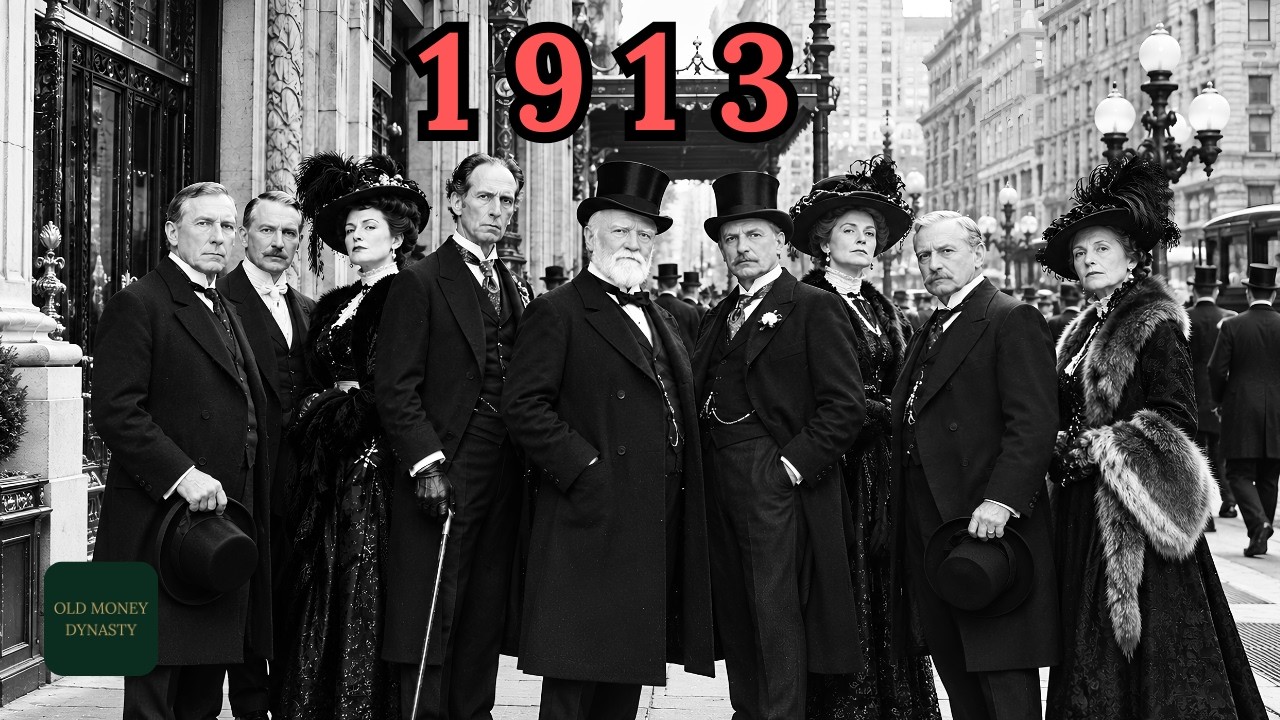
The people it was really written for lived on Fifth Avenue and along the Hudson. One estimate in circulation put the annual bill of John Rockefeller at close to two million dollars. The same guesswork gave Andrew Carnegie nearly six hundred thousand and the Vanderbilts about a hundred thousand. For most of the forty years before that, what the richest families in the country earned had been known to their bankers and to nobody else.
The United States had taxed incomes once, to pay for the Civil War, at rates that reached ten percent, and let the tax lapse in 1872. When Congress tried again in 1894, the new tax was carried to the Supreme Court within months and killed there. So how did the richest families lose the second time? Part of the answer goes back to that courtroom and to a vote that has never been explained.
The justices divided on the tax in April of 1895. Four against four, with one chair empty. It belonged to Howell Jackson of Tennessee. He was at home outside Nashville with tuberculosis, and he had been too ill to hear a word of the argument.
That May, he got out of bed and went to Washington to cast the one vote that both sides were waiting for. Philander Knox had a week left as Secretary of State when he signed the certificate on the twenty-fifth of February, 1913. It declared that a new amendment had become valid to all intents and purposes as a part of the Constitution of the United States. Knox had spent most of his working life in the service of large fortunes.
He had been counsel to the Carnegie Steel Company and the company lawyer through the strike at Homestead. When Andrew Carnegie sold out to J. P. Morgan, Knox was one of the men who put together United States Steel.
Now his signature certified the power to tax fortunes like those of his old clients. The amendment itself is a single sentence. It gives Congress the power to lay and collect taxes on incomes, from whatever source derived, without dividing the burden among the states by population. The law that put that power to use was written in the months that followed by a Democratic Congress.
Its income tax was drafted mostly by a congressman from the Cumberland Hills of Tennessee named Cordell Hull. He had been born in a log cabin, the son of a farmer who went into the lumber trade. He had been pressing for an income tax since he first came to Washington. Hull wrote the tax to reach backward.
Everything a man earned from the first of March 1913 would count, although the bill itself was not finished until October. J. P. Morgan died in Rome on the last day of that March, one month into the first year the tax would cover.
His estate ran to tens of millions of dollars, a large share of it in art. No federal tax on estates existed to touch any of it. For the living, the terms were simple enough. A single man kept his first three thousand dollars a year, and a married couple kept four thousand.
Above that line, the government took one cent on the dollar. Most wage earners made well under three thousand a year and would never see the form. The fight in the Senate was over the top of the scale. On the twenty-eighth of August, a handful of insurgents tried to raise the rates on the largest incomes, and one after another they were voted down.
Miles Poindexter of Washington asked for ten cents on the dollar above half a million and twenty cents above a million. Under the bill as it stood, he told the Senate, “A man with a million a year would pay the same top rate as a man with a hundred thousand. ” He got twelve votes. The law that finally emerged still went further than the bill he had attacked.
Its extra charges on large incomes climbed in steps from one cent above twenty thousand dollars to six cents above half a million. With the basic cent added, the top rate came to seven. The man who would have to collect it, the commissioner of internal revenue, William Osborne, had been in the job since April. Woodrow Wilson signed it at ten minutes after nine on the evening of the third of October.
What he talked about that night was the tariff, which the same bill cut. The business of the country had been set free, he said, from the conditions that made monopoly easy and natural. The income tax rode into law inside a tariff act almost as an attachment, under the names of Oscar Underwood of Alabama and Furnifold Simmons of North Carolina. The law also reached into certain payments before they arrived.
Banks and corporations paying interest to bondholders had to hold back the one cent at the source. Families who lived on the coupons of their bonds met the tax before they met the money. The Treasury printed the return in four pages, three of figures and one of instructions, under the heading “Return of Annual Net Income of Individuals. ” The penalty for missing the deadline was set in capital letters: twenty to one thousand dollars.
The capitals were a sensible choice. That May, while the bill was still in Congress, New York State had chartered the Rockefeller Foundation. Within a year, one hundred million dollars of Rockefeller money had been paid into it. Congress had refused to charter it at all.
The attorney general under Taft had objected to placing so much power in a small body of men. They would be in absolute control, he warned, of the income of a hundred million or more. It is often said that the foundation was built to escape the new tax. Its own first annual report dates the original charter bill to March of 1910, three years before there was any income tax to escape.
And in 1913, no American could deduct a gift to charity from his income at all. The deadline for the first returns fell on a Sunday. That night, the collector in the New York customhouse kept his office open until midnight, and some of the last filers came in through a snowstorm. About 358,000 returns arrived for that first short year.
Together, they paid about twenty-eight million dollars, a small fraction of what Washington spent in a year. The richest taxpayer in the country was not in New York for any of it. John Rockefeller was in Ohio, spending the winter in a house the family normally used in summer. A physician would later swear in a federal court that it had been important to the comfort of Laura Rockefeller that her husband should be with her.
It mattered, he said, to the proper treatment of her illness. The family called her Cettie. Her older sister, Lucy, known as Lute, had lived with them for years and was ill that year as well. Both sisters had first met John Rockefeller in Cleveland more than half a century earlier, when all three were taking lessons in bookkeeping.
The house was Forest Hill, on the eastern edge of Cleveland. Rockefeller had bought the land in the 1870s for a water cure resort that failed. The family arrived on the twenty-fourth of June, 1913. The purpose, as the court later put it, was spending the summer season.
Then the return to New York was deferred, in the same court’s words, from time to time. He turned seventy-four that July. The Supreme Court had broken Standard Oil into more than thirty separate companies two years before, and he still owned roughly a quarter of every one of them. Ohio law made the delay expensive.
Anyone who lived in the state on the annual listing day had to list all his property for taxation. Stocks and bonds counted wherever the certificates happened to be kept that winter. The day fell on the third of February. When it came, Rockefeller was still at Forest Hill.
The county entered him on its rolls with intangible property of $311,422,337. That was about three times the hundred million he was putting into his new foundation. The tax on it came to roughly a million and a half dollars. That was about half a cent on every dollar he owned, charged every year, where Washington was only taxing what he earned.
Four weeks later, the federal return fell due as well. His dividends escaped the new one cent because the companies that paid them had already been taxed on their profits. The extra charges on large incomes still applied. On an income his size, they came to six cents on nearly every dollar.
Money made within the law, Rockefeller told a newspaper man in 1914, was not something the public had any right to share. The Ohio claim he could fight on the facts. The state taxed its residents, and he had made his home in New York for thirty years. His lawyers asked the federal court in Cleveland to stop the county.
The federal claim rested on the Constitution now, which made it harder ground. Still, the last time Congress had tried to tax incomes like his, the question had gone to the Supreme Court, and a New York lawyer named Joseph Hodges Choate had been there to argue it. How do you take a tax to court when federal law says nobody may sue to stop one from being collected? The answer in 1895 was a Massachusetts man named Charles Pollock, who owned ten shares in the Farmers’ Loan and Trust Company of New York.
He sued his own bank and asked the courts to forbid it from paying the new tax. A second suit against another New York trust company was argued alongside it. The tax in question was two percent on any income above four thousand dollars, attached to a tariff act the summer before. It even counted money received by gift or inheritance as income for the year.
President Cleveland disliked the whole act enough to let it become law without his signature. Perhaps one American in a hundred would have paid, and most of the money would have come from a handful of states in the Northeast. In the House, a Nebraska Democrat of thirty-three named William Jennings Bryan had turned the rate into a dare. Of all the mean men he had known, he said, he had never met one he would insult by calling his patriotism less than two percent deep.
Pollock was represented by Choate, a leader of the New York bar, who would later serve as ambassador in London. The court then sat in the old Senate chamber of the Capitol, and the argument ran across five days in March. Choate told the justices that the act of Congress he was attacking was “communistic in its purposes and tendencies. ” He went on to call the principles behind it socialistic, and then, reaching for a newer word, populistic, as any ever put to a political assembly.
The attorney general, Richard Olney, answered for the United States. The argument turned on an old clause in the Constitution. A direct tax had to be divided among the states according to population, so that each state paid by headcount rather than by wealth. If an income tax counted as direct, it was finished.
Mississippi would owe nearly as much per person as New York and would have to raise the money from far poorer people. On the eighth of April, the court gave half an answer. By six votes to two, it held that the tax on income from rents and on the interest paid by state and city bonds could not stand. On everything else, on salaries and profits and dividends, the eight justices sitting divided four against four.
Stephen Field, at seventy-eight the oldest man on the bench, wrote an opinion of his own. His brother Cyrus had laid the first telegraph cable across the Atlantic. Lincoln had appointed him in the middle of the Civil War, and in 1881 the court on which he sat had upheld the Civil War income tax. This one he regarded as something else.
“The present assault upon capital is but the beginning,” he wrote. “It will be but the stepping stone to others, larger and more sweeping, till our political contests will become a war of the poor against the rich. ”
A tie decided nothing beyond the case in front of it. The losing side asked for the whole question to be argued again before a full bench, and the court agreed to hear it in the first week of May.
The missing justice had come down with tuberculosis within a year of joining the court. He was at West Meade, his house outside Nashville, and he was dying. The eighth of April, the day his colleagues divided without him, was his sixty-third birthday. Howell Jackson left his sick bed at West Meade early in May of 1895 and made the journey to Washington.
He was a Tennessee Democrat and a former senator whom a Republican president, Benjamin Harrison, had put on the court barely two years before. The two men had sat side by side in the Senate and become friends. Harrison had lost the election of 1892, and a Senate run by Democrats was unlikely to confirm a Republican in the weeks he had left. So he chose a Democrat he knew.
During the Civil War, that Democrat had enforced the Confederate law for seizing the property of Union loyalists in West Tennessee. Jackson came back to Washington sooner than he had expected to for this one case. He sat through all three days of the new argument, the sixth, seventh, and eighth of May. Every lawyer in the room could count.
Every one of them knew that the only vote not yet on record was his. The Chief Justice, Melville Fuller of Chicago, read the decision on the twentieth of May. The income tax of 1894 was void in every part. The vote was five to four.
Jackson was among the four. He had voted to uphold the tax, together with John Marshall Harlan, Henry Billings Brown, and Edward White. The count does not work unless somebody moved. The tax had four supporters on the bench in April, and Jackson made a fifth.
For it to lose by a single vote, one justice who had stood with the tax in April must have crossed over in May. None of them ever said who. The newspapers settled on George Shiras of Pittsburgh. The Chicago Tribune had reported in April that he was leaning toward the tax, so the papers had a name ready.
A Memphis paper announced a radical change in his opinion the next morning, though he had announced nothing at all. It was never proved. Historians have since made the case for Horace Gray and for David Brewer instead. One of the biographers of Brewer gave the only answer the record supports, which is that no one knows.
Nine men sat in that building, and not one of them ever told. The dissents used language that judges rarely use about their colleagues. Harlan wrote that the decision gave certain kinds of property “a position of favoritism and advantage inconsistent with the fundamental principles of our social organization. ” Henry Billings Brown, a Republican from Detroit, called it “nothing less than a surrender of the taxing power to the moneyed class.
” He hoped, he wrote, that it would not prove the first step toward the submergence of the liberties of the people in a sordid despotism of wealth. Jackson wrote a dissent of his own and delivered it from the bench. He called the ruling “the most disastrous blow ever struck at the constitutional power of Congress. ” Coughing fits stopped him several times in the course of the forty-five minutes it took him to deliver it.
Then he went home to Tennessee, to West Meade, which stood beside the Belle Meade horse farm that his wife’s family had made famous. He died there on the eighth of August, eighty days after the vote he had come to Washington to cast. The following spring, Congress ordered the returns destroyed. Every individual return and the collectors’ lists of tax already paid went to a committee on the fifth of May 1896, and all of it was burned.
The Democrats wrote the grievance into their platform that summer. “But for this decision by the Supreme Court,” it said, “there would be no deficit in the revenue. ”
In Chicago, Bryan won the nomination for president with a speech still remembered for its last line about a cross of gold. Halfway through, he turned on the justices.
The income tax had not been unconstitutional when it was passed. He told the delegates it did not become unconstitutional until one judge changed his mind. He lost to William McKinley that November, and he would lose twice more. When war with Spain came in 1898, Congress paid for part of it with a tax on inheritances instead, and let that lapse in 1902.
The richest families had won everything they asked for, and their victory set the terms of the next fight. The only road left to an income tax now ran through the Constitution itself. Once the power to tax incomes was written there, no court could take it away. “I shall vote for the corporation tax as a means to defeat the income tax.
” Nelson Aldrich said that to the Senate in the summer of 1909. He was a Rhode Island Republican in his fifth term, chairman of the Finance Committee, and the man who ran the Senate on tariffs and money. His daughter Abby had married the only son of John Rockefeller in 1901. In his annual message of 1906, President Theodore Roosevelt had asked for a graduated inheritance tax, and if possible a graduated income tax.
“The man of great wealth,” he wrote, “owes a peculiar obligation to the state, because he derives special advantages from the existence of government. ” Cordell Hull, then in his second term, made the case in the House that spring. He had no disposition to tax wealth unnecessarily or unjustly, he said, but the wealth of the country should bear its just share of the burden of taxation. The votes in the Senate had turned against Aldrich by June of 1909.
Southern Democrats under Joseph Bailey of Texas wanted to fasten an income tax onto the new tariff bill, the one that carried the name of Aldrich himself. Rebel Republicans behind Albert Cummins of Iowa had joined them. The new president, William Howard Taft, sent Congress a message on the sixteenth of June with a different plan. It proposed a tax on the profits of corporations, which Taft described as an excise on the privilege of doing business.
With it came a constitutional amendment permitting an income tax. Aldrich backed both halves of Taft’s plan. His own sentence on the floor names the corporation tax and the income tax, and it does not mention the amendment at all. Congress rarely puts a motive on the record in so few words.
His authorized biographer, writing in 1930, described the aim more gently as an effort to drive a wedge between the Democrats and the Republican radicals. Either way, the income tax came off the tariff bill, and the amendment was sent to the states for ratification. It had passed the Senate seventy-seven to nothing and the House 318 to 4. Some of the men who wanted the tax set on the floor exactly what they suspected.
Champ Clark of Missouri called the resolution simply a scheme to keep Congress from passing an income tax now. “It only takes twelve states voting against it to defeat it,” he reminded the House. William Sulzer of New York was blunter still. “I know they never expect to see this resolution become part of the Constitution,” he said.
“It is offered now to please the people. ”
Alabama ratified first, on the tenth of August. The South and the West came in steadily after that, and the resistance gathered in the East, where most of the money was. In Richmond in the spring of 1910, the Virginia House of Delegates voted the amendment down after its speaker, Richard Evelyn Byrd, made the case against it.
“A hand from Washington,” he warned, “would be stretched out and placed upon every man’s business. The eye of the federal inspector would be in every man’s counting house. ” In Albany, Governor Charles Evans Hughes warned that the amendment might let Washington tax the interest on the bonds of New York itself. New York held out until an election gave its legislature to the Democrats, and ratified in July of 1911.
Connecticut and Utah rejected it outright. So did Rhode Island, the home state of Nelson Aldrich, who by then had left the Senate. None of that was enough to stop it. Delaware, Wyoming, and New Mexico all ratified on the same day, the third of February, 1913, which carried the count past the thirty-six states required.
The Constitution had last been changed forty-three years earlier, to the day. Senator Norris Brown of Nebraska, the author of the resolution, rose to give the Senate the news. His own state had ratified two years before. The Omaha Bee reported the pride he felt in having written it.
“It was no small honor,” the paper added, “to have one’s name attached to an amendment to the Constitution. ”
The casket of Laura Spelman Rockefeller is said to have stayed above ground for about four and a half months. She died of a heart attack at Pocantico, the family estate above the Hudson, on the twelfth of March, 1915. She was seventy-five, and she had been married for fifty years.
She had grown up in Ohio. Her father, Harvey Spelman, was an abolitionist who worked with the Underground Railroad, and she had meant to be a school teacher before she married. A college for black women in Atlanta, which the Rockefellers funded, still carries the Spelman name. The family plot was at Lake View Cemetery in Cleveland, but the Ohio case was still open.
If her husband crossed into Ohio to bury her, the county could put a subpoena in his hand. So the casket went into a borrowed tomb at Sleepy Hollow Cemetery. It belonged to the family of John Archbold, his longtime lieutenant at Standard Oil. The newspapers were told that Rockefeller could not bear to part with her.
Both reasons were true. The federal court in Cleveland gave its answer that May. New York had been his home all along, the judge found, and a summer visit that ran long did not make him a resident of Ohio. Of the 311 million on the county rolls, Ohio could tax none.
It could tax his two automobiles, worth eight thousand dollars between them. That summer, she was buried at Lake View. The federal tax was not so easily escaped. A Union Pacific shareholder named Frank Brushaber had tried the old device of 1895, suing the railroad to stop it paying the tax.
The Supreme Court upheld the tax in January of 1916 without a dissent. The opinion was written by the Chief Justice, Edward White, who in 1895 had been one of the four in the minority. The amendment, he wrote, gave Congress no new power at all. What it did was stop the courts from treating an income tax as a direct tax, which was exactly the step that had killed the tax of 1895.
Then Washington came for Rockefeller directly. Two companies carved out of the old Standard Oil handed their shareholders stock in their pipelines in 1915. It came to some forty-seven million dollars in all. The Treasury called that income.
Rockefeller would not pay, and the government sued him. The executives of another Standard Oil fortune, the Harkness family, paid under protest and sued to get their money back. The richest families did win one round. A shareholder named Myrtle Macomber had received half as many shares again in Standard Oil of California without being paid a cent.
By five votes to four in March of 1920, the court held that a dividend paid in the company’s own shares was not income at all. The pipeline stock was different, because it was stock in another company. The Rockefeller case reached the court in the autumn of 1921. By six votes to two, the justices held that the pipeline stock was income, and that John Rockefeller owed the tax on it.
Seven cents on the dollar lasted three years. In September of 1916, with the war in Europe in its third year, Congress more than doubled the top rate to fifteen cents on income above two million dollars. The same act taxed estates, and this time the estate tax stayed. The first fifty thousand dollars passed free, and above that the government took from one to ten cents on the dollar.
Cordell Hull later claimed the estate tax as his work as well. Within a year, its top rate had gone from ten cents to twenty-five. One of the richest men alive had asked for something far harsher. Andrew Carnegie, who turned eighty that September, had written in 1889 that “by taxing estates heavily at death, the state marks its condemnation of the selfish millionaire’s unworthy life.
” He wanted at least half of a great fortune to go to the public when its owner died. “The man who dies thus rich,” he wrote, “dies disgraced. ” When he died at his summer house in the Berkshires in August of 1919, most of his fortune had already gone into the trusts and foundations he built. Hull had given the House a more practical reason in 1910.
“We cannot expect always to be at peace,” he said. A country at war with a great commercial power, he argued, would be helpless unless it could tax the wealth of the country in the form of incomes. The United States went to war in April of 1917. On the third of October, four years to the day after the first income tax, Wilson signed a War Revenue Act that took the top rate to sixty-seven.
The act that pushed it to seventy-seven on every dollar of income above a million, Wilson signed in February of 1919, three months after the fighting stopped. Seven cents had become seventy-seven. It had taken five years. The war in Europe had been good for American business long before America joined it.
Sixty returns reported incomes of more than a million dollars for 1914. For 1916, there were 206. The war also carried the tax a long way down the income scale. About 437,000 returns were filed for 1916.
The next year, the exemption for a single man was cut to one thousand dollars, and the count rose to close to three and a half million. By 1918, about one American in ten was covered by a return. In the Senate, a New Hampshire Democrat named Henry Hollis worried about what those rates would do to giving. “Men of wealth gave to colleges and to the Red Cross out of their surplus,” he told his colleagues that September, after everything else they wanted had been paid for.
With war taxes this heavy, charity would be the first place they economized. “They will say,” he warned, “charity begins at home. ” A dollar given to charity, Hollis argued, went entirely to the public purpose, and his remedy was a deduction. From that year, a gift to a charitable, religious, scientific, or educational cause could be subtracted from taxable income, up to fifteen percent of it.
By then, John Rockefeller had begun to give his fortune away in another direction. On the thirteenth of March 1917, he gave his son twenty thousand shares of Standard Oil of Indiana. That same year, he set up trusts of twelve million each for his daughters Alta and Edith. Over the next five years, he handed his children something close to half a billion, nearly all of it to his son.
About two hundred million more went to charity. The federal estate tax was six months old when the first of those shares changed hands, and Congress was already raising it. What the old man kept for himself was a small part of what he gave away. The fortune and the tax bills that came with it now belonged to his son.
Andrew Mellon had asked Congress not to do it. He was Secretary of the Treasury, a Pittsburgh banker with one of the largest fortunes in the country. For three years he had been bringing the top rates down, from seventy-three cents on the dollar to fifty-eight. In 1924 he set out his case in a book called Taxation: The People’s Business.
Very high rates on the rich, it argued, raised less money rather than more. The rich simply moved their capital into state and city bonds that Washington could not tax. The Revenue Act passed that spring cut the top rate again, to forty-six. It also carried a clause he had opposed.
The name and address of every taxpayer, and the amount of tax each one paid, were to be open to public inspection. The same law created the first federal tax on gifts, aimed at exactly the kind of transfer Rockefeller had made to his son. It lasted less than two years. Senator Robert Howell of Nebraska put the case for publicity in a sentence.
“Secrecy,” he said, “is of the greatest aid to corruption. ” The country had done something like this once before, on the eighth of July 1865 under the Civil War tax. The New York Times had printed the income of William Backhouse Astor in a headline. It was $1,300,000 for the year before.
A New York publisher bound a whole city of incomes into a single book that year. His preface explained that the book existed to satisfy an imperious public curiosity. The new lists went on view in the offices of the collectors that October, and within days the figures were in newspapers across the country. The largest payment came from the son of John Rockefeller.
It was more than $7,400,000 on his income for 1923. That one sum came to about a quarter of what the entire country had paid in the first year of the tax. His father paid about $124,000. Ten years earlier, the newspapers had expected the father to owe two million a year.
Henry Ford paid nearly two and a half million, and his son Edsel close to two million more. Mellon paid a little over a million. Further down were names that readers might have expected near the top. The son of J.
P. Morgan paid less than a hundred thousand, and William Randolph Hearst paid about forty thousand. An unnamed banker told the Times that the big income taxes were being paid by “the comers, the men who are today making America. ” The Wall Street Journal declined to print the lists at all.
In November it made a sharper point. Tax-exempt bonds, it said, were by far the most important means of holding down the amount the rich paid to the government. It was the argument of the Mellon book, with names attached. Nobody was certain the newspapers had been allowed to print any of this.
The government prosecuted Walter Dickey, publisher of the Kansas City Journal-Post, in what amounted to a test case. The Supreme Court ruled in May of 1925 that printing the lists was no crime. That September they appeared again, with the Rockefeller son at the top once more. Payne Whitney, heir to two family fortunes, paid about $1,700,000.
Edward Harkness paid about a million and a half, and Mellon’s own bill had risen to nearly $1,900,000. A little further down came Vincent Astor, great-grandson of the man in the headline of 1865, at about $640,000. President Coolidge then pressed Congress to end the practice. The Revenue Act he signed on the twenty-sixth of February 1926 cut the top rate to twenty-five cents on the dollar and closed the lists.
The largest income tax payment in America in 1924 came from the son-in-law of Nelson Aldrich. Aldrich had died in April of 1915, in the third year of the tax he had once told the Senate he meant to defeat. His daughter Abby and her husband named their second son after him. Nelson Aldrich Rockefeller grew up to be governor of New York and vice president of the United States.
At the hearings on his nomination in 1974, his deductions were questioned, and he agreed to pay nearly a million dollars to settle the matter. Congress tried publicity once more in 1934. A pink form was to be filed alongside every return, showing income and tax, and open to anyone who asked to see it. The campaign against it was led by Raymond Pitcairn, an heir to the Pittsburgh plate glass fortune.
He chaired a conservative group called the Sentinels of the Republic, and he fought the pink slip on grounds that had nothing to do with money. Two years earlier, the infant son of Charles Lindbergh had been taken from his home and killed. A public list of rich families and their incomes, the campaign argued, was a list for kidnappers. It was a fair fear.
Even the commissioner of Internal Revenue, Guy Helvering, told Congress the slips would cost about half a million dollars to handle. The House voted 302 to 98 to repeal the pink slip in March of 1935. None of the pink slips was ever open to the public. Stephen Field had warned in 1895 that an income tax would be the beginning of a war of the poor against the rich.
The tax that five justices struck down that spring now brings in more money than anything else the federal government collects.
