The man who reads America’s evening news to more viewers than almost anyone alive is the great-great-great-grandson of the richest American of his age. He has said more than once that he expects to inherit nothing from that line, not a single dollar, and he has called the idea of inheriting it a curse. The ancestor was Cornelius Vanderbilt. When the Commodore died in 1877, he left a fortune of roughly one hundred million dollars, several billion by most ways of counting today, and by some accounts more than the United States Treasury itself was holding at the time.
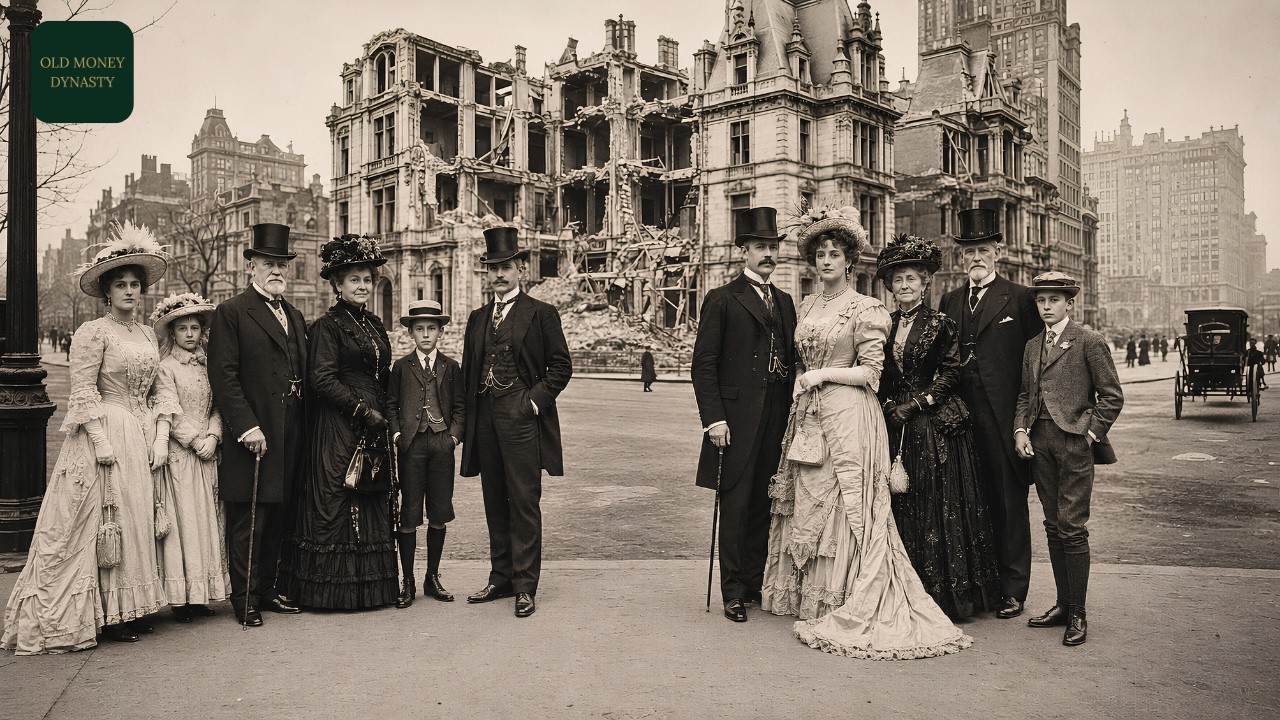
Within about fifty years, almost all of it was gone. Not stolen. Not lost in one catastrophic afternoon on the market. Gone the way these fortunes nearly always go: quietly, and in plain sight.
The street where most of it once sat is Fifth Avenue. For roughly forty years, from the 1880s into the 1920s, that stretch of pavement held the largest concentration of private wealth in American history. Walk those same blocks today and you will find almost no trace of it. The strange part is not that the houses have disappeared.
It is that the money has not. It is still out there. It simply went somewhere else. That is the question this story tries to answer: when the richest families in the country lose their fortunes, where does the money actually go?
The short version is that it does not vanish. It gets spent and taxed away. It crosses oceans and marriages. It hides behind legal walls, and it turns into things you can still walk past today without ever knowing what you are looking at.
Start at the southeast corner of Central Park and walk north up Fifth Avenue. The park runs along one side. A long line of apartment houses and a few museums runs along the other. It looks costly because it is, but it looks like a rich street in a rich city and not much more than that.
What it does not look like is the place it used to be. For about forty years, this single stretch carried more private wealth per block than anywhere else on Earth. It was not a district of banks or trading floors. These were houses.
Single families behind single front doors in homes built on the scale of public buildings. People called it Millionaires’ Row, and the name almost undersold it. On these blocks, a millionaire was the neighbor you quietly measured yourself against. The Astors were here.
So were the Vanderbilts, several branches of them, living in separate houses within sight of one another. Carnegie built near the top of the avenue. Frick built lower down. A copper millionaire named Clark put up a house with more than a hundred rooms that almost no one remembers today.
There is something worth pausing on. The United States was founded against the very idea of inherited aristocracy. It had no dukes, no ancient family seats, no titles handed down with the land. And yet, in the space of a single generation, it grew one anyway, on one avenue, in stone and marble, for everyone to see.
Then count how many of those families you would find on Fifth Avenue now. The number is close to zero. The houses are gone. The names are gone from the doorways.
The wealth, the thing that paid for every bit of it, is the one piece that did not simply disappear. Trace any of these families forward through the decades, and here is what keeps coming up. A fortune is not a building. You cannot send in a crew and bring it down in a morning.
The money keeps going. It changes hands, changes shape, and changes address over and over until it is almost impossible to recognize as the same thing. None of it could be lost until it was first made. And once it was made, it had to be defended.
The families who reached this avenue ahead of everyone else were in no hurry to share it with the ones still on their way up. They drew a line around themselves, and they guarded it with something stranger than money. That line, and the woman who policed it, is where this story truly begins. The thing those families guarded was not their fortunes.
Everyone on the street had a fortune. What they guarded was the right to decide who counted. And the person who held that right was a woman named Caroline Astor. She came from old New York, the Dutch families who had been wealthy since before the country had a flag.
To her, the cash flooding into the city was an embarrassment. Railroad fortunes, oil fortunes, money made too fast by men whose grandfathers no one could name. She watched the city fill with these people, and she set out to draw a line they could not cross. Her instrument was an invitation.
If Caroline Astor called on your family, you existed. If she did not, you did not, no matter how many millions you had just earned. Her winter ball, held in her own ballroom, was the one room in the city that settled the question of who belonged. Being left off her list was not a small slight.
It could shape which clubs admitted your husband and whether your daughter married well. In a city where almost everyone was a stranger from somewhere else, the list was the closest thing to proof of who you were. She did not do it alone. A social advisor named Ward McAllister appointed himself keeper of the rules, and it was McAllister who gave the whole arrangement its famous number.
There were, he announced, only four hundred people in New York who genuinely mattered. The rest, he sniffed, were not at ease in a ballroom. He even sorted the worthy into two kinds: the old families he called knobs, and the newer money he was willing to tolerate, whom he called swells. The irony was hard to miss.
Many of the families doing the judging had far less money than the ones they turned away. What they had instead was time, two or three generations of it, which in this game counted for more than any fortune. Where did the number come from? The answer is almost too small to believe.
As the story has always been told, four hundred was roughly the number of guests Caroline Astor’s ballroom could hold. The capacity of one woman’s reception room set the limit on who counted in the largest city in the country. When the press finally printed the list in the winter of 1892, the name stuck for good. The Four Hundred.
It was a barrier built to keep the newcomers out, and for a while it held. The Vanderbilts, whose railroad fortune was enormous, spent years on the wrong side of it. Then one of them stopped asking to be let in. Alva Vanderbilt had married into the family, and she put up a house on Fifth Avenue larger and louder than anything the older families owned.
In 1883, she announced a costume ball that all of New York wanted to attend. Then she set a trap. No invitation, she let it be known, could go to any family she had not formally received. Caroline Astor’s own daughter was desperate to be there, and so to secure her daughter’s place, Caroline Astor was forced to do the one thing she had refused to do for years.
She called on Alva Vanderbilt. The barrier did not collapse that night, but it cracked loudly, and the whole city heard it. It all sounds petty. It was petty.
It was also a deadly serious contest, and the people fighting it knew exactly what was at stake. There is a small, cruel footnote here. Ward McAllister, the man who had named the Four Hundred, grew too fond of the attention. He gave interviews.
He published a memoir. Polite society decided he had embarrassed them, and they dropped him as quickly as they had once dropped the outsiders. He died a few years later, dining alone at his club. Caroline Astor did not attend the funeral.
That is the thing about a wall like this. It can turn on the people inside it just as easily as it kept others out. And it was about to face something far larger than a society quarrel. While these families spent their energy deciding who could enter a ballroom, a new force was taking shape in Washington, one that would not care in the slightest how old your fortune was.
It would arrive quietly, as a few lines in a tax code. For most of the time these fortunes were being built, the federal government could not touch a dollar of them. There was no income tax. A man could build a fortune of any size and owe Washington nothing on what he earned.
That was the world these houses were designed for, a world where you kept what you made, all of it, for as long as you lived. That world ended in 1913. A new amendment to the Constitution gave Congress the power to tax income directly, and within months the first modern income tax became law. At the start it was almost gentle.
The top rate was seven percent, and it reached only the very rich. Most of the families on Fifth Avenue barely felt it. If you had told those families that a tax form would do what no rival ever could, not a single one of them would have believed you. They were watching each other.
They should have been watching Washington. Then came the First World War. To pay for it, the government raised the top rate again and again. By 1918 it had reached seventy-seven percent.
In the space of five years, a system that took almost nothing had begun claiming the majority of the largest incomes in the country. When the war ended, the rates came down, but they never came down to nothing, and they never would again. The principle had been settled. From that point on, the richest Americans had a permanent, silent partner in everything they earned, and that partner was the government.
Worse, for a dynasty, was what happened at death. A federal estate tax arrived in 1916. For the first time, when the head of one of these families died, the government took a share of everything he left behind. A gift tax followed, to stop them from simply handing it all over early.
The machinery for passing a fortune down, whole and intact, from one generation to the next, had quietly been taken apart. Then the ground gave way completely. American wealth reached its peak around 1929, and the crash that followed wiped out a great deal of it. By the early 1930s, the reported value of the country’s largest estates had fallen by something close to a third, and a government starved for revenue pushed the top rates higher still.
There was a mood behind all of it, too. The country that had once admired these fortunes was beginning to resent them. The same public that had gawked at the mansions now voted for the men who promised to tax them. The age that built Fifth Avenue was slowly and deliberately being taxed out of existence.
Against all of this stood the plain cost of the houses themselves. A Fifth Avenue palace was not only expensive to build, it was punishing to keep. Running one swallowed money. It took a staff of dozens just to keep the doors open, and the heating and repair bills never let up.
In the old days, that cost had been the entire point, a way of showing the world what you could afford. Now it was only a weight, and the fortune beneath it was getting lighter. None of this emptied a single house on its own. The tax did not seize the mansions or drain the bank accounts overnight.
What it did was change the rules, so that holding wealth the old way, out in the open and in stone on Fifth Avenue, slowly stopped making sense. Taxes alone did not empty these houses. What finished the job in family after family was that the heirs behaved as though nothing had changed. They spent as though the old world was still standing.
And no family spent more freely, or fell further, than the one that had begun with the largest fortune of them all. In 1973, about one hundred and twenty descendants of Cornelius Vanderbilt gathered at Vanderbilt University for a family reunion. By one often-repeated account, not a single person in the room was a millionaire. Less than a hundred years earlier, their ancestor had been the richest man in the country.
Now, gathered together, his heirs could not produce one millionaire among them. How does that happen? It began with the Commodore’s will. When he died in 1877, he left almost the entire fortune to a single son, William Henry, and only modest sums to everyone else.
And he attached no conditions to any of it. No trust, no rules about spending or saving. He handed over the largest fortune in America and simply trusted his family to hold on to it. William Henry did more than hold on to it.
In about eight years, he roughly doubled it, building what was by then the largest fortune in the world. But then he made the choice that mattered most. Instead of keeping it together, he split it among his children. The single great mountain of money that two men had spent their lives building was broken into shares.
And a fortune divided is a fortune that can be spent in pieces. The third generation had a different relationship with the money. They had not built it. Most of them had never spent a day at the business that produced it.
What they knew how to do was spend. And they spent on a scale the country had never seen. They put up palaces in the city and even bigger ones in the country. In Newport, they built summer houses so enormous that calling them cottages became a private joke.
The grandchildren had a problem money cannot solve. They had never needed to earn anything. They had grown up inside the finished fortune the way a child grows up inside a house, never wondering who built it or what it cost to keep the roof on. Spending was the only relationship with money they had ever known.
No one showed where this led more clearly than Reginald Vanderbilt, the Commodore’s great-grandson. Reggie had no role in the business and wanted none. By one account, the night he turned twenty-one, he came into an inheritance of around fifteen million dollars. It was a fortune that should have lasted for generations.
He lost seventy thousand of it at the gambling table before sunrise. He spent the rest of his short life much the same way, at the track and the card table, with a bottle never far from reach. His doctors warned him at forty-two that the drinking would kill him. It did, three years later.
He died in 1925, deep in debt, with almost nothing left of what he had been given. He left behind a small daughter named Gloria. Four generations from the richest man in the country to a father who died broke. And there was a second problem, one no amount of spending discipline could have fixed.
The thing that made the money in the first place was the railroad. By the 1930s, the railroads were losing ground to the automobile and to the buses and planes that followed. The Vanderbilts began selling off their stake. In time, the New York Central passed out of the family’s hands completely.
Not long after, the railroad itself collapsed into bankruptcy. The engine that built the fortune had stopped running, and no Vanderbilt was at the controls. Put it all together, and the picture is almost mechanical. The fortune was divided until no heir held real power over it.
They spent faster than anyone could earn. At every death, the tax took its share. And underneath everything, the business itself was dying. The Vanderbilts were not robbed.
The money was simply split up and spent down while the thing that made it faded away. No one had to do anything wrong. They only had to relax. But not all of the family’s money was lost at a card table or sunk into a failing railroad.
Some of it left in a far more deliberate way. It was packed up, carried across the Atlantic, and spent shoring up the crumbling castles of Europe. And it crossed the ocean in the most unlikely form imaginable. It went as a bride.
There was a book for this. It came out regularly, and it read like a shopping catalog. On its pages were Europe’s unmarried noblemen, listed with their titles, their family estates, and a frank note on the size of the fortune each one hoped to marry. The book was called Titled Americans, and it existed because for a few decades, turning new American money into an old European title had become something close to an industry.
The logic on both sides was simple. By the late 1800s, much of the British aristocracy was in trouble. They held the titles and the ancient houses, but a long farming slump had drained the cash that kept those houses standing. Across the ocean sat American families with the opposite problem.
They had vast fortunes and no pedigree at all, and a closed society at home that would never fully let them in. So a trade took shape: American money for European rank. The brokers, more often than not, were the mothers. It was not a handful of cases.
By one count, between 1870 and the start of the First World War, more than four hundred American heiresses married into the titled families of Europe. Each marriage carried a dowry, and a great deal of that money crossed the Atlantic and never came back. The most famous of them was Consuelo Vanderbilt. Her mother was Alva, the same Alva who had once forced her family through the door of New York society.
Now Alva wanted something more than acceptance. She wanted a title. In 1895, she pushed her daughter into marrying the ninth Duke of Marlborough, a man Consuelo barely knew and did not love. By her own account, she wept behind her veil on the way to the altar.
The Duke needed the marriage for one reason. His family seat, Blenheim Palace, was sprawling and falling apart, and he could not afford to keep it standing. The Vanderbilt dowry, reportedly worth a few million dollars in railroad stock, fixed that. American railroad money earned in New York went straight into the stone of an English palace.
The marriage itself was wretched and ended in divorce. But Blenheim still stands, and it was Vanderbilt money that saved it. It is easy to tell this as a story of palaces and titles and forget the young women at the heart of it. Most of them had little say.
They were assets moved across an ocean to settle an arrangement between a mother’s ambition and a stranger’s debts. Some made good lives anyway. Many did not. Not every match was a tragedy, and at least one of them changed history.
Years earlier, an American heiress named Jenny Jerome had married a British lord, Randolph Churchill. Their son was named Winston. A piece of this Gilded Age money helped raise the man who would one day lead Britain through its darkest war. And the bloodlines ran further still.
Through another of these marriages, an American heiress turned out to be a great-grandmother of the woman the world would later know as Princess Diana. The new money of New York had quietly married its way toward the British throne. Marriage was one way the money left. Plain disgust was another.
William Waldorf Astor, heir to the enormous Astor real estate fortune, decided he wanted no more of his own country. He had feuded for years with his aunt over which of them was the true head of New York’s Astor family. He had come to believe, as he put it, that America was no longer a fit place for a gentleman. So he left.
He moved to England and became a British subject. He bought a crumbling old castle called Hever and poured a fortune into rebuilding it. In time, he was made a viscount. He had used American money to buy himself an English title and an English past.
There is an odd mercy in this part of the story. Almost everywhere else, the money simply disappears. Here, it did not. It turned into English stone and English titles, and most of it is still standing.
Blenheim Palace, saved by Vanderbilt railroad shares. Hever Castle, rebuilt with Astor rents. It is the only stop on the whole journey where you can point straight at the money and say, it is still right there, holding up that roof. By now, you might expect every one of these fortunes to vanish the same way, spent at home or carried off across the sea.
But one family watched all of it happen and drew the opposite conclusion. They decided their fortune would never be split among careless heirs and never allowed to drift away. So they locked it down. Not in a vault, but in something far harder to break open: a structure built out of law itself.
It is the reason that, more than a century later, the name is still rich. The man at the start of it was John D. Rockefeller. Through Standard Oil, he built what most historians consider the largest fortune in American history, larger even than the one the Commodore left behind.
But the interesting thing about the Rockefellers is not how the money was made. It is what they did to keep it from going the way of all the others. Rockefeller was, by every account, careful with money to the point of obsession. As a young clerk, long before the oil, he kept a small notebook in which he recorded every cent he earned and every cent he spent.
He never lost the habit. When he had children of his own, he put them on small allowances and made them keep account books, too, noting where every coin went. The richest man in the country raised his heirs as though money were scarce. It showed in how they lived.
While the Vanderbilts were putting up marble palaces a few blocks up Fifth Avenue, the Rockefellers lived in a comparatively plain brownstone just off it, on a side street. They were not competing in the spectacle the others lived for. They had quietly decided that a fortune you pour into a house is a fortune you can lose. So they refused to.
But the real machinery was invisible. Over time, the family did something the others never had. They locked the fortune inside trusts. Money placed in a trust does not belong outright to any single heir.
It is held by professional trustees at the family’s bank, Chase, under rules the heirs cannot easily break. The Rockefellers built their first major family trust in the 1930s and a larger one in the 1950s. The instruction, passed down ever since, was simple. Live on what the fortune earns.
Never touch the fortune itself. And then there was the giving. Rockefeller gave away enormous sums, hundreds of millions of dollars, to universities and medical research, and to a foundation that still carries the name. His son built Rockefeller Center in the middle of Manhattan.
This was the opposite of what the spendthrift heirs had done. Instead of turning the money into parties and palaces that would not outlive them, the family turned it into institutions that would, and that the public could actually use. Giving much of it away was, in the end, part of how they kept the rest. It worked.
More than a century later, the Rockefeller name is still wealthy. By most estimates, the family has held a fortune together across six or seven generations, shared now among a couple of hundred descendants. No single one of them is as rich as the founder once was, but as a family, they did the one thing almost no one else in this story managed. They kept it.
Two fortunes made in the same country at the same time, one of them even larger than the other. One family left theirs out in the open, sunk into houses and handed to heirs with no rules attached, and watched it drain away. The other locked theirs down and lived below its means, treating the fortune as something to guard rather than enjoy. The difference was not luck.
It was structure. The money that survived is the money someone made hard to spend. The Rockefellers had turned their money into things that could not be torn down, into paperwork and institutions that would outlive everyone who signed them. The families on Fifth Avenue had done the reverse.
They had put their wealth into something solid and visible, standing right there on the street for all to see. The trouble with a house is that it can be torn down. And one by one, that is exactly what began to happen. There was a house on Fifth Avenue with one hundred and twenty-one rooms.
It belonged to a copper millionaire named William Clark, and it cost him something like seven million dollars to build, worth well over one hundred million in today’s money. It was finished in 1911. It was pulled down in 1927. A house built to stand for centuries was gone in sixteen years.
Clark’s house was not an exception. It was an early sign of what was coming. All up and down Fifth Avenue through the 1920s and into the ’30s, the great houses came down. A Vanderbilt palace at the edge of Central Park was demolished, and the department store Bergdorf Goodman rose on the spot.
The mansion of Caroline Astor, the woman who had once decided who counted in New York, was torn down, and a synagogue rose in its place. One after another, the monuments of the Gilded Age met the wrecking crew. Why did they let it happen? Because by then the math had turned against them.
The taxes and the ruinous upkeep. On top of that, the land itself had become worth more than the houses standing on it. A mansion site could hold an apartment tower full of paying tenants or a store full of paying customers. Kept as a single-family home, it was simply a way to lose money, slowly and expensively.
So the family sold. And the wreckers came. But the houses did not go without leaving something behind. Pieces of them survived, scattered around the city like relics.
The bronze gates of the Vanderbilt mansion were saved and carried uptown, and they still stand in Central Park at the entrance to the Conservatory Garden. People walk through those gates every day without any idea that they once guarded a vast Vanderbilt palace that no longer exists. A fireplace from the same house was given to the Metropolitan Museum. The fortunes that built Fifth Avenue had been reduced to spare parts in a public park.
For forty years, almost no one tried to stop any of this, and most people did not want to. A mansion was private property, and if its owner chose to sell it to a developer who would flatten it, that was nobody else’s business. There was something else, too. To a lot of New Yorkers, these houses were not treasures.
They were embarrassments, the bloated monuments of an age the country was glad to be rid of. Tearing them down did not feel like a loss. For a long time, it felt like progress. So mansion after mansion fell, and the city barely looked up.
Then, in the early 1960s, the destruction reached something people could not bear to lose. The old Pennsylvania Station, a soaring public monument, was knocked down to make room for an arena and an office block. The loss shocked the city. And on Fifth Avenue, the wreckers came for the Brokaw mansion, a heavy stone house at 79th Street.
This time there was an outcry. A newspaper called its destruction an act of vandalism against the city’s own history. It was too late to save the Brokaw house, but it was not too late to save the rest. In 1965, New York passed its first real law to protect historic buildings.
The law came too late for Millionaires’ Row. By the time it passed, almost all of it was already gone, carted away as rubble decades before. What the law did was freeze what little remained. A few of the old houses were still standing, and now they could not simply be erased.
That left a new question. What do you do with them? Nobody lived like that anymore. By the middle of the 20th century, almost no private family could afford to live in a Gilded Age mansion or wanted to.
So the handful of survivors had to become something else. A few of them found an unlikely second life, thrown open to the public, the kind of place you can walk into this afternoon. And on the empty lots where the others had stood, a new kind of home was rising, one that rebuilt the old exclusivity in a shape you might never recognize. The Fifth Avenue mansions that survived the wrecking crews almost all had one thing in common.
Not one of them was still a home. They lived on by becoming something else entirely. They became museums. Henry Clay Frick had planned for exactly this.
The steel magnate built his mansion intending that it would one day open to the public as a gallery for his art collection. He died in 1919, and in 1935 his house did just that. It is still there on Fifth Avenue, and you can walk through the rooms today. Andrew Carnegie’s mansion uptown became a design museum.
A handful of other houses became smaller museums or were taken over by foreign embassies. The pattern was always the same. The only way a Gilded Age palace survived was to stop being a house and start being something the public could use. But the museums were the exceptions, a few houses out of hundreds.
On most of the avenue, the mansions had simply been cleared away, and something new was going up in their place. The apartment building. It started in 1916, when the first of a new kind of apartment house went up on Upper Fifth Avenue on a lot where a private mansion had stood. At first, the old families were horrified.
Living stacked on top of strangers, like tenants, was beneath them. But the apartments being built were not ordinary flats. They were mansions turned on their end. In the 1920s, a designer named Rosario Candela became the architect of choice for this new world.
His buildings, faced in pale limestone, rose along Fifth Avenue, and the apartments inside were enormous. Fifteen rooms, twenty rooms, servants’ quarters, and private libraries, with ballrooms set high above the street. One of these buildings, at 960 Fifth Avenue, went up on the very lot where Clark’s hundred-room palace had been torn down. The palace was gone, but the address simply climbed back into the sky.
One vast apartment stacked above another. There was a logic to it. A single family could no longer carry the cost of a palace, not after the taxes and the upkeep. But a dozen wealthy families, each buying a single floor, could manage it together.
The cooperative was the old mansion split among many owners, so that no one of them had to bear its whole impossible weight. And this is where the old world quietly reasserted itself. You could not simply buy your way into one of these buildings, no matter how rich you were. Each one was run as a cooperative, governed by a board of the people who already lived there, and that board decided who was allowed to buy.
They could turn you down for any reason or for none at all, and they often did. A century after Caroline Astor decided who counted by sending or withholding an invitation, the same power lived on, moved from her ballroom to a board meeting. The Four Hundred had become a cooperative board, and money alone still could not get you past it. Perhaps the best-known resident of this vertical Fifth Avenue was Jacqueline Kennedy Onassis.
After the White House, after Greece, she came home to New York and bought an apartment high up in one of the Candela buildings, looking out over Central Park. She lived there quietly for the rest of her life. The widow of a president in a fifteen-room apartment in the sky, on the same avenue where the Vanderbilts had once built their palaces on the ground. So the old money did not all leave Fifth Avenue.
A good deal of it simply went up. The horizontal palace became the vertical apartment. The ballroom became the boardroom. The exclusivity survived, carried from the street to the fifteenth floor.
But even this discreet limestone old money was about to be overshadowed. A few blocks south, a different kind of money was rising into the sky. It was newer and louder, and it did not care in the slightest whether any board approved of it. Stand on the south edge of Central Park on a winter evening and look up at the new towers.
They are impossibly tall and impossibly thin, needles of glass against the sky. And you will notice something. Even after dark, a great many of the windows have no lights on at all. Nobody is home.
Often, nobody ever is. This is Billionaires’ Row. It is not, strictly speaking, on Fifth Avenue. It runs mostly along 57th Street and the southern rim of the park, a few blocks from where the Vanderbilt palaces once stood.
But it is the same money in the same corner of the same city, simply rearranged. This is where some of the richest people on Earth now keep an address in New York. The buildings themselves are a new kind of thing. They are called supertalls, and one of them, Central Park Tower, is among the tallest residential buildings ever raised anywhere.
They are engineered to be needle-thin, so that as many apartments as possible can sit far above the rooftops. The higher the floor, the better the view of the park, and the higher the price. From the street, some of them look almost too slender to stand. The numbers are hard to take in.
In 2019, a hedge fund billionaire named Ken Griffin bought a penthouse in one of these towers. The address was 220 Central Park South. The price was about two hundred and thirty-eight million dollars. Years later, it is still the most expensive home ever sold in the United States.
It was, his office explained, simply a place for him to stay when he was in town. That is the pattern all along the row. These apartments are bought by hedge fund and technology fortunes, and by wealthy families from overseas. Many are purchased not in a person’s name, but through anonymous companies, so that no one can easily tell who owns them.
And many of them are not first homes. They are the fourth or the fifth, visited for a few weeks a year, and then left dark. People in real estate have a name for what these towers really are. Safe deposit boxes in the sky.
There is something hollow in all of it. A Gilded Age mansion was many things, but it was alive. A family lived there, with servants filling the back stairs, in a house that was used every single day. These towers hold none of that.
A unit can change hands for the price of a hospital, and then stay dark and silent for years, owned by someone on another continent who may never spend a single night in it. The wealth is real. The home is a fiction. And this is the deepest difference between the old money and the new.
The families who built Fifth Avenue wanted more than almost anything to be seen. The whole point of a marble palace with your name carved over the door was that the city would look at it and know exactly who you were. The new money wants the reverse. It pays enormous sums to own without being named, and to be present in the city without ever quite being there.
The Gilded Age turned money into a monument. Today, money turns itself into a hiding place. So the money never really left. It is still here, on the same few blocks beside the same park.
It simply changed what it wanted from the world. The old money wanted to be admired. The new money wants to be left alone. There is one last question, and it is the one this whole story has been circling.
We know where the money is tonight. The harder question is whether it will stay. Because if the history of this one avenue teaches anything, it is that no fortune, however large, is ever truly safe. The towers look permanent right now.
So did the palaces. There is an old saying about money that explains almost everything that has just been traced. From shirt sleeves to shirt sleeves in three generations. The first generation builds the fortune in its shirt sleeves, working.
By the third, having known nothing but money its whole life, the family has lost it and ended up back where it started. It is not only a saying. It is close to a law. One widely cited study of wealthy families found that around seven in ten lose their wealth by the second generation, and about nine in ten by the third.
The Vanderbilts were not unusual. They were the rule, written very large. Look at the families in this story, and you can watch the rule at work. The Vanderbilt fortune is gone.
The American Astors faded, their title living on quietly in England, while the names that once ruled New York society mean almost nothing to the people who live there now. Only the Rockefellers, who treated their money as something to guard rather than enjoy, are still standing as a fortune. One family out of all of them. That is just about the survival rate history would have predicted.
All of this has a face, and it was there at the very start. Anderson Cooper, the journalist. He is a great-great-great-grandson of Cornelius Vanderbilt, the man whose fortune once towered over every other in the country. But Cooper did not grow up on that money.
By the time he came along, it was effectively gone. His mother was Gloria Vanderbilt, who became a celebrated designer in her own right. When she died in 2019, she left her son relatively little. He did not expect more.
He had built his whole career himself, starting near the bottom, and he has said plainly that he never wanted the family fortune. Inheriting that kind of money, he believes, can be less a gift than a curse. The family that built palaces the size of city blocks produced as its best-known living member a man who earns his own salary and plans to leave his own children very little. The fortune that was meant to last forever lasted about as long as the houses did.
Both are mostly gone now. What remains is the name, and the story of how it all slipped away. Cornelius Vanderbilt, the old Commodore, had clawed his way up from a single boat in New York Harbor to the top of an entire economy. A man like that understands how fragile money really is.
He had little faith that his heirs understood it the way he did. He was right to worry. What he could never have pictured was how fast, and how completely, the thing he built would come undone. The lesson is quiet.
It is that nothing holds, not even a fortune that size, and not even a house built to outlast everyone who lived in it. The families on Fifth Avenue were certain they were building something permanent. They were as certain of it as the people in the glass towers are tonight. They were wrong, and the proof is the avenue itself, where almost nothing they made is left.
The next time you walk up Fifth Avenue, try to see it differently. The money that built it is still in the city all around you, changed beyond recognition. It is in a trust no heir can touch, in a museum you can wander through, in an English castle, in a dark apartment ninety floors above the street. It went everywhere, and it became everything, except the one thing its owners wanted most, which was to stay.
That, in the end, was the only thing the money could never buy.
