In July 1916, a flood tore through the Catawba Valley in western North Carolina and destroyed every rail line in it. That mattered because, three years earlier, the United States government had officially explained the lights on Brown Mountain as train lights. The trains stopped for months. The lights did not.
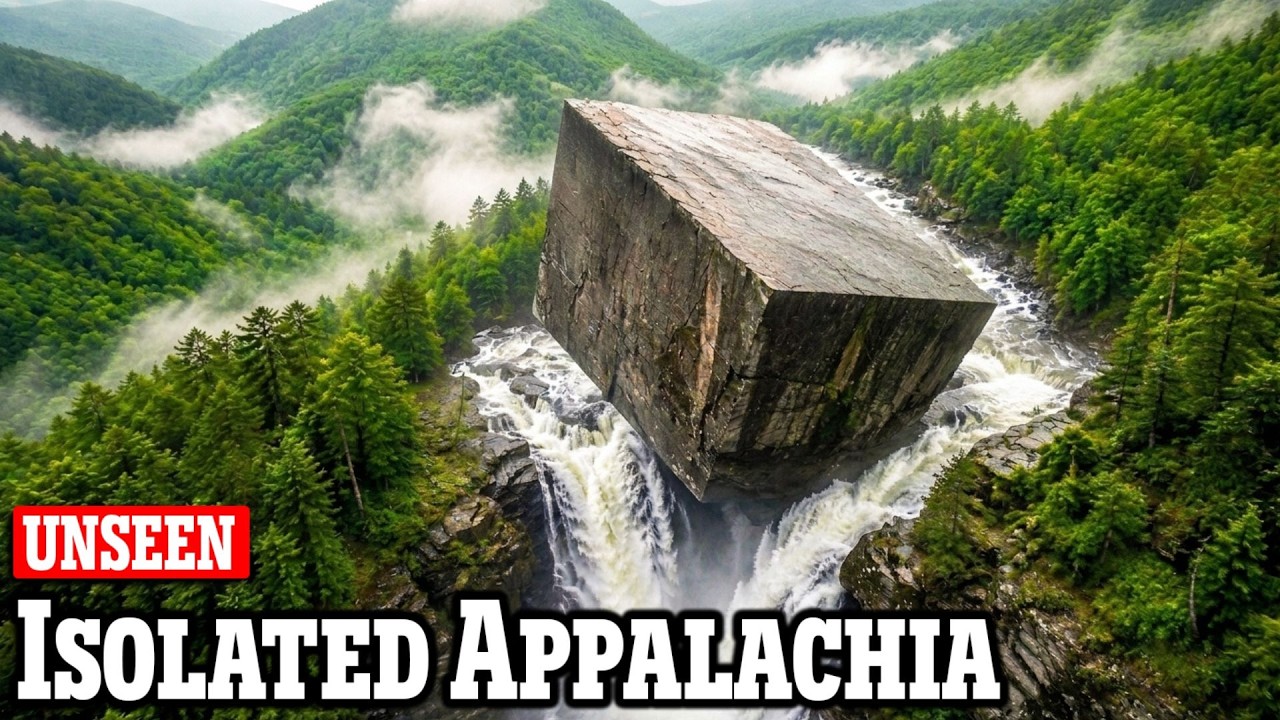
The Appalachians contain thirteen anomalies of this kind. Mountains older than the ocean beside them. Sounds with no source. Living species with no neighbors.
Local people reported them for generations and were dismissed for just as long. Some of these places you can reach by car. One of them needed only a single letter to be solved. Let us begin there.
Number one: the Brown Mountain Lights, Burke County, North Carolina. A long, low ridgeline, its highest point barely 2,600 feet, with no summit worth naming and no trail worth marking. But it has one feature documented for at least 800 years. The lights.
They rise from the slopes after dark. Orbs of light, often red or orange, sometimes blazing white, drift above the ridgeline, hover, split in two, then vanish. Cherokee accounts describe them centuries before European settlement. A German engineer named Gerard De Brahm wrote about them in 1771.
And in 1913, the United States Geological Survey sent a man to settle the matter for good. His name was D. B. Sterrett.
He watched the ridge for several nights, examined the valley below, and concluded that the lights were locomotive headlights from the Catawba Valley Railroad reflecting over the mountain. The report was filed. The case was closed. Three years later, in July 1916, a catastrophic flood swept the Catawba Valley.
It washed out bridges. It tore up rails. No train ran for months, and the roads went with them. So there were no lights of any kind.
The valley below Brown Mountain was dark and still and empty. The lights kept appearing. The Survey sent a second investigator in 1922. George Rogers Mansfield spent seven weeks on the ridge with maps, a telescope, and a barometer.
His conclusion was train lights, grass fires, and, in his words, “nothing abnormal. ” The mystery merited no further investigation. That was the official position. Lights documented before the existence of the automobile, the railroad, and the United States itself, explained by all three of those things.
Studied for a century, never explained. They are still there. Appalachian State University has kept cameras pointed at the ridge since 2011. The cameras have captured the lights.
Researchers have not explained them. The surviving theories include ball lightning, seismic gases, and optical refraction. None of them holds up against an 800-year record. The best viewing spots now have names.
Wiseman’s View, the overlook off Highway 181. On a clear autumn night, you can stand there with strangers and wait. The lights still move across the ridge. That is the thing to understand before going further.
These mountains are older than the answers. When something strange happens here, it has usually been happening for a very long time. And the explanations are always smaller than the mystery. Someone measures, someone files a report, someone declares the matter settled.
The mountains do not read the reports. Which brings us to the sounds. Number two: the Seneca Guns, Cape Fear coast, North Carolina. People have reported them for more than two centuries along the Appalachian front and the ridgelines down to the sea.
Booms, like artillery, echoing from a clear sky or a quiet valley. Windows rattle, dishes jump. There is no storm, no aircraft, no blast site. James Fenimore Cooper wrote a story about these sounds in 1850, and the name he used stuck.
It refers to Seneca Lake in New York, where the same sounds roll across the water. The Carolinas borrowed the name. The mystery travels easily. Military aircraft were blamed, but the reports predate flight by a full century.
Earthquakes were blamed, but seismographs often record nothing at the moment houses shake. In 2020, researchers at the University of North Carolina matched years of sound reports against the state’s seismic network. Most of the sounds left no seismic trace at all. Something loud enough to shake a house was happening above the ground, not beneath it.
And the researchers could not identify what it was. Local people reported these sounds for generations. For generations, they were told it was thunder, or quarry blasting, or just imagination. The quarries closed.
The sounds did not stop. The same mountains, the same dismissal, the same silence in the official files. The third anomaly is quieter and colder. It is a mountain that refuses to obey summer.
Number three: Ice Mountain, Hampshire County, West Virginia. A hill above the North River, where ice persists at the base into July. In the nineteenth century, farmers cut blocks of ice in June. Then botanists came and found something stranger than the ice.
Plants growing around the cold vents belong to regions hundreds of miles to the north. Twinflower, bristly rose, species stranded here at the end of the last ice age. They have survived for 10,000 years on a hillside that exhales chilled air all summer. The mechanism is partly understood.
Cold air sinks into the broken rock in winter and seeps out for months. About sixty vents have been counted along the slope. At the coldest, the air emerges at about 38 degrees Fahrenheit while the forest above bakes at 90. But the vents at Ice Mountain stay colder, and for longer, than scientific models expect.
And the plant community they sustain exists almost nowhere else at this latitude on Earth. In 1838, state geologist William Barton Rogers, later a founder of MIT, examined the slope and admitted the cold defied full explanation. The Nature Conservancy now protects the site. You can visit with a guide.
You will stand in August heat and feel winter breathing out of the hillside. A relict ecosystem running on a natural refrigerator a hundred centuries after the ice that planted it receded north. Three anomalies. A light with no source.
A sound with no identity. A winter with no end. All different. But they share something.
An official once looked at each one, wrote down an explanation, and the mountains remained silent beyond that explanation. The next anomaly is not a light or a sound or a cold hillside. It is the mountain range itself. And the evidence had been flowing through it the whole time, perfectly clear and in the wrong direction.
A river. Number four: the New River, New River Gorge, West Virginia. It rises in Ashe County, North Carolina, flows north through Virginia into West Virginia, where it has cut a gorge nearly 1,000 feet deep. Look at a map and you see the problem at once.
Every sensible river on the Atlantic slope runs east, downhill toward the sea. The New River runs northwest, straight into the Appalachian Plateau, cutting through the ridges as if they do not exist. Rivers do not climb mountains. Unless the river was there first.
That is the accepted explanation, and it is more unsettling than any legend. The New River, despite its name, is one of the oldest rivers on the planet. Estimates range from 10 million to more than 300 million years. It was already running this course when the Appalachians rose beneath it, and it simply kept cutting, sawing through the rock as it climbed, like a thread slicing through a rising loaf of bread.
The mountains grew around the river. The river never moved. And the mountains it cut through are older still. Number five: the oldest mountains on Earth.
Grandfather Mountain, North Carolina. The rocks at the heart of this range formed more than a billion years ago. The Appalachians began rising about 480 million years ago, when the continents that would become North America and Africa began colliding. Consider what did not exist yet.
There were no trees. There was no grass. There were no bones. Nothing had yet crawled onto land.
When the first Appalachian peaks lifted toward the sky, the sky itself held less oxygen, and the ground below was bare rock and a thin film. At their height, these mountains may have rivaled the Himalayas. Then they spent a few hundred million years eroding into the low, folded, forested hills you can cross in an afternoon. The Atlantic opened beside them.
The Appalachians were already ancient when the first wave broke on the new coast. Fragments of the same range now sit in Scotland, Scandinavia, and Morocco, pushed apart by drifting continents. You can stand on Grandfather Mountain and touch a rock that has outlived the birth of an entire ocean. First the ancient ocean closed.
Then the peaks rose. Then they wore away grain by grain over 200 million years. The river never moved. The Cherokee, who lived in these mountains longer than any surviving record, spoke of the hills as living things, of summits shaped while the world was still soft.
One account says the mountains were carved by the strokes of a great hawk’s wings as it flew low over the new earth. Whether you believe that or not, what lies beneath the hills is fact. The root of a billion-year-old mountain system that has witnessed the assembly of continents, and a river that predates the ridges it runs through. Five anomalies done.
Eight waiting. We still have the smoke the forest breathes, the plants stranded an ocean away from their kin, the fish that should not exist, the sound only some can hear, and one mystery on this list that was finally solved after a century. The answer was stranger than the folklore. First, the smoke.
Number six: the Blue Smoke, Great Smoky Mountains, Tennessee. The mountains are named for it. A bluish haze rises from the forest itself on still days, with no fire beneath it and no rising water vapor. For years, it was treated as ordinary fog.
It is not. The trees produce it. Millions of acres of forest release volatile organic compounds, and those molecules scatter blue light, wrapping the ridges in a mist the Cherokee called “Shaconage,” meaning place of the blue smoke, centuries before chemistry could explain why. The forest generates its own local climate.
The name was accurate for 500 years before the scientific explanation arrived. Same mountains, same pattern. The locals named it, and it was explained generations later. Stranger than assumed.
Number seven: the China plants. The coves of the Great Smoky Mountains, Tennessee. Botanists working these coves in the nineteenth century, among them Asa Gray of Harvard, began noticing something abnormal. Species after species grew here and nowhere else on the continent, while their closest living relatives grew in the mountains of eastern China.
Not merely similar plants, but sister species. Gray spent decades working on the puzzle. More than fifty genera are now documented on both sides, separated by an ocean and a hemisphere, with nothing in between. The explanation goes back 50 million years, to a warm world where a single continuous forest covered the northern hemisphere.
Ice ages and dry climates tore that forest apart. Almost everywhere, it died. It survived in only two refuges: the valleys of central China and the coves of the southern Appalachians. These hollows are a museum of a vanished world, and its exhibits are still alive.
A ginseng hunter in Tennessee and a farmer in Hubei can dig the same root from opposite ends of the earth. Same range. Same verdict. The mountains held something no one had noticed.
Number eight: the trapped trout. Shenandoah National Park, Virginia. In the highest, coldest streams, isolated above waterfalls no fish can climb, live populations of native trout that should not be there. Genetic surveys since the 1990s, including work in Shenandoah headwaters, found populations isolated long enough to become measurably distinct.
Small stranded strains, locked behind rock barriers older than any map. How the fish got above the falls in the first place remains an open question for several streams. Barriers older than answers. In these mountains, that phrase always holds.
Eight anomalies. A river older than its mountains. Rock older than trees. Smoke made by a forest.
A garden shared with China. Fish locked in prehistoric stone corridors. None of these were hidden. The river was on every map.
The haze was part of the park’s name. The plants stood at eye level beside the trails, waiting for the right question. The next anomalies were not that patient. They announced themselves loudly.
And their witnesses were called liars for it. A hum. Number nine: the Hum. Hueytown, Alabama.
In 1992, at the southern end of the Appalachians, residents of Hueytown began reporting a low, constant hum. Not so much a sound you hear as one you feel. A diesel engine idling somewhere underground at the edge of perception, night and day. It made national headlines.
Only some people could detect it. Those who could, could not escape it. They were told it was tinnitus, or power lines, or just imagination. Investigators blamed ventilation fans at a nearby coal mine.
The mine objected. The fans were adjusted. The hearers kept hearing. Sound experts measuring other hum cases recorded real low-frequency energy and found no source for it.
The files remain open. Same corridor. Same verdict on the witnesses. Wrong until proven otherwise.
Number ten: the mountains that ring like a bell. From New Madrid, Missouri, to Charleston, South Carolina, in the winter of 1811 and 1812, the ground at the western edge of the Appalachians began to move. The New Madrid earthquakes, centered near the Mississippi River, made the entire old range ring like a bell. Church bells rang in Charleston, set off by ground motion from 600 miles away.
Had the same quakes hit California, they would have died out within a fraction of that distance. The reason is the age of the rock. Old, cold, unbroken crust transmits seismic energy with little loss. The Appalachians are so old and so coherent that they conduct earthquakes the way a forged metal rod conducts sound.
The greatest anomaly of the range, its age, makes it a resonator. And the New Madrid fault system is still considered active. Number eleven: the synchronous fireflies, Elkmont, Tennessee. For two weeks every June in the Great Smoky Mountains, one species of firefly does something no other firefly in the western hemisphere does.
Thousands of them flash at the same time. The forest floor pulses with synchronized light, then goes dark, then pulses again. For nearly a century, locals described it. For nearly a century, science said no.
Entomology textbooks insisted synchronous fireflies existed only in Asia. Tennessee reports were dismissed as coincidence, or pattern-seeking, or exaggerations from porch lights. In the early 1990s, naturalist Lynn Faust, whose family had spent summers in Elkmont since the 1930s, read a scientific paper repeating the claim and wrote to the researchers to tell them they were wrong. She had been watching the light show her whole life.
They came. They measured. She was right. And everyone before her had been right too.
The species was confirmed as synchronous in the mid-1990s. Decades of testimony proven correct in a single June. The park now runs a lottery for viewing spots. Locals reported it for generations.
It took one letter to end the dismissal. Number twelve: the moonbow, Cumberland Falls, Kentucky. The twelfth anomaly has no such ending yet. On the Appalachian Plateau, clear full-moon nights here produce a rainbow made of moonlight.
A pale arc standing in the mist below the falls. It is one of the only places in the western hemisphere where the phenomenon occurs reliably. The exact combination of geometry, mist, and moonlight that makes this waterfall a moonbow machine while ten thousand others do nothing remains debated. You can stand there at midnight and watch the laws of physics do something they do almost nowhere else on the continent.
Then there is the thirteenth anomaly. The one that was solved. Number thirteen: the ghost railroad lights, Maco Station, North Carolina. On abandoned rail lines through Appalachian passes, observers have reported lights for a century.
The most famous haunted the tracks at Maco. A single light swaying over the old roadbed at walking speed, at lantern height. It retreated when chased. Folklore gave it a name: Joe Baldwin, a railroad brakeman said to have been beheaded in an 1867 train wreck, swinging his lantern along the line, searching for his head.
Official science offered nothing at all, because officially the lights did not exist. Then researchers began taking railroad lights seriously, with spectrometers, cameras, and patience. At the most studied sites, an answer finally emerged. Distant headlights, miles away and below the horizon of the old roadbed, were being bent by a thermal inversion.
Cold, dense air pooled in the valleys beneath warmer layers, forming a natural lens. The lens gathered light from over the curve of the terrain and hung it in the air, swaying as the air layers moved. At lantern height. At walking speed.
Every other anomaly on this list is an open file. This one is closed. Consider what the answer actually says. The valleys of this mountain range can build a lens out of air, lift light over a hill, and set it down on an abandoned railway like a man walking home.
The ghost story claimed a lantern. The explanation revealed a mountain range that bends light. The truth was stranger than the brakeman’s tale. That is the unsettling thing about these mountains.
These anomalies are not relics of a naïve past. The Elkmont fireflies were confirmed within living memory. The boom studies were done in 2020. The Brown Mountain cameras record tonight, and hum reports arrive by email now, timestamped, from people pointing their phones at their floors.
The files are still open. New pages are still being added. America has taller mountains. The Rockies are younger, sharper, more photographed.
But the Rockies are children. The Appalachians were eroding before the Rockies were born, before the Atlantic existed, before any living thing had a backbone. The oldest is the strangest. A mountain range this old has had a billion years to accumulate exceptions, and it does not reveal them on our schedule.
You can visit almost everything on this list. The overlook at Wiseman’s View is free. The moonbow keeps its own calendar. The fireflies require a lottery ticket and two weeks of patience.
The hum requires nothing but a pair of unsuitable ears. The lights, for the record, are still moving across the ridge.
