In the autumn of 1896, an early frost settled over the high ridges of western Virginia, and the residents of Grayson County began to notice an unsettling silence from Corbins Ridge, an isolated spur of mountain land where Silas Corbin had lived alone for more than two decades. Born in eastern Kentucky around 1834, Corbin had drifted into the Blue Ridge in the early 1870s and purchased 47 acres of steep, rocky woodland for $12, paid in silver coins. His cabin, built from hand-hewn chestnut logs, was unusual for its small, high windows placed to avoid the clearings below and its thick oak door fitted with iron hardware he had forged himself. For over twenty years, he descended monthly to trade furs and carved wooden implements at Mordecai Hunnicutt’s general store in Independence, always waiting outside until other customers left, paying exact amounts without negotiation, and speaking only in brief, clear statements.
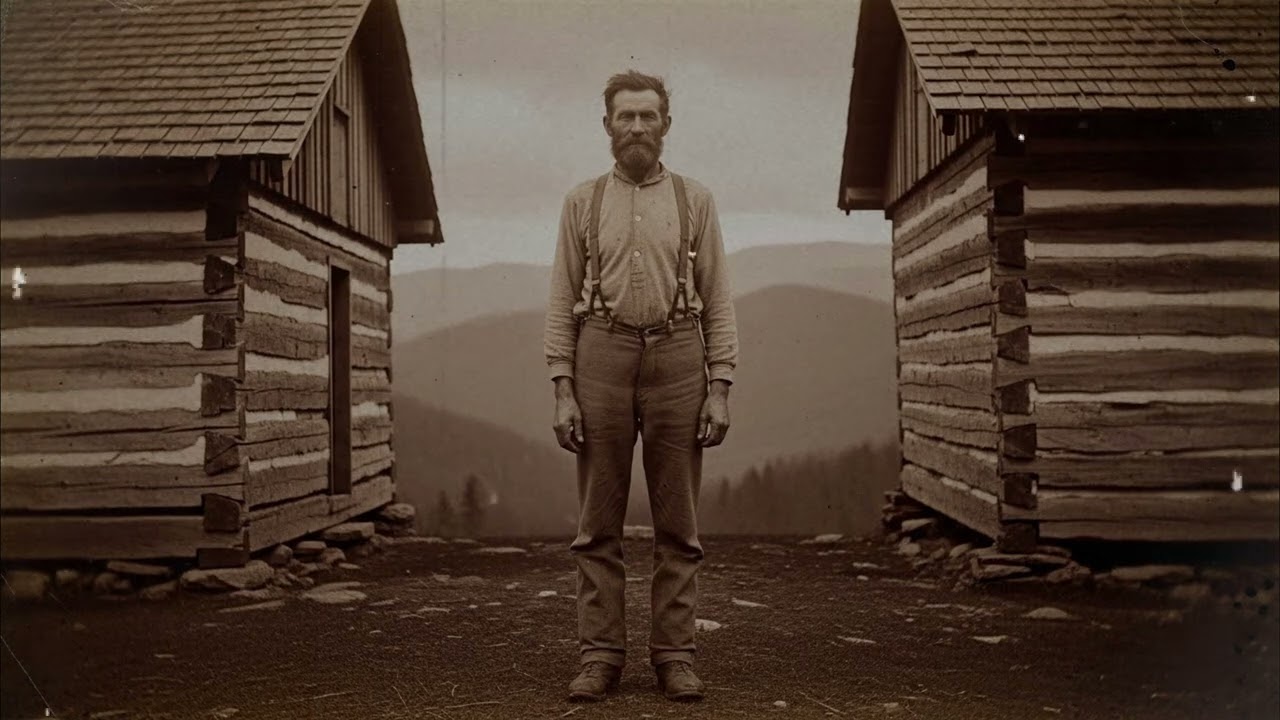
Those who met him described his pale gray eyes as intensely unsettling, as if he were listening to something no one else could hear. In the late summer of 1896, things began to change. Reuben Ashworth, whose property bordered the lower slopes of the ridge, reported hearing rhythmic pounding coming from the direction of the cabin during the pre-dawn hours. The sounds moved around the perimeter of the structure with long pauses between strikes, as if someone was listening after each blow.
Ashworth’s wife noted that their hunting dogs had begun refusing trails leading toward the ridge, retreating with their hair standing on end and their eyes showing white. An elderly former preacher living two miles away reported seeing smoke rising from Corbin’s chimney at odd hours, rising in a straight column even on windy days, with a color that seemed to shift between gray and dark brown. The last confirmed sighting of Silas Corbin occurred on September 23rd, 1896, when he made his monthly supply run to the store. Instead of his usual written list, he verbally requested an unusual quantity of iron nails, several coils of heavy rope, and multiple bags of lime.
When the storekeeper expressed curiosity, Corbin replied only that he was making preparations. His appearance had deteriorated noticeably; he had lost considerable weight, his beard was wild and unkempt, and fresh wounds that looked like nail punctures marked his hands. He spoke in a hurried, whispered style, as if fearing he would be overheard in the empty store. Before departing, he asked whether anyone had been inquiring about him or seeking directions to his cabin.
Assured that no one had, he said, “If anyone comes asking, tell them Silas Corbin is no longer receiving visitors. Tell them the door is closed and will remain so. ” Those were his last words to anyone in the valley. October passed without sign of him.
In early November, a local hunter named Tobias Caudill found a barrier blocking the main trail to the cabin, built from fallen trees and large rocks arranged in a deliberate pattern. Carved into one of the logs was the message “Turn back now. ” Caudill noticed the barrier appeared to have been constructed from the cabin side of the trail, as if Corbin had been trying to keep something in rather than keep people out. Fragments of broken rope were scattered among the debris, as if restraining devices had been cut or torn.
On November 15th, Caudill set out alone for the cabin. As he climbed, he discovered additional obstacles: felled trees across secondary paths, large rocks rolled into strategic positions, and crude spike barriers made from sharpened branches. The work represented weeks of intensive labor, and the barriers became more sophisticated closer to the cabin. When he reached the clearing, he found every opening sealed.
The windows were covered with thick wooden boards nailed from the inside, with nail points protruding outward to injure anyone attempting removal. The door was barricaded, with a secondary barrier of furniture stacked behind it, visible through gaps in the boarding. Around the perimeter, the ground was churned and disturbed, multiple fire pits contained the charred remains of books and clothing, and a series of holes had been dug around the foundation, each filled with lime. Despite repeated calls, there was no response.
Even wildlife seemed to avoid the area. As afternoon faded, Caudill retreated rather than force entry. The community debated what to do, eventually referring the matter to County Sheriff Cornelius Watkins. On November 28th, Watkins, accompanied by Deputy Marshal Obadiah Prewitt and Caudill as guide, ascended the ridge in bitterly cold weather.
They cleared passages through the barriers and reached the cabin. After calling out without response, the sheriff authorized removal of the boards covering the door. The nails had been driven from the inside with such force that removing them proved nearly impossible. Behind the main door, they found a barricade of furniture, tools, and household items stacked with precision that required dismantling piece by piece.
As the interior barrier was removed, a distinctive odor emerged, a complex mixture of smoke, lime, and something organic that none of them could identify. Watkins entered alone. The interior walls had been covered with additional planking, creating a double wall system packed with a mixture of mud, lime, and fibrous material. In the center of the main room, a large area of the floor had been removed, revealing a carefully lined excavation roughly six feet square and three feet deep, filled with lime, ash, and other substances.
Against the far wall, Watkins discovered messages carved into the planking. The earliest, dated August 30th, read, “they know I am here now. Building defenses. ” A September 15th inscription stated, “Sounds from below the floor again last night.
They are getting closer. Must seal everything. ” Other inscriptions included the single word “Silent” repeated several times, and phrases such as “Cannot sleep. They are underneath.
” and “Wrong to bring them here. Wrong wrong wrong. ” The final inscription read, “I should have left them buried where I found them. ”
A search of the rest of the cabin revealed carefully organized caches of preserved food, water, and medical supplies, largely unused.
Corbin’s personal possessions remained in place, his tools properly stored, his winter clothing hanging undisturbed. But of Silas Corbin himself, there was no trace. The sealed structure made it impossible for him to have left through any normal exit, yet he was simply not there. While examining the exterior, Deputy Prewitt discovered that the lime-filled holes contained more than just the chemical compound Corbin had purchased.
Mixed with the lime were fragments of bone, cloth, and metal objects that seemed much older than anything Corbin would have possessed: brass buttons in a style not manufactured for decades, homespun wool of an earlier era, and bone fragments that included both human and animal remains. Excavation revealed that the site had been used for burial purposes long before Corbin constructed his dwelling, with grave depressions and vegetation changes suggesting a Native American cemetery predating European settlement. His reference to “bringing them here” suddenly took on new meaning. He had apparently disturbed the original graves, possibly during construction, and his final psychological deterioration could be understood as guilt and fear resulting from that desecration.
However, this explanation failed to account for several things. The defensive barriers were designed to prevent something from reaching the cabin, not to keep Corbin confined within it. His systematic sealing of the structure from the inside suggested he believed he was protecting himself from an external threat. And his complete disappearance from a building sealed so thoroughly that normal exit was impossible remained unexplained.
Watkins concluded his investigation by classifying the case as a disappearance, noting severe mental disturbance possibly triggered by guilt over disturbing the graves. The property went undisturbed through the winter. When spring arrived, Caudill returned to find the cabin completely destroyed. The logs that had formed the walls were scattered throughout the clearing and down the mountainside, as if thrown with considerable force.
The stone foundation remained intact, but the excavation Watkins had documented was filled with earth and debris, and the lime-filled holes had been disturbed and refilled with no trace of the bone and artifact fragments. The destruction had occurred during a winter when heavy snow would have made access extremely difficult, and no one admitted to visiting the site. The property eventually reverted to the county for unpaid taxes and was sold to a lumber company before being abandoned to reforestation. In 1923, a survey team working for the newly established Shenandoah National Park examined the area and found evidence of an earlier structure beneath Corbin’s foundation, dating to the late 18th century, suggesting the site had been occupied by frontier settlers before him.
Their systematic excavation confirmed the location had been used as a Native American cemetery for an extended period, possibly centuries, following patterns typical of Cherokee or related southeastern tribes. The burial sites showed evidence of multiple disturbances over time, and the report speculated that each successive occupant had eventually abandoned the site after a relatively brief period. The survey also recovered artifacts correlating with Corbin’s residence, as well as personal items belonging to the earlier European occupants, suggesting his experience was not unique but part of a pattern of disturbance and abandonment. In 1961, a Smithsonian Institution team led by Dr.
Margaret Thornfield conducted a comprehensive excavation. Their research indicated the site had been used for burial purposes for over four centuries, with its significance derived from underground water sources and unique geological formations. The team found evidence that each group of settlers had initially disturbed the burial areas during construction, then attempted to restore or seal the graves before abandoning their dwellings. Corbin’s case fit this pattern but represented its most extreme manifestation.
His elaborate defenses and systematic sealing suggested not only recognition of his intrusion, but fear of consequences he believed might result. His disappearance, while unexplained, occurred within the context of an attempt to barricade himself against some perceived threat. Local oral tradition, collected by WPA writers in the 1930s, offered a different interpretation. Elderly residents maintained that mountain people had always known the ridge was a burial ground and avoided disturbing it, but Corbin, as a newcomer, had not understood these customs.
They recalled family members mentioning that during the summer of 1896, Corbin had been observed conducting night-time excavations and reinterring materials around the cabin’s foundation, attempting to undo the damage he had caused. Rather than viewing his preparations as mental breakdown, they understood them as his attempt to isolate himself while working to correct his transgression before winter made continued work impossible. The site was eventually incorporated into Shenandoah National Park and remains restricted today, classified as an archaeological preserve requiring special permits for research access. The specific circumstances of Corbin’s disappearance from a completely sealed cabin have never been explained by any conventional analysis.
The destruction of the cabin during the winter following his disappearance also remains unresolved. The stone foundation has been largely obscured by accumulated earth and vegetation, creating a scene of peaceful wilderness that gives little indication of the dramatic events that occurred there more than a century ago. The questions that could not be answered in 1896 remain unanswered today, preserved in the landscape where Silas Corbin made his final preparations for a threat that only he could perceive.
