The cafe on Rue de la République smelled of burnt chicory and yesterday’s tobacco. Marie Laval sat by the window, her fingers tracing the rim of a cup that held no real coffee, only roasted acorns. Outside, German soldiers walked past in pairs, their boots striking the cobblestones with mechanical precision. She watched them without watching, her eyes fixed on the middle distance, the way a woman lost in thought might stare at nothing.
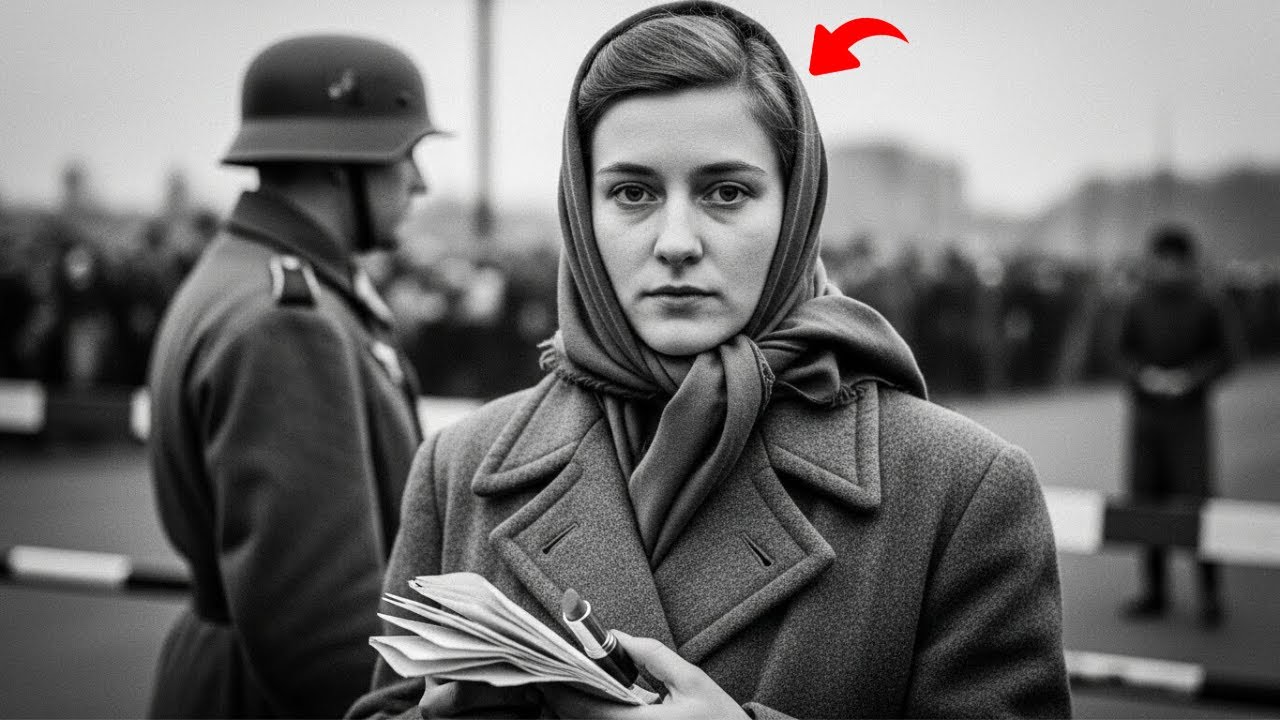
But Marie Laval was not lost in thought. She was counting. Two Wehrmacht privates at 0847. An SS officer at 0851.
A Gestapo civilian at 0853, moving south toward Place Bellecour. Every detail cataloged, every pattern memorized. This was her third café that morning. She would visit two more before noon.
The waiter approached, an old man with hands that trembled from something that might have been age, or might have been fear. He refilled her cup without speaking. In occupied Lyon, conversations were dangerous. Silence was survival.
She had learned this in her first week, back when Marie Laval was still a new identity, still stiff and uncomfortable like a borrowed coat. Her real name was Eleanor Cole. She was 28 years old, born in Manchester, educated at Cambridge, recruited by the Special Operations Executive in October 1942. The SOE had given her three months of training, cramming into those weeks everything she needed to become someone else.
Silent killing. Wireless operation. Lock picking. Document forgery.
How to withstand interrogation. How to die quickly if capture became inevitable. They had also given her a cyanide pill, small and brown, hidden inside a hollow tooth. Eleanor touched her jaw reflexively.
The tooth had been prepared by an SOE dentist who looked more like an undertaker. Bite down hard on the left side. The capsule breaks. Death comes in 45 seconds.
Relatively painless, he had said, though Eleanor wondered how anyone could know that for certain. She finished her false coffee and left exact change on the table. Too much would draw attention. Too little would be remembered.
Everything had to be unremarkable, invisible, forgotten the moment she walked away. This was the first rule of deep cover work. Do not be seen. Do not be remembered.
Do not exist. The March air carried a bite that winter had not quite relinquished. Eleanor pulled her coat tighter, a grey woollen thing with frayed cuffs that looked appropriately shabby for a clerk’s wife. That was her cover.
Marie Lavalle, wife to Robert Lavalle, a railway clerk who had died in the chaos of 1940. No children. No close relatives. Just a woman trying to survive the occupation by working at a textile factory on the city’s outskirts.
The textile factory was real. The job was real. Eleanor worked there four days a week, her hands moving through the repetitive motions of sorting buttons and thread, her mind cataloging everything she saw. The factory owner was a collaborator, his ledgers full of contracts with German quartermaster offices.
But the foreman was resistance, passing information to networks that stretched across occupied France. He did not know Eleanor was SOE. She did not know all the others he worked with. Compartmentalization kept everyone alive a little longer.
At 1100 hours, Eleanor crossed the Saône River, walking toward the old quarter where stone buildings pressed close together like conspirators. She stopped at a bakery where the bread was dense and grey, made from flour stretched with sawdust. The baker’s daughter handed her a loaf wrapped in newspaper. Eleanor paid, exchanged pleasantries about the weather, and left.
Inside the wrapping was a thin strip of paper, no wider than a fingernail. On it, written in pencil so light it could be erased with a breath, were three words: Checkpoint Wednesday dawn. Eleanor did not react. She walked home, climbed three flights of stairs to a small apartment that smelled of mildew and loneliness, and burned the paper in the sink.
Then she sat by the window and watched the street below, committing faces to memory. The woman who sold vegetables from a cart. The man who always wore a brown hat. The children who played near the fountain.
Any one of them could be an informant, a collaborator, or a Gestapo plant. By nightfall, she had encoded the message using a silk square hidden inside her coat lining. The square was printed with a one-time pad, rows of random letters that could transform plain text into gibberish that only London could decode. She worked by candlelight, her fingers moving with practiced speed.
The encoded message read: Checkpoint active route seven stop German intelligence increase stop request aboard lion exfiltration stop. At 0200 hours, Eleanor climbed onto the roof of her building. The wireless set was hidden in a chimney stack, wrapped in oilcloth. She assembled it quickly, unrolled the antenna wire, and began tapping out the message in Morse code.
Thirty seconds of transmission. No more. German direction-finding vans could triangulate a signal in under three minutes. She finished, disassembled the set, and returned to her apartment.
Then she lay in bed, staring at the ceiling, waiting for dawn and whatever would come with it. The resistance network Eleanor worked with was called Freelance. It was not large. Thirty-seven people spread across Lyon and the surrounding countryside.
Most were French, ordinary citizens who had decided that collaboration was a betrayal they could not stomach. A pharmacist who passed information hidden in prescription bottles. A postman who read mail addressed to German officers. A schoolteacher who used her classroom to store weapons.
Each of them risked everything for intelligence that might matter, might save lives, might help end the war a day sooner. Eleanor’s role was coordinator and wireless operator. She collected information from the network subunits, encoded it, and transmitted it to London. London sent back instructions, supply drop coordinates, target assessments.
It was a fragile chain dependent on luck and discipline. One arrest could unravel everything. One moment of carelessness could kill them all. She had been in Lyon for four months.
In that time, Freelance had provided intelligence on German troop movements, railway schedules, fuel depot locations, and collaborator identities. They had also lost three members. The first had been arrested in January, a young man named Claude who worked at the railway station. The Gestapo had taken him to Montluc prison.
No one knew what happened to him after that. The second and third had disappeared in February, a married couple who ran a café near the Perrache station. Their bodies were found in the Rhône three days later, weighted with stones. Each loss was a reminder that death was not abstract.
Eleanor attended the couple’s funeral, standing in the back of the church, watching faces for signs of surveillance. The Gestapo often monitored funerals, looking for patterns, connections, grief that seemed excessive or suspicious. She saw no obvious watchers, but that meant nothing. The best surveillance was invisible.
After the funeral, she met with the network’s leader, a man called Pascal. His real name was Michel Reynard. He was 43 years old, a former history teacher with a limp from the Great War and a hatred of Germans that ran deeper than any ideology. They met in the basement of a bookshop, surrounded by volumes no one had touched in years.
Pascal spoke quietly, his voice rough from cigarettes. “The Gestapo is expanding their operations. More checkpoints, more raids, more informants. Our window is closing.
”
Eleanor nodded. “London wants us to focus on railway targets. The Germans are moving reinforcements east toward the Russian front. If we can disrupt those movements, even by a few days, it could matter.
”
Pascal lit a cigarette, the flame casting sharp shadows across his face. “And if we fail, we die. Simple as that. ”
“Yes,” Eleanor said.
“Simple as that. ”
They discussed logistics, methods, timing. The railway line between Lyon and Dijon was heavily guarded, but there were vulnerabilities. Signal boxes that could be sabotaged.
Switches that could be jammed. Bridges that could be damaged with small explosives. It would not stop the German war machine, but it would slow it. In war, every delay mattered.
Pascal handed her a folded map marked with pencil notations. “These are the targets. I need you to transmit them to London. Get approval for the operations.
We’ll start next week. ”
Eleanor studied the map, memorizing the locations. Then she folded it and slipped it inside her coat. “I’ll send it tonight.
”
Pascal hesitated. “Be careful, Marie. The Gestapo is getting better at finding wireless operators. They caught a woman in Marseille last week.
Took her set, broke her codes, ran a deception operation for three days before London realized it was compromised. ”
“How did they catch her? ”
“Carelessness. She transmitted from the same location twice.
The direction-finding vans triangulated her position. ”
“I won’t make that mistake,” Eleanor said. Pascal smiled, but there was no warmth in it. “Everyone says that.
Then they get tired or rushed or confident. And then they die. ”
By late March, the Gestapo presence in Lyon had become suffocating. Checkpoints appeared on streets that had been cleared the day before.
Raids swept through apartment buildings at dawn. Arrests increased. People disappeared. The city felt like a noose tightening slowly, methodically, without mercy.
Eleanor adjusted her routines constantly. She never used the same café twice in one week. She never walked the same route home. She changed her work schedule at the textile factory, arriving early some days, late on others.
Unpredictability was protection, a way to avoid patterns that watchers could exploit. But unpredictability had limits. Some things could not be avoided. She still had to transmit intelligence to London.
She still had to meet with Pascal and other network members. She still had to maintain her cover as Marie Lavalle, the quiet widow who worked and went home and bothered no one. And maintaining that cover meant appearing at places where she was expected, behaving in ways that were consistent, living a life that looked normal even as everything beneath the surface was preparation for violence. On March 28th, Eleanor received a message from Pascal.
It came hidden in a newspaper, the words formed by pinpricks beneath certain letters. The message read: “Checkpoint route 7 dawn Wednesday, April 1st, stop. All personnel crossing prohibited, stop. Abort Lyon operation, stop.
Exfiltrate immediately, stop. ”
Eleanor burned the newspaper and sat in her apartment weighing options. Route 7 was the main road connecting Lyon to the countryside south of the city. It was the primary escape route for anyone trying to leave the region.
If the Germans were establishing a permanent checkpoint there, it meant they suspected resistance activity in the area. It meant the net was closing. London’s orders were clear. Continue operations until further notice.
Prioritize railway intelligence. Do not exfiltrate unless compromise is imminent. But Pascal was telling her to leave. That meant he believed the network was in immediate danger.
Pascal did not panic. If he said run, it was because staying meant death. Eleanor made her decision. She would transmit one final intelligence report to London, then destroy her wireless set and prepare to leave Lyon.
If London sent further instructions, she would not receive them. If the network needed her after she left, they would have to manage without her. Survival was not cowardice. It was strategy.
A dead agent could not gather intelligence. A captured agent was worse than dead. At 0230 hours on March 30th, Eleanor climbed onto the roof for the last time. The wireless set assembled quickly, the routine now so familiar that her hands moved without thought.
She transmitted the railway intelligence Pascal had provided, along with a brief addendum: “Freelance network compromised, stop. Checkpoint activity indicates German awareness, stop. Requesting immediate exfiltration instructions, stop. ”
She finished the transmission in 32 seconds.
As she began disassembling the set, she heard it. A low hum, mechanical and steady, growing louder. A vehicle moving slowly through the streets below. She froze, her hands still on the wireless.
The hum stopped. Silence. Then voices, German voices, sharp commands that echoed off stone walls. Eleanor left the wireless set on the roof and climbed down the access ladder as quietly as possible.
In her apartment, she pulled on her coat, grabbed the small bag she kept packed for emergencies, and left through the back stairwell. The building had two exits. The Gestapo, if they were conducting a raid, would cover the front. She had maybe three minutes before they secured the back as well.
She emerged into an alley that smelled of rotting vegetables and urine. No soldiers. No vehicles. She walked quickly but did not run.
Running drew attention. Running marked you as guilty. She reached the end of the alley and turned onto a side street, moving west toward the river. Behind her, she heard shouting, doors slamming, footsteps.
Eleanor did not look back. She crossed the Saône at Pont Lafayette, her footsteps echoing on the wet stones. On the far side, she slipped into a maze of narrow streets where buildings leaned together like drunks supporting each other. She knew this part of the city.
She had mapped it during her first month in Lyon, identifying safe houses, dead ends, routes that could be used for escape or ambush. At 0345, she knocked on a door marked with faded blue paint. The door opened a crack. A woman’s face appeared, old and cautious.
Eleanor whispered a password. The woman hesitated, then opened the door wider. The safe house belonged to a woman named Marguerite, a former schoolteacher whose husband had been killed in 1940. Marguerite did not ask questions.
She provided Eleanor with a cup of real coffee, a luxury so rare that Eleanor almost wept at the taste, and a place to sleep on a narrow cot in the cellar. In the morning, Marguerite would provide papers for a new identity. But tonight, Eleanor slept with one hand on the pistol hidden beneath her coat, knowing that safety was temporary and death was patient. April 1st, 1943.
Dawn broke cold and grey over Route 7, the main road connecting Lyon to the small towns and villages scattered across the southern countryside. The checkpoint appeared overnight, materializing like something conjured from bureaucratic nightmares. Wooden barriers painted in black and white stripes. Sandbag emplacements.
A machine gun position with clear fields of fire. And German soldiers, six of them, wearing the grey-green uniforms of the Wehrmacht with the careful, methodical expressions of men trained to spot deception. Eleanor approached the checkpoint at 0715, walking beside an old farmer who pushed a cart loaded with turnips. She wore a different coat now, brown instead of grey, and carried identity papers that identified her as Jeanne Moreau, a seamstress from a village 15 kilometers south of Lyon.
The papers were good forgeries, created by a specialist in the resistance who could replicate Gestapo stamps with frightening accuracy. But good papers were not perfect papers. Under close examination, they would fail. The farmer reached the checkpoint first.
A German corporal examined his papers, asked questions in broken French, then waved him through without searching the cart. Eleanor stepped forward. The corporal looked at her with the blank efficiency of a man processing paperwork. “Papers,” he said in German.
Eleanor handed him the forged documents. Her hands did not shake. She had learned to control that. Fear was internal, invisible.
What mattered was the performance. She was Jeanne Moreau, seamstress, traveling to Lyon to deliver mended clothes to a customer. A simple story, mundane and forgettable. The corporal studied the papers for what felt like hours but was probably 30 seconds.
Then he looked at Eleanor, his eyes moving from her face to the photograph on the identity card and back again. “Where are you going? ”
“Lyon. To deliver clothes.
” Eleanor spoke in French, her accent deliberately provincial, the vowels flattened and rough. “For whom? ”
“Madame Beaumont. On Rue Mercier.
She is waiting for the clothes. I am late already. ”
The corporal grunted. He handed the papers to another soldier, an older man with sergeant stripes and eyes that suggested he had seen too many interrogations.
The sergeant examined the papers more closely, holding them up to the morning light. Eleanor watched his face, looking for signs of suspicion. The sergeant frowned. “This stamp,” he said in German to the corporal.
“It looks wrong. The ink is too dark. ”
Eleanor’s heart rate increased, but her expression remained neutral. She did not understand German.
That was part of her cover. Jeanne Moreau spoke only French. Eleanor Cole, the SOE agent fluent in four languages, did not exist here. The corporal took the papers back, squinting at the stamp.
“Maybe the light is bad. Or maybe the clerk in her village was drunk when he made it. ”
The sergeant was not convinced. He looked at Eleanor with narrowed eyes.
“Open your bag,” he said in French. Eleanor complied, setting her small cloth bag on the wooden table beside the checkpoint. The sergeant unpacked it methodically. A sewing kit, thread, needles, scissors, a wrapped bundle of mended shirts and trousers, a battered tin containing bread and cheese, an apple wrinkled from storage, a handkerchief, and at the bottom, a small wooden case no larger than a matchbox.
The sergeant picked up the case and opened it. Inside was a single item. A lipstick. Red, slightly worn, its metal tube dented from use.
The sergeant held it up, examining it with the same care he had given the forged papers. “Why do you carry this? ”
Eleanor smiled, the expression shy and embarrassed. “It was my mother’s.
She died last year. I keep it to remember her. ”
The sergeant’s expression softened slightly. He closed the case and handed it back to Eleanor.
Then he picked up the bundle of clothes and began unwrapping them. Eleanor waited. Her breathing was steady. Her hands rested calmly at her sides.
But inside, calculations ran through her mind. If the sergeant found anything suspicious, she would have seconds to react. The cyanide pill was still in her tooth. She could bite down, die quickly, take whatever secret she carried with her.
But the sergeant found nothing. Just mended clothes, the stitching neat and professional. He re-wrapped the bundle and placed it back in Eleanor’s bag. Then he looked at her identity papers one final time, his eyes moving between the photograph and Eleanor’s face.
Finally, he nodded. “You may pass. ”
Eleanor took her papers, whispered a polite thank you, and walked through the checkpoint. She did not hurry.
She did not look back. She walked at the pace of a woman with nothing to hide, nothing to fear. Only when she had rounded a bend in the road and was out of sight of the soldiers did she allow herself to breathe deeply. The lipstick in its wooden case remained in her bag, innocent and unremarkable.
What the sergeant had not seen, what he could not have seen without breaking the lipstick open, was what lay inside. The lipstick’s core had been carefully hollowed out. In its place, rolled into a cylinder thinner than a cigarette, was a piece of silk. On that silk, written in microscopic script, were the names, addresses, and operational details of 17 resistance members across southern France.
The lipstick trick was old, dating back to the First World War. Intelligence services had used it for decades, hiding documents in cosmetics, fountain pens, belt buckles, anything innocuous enough to pass casual inspection. The SOE had taught Eleanor a dozen variations during training. What made this one effective was not sophistication, but psychology.
A lipstick was feminine, personal, sentimental. German soldiers, trained to look for weapons and wireless sets and forged papers, did not think to examine cosmetics. They saw a woman’s vanity, a daughter’s grief, and dismissed it as irrelevant. Eleanor walked for two hours, moving through villages where children played in muddy streets and old men sat in doorways, watching the world with expressions of exhausted patience.
At noon, she reached a farmhouse owned by a man named Lucien, a member of the resistance who had been waiting for her arrival. Lucien fed her, gave her a place to rest, and promised to arrange transport to the Spanish border. From there, Eleanor could make her way to Gibraltar and eventually back to England. But as she lay on a narrow bed in Lucien’s farmhouse, staring at water stains on the ceiling, Eleanor knew she would not leave France.
Not yet. The intelligence in the lipstick had to reach London. The network was compromised, but the people named in that list were still operating, still gathering information, still risking their lives. She could not abandon them.
That night, she asked Lucien for a wireless set. The transmission went out at 0245 on April 3rd, broadcast from the attic of a barn ten kilometers south of Lyon. Eleanor tapped out the encoded message in under 40 seconds, her fingers moving with muscle memory precision. The message contained everything.
The checkpoint intelligence. The names and locations of resistance members at risk. A request for immediate extraction procedures. She finished, disassembled the wireless set, and climbed down from the attic.
Lucien was waiting, his face drawn with tension. “You should not have done that. The Germans will triangulate the signal. ”
Eleanor handed him the wireless set.
“Hide this. If they come, tell them you know nothing. ”
“And you? ”
“I’ll be gone before dawn.
”
But she was not gone before dawn. At 0520, while Eleanor was walking south on a dirt road toward the next safe house, two Gestapo vehicles appeared behind her, their engines loud in the pre-dawn silence. Eleanor did not run. Running confirmed guilt.
Instead, she stepped off the road and kept walking, her pace unhurried, her expression neutral. The vehicles passed without stopping. She reached the safe house at 0630, a stone cottage surrounded by fields of winter wheat. The owner was a widow named Céleste, a woman in her sixties who had lost two sons in the war and had decided that grief could be weaponized.
Céleste fed Eleanor, provided her with clean clothes, and explained the route south. “You will cross into the Vichy zone near Valence. From there, the journey to Spain is difficult but possible. I have arranged contacts in Perpignan.
They will help you cross the Pyrenees. ”
Eleanor thanked her, memorized the route, and rested through the day. She did not sleep. Sleep required trust, and trust was a luxury she could no longer afford.
Instead, she sat by the window and watched the road, counting vehicles, noting patterns. Three German motorcycles at 0930. A staff car at 1145. A supply truck at 1330.
The traffic suggested routine patrols, nothing extraordinary. But Eleanor knew that routine was sometimes a mask for something more coordinated. At 1800, Céleste brought news. The Gestapo had raided three safe houses in Lyon that morning.
Seven arrests. Two resistance members had been shot trying to escape. The network was collapsing. Pascal was in hiding, and several key members had already fled the city.
The intelligence Eleanor had transmitted had arrived in time. London had sent warnings to other networks in the region. Dozens of people had been pulled out of danger. But dozens more remained exposed.
The silk list hidden inside the lipstick contained names of people spread across 100 kilometers of occupied territory. She had transmitted the list, but words on paper did not guarantee safety. The resistance members needed to be warned directly, individually. That would take time.
Time Eleanor did not have. She decided to move that night, traveling under cover of darkness. Céleste provided her with a bicycle, a rusty machine that creaked with every pedal stroke but would allow her to cover ground faster than walking. Eleanor left at 2200, riding south on narrow farm roads barely visible in the moonlight.
The night was cold. Her breath came out in visible clouds. She passed through villages where every window was dark, where the only sound was the distant barking of dogs. At 0130, she reached a crossroads marked by a stone shrine to some forgotten saint.
A man was waiting there, standing beside the shrine, smoking a cigarette. Eleanor recognized him immediately. It was Pascal. He stepped forward as she approached, his face grim.
“I was afraid you’d already left. ”
Eleanor dismounted the bicycle. “I was going to. ”
“But you came back.
” Pascal’s voice carried a mixture of admiration and frustration. “You transmitted from Lucien’s farm, didn’t you? The Germans picked up the signal. They raided the area this morning.
Lucien is dead. ”
Eleanor felt the words like a physical blow. She had known the risks. She had accepted the consequences of using the wireless.
But knowing that her actions had resulted in Lucien’s death was different from understanding it intellectually. It was personal. It was blood on her hands. “I’m sorry,” she said.
Pascal waved the apology away. “We’re all sorry. It doesn’t change anything. ” He handed her a folded paper.
“London sent new instructions. They want you to make contact with a network near Toulouse. There’s a resistance cell there working on sabotage operations. They need a wireless operator.
”
Eleanor unfolded the paper and read the coded message by moonlight. The instructions were specific. Names, addresses, recognition phrases. A journey that would take her deeper into occupied France instead of toward escape.
She looked at Pascal. “What about you? ”
“I’ll stay in Lyon as long as I can. The network isn’t dead yet.
We have people who can still operate. But we need time to reorganize. Your transmission bought us that time. ”
Eleanor folded the paper and put it in her coat.
Then she mounted the bicycle again. Pascal watched her. “You could leave. No one would blame you.
”
Eleanor smiled, a tired expression without joy. “Yes, they would. I would. ”
She pedaled south, leaving Pascal standing beside the shrine.
The road ahead was long, dangerous, uncertain. But it was the only road she knew how to take. The Gestapo’s pursuit of resistance networks in southern France intensified through April and into May. Checkpoints multiplied.
Surveillance increased. Informants were recruited, coerced, blackmailed into cooperation. The Germans understood that they were losing the intelligence war, that partisans and spies were gathering information that undermined every strategic decision. They responded with methodical brutality.
In Lyon, the Gestapo arrested 34 people suspected of resistance activity between April 1st and April 15th. Most were interrogated at Montluc prison, a fortress-like structure built in the nineteenth century and now repurposed as a chamber of systematic horror. Interrogators used methods refined over years of occupation. Sleep deprivation, beatings, electric shocks, mock executions.
Some prisoners broke immediately, shattered by the first blow. Others held out for days, their silence purchased with unimaginable suffering. Pascal was arrested on April 22nd. He had been moving between safe houses, coordinating what remained of the Freelance network, trying to warn members who had not yet fled.
The Gestapo caught him at a checkpoint near Perrache station. They found nothing incriminating on his person, but someone had informed. Within an hour, Pascal was at Montluc prison. Eleanor learned of his arrest three days later, when she received a message from a courier in Valence.
The message was brief. Pascal captured stop network collapse stop no further contact possible stop. She burned the message and sat in silence, trying to calculate what Pascal’s arrest meant for the people still operating in the region. If Pascal broke under interrogation, he could name everyone.
Addresses, recognition codes, operational procedures. The Gestapo would roll up every cell, every contact, every person who had ever worked with the Freelance network. But Pascal was strong. He had endured torture before, during the Great War.
Eleanor believed he would hold out as long as possible. Maybe long enough for others to escape. But belief was not strategy. Eleanor sent a coded message to London requesting instructions.
London’s response arrived two days later. Continue Toulouse operation stop avoid Lyon region stop Pascal silence not guaranteed stop assume compromise possible stop. Eleanor moved south, traveling through a landscape that felt increasingly hostile. German patrols were everywhere.
Checkpoints appeared without warning. Civilians eyed strangers with suspicion. The resistance was fracturing, cells isolating themselves from each other to prevent total collapse. Trust, the foundation of all clandestine work, was evaporating.
She reached Toulouse on May 8th, crossing into the city by train, her forged papers identifying her as a secretary traveling for work. The train was crowded with soldiers, civilians, black marketeers, and refugees. Eleanor sat in a corner, her face turned toward the window, watching the countryside scroll past. Fields, villages, rivers.
All of it looked peaceful from a distance. All of it was crawling with danger. In Toulouse, she made contact with a network called Chestnut. They were smaller than Freelance, only 15 members, but they were disciplined and careful.
The network’s leader was a man called Armand, a railway engineer who had access to schedules, cargo manifests, and troop movement data. Armand provided Eleanor with a wireless set, a safe house, and a list of intelligence priorities. He also gave her a warning. “The Gestapo is hunting wireless operators aggressively.
They have new direction-finding equipment, faster and more accurate. If you transmit more than twice from the same location, they will find you. ”
Eleanor nodded. “I know.
”
Armand studied her. “You are different from other agents. You don’t flinch. ”
“I flinch,” Eleanor said.
“You just don’t see it. ”
Over the next three weeks, Eleanor transmitted intelligence reports to London six times. Each transmission came from a different location. A barn outside the city.
A church attic. An abandoned warehouse. A boathouse on the Garonne River. She moved constantly, never establishing patterns, never allowing herself to feel safe.
The wireless set was her lifeline to London, but it was also a beacon that could guide the Gestapo directly to her. On May 28th, during her sixth transmission, she heard vehicles approaching. She was broadcasting from the attic of a farmhouse, the antenna wire strung through a hole in the roof. The transmission was not finished.
She had 40 seconds of material left to send. But the vehicles were getting closer. She could hear engines, the crunch of tires on gravel. Eleanor made a decision.
She continued transmitting. Thirty seconds. Twenty. Ten.
The vehicles stopped outside the farmhouse. Doors slammed. Voices shouted in German. Eleanor finished the transmission, disassembled the wireless set, and climbed down from the attic.
She exited the farmhouse through a back window, dropped into a field of sunflowers, and ran. Behind her, German soldiers entered the farmhouse, their boots loud on wooden floors. She heard them calling to each other, searching rooms, moving methodically. She ran through the sunflowers, the tall stalks providing cover, her breath coming hard and fast.
She reached an irrigation ditch, dropped into it, and crawled through muddy water for 200 meters. Only when she emerged on the far side of the field, hidden by a line of trees, did she allow herself to stop and listen. The Germans were still at the farmhouse. She could hear them, their voices faint with distance.
They had not pursued her. Either they had not seen her, or they were focusing on the farmhouse, searching for evidence that this was a resistance safe house. Eleanor waited 30 minutes, then moved south, walking through woods and fields, avoiding roads, traveling in the direction of Spain. She did not return to Toulouse.
The network was compromised. The farmhouse had been a safe house used by multiple members. If the Germans found anything there, they would roll up the entire network. Eleanor’s only option was to run.
By June 1943, Eleanor Cole had been operating behind enemy lines for eight months. She had used six different identities. She had lived in eleven different safe houses. She had transmitted over 40 intelligence reports to London.
She had survived five close calls with the Gestapo and had watched eleven people she knew get arrested, killed, or disappear. And she was beginning to forget who she was. Identity, she was learning, was not fixed. It was malleable, constructed, performed.
Marie Lavalle, Jeanne Moreau, Céleste Durand, Isabelle Mercier. Each name came with a history, a backstory, a personality that had to be inhabited completely. A clerk’s widow from Lyon walked differently than a seamstress from a rural village. Their vocabularies were different.
Their postures, their gestures, their ways of responding to stress. Eleanor had learned to slide between identities with the ease of an actress changing costumes. But the performance was costing her something. Late at night, lying in whatever safe house she occupied, she would sometimes struggle to remember details of her real life.
Had she grown up in Manchester or Liverpool? What was her mother’s maiden name? Did she have a brother, or had she invented that for a cover story? The memories were blurring, bleeding into each other until she was no longer certain what was real and what was constructed.
She reached the Pyrenees on June 15th, traveling with a guide named Henri who specialized in smuggling refugees across the mountains into Spain. The journey took four nights, moving through high passes where the air was thin and cold, where every step felt like it might be her last. They traveled in groups of ten, refugees and escaped prisoners of war and resistance members fleeing the Gestapo. No one spoke much.
Everyone understood that one mistake, one twisted ankle, one moment of panic could kill them all. Eleanor crossed into Spain on June 19th. She felt nothing. No relief, no joy, no sense of accomplishment.
Just exhaustion. She was processed by Spanish authorities, who were technically neutral but sympathetic to the Allies. Within a week, she was in Gibraltar. Within two weeks, she was in London, sitting in a debriefing room at SOE headquarters on Baker Street, answering questions asked by men who had never left England.
They wanted details. Names, locations, methods. What had worked? What had failed?
Which networks were compromised? Which agents were still operational? Eleanor answered mechanically, her voice flat, her responses precise. She had been trained to compartmentalize, to separate emotion from duty.
But she was learning that compartmentalization was not the same as healing. The debriefer, a middle-aged man named Collins, asked about the lipstick trick. “How did you come up with that particular method? ”
“It’s not original,” Eleanor said.
“Intelligence services have been hiding documents in cosmetics since the last war. I just adapted it for this situation. ”
Collins made notes. “And it was effective?
”
“Yes. ”
“Would you use it again? ”
Eleanor hesitated. Then she said, “I don’t think I’ll be going back.
”
Collins looked up from his notes. “Why not? ”
“Because I’m not sure I can remember how to be Eleanor Cole anymore. ”
The room fell silent.
Collins closed his notebook. “You did extraordinary work, Ms. Cole. You saved lives.
You provided intelligence that helped shape operational planning. You have nothing to be ashamed of. ”
Eleanor nodded. But she did not believe him.
Shame was not the word for what she felt. It was something else. Displacement. Disconnection.
A sense that she had spent so long pretending to be other people that her own identity had become just another performance. The SOE offered her time to recover. Rest, medical evaluation, psychological support. But Eleanor knew that recovery was not possible.
What she had experienced could not be undone. The faces of people who had been arrested because of her actions would not fade. The sound of German voices at checkpoints would not stop echoing in her memory. The taste of fear, metallic and sharp, would not leave her tongue.
She requested reassignment. The SOE hesitated, concerned about her mental state. But the war needed operatives, and Eleanor Cole was too valuable to waste. In August 1943, she was sent to Italy, operating under a new identity in a new network, gathering intelligence for the Allied advance up the peninsula.
The war would continue for two more years. Eleanor would survive it. But the woman who returned to England in May 1945 would be someone unrecognizable to the girl who had been recruited in 1942. The price of deception was not paid in moments of danger.
It was paid in the long, quiet years afterward, when peace brought no peace and safety felt like a lie she had forgotten how to believe. Eleanor Cole was awarded the George Cross in 1946, a ceremony held at Buckingham Palace attended by survivors and families of those who had not survived. She accepted the medal, shook the King’s hand, and said nothing about what she had done or what it had cost her. The citation mentioned bravery, dedication, and service to the nation.
It did not mention the lipstick trick. That detail remained classified for 30 years. After the war, Eleanor returned to Cambridge, completed a degree in modern languages, and took a position teaching French literature. She never married.
She kept no close friends. She lived quietly, her life marked by routine and solitude. Former SOE agents occasionally contacted her, inviting her to reunions or memorial services. She declined.
The past was not something she wanted to revisit. In 1973, the British government declassified portions of the SOE operational records. Historians began writing about the secret intelligence networks that had operated behind enemy lines. Eleanor’s story appeared in fragments.
A mention in a footnote. A brief paragraph in a book about French resistance. She was contacted by journalists who wanted interviews. She refused.
What could she say that would make sense to people who had never lived with the daily possibility of betrayal, capture, death? But one story did emerge, passed through resistance networks, told and retold until it became legend. The spy who used a lipstick to carry intelligence through a German checkpoint. The story was accurate in its basics but wrong in its implications.
It suggested cleverness, ingenuity, a moment of brilliance that saved the day. What it did not capture was the terror, the calculation, the cold understanding that if the German sergeant had been more suspicious, more thorough, more careful, Eleanor would have died in that moment, and the intelligence would have died with her. The lipstick trick was not genius. It was desperation disguised as confidence.
It was a gamble that paid off because the German sergeant saw what he expected to see. A woman. A lipstick. A sentimental object.
He did not see the intelligence hidden inside because he did not imagine it could be there. That was the real lesson of the lipstick trick. Deception worked not because spies were clever, but because people believed what they wanted to believe. The Germans wanted to believe that resistance networks were disorganized, ineffective, easily crushed.
They wanted to believe that women were not threats, that cosmetics were irrelevant, that checkpoints provided security. And because they believed those things, they missed what was hidden in plain sight. Eleanor Cole died in 1997 at the age of 82. Her obituary in The Times mentioned her academic career and her wartime service, but provided no details.
She was buried in a small cemetery in Sussex, her grave marked with a simple stone that gave her name, her dates, and nothing else. No mention of the SOE. No mention of France. No mention of the intelligence she had gathered or the lives she had saved.
But in Lyon, in the archives of the French Resistance, her name appears in records alongside Pascal, Lucien, Céleste, and dozens of others who fought in silence. In Toulouse, a street was named after Armand, the railway engineer who provided intelligence that disrupted German troop movements. In villages across southern France, plaques commemorate safe houses, meeting points, places where ordinary people made extraordinary choices. Eleanor’s legacy was not the lipstick trick.
It was not the intelligence reports or the networks or the medals. It was the understanding that courage is not heroic. It is ordinary people making decisions in moments when every option is dangerous, choosing to act because inaction is worse. It is the woman standing at a checkpoint, her heart racing, her expression calm, holding a lipstick and hoping that today luck and deception will be enough.
The war ended. The checkpoints were dismantled. The Gestapo buildings became museums or were torn down. The resistance networks dissolved, their members returning to lives that looked normal but would never feel normal again.
And Eleanor Cole, who had once been Marie Lavalle and Jeanne Moreau and a dozen other women, returned to being herself, or what remained of herself after eight months of pretending to be someone else. She kept the lipstick. It sat on her dresser for 50 years, a small metal tube with red paint worn away by time. Visitors who saw it assumed it was just an old cosmetic, a keepsake with sentimental value.
They were right. But they did not know that inside that lipstick, once, silk had carried names that saved lives. They did not know that at a checkpoint on a cold April morning, that lipstick had been examined by a German sergeant who saw only what he expected to see. And they did not know that Eleanor, looking at that lipstick each night before sleep, remembered not triumph but terror, not pride but the quiet, relentless understanding that she had been lucky.
And luck, in war, was the most fragile thing of all.
