The cavernous space of the Rockland Palace on that sweltering Saturday night was a pressure cooker. The heavy summer air outside had baked Harlem all day, and now the neighborhood itself seemed to hold its breath, a city standing on the edge of a blade. But inside the arena, the world had been shrunk to a twenty-foot square of blood-stained canvas under the unblinking glare of the arc lamps. This was no ordinary boxing match.
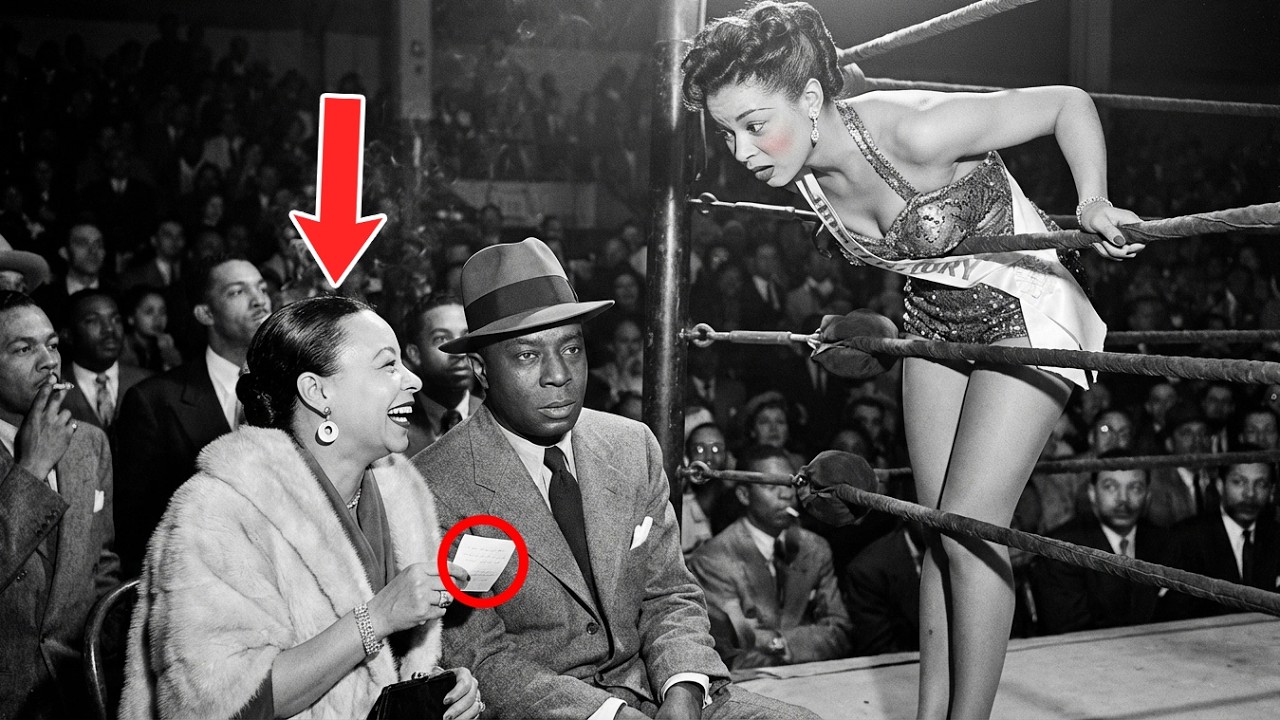
It was a summit, a shadowy theater where the apex predators of the city came to watch other men bleed for pocket change while they carved up neighborhoods and fortunes in the smoke-filled corners. The entire social hierarchy of the New York underworld was mapped out in the seating. In the upper balcony, where the air was so thick it burned the lungs, the corner boys and numbers runners leaned over the iron railings, shouting themselves hoarse, waving crumpled dollar bills. Below them sat the middle management: the Italian capos from downtown, the precinct captains in cheap suits who turned a blind eye for an unmarked envelope, the lieutenants of uptown crews.
They spoke in hushed tones, their eyes darting, calculating alliances. And ringside, in the front row, sat the gods. That row was holy ground, where the spray of a fighter’s sweat and blood could land on a custom-tailored lapel, and where a single nod could authorize a fortune and a single frown could end a life. Standing in the heavy shadows of the fighter’s entrance tunnel, waiting for her cue, was a girl who believed she was destined to sit among those gods.
Her name was Ruby, and she was twenty-two years old, a weapon carved from blind ambition and flawless genetics. She wore a heavily sequined scarlet dress cut dangerously high on the thigh and scandalously low on the chest, a garment designed to steal the breath of every man in the room. She was the premier ring girl for the Rockland Palace, but she viewed the job as a temporary stepping stone, an audition for a much grander stage. She had spent six months observing the power dynamics of the city, watching how men moved, how they commanded fear with a whisper.
She believed power was a mechanical lock, and she was the master key. She didn’t want the corner boys or the thick-necked enforcers who bought her watered-down drinks at the Red Rooster. She wanted the absolute apex. She wanted the undisputed top of the food chain.
A sudden shift in the atmosphere pulled her from her reverie. It wasn’t a noise that caught her attention, but the chilling absence of it. The chaotic roar of the arena dipped, as if an invisible hand had turned down the volume of the world. The shouting from the balcony tapered into a nervous murmur.
The bookies froze mid-sentence. The Italian bosses stubbed out their cigars and sat up straighter. The temperature seemed to drop ten degrees. Ellsworth Bumpy Johnson had arrived.
He did not walk into the arena; he glided. He parted the sea of humanity with the gravity of a man who owned the floorboards he stepped upon. He wore a custom-tailored charcoal gray three-piece suit, immaculate despite the humidity. A wide-brimmed fedora cast a sharp shadow over eyes that had seen the darkest corners of the human soul.
This was a man who had survived Alcatraz, an intellectual who read Shakespeare among murderers, a chess master who viewed the streets of Harlem as a board of sixty-four squares. He wore his power with the quiet stillness of an old lion who knows he has no natural predators. Flanking him to the left was Junie Byrd, a walking mountain of coiled violence. He was Bumpy’s lifelong friend, his shadow, his enforcer.
Junie didn’t look at the crowd; he looked through them, his dead eyes scanning on a grid, his calloused hands never far from the steel he carried. Men backed away rather than risk bumping his shoulder. But it was the woman on Bumpy’s right arm that made Ruby’s eyes narrow. Mamie Johnson moved with a regal grace that could not be bought or imitated.
She was the undisputed queen of Harlem. She wore an elegant midnight blue dress, a single string of pearls, a mink stole draped over her shoulders, entirely immune to the heat. She did not fidget. She carried herself like visiting royalty surveying loyal subjects.
She knew where every skeleton in the city was buried, and she knew who held the shovel. When Bumpy had been away in the darkest holes the federal government could build, Mamie had not just kept his house; she had kept his empire, navigating mob politics with a mind as sharp as her husband’s. Ruby watched them from the shadows, digging her manicured nails into the cardboard round card. To her, Mamie was just an older woman, a fading relic.
She saw the gray at Mamie’s temples, the faint lines around her eyes, and her arrogance blinded her to the steel beneath the velvet. She made a fatal miscalculation, assuming Mamie was just a habit, a comfortable piece of furniture Bumpy kept around out of obligation. “She’s the past,” Ruby whispered to herself. “I’m the future.
He just doesn’t know it yet. ”
The bell rang for the first bout. The crowd roared back to life. Bumpy and Mamie took their seats at the center of ringside, their chairs practically touching the canvas.
Junie did not sit. He stood exactly three paces behind them, an immovable sentinel. Ruby took a deep breath, pushed her chest forward, and stepped out into the blinding light. The heat hit her like an oven, but she ignored it, plastering on a practiced smile as she held the card for round one.
Her walk was a weaponized performance, a slow, mesmerizing sway designed to arrest the attention of every man in the building. Catcalls rained down from the balcony, but she tuned them out. She wasn’t performing for them. She was performing for the front row.
As she rounded the corner, she slowed her pace by a fraction, letting the rhythm of her hips exaggerate. She turned her head, letting her hair cascade over her shoulder, and locked her eyes onto the king of Harlem. She poured every ounce of seduction into that single look. It was an invitation, a challenge, a promise.
Bumpy did not smile. He did not lean forward. He didn’t even blink. He looked up at her with the exact same detached evaluation he might use to inspect a scuff mark on a new pair of shoes.
His eyes registered her presence, calculated her intent, and categorized her as irrelevant. It was an absolute zero reaction, a wall of solid ice. For a split second, Ruby’s smile faltered. The coldness of his gaze hit her like a physical blow.
She had never met a man who didn’t react to her. But the rejection didn’t deter her. It poured gasoline on the fire of her ambition. To make the untouchable man touch her, that was the ultimate prize.
She finished her rotation and slipped between the ropes, returning to her stool in the shadows, where she had a clear view of the front row. She watched them with the focus of a hawk. They didn’t speak much. They didn’t have to.
When Bumpy reached for his silver cigarette case, Mamie already had the gold lighter in her palm. When a sweating politician approached, hoping for a moment of the boss’s time, Bumpy didn’t turn his head until Mamie gave a tiny nod of approval. It was a partnership of absolute equals, built on decades of survival. But Ruby couldn’t see that.
All she saw was an obstacle sitting in the space she deserved. She sat there in the sweltering heat and made a decision. The subtle approach had failed. She needed to escalate.
She was going to make a move so bold that he would have no choice but to acknowledge her, and she was going to do it right under the regal nose of Mamie Johnson. The preliminary fights dragged on, a brutal blur of leather and blood. When the long intermission arrived, Ruby sprinted back to the cramped dressing room beneath the bleachers. It was a concrete box that smelled of mildew and cheap face powder.
She sat at the cracked vanity and pulled out a piece of expensive, cream-colored stationery. She couldn’t write a long plea. That was amateur work. She needed to be mysterious, direct.
She pressed her gold fountain pen to the paper and wrote an address: a discreet, upscale hotel in Midtown Manhattan, far from the gossiping eyes of Harlem. Beneath it, she wrote a single line. “Midnight. Come alone.
” It was a command, not a request. She sprayed a single drop of heavy jasmine perfume onto the center of the note, folded it precisely, and slipped it into a hidden seam in her dress. Her heart hammered against her ribs. Flirting with a mob boss from across the room was risky.
Openly disrespecting his wife in public was a death wish. But her hunger for the crown eclipsed her fear of the executioner. She walked back out into the arena just as the ring announcer stepped to the center of the canvas. “Ladies and gentlemen, it is time for the main event.
” The crowd erupted. Two heavyweight mountains of scarred muscle climbed through the ropes. The referee shouted instructions, but nobody was listening. Ruby took a deep breath, pulled the round-one card from the stack, and stepped through the ropes.
She began her walk, moving through the tidal wave of noise with singular focus. Everything else faded away. She rounded the first corner. She could see Bumpy, unnervingly still, an island in a raging sea.
Mamie was beside him, her posture flawless. Junie stood behind them, his gaze scanning the crowd. Ruby’s fingers casually dropped to her side, brushing the hidden seam. The folded square of paper felt like a loaded derringer.
She turned the second corner, walking directly in front of the VIP section. She was ten feet from Bumpy. Eight. Six.
The king was leaning forward, his forearms resting on the canvas apron, his large hands perfectly still. This was her window. She slowed her pace to an agonizing crawl, letting her hips exaggerate. She wanted witnesses.
She wanted everyone to see her audacity. But her eyes were fixed on Bumpy’s right hand. She took one more step, bringing herself to the very edge of the ropes, directly above him. The smell of his cigar washed over her, mixing with the jasmine on her fingertips.
She smiled down at him, a slow, predatory curve. She lowered the card, breaking the barrier between the ring and the audience. With practiced sleight of hand, her fingers slipped into the hidden seam, extracted the square of paper, and leaned over the ropes. She extended her hand downward, the note pinched between her thumb and forefinger, moving directly toward the back of Bumpy Johnson’s resting hand.
The distance between her fingertips and his hand was exactly six inches. In a room packed with three thousand screaming bodies, six inches was nothing. But in the invisible geography of the Harlem underworld, those six inches were a heavily fortified border between the gutter and the throne. Ruby, blinded by adrenaline, was attempting to leap across that chasm with a piece of perfumed paper.
Time seemed to hit a wall. The roar of the crowd faded to the sound of her own panicked heartbeat. The arc lamps narrowed their focus on three figures: the unmoving king, the observant queen, and the hopelessly naive interloper. Five inches.
The scent of jasmine clashed with the scent of the cigar. The cigar was the scent of established power. The jasmine was the scent of desperation, a chemical announcement of her amateurism. Four inches.
Ruby kept her eyes locked on Bumpy’s hand, a victorious smile already pulling at her lips. In her mind, she had already won. She was already packing her suitcases, envisioning the penthouse suites, the black Lincolns, the terrified whispers. She waited for his hand to flinch, to palm the note, to look up and validate her existence.
Three inches. Ellsworth Johnson did not move a single millimeter. His breathing did not hitch. The ash on his cigar did not tremble.
His eyes remained fixed on the fighters in the center of the ring. He was a statue carved from stone. This was a man who had survived the mind-breaking isolation of Alcatraz, who had stared down men with Tommy guns. To Bumpy, Ruby was not a temptation; she was a minor, insignificant variable in a room filled with larger equations.
To react to her would be to acknowledge she had power over him. And Bumpy Johnson did not hand that power to anyone. He simply ceased to acknowledge the space she occupied. Two inches.
And then, a movement shattered the frozen tableau. It was not Bumpy. It was not Junie, who had tracked Ruby’s hand from the moment it left her hip, had calculated the trajectory, and determined the paper was not a blade or a syringe. He had elected to stand down, a coiled spring.
The movement belonged entirely to Mamie. If Ruby’s approach had been a loud, desperate performance, Mamie’s interception was a master class in elegant, economical precision. She did not gasp. She did not slap Ruby’s hand away.
She did not stand up and cause a scene. That was exactly the reaction Ruby had been banking on. A public meltdown would have meant Ruby was a recognized threat. It would have leveled the playing field.
Instead, Mamie moved with the smooth, devastating strike of a rattlesnake. Her left hand, resting calmly on her lap, simply floated upward. The massive diamond on her ring finger caught the light, throwing tiny rainbows across the canvas. She didn’t turn her head.
She kept her chin perfectly level. She simply extended her arm and intercepted the falling note one inch before it could touch Bumpy’s hand. Her fingers plucked it cleanly out of the air. There was no physical contact between the two women.
Mamie removed the object of contention with the casual grace of a woman picking lint off her husband’s lapel. Ruby froze. The triumphant smile shattered. The river of adrenaline that had made her feel invincible evaporated, replaced by a freezing, paralyzing terror.
The fantasy she had constructed collapsed into dust. She had miscalculated. Catastrophically, perhaps fatally. Mamie pulled her arm back, bringing the note into her lap.
She did not rip it to shreds. She did not throw it back. She held it up, tilting it back and forth, allowing the lights to illuminate the expensive paper. She was inspecting it like a jeweler inspecting a suspicious stone.
The silence from the front row was absolute, drowning out the roar of the crowd. The capos had stopped talking, their cigars dying in the corners of their mouths. They were watching intently. This was a direct challenge to the public image of the most powerful black man in America.
In their world, how a boss’s wife handled public disrespect was a reflection of the boss’s strength. If Mamie showed weakness, it would register as a crack in the armor of the Johnson syndicate. Mamie knew this perfectly well. She brought the note closer to her face.
She didn’t unfold it. She didn’t need to read the address or the command to know what it contained. She lowered her chin and inhaled softly, pulling the scent of the cheap jasmine into her lungs. A tiny wrinkle appeared at the bridge of her nose, the look of a refined woman discovering an insect floating in her champagne.
Then she turned her head slowly, majestically, and locked her eyes onto Ruby’s frozen stare. For the first time, Ruby actually saw the woman in front of her. She didn’t see a fading relic. She saw a fortress.
She saw decades of surviving midnight police raids. She saw a mind that had navigated bloody mob wars while her husband was locked in a cage three thousand miles away. She saw a woman who ruled a neighborhood that ate the weak for breakfast. Ruby’s throat felt packed with sawdust.
She couldn’t swallow. She couldn’t breathe. Mamie’s gaze pinned her in place like an insect to a corkboard. And then, the impossible happened.
Mamie did not glare. She did not scowl. She smiled. It was a genuine, full, radiant smile that reached her eyes.
And then, she laughed. It started low, a soft chuckle that grew into a full, unforced peel of pure amusement. She tilted her head back, her pearls catching the light, and she laughed. It was the most devastating sound Ruby had ever heard.
If Mamie had screamed at her, Ruby could have handled it. Anger would have meant validation. Anger would have proven she was a legitimate threat. But laughter was total annihilation.
Mamie was not laughing to be cruel. She was laughing because the situation was genuinely ridiculous to her. The audacity of this cheap girl attempting to step into the heavyweight ring of Harlem syndicate politics with a folded piece of stationery and dime-store jasmine was simply too absurd to process with anything other than comedy. The laughter rippled down the front row.
The tension that had locked the capos in stillness broke. Seeing the queen unbothered gave the dangerous men permission to react. A low rumble of chuckles spread among them. They were laughing at the pathetic amateurism of the girl frozen against the ropes.
Ruby felt the blood drain from her face, then rush back in a burning flush of humiliation. The laughter felt like physical blows. She had wanted their attention so badly. Now she had it, but she was the punchline.
Mamie’s laughter slowly subsided, leaving a warm smile. She looked back down at the note in her palm. She did not hand it to Bumpy. She did not tuck it away.
She pinched the corner of the note and extended her arm, holding it back toward Ruby. Ruby’s hand, moving on pure instinct, reached out and took the note back. It felt like it weighed a thousand pounds. Mamie leaned forward, closing the distance by a fraction.
Her voice, perfectly modulated, carried only to Ruby’s burning ears. “Sweetheart,” Mamie said, the word dripping with condescending pity. “If you are aiming to walk into a bank and demand the keys to the main vault, you don’t hand your little stick-up note to the teller while the true owner of the bank is sitting right there watching you. ”
Ruby’s mouth opened, but no words formed.
Her mind was blank, short-circuited by the force of Mamie’s dominance. “And you certainly don’t try to pull off the grand master heist wearing that much desperation and smelling of dollar store jasmine,” Mamie continued, her voice soft and lethal. “It heavily lacks a certain required sophistication. ”
She paused, letting the words sink into Ruby’s chest.
The capos chuckled again, nodding in appreciation of the verbal counterpunch. “This is a heavyweight game, little girl,” Mamie said softly. The warmth vanished from her eyes, replaced by a flash of cold, unyielding steel. A brief glimpse of the monster that slept beneath the pearls.
“And you are strictly, entirely penny ante. Run along now before you trip on those borrowed shoes and hurt yourself. You are blocking my view of the fight. ”
Mamie didn’t wait for a response.
She didn’t demand an apology. She didn’t need one. She turned her head smoothly away, dismissing Ruby’s existence from her reality, and returned her gaze to the ring. As she turned, she reached out her left hand and placed it gently, possessively, over Bumpy’s right hand resting on the apron.
Throughout the entire confrontation, Bumpy had not moved a single muscle. But as Mamie’s hand settled over his knuckles, a microscopic shift occurred. He still didn’t turn his head. But a slow, infinitesimal smile touched the corners of his hard mouth.
He turned his large hand over on the canvas, his thick fingers intertwining with hers. He gave her hand a single, firm squeeze of profound approval. It was a silent confirmation of everything Ruby had failed to understand. They were a unified front, an impenetrable fortress.
He didn’t need to protect himself from the desperate advances of the street. He had a queen who handled the annoyances before they could reach the steps of the throne. Ruby stood frozen against the ropes, the crushed note burning in her fist. The powerful men had already forgotten her.
She was nothing to them, a momentary distraction. She slowly lowered the round card. The scarlet dress, which had felt like armor, now felt like a foolish costume. She didn’t finish her walk.
She didn’t flash her smile. She simply turned, her shoulders slumped in total defeat, and stumbled back toward the tunnel, fleeing into the dark, anonymous shadows from which she had so arrogantly tried to rise. Back at ringside, the bell rang, ending the first round. The crowd roared.
The fighters retreated to their corners. In the center of the front row, Bumpy calmly raised his free hand and signaled a passing waiter. “Two bourbons,” he said quietly. He turned his head and looked at his wife, his eyes shining with a rare, private amusement.
“Neat,” he added. Mamie didn’t turn to look at him. She kept her eyes on the ring, but the victorious, unbothered smile remained on her lips. “Make it three,” she corrected the waiter smoothly, her thumb tracing the gold band on Bumpy’s finger.
“Junie looks like he could use a strong drink. ”
Behind them, standing in the shadows, Junie shifted his weight. He didn’t smile. He didn’t speak.
But he slowly let his massive right hand drop away from the lapel of his jacket, moving it safely away from the grip of his hidden revolver. The tension drained out of his shoulders. The threat had been neutralized. The perimeter was secure.
The king was resting quietly in his chair. The queen was completely unbothered. And the strict, unforgiving order of the Harlem underworld had been effortlessly maintained by a few well-placed words and an untouchable, echoing laugh.






