The crowd on the hill was enormous, twenty thousand strong, with more arriving all day. They had come to Biskupia Gorka, the hill overlooking Gdansk, to watch five women die, and the mood was one of grim satisfaction. Vendors moved through the packed mass selling food and drink, turning the occasion into something like a dark holiday. The gallows stood ready, a massive wooden structure built for the day’s work, and beneath it a truck idled, waiting to serve as the platform from which the condemned would be dropped.
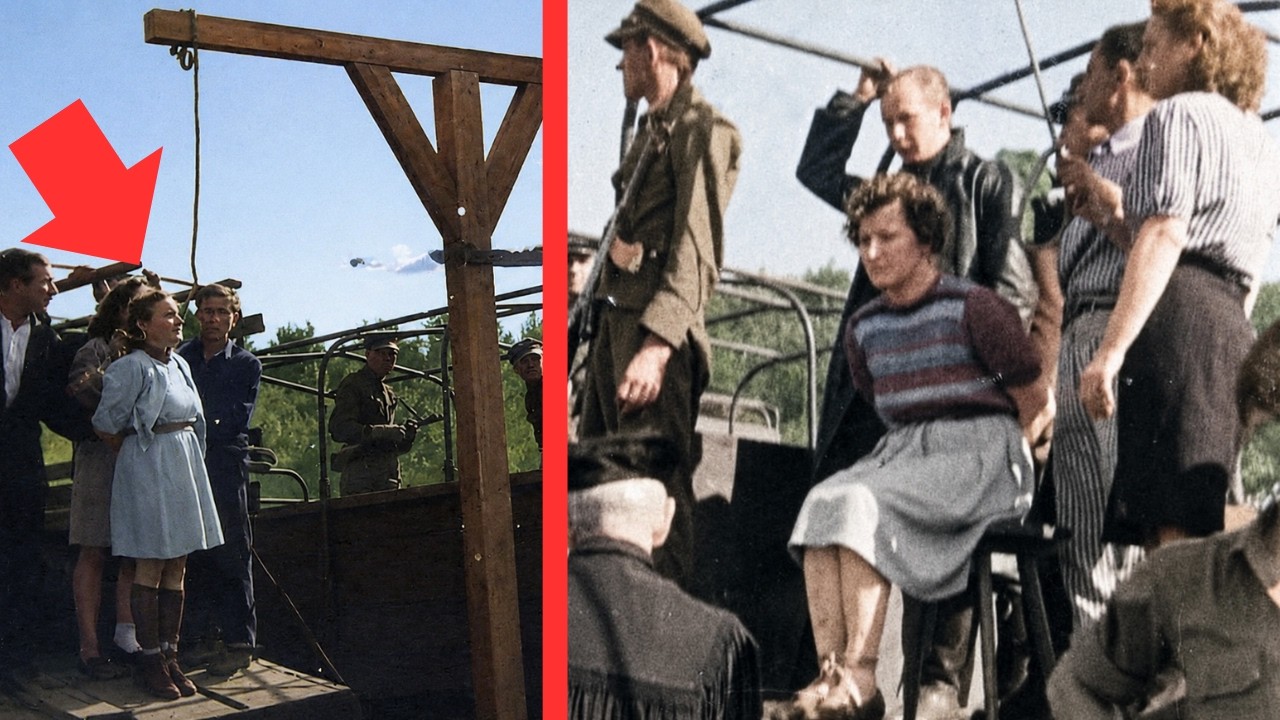
On the 4th of July 1946, the first of the women was brought forward. Jenny Wanda Barkmann went first, and the crowd watched in silence as the noose was placed around her neck and the truck pulled away, leaving her to strangle slowly at the end of the rope. She was young, twenty-four, and her body swung in the air until the life was gone from it. Then the guards brought the next woman, and this time the crowd began to stir with recognition.
This was Eva Paradies, twenty-five years old, and the people packed on the hillside knew exactly what she had done. Paradies was helped onto the back of the truck, positioned on the other side of the two-pronged gallows from where Barkmann still hung. An official stepped forward and read out her crimes in a loud voice, so that all could hear. The crowd had gone quiet, and in that quiet her cries carried clearly.
She screamed and wept as she understood what was coming next. The executioner—a former prisoner of Stutthof himself—climbed up and secured the noose around her neck. He checked the knot, made his final adjustments, and then gave the signal. The truck drove slowly forward, and the rope snapped taut.
Paradies did not die immediately. The noose had not broken her neck, and she was left to strangle, her body twisting and swinging wildly at the end of the rope. The crowd jeered as she struggled, and the swinging continued until at last she was still. She was left hanging there, another body beside Barkmann’s, as the remaining executions were carried out that day.
Afterward, her body was presumed to have been donated to medical science, handed over to local institutions once she had been declared dead. The woman who died on that gallows had not always been a monster. Eva Paradies was born in December 1920, in a Germany still recovering from the First World War. Her early life was ordinary, with little to suggest the fate that awaited her.
Like many girls of her generation, she was almost certainly a member of the League of German Maidens, the compulsory youth organization the Nazis had established for young women. Some joined out of enthusiasm, others out of fear, and many were pushed into it by parents who saw advantage in cooperating with the new regime. The organization taught loyalty, obedience, and the virtues of the Reich, and it shaped the minds of a generation of German girls. As the war ground on, Germany began to run short of men.
The demands of the Eastern Front were insatiable, and the SS found itself scraping the bottom of its manpower reserves. Even male concentration camp guards who had been wounded and invalided out of frontline service were pressed back into uniform and sent east to hold the line against the Red Army. Someone had to replace them in the camps, and the SS turned to women. Young women across Germany were offered a way out of their mundane wartime jobs—hairdressers, shop workers, nurses—and into a position of authority.
They would receive regular pay, better than most wartime salaries, and the chance at promotion. They would become Aufseherinnen, female overseers, the women who guarded the camps’ female prisoners. Thousands answered the call. They were sent to Ravensbrück and other camps to train, and there they were taught the methods of the SS.
They learned how to keep prisoners in submission through violence, how to beat and batter inmates into obedience. The training was brutal, and it filtered out the women who could not stomach the cruelty. Those who passed were sent out to the camps across the Reich, ready to serve. In August 1944, Eva Paradies was assigned to Stutthof, the concentration camp near Danzig on the Baltic coast.
She was sent first to the SK3 camp, a satellite of the main complex, where she completed her training. Within weeks she was transferred again, this time to the Bromberg Ost subcamp, where she took on the role of wardress. She was put in charge of a barracks and given oversight of the female prisoners housed there. Her duties were simple: keep order, keep discipline, and keep the prisoners working.
The women under her charge were sent to a nearby railyard to load cargo onto trains, to repair tracks, and to dig trenches—heavy, exhausting labor that wore down even the strongest. Paradies served alongside other women who would also face judgment for their crimes. Hertha Bothe, who would later stand trial at Belsen, worked the same camp. Gerda Steinhoff was there too, a woman who would share Paradies’s fate on the gallows at Biskupia Gorka.
Together they made the lives of their prisoners a living hell. At Bromberg Ost, Paradies earned her reputation as one of the worst. Witnesses later testified against her, and their accounts painted a picture of casual, relentless cruelty. One witness described how Paradies ordered a group of female prisoners to strip naked in the freezing cold of winter, then doused them with ice-cold water.
When the women moved, she beat them. The combination of freezing temperatures and soaking wet clothing was a death sentence in its own right. Prisoners exposed to such treatment could easily succumb to hypothermia in the middle of the night, and Paradies knew it. This was not an isolated incident.
It was typical of her behavior, dangerous and vicious, and the dangers she inflicted on the women in her charge were real and immediate. She was not content with just torture. Witnesses held her responsible for the deaths of prisoners she beat to death herself. She was also known to have selected female prisoners to be sent to the main camp at Stutthof, where a small gas chamber waited.
Those who were chosen for such transfers rarely came back. Eventually, Paradies was moved back to Stutthof’s main camp, where she continued her work. But the war was closing in on Germany, and the camps were being evacuated as the Red Army advanced. In April 1945, with the end in sight, Paradies accompanied one of the final transports of female prisoners from Stutthof to the Lauenburg subcamp.
It was her last act as a guard. After the transport arrived, she ran. She tried to escape, to disappear into the chaos of a collapsing Germany, but she did not get far. She was captured shortly after the war came to an end.
Paradies was brought before the Stutthof trials, where she stood alongside her fellow guards. Jenny Wanda Barkmann, Gerda Steinhoff, and the others faced the court with her, and the witnesses came forward to testify. The courtroom heard what Paradies had done at Bromberg Ost, heard about the freezing water and the beatings, heard about the prisoner she had killed with her own hands. Throughout the proceedings, Paradies seemed not to take the court seriously.
She showed little emotion, little remorse, little concern for the weight of the evidence against her. It was only when the sentence was read—death—that the mask cracked. Only then did the tears come. She had a great deal of time to think about her fate.
The executions were set for the 4th of July 1946, and the authorities made them a public spectacle. The gallows at Biskupia Gorka were built large enough to hang several people at once, and the crowd that gathered to watch was enormous. The people of Poland had suffered immensely under the German occupation. Millions had been killed in mass executions, in gassings, in the indiscriminate brutality of the occupation.
The anger in the country ran deep, and there was a hunger for justice—or at least for the sight of it being done. The public execution of the Stutthof guards was a chance for the people to see with their own eyes that the perpetrators were being held accountable. It was a small form of justice, but it was visible, and it mattered. Eva Paradies was twenty-five years old when she died, swinging at the end of a rope in front of a jeering crowd.
She had lived a normal childhood, had joined the organizations expected of her, had taken a job that offered pay and promotion in wartime. And in that job, she had become a monster. The people of Poland who watched her die saw her punishment as fair, proportionate to the crimes she had committed. Whether the woman on the gallows ever understood the weight of what she had done is unknown.
She died as she had lived out her last months: crying, struggling, and swinging wildly at the end of a rope, with the crowd’s jeers ringing in her ears.
