The stone chimney still stands at the highest point in Oakland County, a single column of masonry rising from the forest floor. Around it, low foundations trace the outlines of rooms that have not held a roof since January 1999. Rusted fixtures protrude from the earth. Trees grow through what was once a floor.
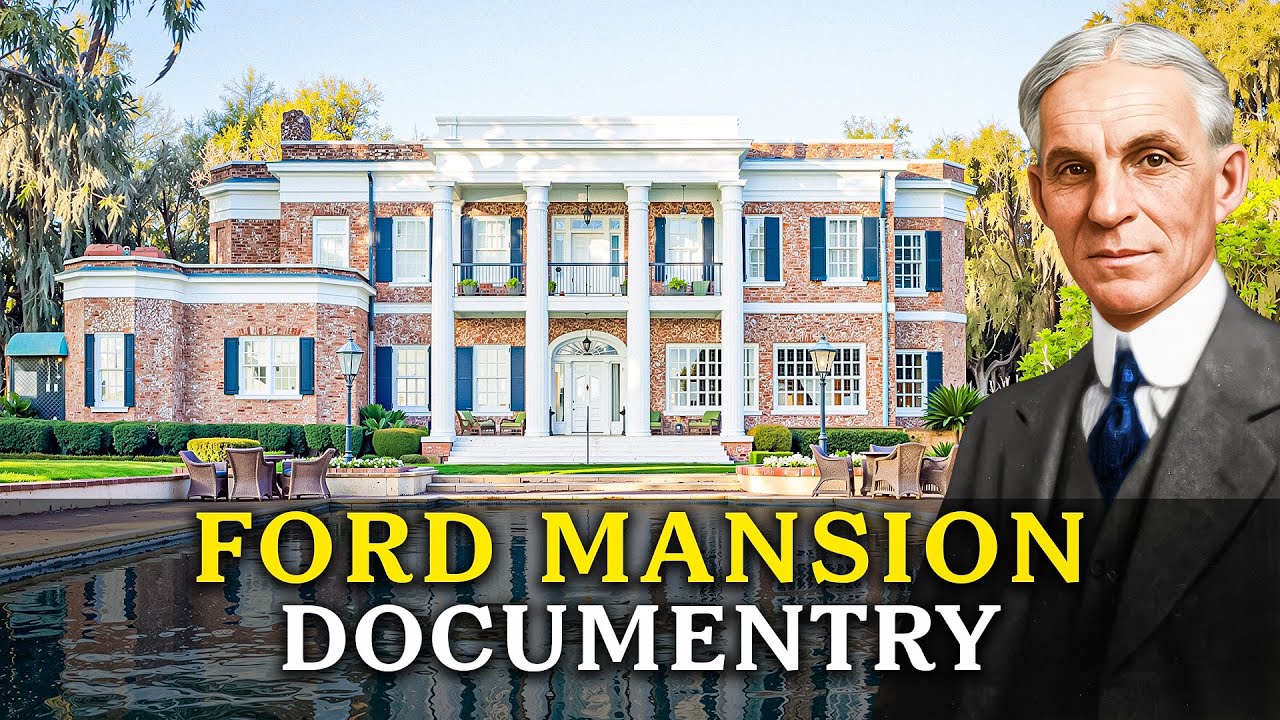
This is all that remains of Haven Hill, the retreat Edsel Ford built to escape the weight of being Henry Ford’s only son, and the place where American royalty once walked among the pines. To understand what happened here, you have to go back to the early 1920s, when America was roaring and the Ford Motor Company had revolutionized not just transportation but the entire American way of life. By the time Edsel Ford began purchasing land in Highland and White Lake townships in 1923, ten million Model T automobiles had rolled off assembly lines. The family wealth had swelled to proportions difficult to comprehend.
Henry Ford’s net worth reached $1. 2 billion, equivalent to roughly $22 billion today. The Fords were not simply rich. They were American royalty, comparable in influence and public fascination to the Kennedys or the British royal family.
Their lives shaped the destiny of Detroit and, by extension, the entire American automobile industry. Edsel Ford was born on November 6, 1893, the only child of Henry and Clara Ford. By 1923, when he began assembling what would become Haven Hill, he was already president of Ford Motor Company, a position he had assumed in 1919 at just twenty-six years old. He was married to Eleanor Lowthian Clay, the niece of department store magnate J.
L. Hudson, and they were raising four children: Henry II, Benson, Josephine, and William Clay. On paper, Edsel Ford had everything. In reality, he was living under pressures that would eventually consume him.
The Fords had been living in Detroit’s Indian Village neighborhood, a prestigious area that should have provided the privacy and security a family of their stature required. But by the early 1920s, that privacy was eroding. Detroit was growing and changing. Labor tensions at Ford Motor Company were escalating into something dangerous.
The wealthy were increasingly seen not as leaders but as targets. Then came the Lindbergh kidnapping, which sent shockwaves through every affluent family in America. If it could happen to Charles Lindbergh’s son, it could happen to anyone’s children. Edsel began purchasing parcels of land in western Oakland County.
Piece by piece, he assembled what would eventually become a 2,422-acre estate. The land included one of the highest elevations in Oakland County, a dramatic hill rising adjacent to a wooded lake. The locals had called it Heaven Hill for generations. Edsel renamed it Haven Hill, a sanctuary, a nerve retreat, a place where he could escape the crushing weight of being Henry Ford’s only son.
Construction on the main lodge began in 1924 and continued through 1931, though the family moved in by 1926. The architect, Robert O. Derrick, who would later design the Henry Ford Museum in Dearborn, created a structure that married rustic charm with sophisticated comfort. The lodge sprawled across 6,900 square feet, built from cedar logs harvested from Michigan’s Upper Peninsula.
Rough timber and stone gave it an authentic wilderness feeling, while the interior featured stone fireplaces, plank flooring, and every modern convenience money could buy. The landscape architect Jens Jensen, who had designed the grounds at Henry Ford’s Fair Lane estate, created a masterwork around the lodge. Jensen was famous for his prairie style, which emphasized natural elements and native plants. He designed gardens, walking trails with boardwalks and bridges, and gazebos positioned at scenic overlooks to give Haven Hill that authentic Up North feeling.
Pine needles were trucked in regularly and scattered across the grounds, filling the air with a fresh, piney scent. Haven Hill was not just a house. It was a self-sufficient world. The estate included a working farm with an 11,000-square-foot barn housing 1,500 sheep, cows, chickens, and horses.
This was no gentleman’s hobby farm. It was a genuine working operation that could sustain the estate and its staff. Two vegetable gardens provided fresh produce year-round. Henry Ford himself had once said that with one foot in industry and one foot in agriculture, America is safe.
His son took that philosophy seriously at Haven Hill. A gatehouse served as the secure entrance where security personnel checked anyone who wished to enter the property. This was not paranoia. This was the 1920s and 1930s, when labor tensions were reaching violent peaks, when the wealthy were genuine targets for kidnapping and extortion, when a man like Edsel Ford had real reasons to be concerned about his family’s safety.
The gatehouse was functional, necessary, a checkpoint that allowed the family to feel secure on their own property. The carriage house, originally built to house the chauffeur and the Ford family cars, eventually became a playhouse for Henry II, Benson, Josephine, and William Clay. Imagine being a child with an entire log cabin as your personal playhouse. The building had real electricity and real plumbing.
It was not a toy. It was a fully functional structure that just happened to be used by children for their games and adventures. The horse riding stables were substantial, with a full riding arena where the family could practice and exercise their horses. Eleanor Ford in particular was an accomplished rider.
The stables were working facilities that housed and trained animals the family rode regularly across the 2,422 acres of trails that crisscrossed the property. The swimming pool was built to exacting standards, with a cabana building attached that contained changing rooms and facilities for guests. On hot Michigan summer days, the pool would be filled with family and friends, the sound of splashing and laughter echoing across the grounds. The tennis court sat nearby, perfectly maintained.
Then there was the toboggan run: 3,000 feet of carefully constructed track starting from the highest point on the property and running down the hillside. But this was no ordinary toboggan run. It featured a motorized tow lift that would pull you back up to the top so you could make run after run without having to climb. In the 1920s and 1930s, this was cutting-edge recreational technology.
The Ford children and their friends could spend entire winter days flying down that hill, the cold air stinging their faces, the snow spraying up around them. There was also a lagoon, artificially created by damming a small creek that ran through the property. This lagoon became a focal point for the estate’s social activities. Boats could be taken out on the water.
For William Clay Ford’s twenty-first birthday in 1946, the family had a full-size replica pirate ship built on that lagoon, complete with rigging and sails. That party, held on the Apple Patio with Frank Sinatra performing, must have been the social event of the season. At the top of the hill, the lodge commanded spectacular views in every direction. From the windows and terraces, you could see rolling hills, forests, and the lake Edsel had renamed Haven Hill Lake by damming Cedar Creek.
On clear days, the view stretched for miles. Standing on that elevation, surrounded by 2,422 acres of private land, you could almost forget the troubles of the outside world. Almost. Because no matter how beautiful the sanctuary, no matter how carefully designed the escape, the pressures that drove you there in the first place were still waiting.
Haven Hill was more than a private sanctuary. It became an entertainment venue where Edsel and Eleanor hosted some of the most famous people of their era. Charles Lindbergh walked these halls just months after his historic solo flight across the Atlantic Ocean in 1927. He would later return multiple times, a close friend to the Ford family during the height of his fame.
The friendship between the Fords and Lindberghs ran deep, which made the 1932 kidnapping and tragic loss of Lindbergh’s son all the more haunting for Edsel and Eleanor, who understood too well what it meant to fear for their children’s safety. Thomas Edison, Henry Ford’s close friend and one of America’s greatest inventors, visited Haven Hill. By the time he walked these grounds, Edison was in his later years, but his presence connected the retreat to the very birth of American innovation. Here was a man who had helped light the world, taking his leisure at a retreat built with automotive wealth.
Admiral Richard Byrd, the polar explorer whose expeditions Edsel Ford personally financed, was a frequent guest. In 1926, Byrd made his historic flight over the North Pole, made possible by Edsel’s backing. In gratitude, Byrd named the Edsel Ford Range of mountains in Antarctica after his benefactor. When Byrd visited Haven Hill, he brought with him stories of ice and endurance, of places on Earth that remained unconquered.
Edgar Rice Burroughs, the creator of Tarzan, was another guest. Jackie Cooper, the young actor who had captured America’s heart, visited as well. The Duke of Windsor, formerly King Edward VIII of England, who had abdicated his throne for love, spent time at this American wilderness retreat. These were not casual visits.
Haven Hill was where relationships were forged, where deals were discussed, where the powerful and famous could relax away from public scrutiny. But beneath the surface, something was deeply wrong. Edsel had been groomed from childhood to take over the family business. He spent his youth tinkering on cars with his father, learning the business from the factory floor up.
He studied at the Detroit University School, where he took courses in drafting and engineering. By 1916, he was company secretary. In 1919, at age twenty-six, he became president of Ford Motor Company. There was a cruel irony at the heart of Edsel’s presidency.
He had the title, but he did not have the power. Henry Ford had never truly let go. While Edsel served as president, Henry maintained control over every major decision. More than that, Henry seemed to take a perverse pleasure in contradicting, undermining, and publicly humiliating his only son.
In meetings with other executives, Henry would interrupt Edsel, overrule him, even shout at him to shut up before storming out of the room. The relationship between father and son was complex, toxic, and ultimately tragic. Henry loved Edsel in his own way, but he could not seem to help treating him like a disappointment. When young Edsel accidentally cut the tip of his finger off in the machine shop Henry had built for him, Henry was not concerned about his son’s injury.
He was disappointed that Edsel had been careless. The incident seemed to confirm Henry’s suspicion that his son was not tough enough, not mechanical enough, not enough like Henry himself. Edsel’s gifts lay in different areas. He had an artistic sensibility, a keen eye for design and aesthetics.
He wanted to modernize the Model T, to bring style and innovation to Ford’s lineup. In the early 1920s, he commissioned a redesign of the aging Model T. Henry’s response was brutal and simple: rub it out. Destroy it.
The Model T was perfect as it was, and no son of his was going to change it. Edsel backed down. What choice did he have? To fight his father openly would have torn the family apart.
To disengage meant abandoning his responsibilities. He was trapped between duty and dignity, and the stress was taking its toll. Haven Hill was supposed to be Edsel’s escape from all of this. It was his nerve retreat, a place where he could be himself, where he could spend time with Eleanor and their children away from his father’s judgment.
At Haven Hill, Edsel could simply be a husband, a father, a man who enjoyed the beauty of nature and the company of interesting people. But you cannot escape your life by driving a few miles into the countryside, no matter how beautiful the sanctuary you have built. The pressures continued to mount throughout the 1930s. Finally, in 1927, changing market conditions and plummeting sales forced even Henry Ford to admit that the Model T’s time had passed.
Edsel was allowed to develop the Model A, which became a tremendous success, selling nearly five million units over four years. He founded the Mercury division. He was responsible for the Lincoln Zephyr and the iconic Lincoln Continental, whose hood ornament he personally selected as a racing greyhound. He introduced hydraulic brakes and strengthened Ford’s overseas production.
These were genuine achievements, accomplishments that would have made any executive proud. But for Edsel, each success came at tremendous personal cost. He was constantly battling his father, constantly having his judgment questioned, constantly being humiliated in front of his peers. Making matters worse was Harry Bennett, Henry Ford’s security chief.
Bennett was a tough, brutal man who served as Henry’s enforcer. He seemed to take particular pleasure in making Edsel’s life difficult. And Henry allowed it, perhaps even encouraged it, as if he thought the abuse would toughen his son up. It did not toughen Edsel up.
It was killing him. By the early 1940s, Edsel Ford’s health was failing. He had developed stomach problems, chronic pain that would not go away. Doctors diagnosed stomach cancer.
The disease had already metastasized by the time they caught it. Surgery was attempted, but it was unsuccessful. Henry Ford refused to accept what was happening. He blamed Edsel’s lifestyle, insisted that if his son would just stop smoking, eat better, see different doctors, everything would be fine.
He could not, or would not, see that his son was dying. At home in Grosse Pointe Shores, in the beautiful Cotswold-style mansion that architect Albert Kahn had designed for the family, Edsel Ford spent his final days. Eleanor cared for him. The children visited.
The man who had financed polar expeditions, who had commissioned Diego Rivera’s famous Detroit Industry murals at the Detroit Institute of Arts, who had quietly been one of Detroit’s greatest art patrons and philanthropists, was fading. On May 26, 1943, Edsel Ford passed away at his lakeside home. He was forty-nine years old. The official cause was stomach cancer and undulant fever.
But many people, including Edsel’s own son, Henry Ford II, believed the real cause went deeper. Henry II would later be quoted saying about his grandfather, “That old man killed my father. ”
Whether the stress and abuse Edsel suffered directly caused or accelerated his cancer is something doctors can debate. What is undeniable is that Edsel Ford lived under crushing psychological pressure for most of his adult life, that he suffered public humiliation and private torment, and that he died far too young.
After Edsel’s death, Henry Ford briefly reassumed the presidency of Ford Motor Company. But the elderly founder, now eighty years old, was mentally inconsistent and no longer fit for the position. The company began to hemorrhage money, losing over ten million dollars a month. Ford Motor Company was in crisis.
It was Edsel’s widow, Eleanor, who finally broke the deadlock. Controlling over forty percent of the company shares she had inherited from her husband, Eleanor delivered an ultimatum to Henry Ford: step down and let Henry Ford II take over, or she would sell her shares and take the company public. Clara Ford, Henry’s wife, supported Eleanor, effectively telling her husband that he was destroying any hope of family unity. Cornered by his wife and daughter-in-law, Henry Ford finally relented.
On September 21, 1945, Henry Ford II became president of Ford Motor Company. One of his first acts was to fire Harry Bennett and clean house of his grandfather’s cronies. He was twenty-eight years old, and he was determined to transform the company from an outsized family business into a modern corporation. Henry Ford, the great industrialist who had revolutionized American manufacturing and created the middle class his workers could afford to join, died on April 7, 1947.
He was eighty-three years old. He had outlived his only son by less than four years. After Edsel’s death in 1943, Haven Hill’s purpose changed. Eleanor Ford no longer wanted to keep the vast estate.
Too many memories perhaps, too much upkeep for a property that had been meant as Edsel’s sanctuary. In 1946, just three years after her husband’s passing, Eleanor sold Haven Hill to the Michigan State Park System, for what would become the Highland State Recreation Area. The state initially used the lodge as a conference center and environmental learning center. Park administrators and guests walked the same halls where Charles Lindbergh and Thomas Edison had once stayed.
The toboggan run still operated. The grounds, lovingly maintained according to Jensen’s original design, remained beautiful. For a time, it seemed that Haven Hill might have a second life as a public resource, a place where ordinary Michiganders could experience a piece of automotive history. But by 1980, state budget cuts forced the closure of the structures.
The lodge, the carriage house, the barn, all the buildings that made up the Haven Hill complex were locked up and left empty. Nature began its slow work of reclamation. Vines crept up walls. Trees grew closer.
The paths and trails once meticulously maintained became overgrown. For nineteen years, Haven Hill sat abandoned. The gatehouse, which had once been the secure entrance to a sprawling estate, was gradually swallowed by forest overgrowth. The swimming pool cracked.
The tennis courts disappeared beneath weeds. Inside the lodge, the stone fireplaces where the Ford family had warmed themselves on winter evenings stood cold. The windows, no longer maintained, began to fail. Weather got inside.
Then, in late January 1999, tragedy struck in a senseless act that would seal Haven Hill’s fate forever. Teenage vandals broke into the vacant lodge on a winter night in 1999. They were just kids, probably looking for a thrill, a place to explore where they were not supposed to be. Maybe they were curious about the famous Ford family retreat.
Maybe they just wanted somewhere to hang out away from adult supervision. Whatever their intentions, the result was catastrophic. A fire started. Whether it was accidental or deliberately set, the outcome was the same.
The flames spread through the 6,900-square-foot structure, consuming the cedar logs that had been harvested from Michigan’s Upper Peninsula seventy-six years earlier. The lodge burned through the night, flames visible for miles around, a beacon of destruction at the highest point in Oakland County. By morning, Haven Hill Lodge was gone. The roof had collapsed.
The walls had fallen. All that remained was the stone chimney, still standing like a grave marker, and the foundations that traced where rooms had once been. The heart of the estate, the place where Edsel Ford had sought peace, where his children had grown up, where American royalty and international celebrities had gathered, was reduced to rubble and ash. The state lacked the resources to rebuild.
The ruins were simply left as they were. Over the following years, other parts of the estate were lost as well. The horse riding stables burned down in another fire. In 2008, a severe storm with high winds caused the massive barn, which had once housed 1,500 sheep, cows, chickens, and horses, to collapse.
One by one, the structures that made up Haven Hill disappeared, leaving only fragments and memories. Today, you can still visit what remains. Haven Hill is now part of the Highland State Recreation Area. The property covers 5,900 acres of rolling hills, forests, and lakes, created by combining the old Haven Hill estate with other parcels acquired by the state.
It is a beautiful park, popular with hikers, mountain bikers, and equestrians. To reach the ruins of Haven Hill Lodge today, you start at the gatehouse. The structure has been partially restored through the efforts of volunteers from the Friends of Highland Recreation Area, an organization dedicated to preserving what is left of the estate’s history. The gatehouse, which once served as the secure entrance where guards checked visitors before allowing them onto the property, now sits near the park entrance, no longer hidden by the forest overgrowth that nearly consumed it.
From there, you follow trails that wind through the woods. These are the same paths the Ford family once walked, though now they are used by hikers and mountain bikers rather than industrial magnates and their famous guests. The terrain is hilly, dramatic. You understand why Edsel Ford fell in love with this land.
As you climb toward the highest point in Oakland County, you start to see fragments of the past. Rusted metal fixtures protrude from the ground. Concrete poles and other foundations appear among the trees. Then you arrive at the lodge site.
The stone chimney still stands tall and solitary, though it is slowly deteriorating and has been cordoned off for safety. It is a haunting sight, this single vertical element rising from the horizontal spread of foundations. Around it, you can trace the footprint of the entire lodge. Low stone walls mark where rooms once stood.
You can identify where the terraces were, where people stood and looked out at those spectacular views in all directions. Interpretive signs installed by the Motor Cities National Heritage Area provide context, explaining who Edsel Ford was, who visited here, what this place meant. The signs talk about the celebrity guests, about Haven Hill as Edsel’s nerve retreat, about the fire that destroyed it all. But standing among the ruins, the signs seem inadequate.
They tell you facts, but they cannot convey what it must have felt like to be here in the 1920s and 1930s, when this was a living, breathing center of American power and culture. They cannot make you feel the weight Edsel Ford carried every time he drove up to his sanctuary, hoping to find peace from his father’s judgment. If you continue exploring, you can find the carriage house, which still stands but is boarded up. This is one of the only original structures that has not been lost to fire or collapse.
Inside this building, young Henry II, Benson, Josephine, and William Clay Ford once played, oblivious to the forces that were slowly destroying their father. The pool is still there, though cracked and dry. The tennis court is buried somewhere under decades of vegetation. The 3,000-foot toboggan run with its motorized lift is gone, reclaimed by the forest.
The remains of the barn, mostly collapsed after the 2008 storm, are fenced off for safety. What strikes you walking through these ruins is how thoroughly nature has reclaimed what was once a triumph of wealth and landscaping. Jensen’s carefully designed prairie-style grounds have reverted to wild forest. Trees grow through foundations.
The pine needles that were once trucked in to maintain that Up North atmosphere now fall naturally from the surrounding forest. The estate that was meant to be a controlled, cultivated sanctuary has become genuinely wild again. In a strange way, Haven Hill has returned to what it was before Edsel Ford arrived: Heaven Hill, the highest point in Oakland County, a beautiful piece of Michigan wilderness. But the ghosts remain.
Eleanor Clay Ford lived until October 19, 1976. She was eighty years old when she passed away, having outlived her husband by thirty-three years. After Edsel’s death, Eleanor had become one of Detroit’s most important philanthropists, continuing and expanding the charitable work she and Edsel had done together. She supported the Detroit branch of the NAACP, the Henry Ford Hospital, the Detroit Symphony, and countless other organizations.
She served on the board of directors of Ford Motor Company as one of only fifteen women directors in the company’s history. Most importantly, Eleanor ensured that the Grosse Pointe Shores mansion, the beautiful home Albert Kahn had designed for her family, would be preserved for the benefit of the public. Today, the Edsel and Eleanor Ford House is a national historic landmark, open for tours with its eighty-seven acres of lakefront grounds and original art collection intact. Haven Hill never received the same preservation.
The state did not have the resources. The public did not seem to care as much about a hunting lodge in the woods as they did about the grand mansion on Lake St. Clair. When the lodge burned in 1999, there was no outcry, no campaign to rebuild.
It was simply gone, and people moved on. The Ford family continued to shape American industry for decades after Edsel’s death. Henry Ford II transformed the company his grandfather had founded and his father had struggled to modernize. Under his leadership, Ford Motor Company became a publicly traded corporation in 1956 and grew into one of the largest companies in the world.
He served as CEO until 1979 and as chairman until 1980, finally stepping down at age sixty-three. Benson Ford and William Clay Ford also worked in the family business. The Ford name remains synonymous with American automotive manufacturing. The Friends of Highland Recreation Area, a volunteer organization, maintains the grounds around the former lodge for park visitors.
They have worked since 2007 to clean up the site, install informative signage, and preserve what is left. They have partially restored the gatehouse, rebuilt garage doors, installed new windows, repaired roofs. It is slow, dedicated work done by people who understand that this place matters, that it is more than just some old ruins in the woods. The fireplace chimney, slowly crumbling, cannot last forever.
Eventually, even that last vertical element will fall. The foundations will continue to sink into the earth. Given enough time, there will be nothing left but stories and photographs, memories of a place that once represented the pinnacle of American industrial wealth and the private sorrows it concealed. Haven Hill was always about escape, about trying to find peace in a world that would not grant it.
Edsel could not escape his father’s shadow, could not escape the responsibilities of being the only heir to the Ford empire, could not escape the stress that likely contributed to his early death. The sanctuary he built could not protect him from any of it. After he died, the sanctuary could not protect itself either. All that wealth, all that power, all those celebrity guests and elaborate amenities, and what remains?
A chimney, some foundations, metal fixtures rusting in the soil, the bones of buildings picked clean by time and fire. The estate that Edsel Ford spent from 1923 to 1931 building was sold by his widow just three years after his death. It served as a state conference center for thirty-four years before being abandoned. It sat empty for nineteen years before burning down.
From vision to ashes, seventy-six years. Henry Ford II believed his grandfather killed his father. Eleanor Ford must have believed something similar when she gave Henry Ford that ultimatum in 1945. But Henry Ford too suffered.
He lost his only child. He watched his son die at forty-nine, and then he lived for four more years carrying that loss. When Henry died in 1947, the nurses at Henry Ford Hospital lined up in their white uniforms to pay their respects to the founder. The man they were honoring had achieved extraordinary things and made terrible mistakes.
One of his worst mistakes cost him the person he probably loved most in the world. Haven Hill witnessed all of this. The lodge heard conversations between Edsel and Eleanor about the latest humiliation at the factory. It heard the children playing, unaware of their father’s struggles.
It heard laughter and music at parties, strategy sessions with Admiral Byrd, discussions about art with visiting intellectuals. It was built to be a refuge, and for a while it succeeded. But no refuge lasts forever. No sanctuary can truly keep out the world.
Haven Hill, for all its beauty and seclusion, could not save Edsel Ford. And when he was gone, it could not even save itself.






