The jury had been out for three days when the foreman finally rose to deliver the verdict. The courtroom in Salem was packed, reporters from Boston and New York pressed against the rail, and Thaddius Whitmore stood motionless at the defense table, his face betraying no emotion. When the word “guilty” echoed off the granite walls of the Essex County Courthouse, he did not flinch. His only words, according to the Boston Herald, were directed to his children.
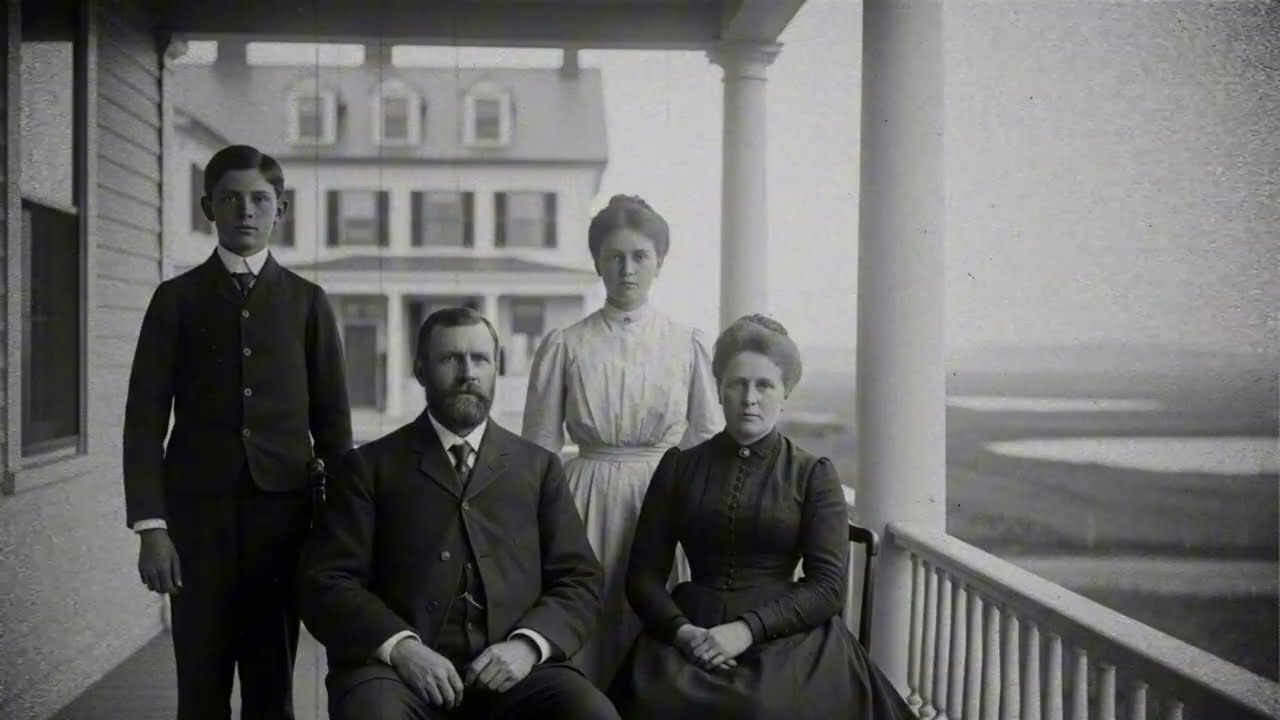
“Charlotte, William, remember me as I was, not as they claim I am. ”
The condemnation of Thaddius Whitmore of Ipswich, Massachusetts, for the murder of his wife Eleanor would conclude one of the most sensational legal proceedings in Essex County history. But it would leave behind a question that the courts never fully answered, and that historians would only begin to untangle more than seventy years later, when a graduate student opened a sealed metal box that should have remained forgotten. The year was 1965.
Margaret Atwood, a history student at Salem State College, was researching shipping trade in Essex County when she stumbled upon a collection of documents filed under “unresolved matters, 1890-1900. ” The records, yellowed and stained as if by water, had been sealed in a metal box and forgotten in the courthouse archives. They concerned the Whitmore case, a name she recognized. The grand mansion that had once overlooked the Ipswich marshes had been demolished decades earlier, but the story surrounding it had never entirely faded from local memory.
On March 17, 1892, the Essex County Register reported that Thaddius Whitmore, patriarch of the Whitmore family, had reported his wife Eleanor missing. She had last been seen three days earlier, departing for a visit to her sister in neighboring Rowley. She never arrived. The newspaper account was brief, three paragraphs on page seven.
No one suspected that this disappearance would mark the beginning of a tale that would eventually consume the entire Whitmore household. The Register described Eleanor as a woman of impeccable character and gentle disposition, noting that her absence was cause for grave concern among the good people of Ipswich. Sheriff Thomas Caldwell had organized a search party to comb the route between the Whitmore estate and the train station, but no trace of the missing woman had been found. The article concluded with a plea for anyone with information to come forward.
Thaddius Whitmore, a stern-faced man of 49 with a neatly trimmed beard graying at the temples, was well regarded in Ipswich society. A former ship captain turned businessman, he managed what remained of the family’s investments with a reputation for shrewdness. The household consisted of his wife Eleanor, their daughter Charlotte, aged 20, and their son William, 17. Three servants completed the household: Mrs.
Agatha Collins, the housekeeper of nearly fifteen years; Martin Reynolds, the groundskeeper and handyman; and Sarah Jenkins, a young woman who served as both kitchen help and Charlotte’s lady’s maid. To all external observers, the Whitmores appeared a model of New England propriety. Thaddius served on the town council and donated generously to the First Congregational Church. Eleanor chaired the Ladies’ Aid Society.
Charlotte was known for her musical talents on the piano, while William was preparing to attend Harvard the following autumn. The family regularly hosted small gatherings for Ipswich’s elite, where Eleanor would serve her renowned currant cakes. But behind the polished facade of their Federal-style mansion, something had begun to crack long before Eleanor’s disappearance. The winter of 1891-1892 had been particularly harsh, with record snowfall isolating the town for weeks.
The Whitmore estate, situated at the end of a long private drive off what is now County Street, was even more secluded. Martin Reynolds later told authorities that during those winter months, Thaddius had become increasingly reclusive, often working late into the night in his study, the light visible from across the marshlands. On several occasions, Reynolds observed Thaddius walking the property grounds at unusual hours. “He would pace back and forth along the edge of the marsh, sometimes stopping to stare out at the water for long periods,” Reynolds reported.
“When I asked if he needed assistance, he would dismiss me abruptly, saying he was merely getting fresh air. ”
The first signs of trouble appeared in the town physician’s records. Dr. James Harrison had been called to the Whitmore home six times between November 1891 and February 1892.
The visits were ostensibly for Eleanor, described as suffering from “nervous exhaustion” and “female hysteria,” common diagnoses of the era for women displaying symptoms of anxiety or depression. Dr. Harrison prescribed the standard treatments: rest, isolation, and valerian tincture to aid sleep. What makes these medical visits noteworthy is the margin note Dr.
Harrison added to his February 13th entry: “Patient appears more fearful than ill. Speaks of being watched. Husband dismissive of concerns. Prescribed increased dosage.
”
In a later deposition, Dr. Harrison elaborated. Mrs. Whitmore displayed none of the physical symptoms typically associated with hysteria.
There was no fever, no unexplained pain, no fainting spells. Rather, she presented as a woman under considerable mental strain. She spoke in hushed tones and seemed reluctant to discuss her condition when her husband was present. On his final visit, she grasped his arm as he was leaving and whispered, “Please, doctor, I am not imagining things.
”
Mrs. Collins, the housekeeper, painted a more complex picture of the household dynamics. In a statement given to the Essex County Sheriff’s Office in April 1892, she described how Eleanor had become increasingly withdrawn after the new year. “She would start at small noises,” Mrs.
Collins recounted. “More than once, I found her standing at the window of her bedroom, staring out at the grounds as if expecting someone. ”
Mrs. Collins also noted changes in the relationship between Thaddius and Eleanor.
They had always been reserved with one another, as was proper, but there had been a certain warmth there, small courtesies, the occasional shared smile. By January, these had disappeared entirely. “Mrs. Whitmore would tense visibly when her husband entered a room, and Mr.
Whitmore watched her constantly, his eyes following her movements in a way that made even me uncomfortable. ”
Sarah Jenkins, in her written account submitted to the sheriff’s inquiry, noted that Eleanor had taken to keeping her bedroom door locked at night, unusual behavior in a household that had previously operated on implicit trust. Jenkins wrote that she could hear Mrs. Whitmore moving about her room late into the night, sometimes pacing, sometimes writing.
Once, Jenkins witnessed her hiding something beneath a loose floorboard under her dressing table. When she noticed Jenkins watching from the doorway, she was not angry, but seemed almost relieved. “Sarah,” she said, “there may come a time when someone needs to know where to look. ”
On the morning of March 14, 1892, Eleanor Whitmore announced at breakfast that she would be visiting her sister, Mrs.
Katherine Perkins, in Rowley. According to Thaddius’s statement, he had offered to have Martin drive her in the family carriage, but she had declined, preferring to take the 11:30 train from Ipswich station. She packed a small valise, enough for a three-day stay. Sarah Jenkins’ account of that morning adds a telling detail.
Mrs. Whitmore seemed unusually calm, almost resolved. “She wore her dark blue traveling dress, the one with the pearl buttons, and carried her mother’s cameo brooch pinned at her throat,” Jenkins recalled. “As I helped her with her hat, she pressed a small envelope into my hand and whispered, ‘Give this to Charlotte if I am not back in three days.
‘”
When Jenkins tried to question her, she simply shook her head and said, “Some things cannot be spoken aloud in this house. ”
Thaddius claimed to have been in his study when she departed, engrossed in business correspondence. Charlotte was practicing piano in the parlor. William was reportedly in town, meeting with his Harvard entrance examiner.
Mrs. Collins watched Eleanor leave through the front door at approximately 10:45 a. m. “From the kitchen window, I watched Mrs.
Whitmore walk down the long drive that led to County Street,” she recalled. “She never looked back at the house. That struck me as strange somehow. ”
Three days later, when Eleanor had not returned or sent word, Thaddius contacted the authorities.
Initially, there was little concern. The most likely explanation seemed to be that she had extended her visit, perhaps due to poor weather. A telegram was sent to Katherine Perkins in Rowley. Her response arrived that same evening and transformed a minor domestic irregularity into something far more troubling: Eleanor had never arrived in Rowley.
Katherine had been expecting her sister but assumed the visit had been postponed due to the weather. Katherine’s subsequent statement to Sheriff Caldwell revealed additional context: “Eleanor had written to me the week before, saying she needed to discuss an urgent family matter in person. Her letter was vague, but conveyed a sense of disquiet. She mentioned having discovered something that ‘changes everything.
‘”
The first investigative steps were routine. Sheriff Caldwell dispatched deputies to check the train station. The station master, Frederick Simons, confirmed that he had sold Mrs. Whitmore a ticket on the morning of the 14th but could not recall with certainty whether she had boarded the train.
No passengers from that day could be found who remembered seeing her on board. Inquiries were made in Rowley and Newburyport, the next stop on the line, but no one reported seeing Eleanor Whitmore. The case might have remained a simple missing person’s investigation had it not been for what happened next. On March 29th, exactly two weeks after Eleanor’s disappearance, Charlotte Whitmore found a letter in her mother’s sewing basket.
The letter, addressed “to my dearest daughter” and dated March 13th, the day before Eleanor vanished, read: “My dearest Charlotte, should anything happen to me, know that I have not abandoned you willingly. For some time now, I have felt a darkness growing within these walls. Your father is not the man you believe him to be. I have discovered things, terrible things, that I cannot commit to paper.
Trust no one in this house save yourself. Look to the accounts. The truth lies in the numbers. With all my love and in haste, Mother.
”
Charlotte brought this letter directly to Sheriff Caldwell rather than showing it to her father. In her statement, she explained that in recent months she had noticed a change in her mother. Since Christmas, she had grown watchful, almost furtive. “She would fall silent when my father entered a room.
More than once I found her in his study when he was away, examining his papers. ”
The sheriff’s subsequent interview with Thaddius Whitmore is recorded in detail. Thaddius dismissed the letter as evidence of his wife’s declining mental state, referencing Dr. Harrison’s diagnosis as supporting evidence.
“My wife had become increasingly erratic in her behavior and thinking,” he told Sheriff Caldwell. “She would make odd accusations, claiming that items had been moved in her rooms, that someone had been through her personal correspondence. She even suggested that I was somehow tampering with her food. ”
Sheriff Caldwell found the timing suspicious.
He ordered a more thorough search of the Whitmore property and surrounding areas. The search revealed nothing until April 3rd, when Deputy Frank Morris discovered a torn piece of dark blue fabric caught on a bramble near the path leading from the Whitmore house to the marsh. The fabric matched the description of Eleanor’s traveling dress. It had been caught approximately four feet above the ground, consistent with someone moving through the underbrush rather than along the established path.
Most telling was the pearl button still attached to the fabric, which Charlotte identified as identical to those on her mother’s garment. The investigation intensified. Thaddius’s alibi of working in his study on March 14th was supported by Mrs. Collins, who claimed to have brought him tea twice that afternoon.
William’s Harvard examiner confirmed their meeting in town. Charlotte’s presence at the piano was verified by Sarah Jenkins. Yet discrepancies began to emerge. Martin Reynolds, questioned about the family carriage, noted that on the morning of March 15th he had found the vehicle unusually dirty, with marsh mud caked on the wheels.
When he mentioned this to Thaddius, the master of the house explained that he had taken a brief drive the previous evening to clear his head. Suspicions mounted when Sheriff Caldwell, acting on Eleanor’s cryptic reference to “the accounts,” requested access to the Whitmore family’s financial records. Thaddius initially refused, citing privacy, but relented when presented with a court order. The ledgers revealed troubling discrepancies.
The family’s shipping investments had been performing far worse than publicly known. Several properties had been mortgaged. Significant sums had been withdrawn from accounts. Most damning was a change to Thaddius’s will executed in February, which removed Eleanor as beneficiary and divided the estate between the children with Thaddius’s brother Julian as trustee until they reached age 25.
Furthermore, Eleanor’s personal inheritance from her father, a considerable sum held in trust, had been transferred to accounts accessible only by Thaddius. The transaction dated from January 1892 and bore Eleanor’s signature, though Katherine Perkins would later testify that her sister had never mentioned such a transfer. When confronted, Thaddius maintained that the financial maneuvers were legitimate business decisions. The will change was meant to protect the children’s inheritance from what he described as Eleanor’s increasingly erratic spending habits, though no evidence of such spending could be found.
The transfer of Eleanor’s inheritance had been done with her full knowledge and consent. The case took another turn on April 7th when Martin Reynolds approached Sheriff Caldwell privately. Reynolds reported that on the night of March 14th, he had been awakened around midnight by the sound of Thaddius’s carriage. Looking out his window above the stables, he observed Thaddius driving alone toward the marsh road, an unusual occurrence at that hour.
Reynolds had not mentioned this earlier because, as he stated, “Mr. Whitmore pays my wages, and I have a family to feed. ”
Reynolds provided additional details. Thaddius was driving with purpose, and the carriage was laden with something heavy.
The horses strained on the incline toward the marsh road. When the carriage returned nearly two hours later, whatever burden it had carried was gone. The marsh road led to a remote area of coastline where the Whitmore Shipping Company had once maintained a small private dock. Though no longer used for commercial purposes, the weathered pier still stood jutting into the cold Atlantic waters.
Sheriff Caldwell organized a search of this area on April 8th. As the tide was particularly low that morning, the search party could examine sections of the marshy coastline normally submerged. In a tidal pool approximately 50 yards from the old dock, they discovered a woman’s boot matching the style Eleanor was known to favor. The boot was partially buried in silt, suggesting it had been there for some time.
It was identified by both Charlotte and Mrs. Collins as belonging to Mrs. Whitmore. The location was significant: this area of marsh was accessible only by the private road from the Whitmore estate or by boat.
The discovery was enough for Sheriff Caldwell to bring Thaddius in for formal questioning. The interrogation lasted seven hours, during which Thaddius maintained his innocence. He suggested that Eleanor might have gone to the dock herself, perhaps to take her own life due to her deteriorating mental state. When asked why he hadn’t mentioned this possibility earlier, he claimed he had been protecting the family’s reputation and his children from the stigma of suicide.
“My wife had become increasingly melancholic,” Thaddius stated. “She spoke of feeling that she had failed in some fundamental way as a wife, as a mother. ”
Sheriff Caldwell pressed: “And your night drive on the 14th, the same night your wife vanished, was merely coincidence? ”
Thaddius responded: “I was disturbed by my wife’s departure.
Something in her manner that morning had seemed final. When I could not sleep, I took the carriage out, hoping that physical activity might quiet my mind. I drove toward the dock, thinking perhaps Eleanor had gone there instead of to her sister’s. Finding nothing, I returned home.
”
Without a body or more conclusive evidence, the sheriff could not justify holding Thaddius. He was released but remained under suspicion. In the days that followed, the Whitmore household became increasingly isolated from the town. Invitations to social gatherings stopped.
Neighbors crossed the street to avoid encounters with family members. Charlotte and William were kept home from church services. The Ipswich Chronicle ran a front-page story on April 15th titled “Mystery Deepens in Whitmore Disappearance. ”
Inside the house, the atmosphere grew suffocating.
According to Sarah Jenkins, Thaddius became controlling, dictating when his children could leave the property and forbidding them from speaking to townspeople about family matters. He installed new locks on the exterior doors and kept the keys on his person at all times. He began taking his meals alone in his study. “The house became like a tomb,” Jenkins recounted.
“Curtains were kept drawn. Voices were hushed. ”
William, initially supportive of his father, began to exhibit signs of doubt. Jenkins overheard an argument between father and son in which William demanded to know what had really happened to his mother.
William emerged from the study with reddened eyes and packed a bag the following morning, ostensibly to stay with a school friend in Boston until his Harvard term began. Before departing, he had a long conversation with his sister in the garden. At one point, Charlotte began to weep, and her brother embraced her. Charlotte took to spending long hours in her mother’s room, going through her possessions.
“She would examine every book, every drawer, every seam in her mother’s garments,” Mrs. Collins stated. When her father inquired about these activities, she claimed to be seeking a particular brooch. On April 22nd, nearly six weeks after Eleanor’s disappearance, Charlotte approached Sheriff Caldwell with a new piece of evidence.
Hidden in the false bottom of her mother’s jewelry box, she had discovered a small diary. The entries dated back several months and documented Eleanor’s growing suspicions about her husband’s activities. She wrote of strange meetings Thaddius conducted late at night, of missing financial documents, and of overhearing fragments of conversations that suggested he was involved in something illicit. More disturbing were her observations of his changing behavior toward her.
A particularly revealing entry from February 3rd read: “Tea returned very late again. His coat smelled of smoke, though he claims not to have visited any establishment where smoking occurs. When questioned, he became defensive, accusing me of spying on him. Later, I discovered a letter in his coat pocket addressed to someone named Wells in Boston.
The contents referred to ‘our arrangement’ and ‘maintaining absolute discretion. ‘”
Another entry dated February 18th read: “I am now convinced that T. has been systematically transferring funds from my inheritance. The bank statements he shows me are fabrications.
I verified this today by visiting Mr. Patterson at First National who showed me the actual records. Nearly half of my father’s legacy is gone. When I confronted T.
, he denied everything, then suggested I was becoming delusional. He threatens to have Dr. Harrison commit me to Danvers Asylum if I continue to make wild accusations. I must be careful now.
”
The final entry, dated March 13th, was brief: “He knows that I know. I saw it in his eyes at dinner. I must get to Catherine tomorrow and bring her the papers. If I wait, it may be too late.
”
Armed with this new information, Sheriff Caldwell obtained a warrant to search Thaddius’s study more thoroughly. Behind a loose panel in the wainscoting, deputies discovered a locked metal box containing correspondence between Thaddius and several business associates in Boston and New York. The letters outlined what appeared to be an investment scheme involving misrepresented assets and fraudulent stock certificates. Thaddius had created a shell company called Atlantic Maritime Ventures, which existed only on paper but was presented to investors as a thriving shipping enterprise with a fleet of vessels operating between Boston and the West Indies.
He had been using the Whitmore family’s respected name to lure investors. More damning was a letter from a businessman named Harrison Wells threatening to expose the scheme unless he received additional compensation. Wells wrote: “Consider carefully what exposure would mean for a man of your standing, not merely financial ruin, but imprisonment. What would your wife say if she knew the truth about Dartmouth Shipping?
”
A ledger found among the documents revealed that Thaddius had accumulated debts exceeding $50,000, an enormous sum in 1892. The most recent entry, dated March 10th, showed a desperate attempt to secure additional funding from a Boston bank using properties that had already been mortgaged elsewhere as collateral. Sheriff Caldwell now had motive. Eleanor had discovered her husband’s fraudulent activities and threatened to expose him, potentially facing him with ruin and imprisonment.
On April 25th, 1892, Thaddius Whitmore was arrested on suspicion of murdering his wife. The arrest caused a sensation. The Boston Globe ran a front-page story with the headline “Prominent Ipswich Businessman Arrested in Wife’s Disappearance. ”
Still, without a body, the case remained circumstantial.
Thaddius maintained his innocence throughout his detention, and his lawyer, prominent Boston attorney Harrison Montgomery, worked to discredit the evidence. Montgomery suggested that Eleanor had discovered her husband’s financial improprieties and fled, perhaps to file for divorce, taking the incriminating papers with her. The breakthrough came on May 7th when an unusually strong storm surge washed away portions of the marshland near the old Whitmore dock. A local fisherman, Henry Marsh, discovered partial human remains exposed by the erosion.
The county medical examiner identified them as belonging to a female of Eleanor’s approximate age and height. Among the remains was a gold locket containing a miniature portrait of Charlotte as a child, a piece of jewelry Eleanor was known to wear consistently. Dr. Edward Simmons, the medical examiner, reported: “The remains consist of a partially decomposed torso and skull fragments.
The soft tissues show signs of prolonged immersion in saltwater. There is a significant fracture to the right parietal bone of the skull, consistent with a powerful blow from a blunt instrument. This injury would likely have been fatal and appears to have been inflicted ante-mortem. ”
Thaddius Whitmore’s trial began on August 15th, 1892, and became one of the most sensational legal proceedings in Essex County history.
The courtroom in Salem was filled to capacity each day. Judge Alden Richardson, a stern jurist with a reputation for impartiality, presided. The jury consisted of twelve men from various parts of the county, none from Ipswich itself to avoid potential bias. The prosecution, led by District Attorney Robert Gaskell, presented a compelling narrative.
Thaddius, facing exposure of his financial crimes, had killed Eleanor to silence her, transported her body to the marsh in his carriage, and weighted it down in the tidal waters, expecting the currents to carry it out to sea. Gaskell’s opening statement was methodical: “Gentlemen of the jury, this case before you is not merely about the disappearance of a respected woman. It is about the calculated destruction of a human life to protect a web of deception. The evidence will show that Thaddius Whitmore, when faced with the collapse of his fraudulent financial empire and the prospect of public disgrace, made the coldest of calculations.
Rather than face the consequences of his actions, he silenced the one person who could expose him: his own wife, Eleanor Whitmore. ”
The defense argued that the evidence remained circumstantial. The remains, while likely Eleanor’s, showed signs of decomposition consistent with drowning, possibly suicide. Montgomery emphasized Eleanor’s documented mental health issues and suggested she had taken her own life out of despair over her husband’s betrayal.
“The prosecution asks you to convict a man of the most serious crime based on supposition and conjecture,” Montgomery argued. “Yes, Mr. Whitmore made grave errors in his business dealings. Yes, these actions betrayed his wife’s trust, but there is a vast gulf between financial impropriety and murder.
”
Over the next three weeks, the prosecution methodically built its case. Dr. Harrison testified about Eleanor’s mental state, emphasizing that she had appeared fearful rather than suicidal. The financial evidence showed Thaddius’s desperate situation.
Martin Reynolds testified about the midnight drive. The defense countered each point. They questioned Dr. Harrison’s ability to distinguish between fear and depression.
They brought in character witnesses who attested to Thaddius’s reputation for integrity. They suggested that Reynolds, having been recently reprimanded by Thaddius, might harbor resentment. Charlotte’s testimony proved pivotal. She described her mother’s increasing fear in the weeks before her disappearance and her father’s controlling behavior afterward.
When asked if she believed her father capable of murder, she paused for a long moment before responding: “I no longer know the man who raised me. ”
“My mother was not a fanciful woman, prone to imagining threats,” she continued. “She was practical, level-headed. In the week before she disappeared, my mother told me, ‘Charlotte, whatever happens, remember that I have always sought to protect you and William, even when you may not understand my actions.
‘”
William’s testimony was equally damaging. He revealed that on the morning after his mother’s disappearance, he had noticed his father’s boots caked with marsh mud in the utility room, boots that were missing when deputies later searched the house. “My father had always been fastidious about his footwear, insisting that muddy boots remain in the utility room rather than soiling the house,” William stated. “Three days later, when I sought those same boots to examine them more closely, they were nowhere to be found.
”
The most dramatic moment of the trial came when Harrison Wells testified for the prosecution. Wells, a portly man with a carefully waxed mustache, described how Thaddius had approached him two years earlier with an investment opportunity. Over time, Wells had invested nearly $12,000. By January, he had become suspicious.
“I engaged a private investigator who discovered that no vessels were registered to Atlantic Maritime Ventures,” Wells testified. He further testified that in early March he had received a surprising letter from Eleanor Whitmore requesting a meeting. “Mrs. Whitmore wrote that she had discovered discrepancies in her husband’s business dealings and wished to discuss the matter confidentially.
I agreed to meet her in Boston on March the 16th, but she never appeared. ”
The prosecution’s final witness was Katherine Perkins, Eleanor’s sister. She testified that Eleanor’s letters had grown increasingly troubled. “In February, she wrote asking if she and her children might visit for an extended period, something she had never suggested before,” Katherine stated.
“Her final letter, which arrived on March 12th, stated that she would be coming alone on the 14th with documents that would require immediate action. She emphasized the need for discretion, writing, ‘Thaddius must not know of these discussions until matters are properly arranged. ‘”
When Katherine produced this letter in court, Thaddius visibly paled. The defense case rested primarily on creating doubt about the identification of the remains.
Montgomery called a medical expert who testified that the skull fracture could have resulted from rocks in the marsh rather than from an assault. He suggested that the financial documents Eleanor had gathered might have been in preparation for leaving her husband rather than exposing him. Montgomery’s closing argument appealed to the jury’s reluctance to convict on circumstantial evidence. “Gentlemen, you have been asked to send a man to his death based on supposition, inference, and conjecture.
None of these facts proves murder. I urge you to remember that in our system of justice, a man is innocent until proven guilty beyond reasonable doubt. ”
District Attorney Gaskell’s closing was equally powerful: “The defendant would have you believe in a series of remarkable coincidences: that his wife discovered his fraudulent activities and then happened to disappear; that he happened to drive to the marsh on the very night she vanished; that her remains happened to be found near the Whitmore dock with injuries consistent with violent assault. Ladies and gentlemen, these are not coincidences.
They are links in a chain of evidence that leads inexorably to one conclusion. Thaddius Whitmore, facing ruin and disgrace, murdered his wife to silence her. ”
On September 3rd, 1892, after three days of deliberation, the jury returned a verdict of guilty. Thaddius Whitmore was sentenced to life imprisonment at the Massachusetts State Prison in Charlestown.
The aftermath was as tragic as the crime itself. Charlotte, unable to bear the whispers and stares, sold the family estate at a fraction of its value and moved to Europe, reportedly settling in Switzerland. She never returned to America. The once grand Whitmore mansion stood empty for several months.
Local children began to refer to it as “the murder house. ” It was purchased by a Boston merchant named George Harrington, but the Harringtons never settled comfortably. Mrs. Harrington complained of an oppressive atmosphere and refused to sleep in the master bedroom.
William abandoned his plans to attend Harvard and instead enlisted in the army, serving in the Spanish-American War. Records indicate he died of yellow fever in Cuba in 1898, leaving no descendants. His military records include a personal effects inventory that mentions a small gold key on a chain, purpose unknown. Thaddius Whitmore died in prison in 1906, maintaining his innocence until the end.
In his final letter to the prison chaplain, he wrote: “I have been punished not for what I did to Eleanor, but for what I failed to be for her. That is justice of a kind, I suppose. ” Prison records describe him as a model prisoner, working in the prison library and teaching basic arithmetic to illiterate inmates. He received no visitors during his fourteen years of incarceration.
The case might have remained another tragic footnote in Essex County history had it not been for a discovery made by Sarah Jenkins in 1904. Jenkins, who had left the Whitmore household immediately after the trial, came forward with a startling revelation. In a sworn statement to the Essex County Prosecutor’s Office, she claimed that Charlotte Whitmore had confided in her shortly before leaving for Europe. According to Jenkins, Charlotte had admitted to finding her mother’s complete diary, not just the excerpts presented at trial.
The full diary reportedly contained entries suggesting that Eleanor had been planning to leave Thaddius for some time and had been secretly corresponding with a former suitor from her youth, a man named James Thornfield. Several entries discussed plans for Mrs. Whitmore to leave her husband and establish a new life elsewhere, possibly in Montreal, where Thornfield had business interests. Jenkins further alleged that Charlotte had deliberately withheld this information, as well as letters she had discovered between her mother and this man, because she believed her father was guilty and wanted him punished for his financial crimes against the family, if not for murder.
“Miss Charlotte told me that she had found letters in a hidden compartment of her mother’s writing desk,” Jenkins said. “Miss Charlotte believed that her mother had indeed planned to abandon the family, but may have confronted her father before departing, leading to violence. ”
When asked why she had not come forward sooner, Jenkins replied: “Miss Charlotte made me swear on the Bible not to speak of these matters until after her father’s death. She said, ‘He deserves punishment for what he did to our family, whether or not he killed mother.
‘ I have kept that oath until now. ”
The Essex County Prosecutor’s Office reviewed the case but ultimately decided not to reopen it. Thaddius remained in prison, his conviction intact. Jenkins’s statement was filed away, its implications unexamined.
Margaret Atwood’s 1965 investigation uncovered additional correspondence between Charlotte and William that suggested both siblings may have had knowledge of their mother’s plans to leave. In one letter dated October 1892, Charlotte wrote to William: “I sometimes wonder if we have done right. Father is a criminal in his business dealings. Of that I have no doubt.
But did he kill mother? The more I reflect on those final weeks, the less certain I become. ”
Another letter written in 1897, shortly before William’s deployment to Cuba, hinted at a shared secret: “I dreamt of mother last night, standing by the marsh, as she used to when we were children. In the dream, she asked if we had found it yet.
You know what she meant, I think. Before you leave for this war, brother, should we not resolve that final question? The key you have and the box I discovered might contain the answer neither of us has been brave enough to seek. ”
The most disturbing piece of evidence Atwood discovered was a partial letter written by Eleanor Whitmore herself, dated March 18th, 1892, four days after her supposed disappearance.
The letter, found among Charlotte’s possessions after her death in Geneva in 1951, was addressed “to my dearest children” and read: “By now you must know I have gone. Please understand that this decision was not made lightly or without great pain. The life I have lived these past years has been a prison of propriety and secrets. Your father is not the man I married, and I can no longer bear witness to what he has become.
I have secured means for us all to start anew, away from Ipswich, away from the Whitmore name and all it has come to represent. Charlotte, William, when you receive word from me, I pray you will find the courage to… ”
The letter ended there, unfinished. Atwood’s research led her to Montreal, where she discovered records of a property purchased in February 1892 under the name Eleanor Prescott, Eleanor’s maiden name.
The property, a modest house in a respectable neighborhood, had been sold in June 1892 without ever being occupied. The purchaser was listed as James Thornfield, whose business records indicated he had left Montreal in April 1892 for Europe, never to return to Canada. In 1963, during construction of a seawall near the site of the old Whitmore dock, workers uncovered a rusted metal box containing waterlogged papers. Among them was a deed to a property in Montreal purchased in February 1892 under the name Eleanor Prescott, correspondence with a Montreal bank establishing an account, a train ticket from Ipswich to Boston dated March 14th, 1892, and a steamship passage from Boston to Montreal scheduled for March 16th.
These items suggested that Eleanor had indeed planned to leave her husband and begin a new life in Canada. But most intriguing was a partial diary entry, the ink badly faded but still legible in parts: “March 14th. I leave today with mixed emotions. T.
suspects something I fear. Last night he questioned me about the missing documents from his study. Documents that would prove his guilt. I told him nothing, but his eyes…
I have never seen such coldness there before. If I can reach the station without incident, all will be well. I have arranged for J. to meet me in Boston tomorrow.
From there, Montreal, and then… ”
The entry ended abruptly, as if the writer had been interrupted. The final piece of the puzzle emerged in 1968, when renovations to the old First National Bank building in Ipswich revealed a safety deposit box that had remained unopened since 1892. The bank’s records showed it had been rented to Eleanor Whitmore in January of that year.
Inside was a journal chronicling Thaddius’s financial misdeeds in meticulous detail, along with original documents proving his fraud. Also in the box was a letter addressed to the Essex County District Attorney, never sent, in which Eleanor outlined her fears that her husband might harm her if he discovered her knowledge of his crimes. The letter concluded: “Should anything happen to me, I beg you to look beyond the marshes, beyond the facade of respectability that shrouds the Whitmore name. The truth may not lie where it seems most obvious.
”
The most revealing item was a small leather-bound notebook containing what appeared to be coded entries. When deciphered by Atwood with the help of a cryptographer, the notebook proved to be Eleanor’s record of her own financial preparations for escape. It detailed funds secretly withdrawn from her personal accounts, investments liquidated without her husband’s knowledge, and assets transferred to the Montreal bank. A note tucked into the notebook, written in what appears to be Eleanor’s hand but with a shakier script, added: “He knows.
Confronted me tonight about the missing papers. Threatened. Must leave immediately. Changed plan.
Marsh path to avoid the house. Signal arranged with Martin to bring carriage to dock at midnight. Pray I reach sea safely. ”
This note suggests a critical alteration to Eleanor’s escape plan, one that might explain her fate.
Rather than departing openly for the train station, as announced at breakfast, she may have planned to slip away at night via the marsh path to the old dock, where perhaps a boat waited to take her down river to where she could board the train to Boston unobserved. Did Thaddius discover this plan? Did he confront her on the marsh path? Or did Eleanor, attempting to navigate the treacherous marsh at night, simply meet with a tragic accident?
A final tantalizing clue appeared in 1972, when a retired Ipswich fisherman named Thomas Marsh, the son of Henry Marsh who had discovered Eleanor’s remains, came forward with a story passed down from his father. According to the younger Marsh, his father had found more than just partial remains and a locket that day in 1892. He had also discovered a small leather satchel buried in the silt nearby containing papers in a woman’s purse. Henry Marsh, concerned about becoming entangled in the increasingly sensational case, had kept the satchel hidden.
Among the papers were letters suggesting that Eleanor had been meeting secretly with James Thornfield and planning to leave her husband. There was also a train ticket and a substantial amount of cash. Why had Henry Marsh kept this evidence secret? According to his son, the elder Marsh had been deeply religious and disapproved of a wife abandoning her husband.
He had also been financially indebted to Thaddius Whitmore for a loan that had saved his fishing boat years earlier. Whether out of moral judgment or misplaced loyalty, he had withheld evidence that might have altered the course of the trial. Thomas Marsh claimed that his father had confessed the secret on his deathbed in 1922, expressing remorse for his silence. Today, the site where the Whitmore mansion once stood is marked only by a weathered stone wall and the gnarled remains of what was once a formal garden.
The marsh road has long since been reclaimed by nature. The old dock exists only in historical photographs. The story of the Whitmores, of appearances maintained at terrible cost, of secrets festering behind closed doors, of justice both served and miscarried, continues to resonate. What truly happened to Eleanor Whitmore remains unanswered.
Did she flee only to meet with foul play, either by accident or at the hands of her husband who tracked her down? Did Charlotte and William knowingly allow their father to be convicted of a crime he may not have committed? Or was the partial letter a fabrication created by Charlotte to assuage her own conscience? The truth remains buried, like Eleanor herself, in the shifting sands of the Ipswich marshes.
In the cold waters where the Ipswich River meets the Atlantic, secrets still swirl in the currents, never fully revealed, never entirely forgotten. And sometimes on particularly still nights, locals say, the marsh path seems to hold the faintest impression of footsteps: a solitary figure making her way toward the freedom she would never reach.
