The church bells of London rang out to announce the birth of a royal son, and within days the news was racing across Europe. There was only one problem. There was no baby. There had never been a baby.
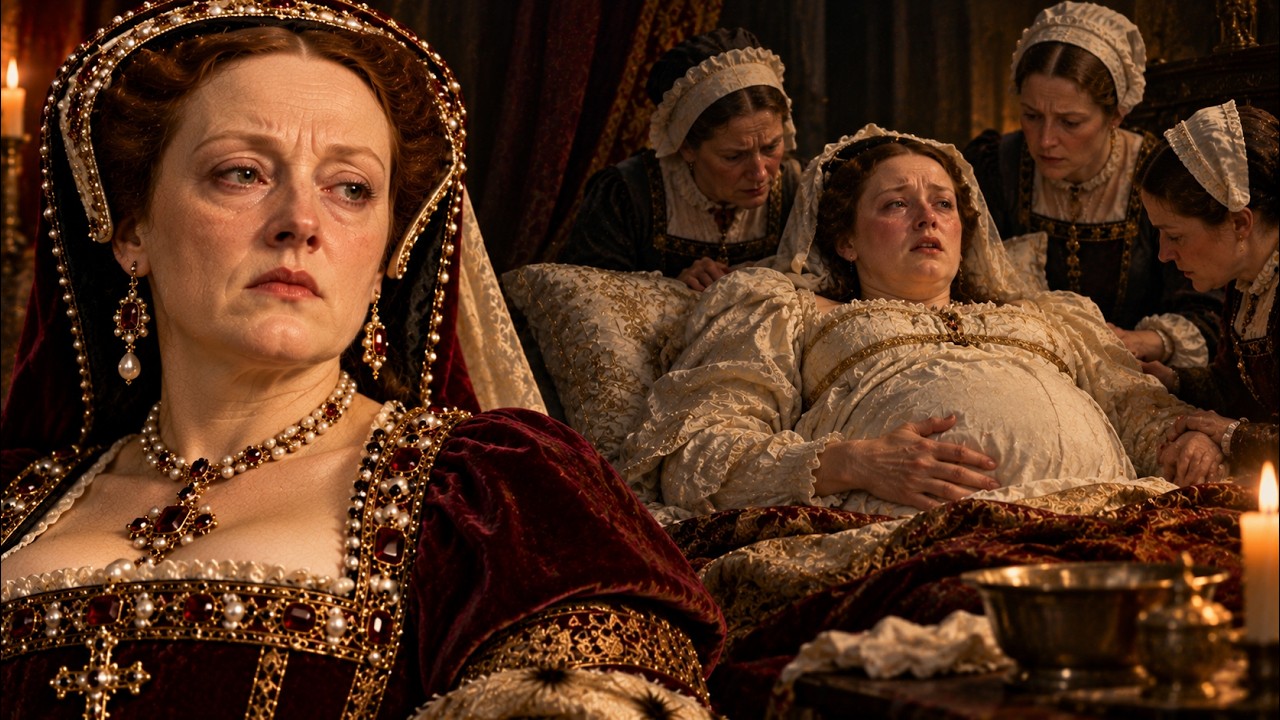
And it would take more than a year for anyone to admit the truth. To understand how a queen could believe so deeply in a pregnancy that was not real, you have to understand what that pregnancy meant to her. For Mary Tudor, a child was never just a child. It was the answer to a lifetime of loss.
Mary was born on the 18th of February 1516, the only surviving child of Henry VIII and his first wife, Catherine of Aragon. For the first seventeen years of her life, she was a beloved princess, and her father proudly called her the pearl of his realm. Then Henry fell in love with Anne Boleyn, and everything collapsed. He broke with the Church of Rome to end his marriage, and Mary, who stayed loyal to her mother and to the Catholic faith, was declared illegitimate.
Her title as princess was taken away. She was sent to serve in the household of her baby half-sister Elizabeth, and she was forbidden to see her mother. When Catherine of Aragon died in 1536, Mary was not allowed to attend the funeral. She was twenty years old, and she was alone.
Under heavy pressure, she was eventually forced to sign a document accepting her father’s authority over the church and declaring her parents’ marriage unlawful. It was a humiliation she never forgot. During these years, Mary’s health began to suffer in ways that would trouble her for life. From about the age of fourteen, she complained of headaches, toothaches, and stomach pains.
Her periods were irregular, and often they stopped for long stretches. Doctors of the time called it suffocation of the womb, a catch-all name for many different female complaints. She also suffered from depression and from long periods of sadness. That detail matters a great deal later in the story.
After Henry’s death in 1547, her younger half-brother Edward VI took the throne. Edward was a committed Protestant, and he pushed England away from the old faith. Mary refused to give up her Catholic mass and was in constant conflict with his council. Then, in July of 1553, Edward died at the age of fifteen, and his supporters tried to put Lady Jane Grey on the throne to keep England Protestant.
They failed. Mary rallied support across the country, and within nine days Jane was removed. Mary entered London in triumph and became the first queen to rule England in her own right. She was thirty-seven years old, unmarried, and with no children.
The great question at once became the same one that had haunted her father: who would inherit the crown? If Mary did not marry and have a child, the throne would pass to Elizabeth, the daughter of Anne Boleyn, who was a Protestant. For a woman who had suffered so much for her faith, this was unbearable. A child would secure Catholic England.
A child would prove that her suffering had meant something. And a child would finally give her the family she had been denied. So she chose a husband. He was Philip of Spain, the son of the powerful Holy Roman Emperor Charles V.
Philip was twenty-seven years old; Mary was thirty-eight. The match was unpopular in England, where many people feared that the country would become a Spanish colony. A rebellion led by Sir Thomas Wyatt broke out in early 1554 and nearly reached London before it was crushed. But Mary refused to back down.
They married on the 25th of July 1554 at Winchester Cathedral. Philip had made it clear that his role in England was political. He wanted a Catholic ally and a possible heir who would link the English crown to the Spanish Empire. But Mary fell deeply in love with him.
She wrote to him constantly, and she hated being apart from him. And only a few weeks later, she began to show signs of pregnancy. The first signs appeared in the autumn. Her periods stopped.
She was sick in the mornings and lost her appetite for certain foods. Her breasts grew larger, and her belly began to swell. Her doctors examined her, and they agreed that she was with child. By November, the news was officially announced.
Church services were held across the country to give thanks. In London, people reportedly lit bonfires and rang bells. Some accounts say Mary felt the baby move in late November. Parliament was told, and so was Cardinal Reginald Pole, the papal representative who had returned to England.
A great sense of hope settled over the kingdom. Mary was in her thirties, which was considered old for a first child at the time, but her doctors were confident. Then the preparations began. The queen chose a royal nursery and appointed nurses and a midwife.
A splendid cradle was made. Letters were drafted to announce the birth of a child to the rulers of Europe. And in April of 1555, in a grand ceremony, Mary withdrew into her private rooms at Hampton Court Palace to begin what was called her confinement, the period before a royal birth when a queen stayed in her chambers. There was one more detail.
Parliament had already agreed that Philip would act as protector of the kingdom if Mary died and left a young child behind. Mary also made her will before the birth. She knew the risks, but she was also happy. In Tudor England, a royal confinement was a solemn ritual.
The queen was surrounded only by women. The windows were hung with tapestries to keep the room dim, and the men of the court were kept away. Prayers were said in churches across the country. It was meant to protect the mother and the child, and it also meant that very few people saw the queen at all.
That secrecy would soon make it much harder for anyone to question what was happening. Elizabeth was summoned to court. She had been kept under watch after the Wyatt rebellion, even imprisoned for a time in the Tower. Now she was brought to Hampton Court to be present for the birth, and it must have been a strange scene.
If Mary had a son, Elizabeth would no longer be the heir. The weeks went by, and nothing happened. Then, on the 30th of April, a rumor spread that the queen had given birth to a son. Bells rang in London, church services were held, and people reportedly celebrated in the streets.
The news traveled abroad, and in the Netherlands there were celebrations too. Charles V was said to be overjoyed. But it was not true. There was no baby.
Doctors told the queen that she had simply miscalculated the due date and that the child would come in May. The court tried to keep up the pretense. Servants whispered. Foreign ambassadors began to doubt.
Some reported rumors of a plot to smuggle in a baby and pass it off as Mary’s. The Venetian ambassador, Giovanni Michieli, wrote home with growing skepticism. Those rumors were never proven, and they may have been gossip, but they show how strange the situation had become. Meanwhile, Mary’s body began to change.
By May, her swelling started to go down. Her health improved, yet she refused to accept it. Accounts from the time describe her sitting on cushions on the floor of her chamber with her knees drawn up to her chest, staring ahead in silence. The people around her did not know what to say.
By the summer, the explanation about miscalculating the date had worn thin. The court left Hampton Court for Oatlands, and the preparations for the birth were quietly set aside. In late summer, Philip left England to join his father in the Netherlands. Mary was heartbroken.
The baby she had hoped for was gone, and now her husband was gone as well. So what actually happened to her? Doctors today call this condition pseudocyesis, or false pregnancy. It is a rare condition in which a woman shows many of the signs of pregnancy, including a missed period, a swollen abdomen, breast changes, and even the sensation of movement, but she is not actually carrying a child.
It is not the same as lying. The women who experience it are not pretending. Their bodies genuinely react as if they were pregnant. The causes are not fully understood.
Many experts believe it is connected with a powerful mix of hormones and emotions. The brain can send signals that change the body’s hormone levels, which can stop periods and cause the breasts and abdomen to change. A woman who desperately wants a child, or who is deeply afraid of not having one, may be especially vulnerable. Some doctors have described cases in which the belly grew so large that even physicians were convinced.
Now consider Mary’s situation. She was a woman who had spent most of her life in grief and fear. She was thirty-eight years old, and she knew her chances of having a child were slipping away. She was in love with a husband who would soon leave, and she was surrounded by people who told her that everything depended on one thing.
The pressure was immense. But there is another explanation that many historians take seriously. Mary may have had a medical condition that caused symptoms resembling pregnancy. One theory is that she had a cyst or tumor on her ovary, which could cause her abdomen to swell and her periods to stop.
Another, proposed by a doctor named Milo Keynes in the year 2000, is that she had a tumor on her pituitary gland, a small gland at the base of the brain. According to this idea, the tumor could have disrupted her hormones, causing missed periods, headaches, and problems with her eyesight, all of which she suffered from. We cannot be certain, because we cannot examine her body. But these theories show that her symptoms may have been physical as well as emotional.
It is also possible that both explanations were true. A real illness may have caused her periods to stop and her body to swell, and her hopes and fears may have made her believe it was a child. Either way, one thing is clear: Mary’s suffering was real, and she was not acting. Whatever lay behind the swelling, the disappointment was crushing.
And it came at a moment when she had already lost so much. For a woman in her position, there was no private way to grieve at all. And the story did not end there. In the years that followed, Mary’s reign grew darker.
Her government revived the old heresy laws, and over the next three years around 280 Protestants were burned at the stake. It is the reason history gave her the name Bloody Mary. Mary believed she was saving souls, and some historians note that she saw the burnings as part of her duty to God. But they turned many English people against her.
Some of her contemporaries even believed that her failure to have a child was a sign of God’s judgment. Mary herself seems to have wondered about this. According to one account, she believed that God had denied her a child because she had not been harsh enough on heretics. It is a haunting idea.
A woman who was desperate for a child, and who saw the loss of that child as a punishment, may have felt driven to be even more severe. In March of 1557, Philip returned to England. He had come for a reason, and it was not romance. He wanted to bring England into his war against France.
Mary agreed, but when he left again in July, the war went badly. In January of 1558, the French captured Calais, the last English possession in France, which had been held for over two hundred years. It was a national humiliation. Mary was reportedly devastated, and she is said to have declared that when she died, the word Calais would be found written on her heart.
Then, remarkably, she believed she was pregnant again. By early 1558, Mary was around forty-two years old. She had stopped having regular periods, and her stomach had swollen again. In March, she made her will.
In it she wrote that she was hopeful that she was with child, and she once more named Philip as the guardian of her child. This time, though, hardly anyone believed it. The court had learned from the first time. Many suspected that her swelling was caused by an illness and that the queen was not well.
Think about how painful that must have been. She had already been through this once. She had endured the whispers, the embarrassment, and the loss of her husband. And now, three years later, with her health failing, she was hoping it might happen again.
Her prayer book may reflect that heartbreak. A book of prayers connected with Mary is said to contain pages that are stained with tears, particularly on the prayers for women who are expecting a child. We should be careful, because it is hard to prove who shed those tears. But the image has stayed with historians, because it fits so well with the picture of a woman who wanted a child more than anything in the world.
The pregnancy, of course, never came. By the summer of 1558, it was clear that something was seriously wrong. Mary developed a fever. She suffered from dropsy, a swelling caused by a buildup of fluid in the body.
She had headaches, grew weak, and her sight began to fail. She was moved from Hampton Court to St. James’s Palace, a place she had always liked. At this time, England was in the grip of a virulent influenza epidemic, and thousands of people were dying.
Historians still disagree about what killed Mary. Some think it was influenza, which may have hit her when she was already weakened. Others believe it was a cancer of the ovary or the womb, which could also explain her swelling and her earlier symptoms. We cannot be sure.
All we know is that she grew steadily worse through the autumn. By now, everyone knew that the queen would not recover, and the court’s attention turned to the one question she dreaded: who would be the heir to the throne. It was Elizabeth. Mary had never trusted her half-sister.
She suspected that Elizabeth was only pretending to be Catholic and that she would undo everything. But she had no choice. In the final weeks of her life, she agreed to name Elizabeth as her successor, and she asked her to keep the Catholic faith and to pay her debts. Meanwhile, her courtiers began to leave.
Many of them rode to Hatfield House, where Elizabeth was waiting, to be among the first to greet the new queen. Mary was lying in her bed, and she could see her court slipping away from her. It was a cruel irony. The same woman who had been surrounded by so many people during her false pregnancy was now almost alone.
On the morning of the 17th of November 1558, Mary heard mass in her room. She died in the early hours, at around five o’clock, at St. James’s Palace. She was forty-two years old.
Within hours, Cardinal Pole, her closest religious adviser and a lifelong friend, died as well. He was also gravely ill at the time, and the double loss seemed to mark the end of an era. Her coronation ring was taken to Elizabeth at Hatfield, and Elizabeth was proclaimed queen. London celebrated with bells ringing and bonfires burning in the streets.
It was a very different celebration from the one that had marked the false birth three and a half years earlier. Mary’s body was embalmed, and her heart was placed in a separate coffin. In December, she was carried in a grand procession to Westminster Abbey, with a figure of her laid on the coffin. She was buried on the 14th of December after a requiem mass in a chapel of the abbey.
Years later, when Elizabeth died, she was buried in the same tomb. A Latin inscription that was later placed on it describes the two sisters as partners in the throne and in the grave. So why did Mary I suffer a false pregnancy before her death? The most honest answer is that we do not know for sure.
It may have been a condition called pseudocyesis, in which her hopes and fears produced real physical changes. It may have been an illness such as a cyst or a tumor that copied the signs of pregnancy. It may have been both. What we can say is that the signs were genuine, that her doctors believed in them, and that Mary believed in them most of all.
And what that tells us is something history often forgets. Mary was not just Bloody Mary, the queen who burned heretics. She was also a woman who lost her mother, her title, and her place in her father’s court, and who fought her way to the throne, only to be denied the one thing she wanted most. That does not excuse the suffering that happened under her rule, but it does help us see her as a human being.
The bells that rang for a baby that never came are a reminder of how powerfully hope can shape what we see. In the story of Mary I, that hope was both her greatest comfort and her cruelest wound, even to the very end.
