By the fall of 1881, Nettie Boggs had been catching babies in the hills of Owsley County, Kentucky, for longer than anyone could remember without her. She had delivered children in blizzards and in the brutal August heat that made the cabin walls sweat. She had delivered babies to mothers of thirteen and mothers of forty-six. She had delivered infants who came out silent and pale, and infants who came out screaming so loudly that the dogs outside howled in sympathy.
She thought she had seen every kind of birth the mountains could offer, until the morning a man she did not recognize appeared at her door and asked her to come to a place called Derbon Hollow. He gave her his name: Elias Grimesby. He was tall and thin, and he stood on her porch turning the brim of his hat slowly between his fingers like a man winding a clock. He did not look at her directly.
His eyes moved to the left of her face, then to the right, then to the ground, then back again, as if her actual features were something he was not permitted to observe. He told her his wife, Cordelia, was expecting their fourth child, that the baby would come within a week, and that they had no one to assist with the birth. When Nettie asked why he had come all this way from Derbon Hollow instead of sending someone to fetch old Hatty Combs, who lived closer to his place, Elias Grimesby went perfectly still. His fingers stopped turning the hat brim.
He looked at the ground between his boots and said only that Hatty Combs would not come. Nettie Boggs had been a midwife long enough to know that some families carried a bad reputation the way other families carried a prized inheritance. There were houses in those hills where the women drank through their lying-in, houses where the men refused to leave the birthing room, houses where the grandmothers insisted on packing a newborn’s navel with cobwebs and soot from the chimney. She had seen all of it.
She had worked through all of it. She told Elias Grimesby she would come and told him the price, and he counted out the coins from a leather pouch without any haggling. She remembered that detail later. Most families in those hills bargained.
The Grimesbys did not. They paid the exact amount, as if they had known it before she spoke it. What Nettie Boggs found when she reached the Grimesby farm three days later became the subject of an affidavit she gave to the circuit clerk of Owsley County in the spring of 1882. That affidavit was filed as an appendix to a property dispute that had nothing to do with childbirth.
It sat in the courthouse basement for over a century before a graduate student named Eleanor Marsh pulled it from a water-damaged file box in 1994. The document ran to eleven pages of dictated testimony, and its contents were strange enough that Marsh included it in full in her doctoral dissertation on midwifery practices in central Appalachia. The dissertation was never published. Marsh left academia the following year.
But her copy of the Boggs affidavit circulated among folklorists for decades afterward, and it remains the oldest and most detailed account of what happened inside the Grimesby house during the years when every midwife in three counties learned to refuse that particular summons. To understand what Nettie Boggs faced that October morning, you have to understand the valley itself. Owsley County in the 1880s lay deep in the Cumberland Plateau, where the land folded in on itself like a closed fist. The hills ran from northeast to southwest in long parallel lines, and between them the hollows dropped into valleys so narrow that the sun reached the creek beds for only a few hours at midday.
The soil was poor, the timber thick, and the population scattered across farms that might be a two-hour walk from the nearest neighbor and a full day’s ride from the county seat at Booneville. Most families had lived there for two or three generations by the time of this story. They were descendants of the Scotch-Irish and English settlers who had crossed the Cumberland Gap in the late eighteenth and early nineteenth centuries. They came looking for land and isolation, and they found both in such abundance that by the 1880s some of these hollows had developed customs, vocabularies, and even pronunciations unique to each drainage.
A family living on one side of a ridge might speak in ways that seemed foreign to a family on the other side. A remedy used in one hollow might be unknown just three miles away. The mountains created pockets, and in those pockets things grew differently. Derbon Hollow was one of the deepest of these pockets.
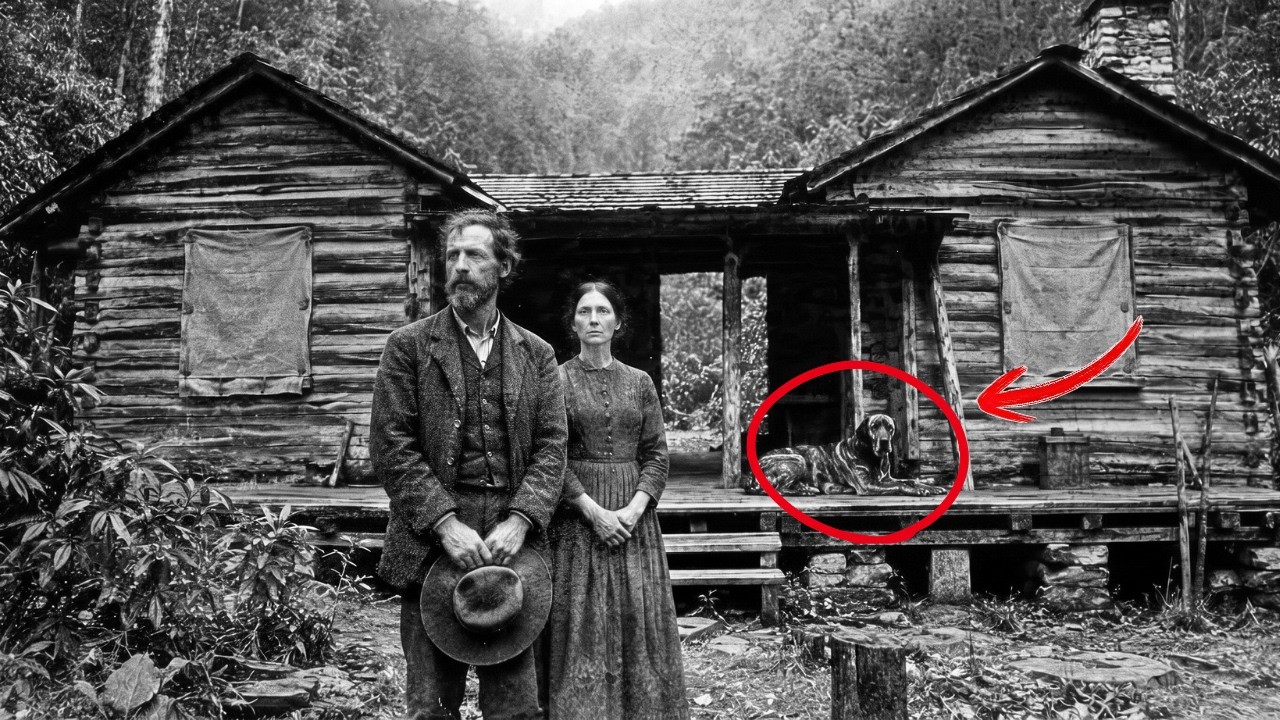
It ran back into the hills for nearly two miles, following a stream the locals called Derbon Branch, and at the head of the hollow, where the creek split into two thin forks, the ground rose sharply on three sides, forming a kind of natural amphitheater walled by rock and laurel. The Grimesby house stood at this upper end, built on a small level bench above the fork. According to surviving accounts, it was a double-pen log structure with a central dogtrot, the standard design for a family of middling means in that region. It had a stone chimney at each end, a loft above each pen, and a covered porch running the length of the front.
Behind the house sat a smokehouse, a root cellar dug into the hillside, and a small barn that leaned perceptibly to the east. The Grimesbys had not been in Derbon Hollow as long as most of their neighbors. The family first appeared in Owsley County tax records in 1874, when a man listed as E. Grimesby paid tax on sixty-two acres at the head of Derbon Branch.
No record of the land purchase survived. No deed was ever recorded in the county clerk’s office. The property simply appeared in the rolls as if it had always been there, valued at forty dollars with a marginal note that the clerk’s handwriting made almost illegible. Eleanor Marsh, in her transcription notes, believed the note read: “No survey according to claimant.
” This meant Grimesby had asserted ownership of the land without a formal survey. This was not unusual in the more remote parts of the county, where squatters’ rights and long residence were often accepted as sufficient proof of ownership. But it also meant the Grimesbys had no documented origin. They arrived in the hollow and stayed, and no one could say with certainty where they had come from.
What the neighbors knew, or thought they knew, was assembled from fragments and passed along through that kind of oral exchange that functioned as the primary information network in rural Appalachia. According to a 1938 interview with a WPA field worker named Calloway Hunt, an elderly woman named Bessie Seizemore, who had lived as a child at the lower end of Derbon Branch, remembered hearing that the Grimesbys had come from somewhere in Virginia. She could not say where in Virginia. She remembered that Elias Grimesby’s accent was a little different from the local speech, that he pronounced certain words in a way that marked him as an outsider, though she could not recall those words.
She remembered that he was tall, that he walked with his head tilted slightly forward, and that he had a habit of standing very still while others spoke, as if he were listening not just to their words but to something behind their words that only he could hear. Cordelia Grimesby, according to Bessie Seizemore, appeared far less often. She came to the store at the mouth of the hollow only a few times a year, always accompanied by Elias, and always walking a few steps behind him. She did not speak to anyone if she could avoid it.
Seizemore described her as small, dark-haired, and possessed of a stillness that went beyond shyness. It was, she said, the stillness of a person who had been ordered not to move and had obeyed that order so completely and for so long that the obedience had become a condition of the body. Cordelia Grimesby moved like someone trying to take up as little space as possible in the world. The couple had three children by the time Nettie Boggs received her summons in the fall of 1881.
The eldest was a boy whose name appears in different sources as either Josiah or Joseph, born around 1875, making him about six years old at the time of this story. The second was a girl named Pearl, born around 1877. And there was another boy whose name appears in no surviving record, referred to in the Boggs affidavit only as the younger boy. Presumably these children had been born with someone’s help, but no midwife in Owsley County ever claimed responsibility for their births, and no birth records exist for any of them in the county clerk’s files.
This absence was significant. Birth records in Owsley County during that period were kept by the county clerk based on reports submitted by the attending midwives or, less commonly, by physicians. If no midwife attended the birth, no record was filed. The absence of records for the first three Grimesby children meant either that they were born without any outside assistance, or that whoever assisted chose not to report them, or that records were filed and later lost.
Any of these explanations was possible. None of them was reassuring. Nettie Boggs left her home on the morning of October 14, 1881, carrying her birthing bag over her shoulder and a lantern in her left hand. The sky was overcast and the temperature had dropped sharply overnight.
She walked three miles to the mouth of Derbon Hollow and then followed the creek path up into the valley itself, climbing steadily as the hollow narrowed around her. She noted in her affidavit that the path was in bad condition, full of roots and weeds, and that at several points she had to leave the path entirely and push through laurel thickets to get around washouts. She estimated the walk from the mouth of the hollow to the Grimesby farm took her nearly two hours, putting her arrival at around noon. Her first impression of the farm, as she recorded it, was that the place was quieter than it should have been.
A farm with three small children and livestock should have made some noise: dogs barking, chickens clucking, children calling to one another. But the Grimesby farm was silent in a way Nettie described as resembling the stillness after a gunshot. Everything seemed suspended. The chickens were there, she could see them in a fenced pen beside the smokehouse, but they were huddled in one corner and not moving.
A dog lay on the porch, a large speckled hound, and it raised its head when she approached but did not stand or bark. It looked at her, she said, the way a dog looks at something it has been told not to acknowledge. Elias Grimesby came out of the house before she reached the porch steps. He was wearing the same clothes he had worn when he came to her door, or clothes so similar she could not tell the difference.
He thanked her for coming. He told her Cordelia was inside and that labor had begun during the night. He led her through the dogtrot to the left pen of the house, which served as the main living space and, at that moment, the birthing room. What Nettie Boggs saw when she entered that room was the first thing she described in detail in her affidavit, the detail that made Eleanor Marsh stop reading for the first time and go back to read the passage again to make sure she had understood it correctly.
The room was dim. The windows were not curtained but covered with heavy fabric nailed directly to the log walls over the openings. The only light came from the fireplace and a single tallow candle on a shelf near the bed. In that low red light, Nettie could see Cordelia Grimesby lying on a rope bed against the far wall.
She lay on her back, covered with a quilt to her waist, her hands at her sides, palms up, fingers slightly curled. Her eyes were open, and she was staring at the ceiling. But the part that stopped Nettie Boggs, the part she said made her set down her birthing bag and step backward before she caught herself, was not Cordelia. It was the walls.
The interior walls of the room. Every visible surface of wood, from floor to ceiling, was covered with writing. Not writing in the sense that someone had hung a sampler or a Bible verse. Writing in the sense that someone had taken a piece of charcoal or a burnt stick and written in small, dense, cramped script over every available inch of the surface.
The writing covered the logs. It covered the chinking between the logs. It covered the mantel above the fire. It covered the underside of the mantel where the candle sat.
It covered the back of the door Nettie had just entered through. The writing climbed the walls and crossed the ceiling joists and continued onto the loft floorboards above. Nettie Boggs stood at the entrance of that room and looked at walls that were more writing than wood. She could not read most of it.
The script was too small, the light too weak, and she was standing too far away. But the parts she could make out, the parts nearest the candle, appeared to be names. Lists of names written one after another, over and over, sometimes in horizontal lines, sometimes in columns, sometimes in spirals radiating from a central point like the spokes of a wheel. She recognized some of the names as common Appalachian names of that era.
Some she did not recognize at all. Some appeared to be in a language or script she could not identify, though she admitted in her affidavit that she was not a woman of extensive education and could not say whether she was looking at a foreign language or simply at handwriting so distorted as to be illegible. Elias Grimesby, standing behind her in the dogtrot, said nothing about the walls. He did not acknowledge the writing.
He did not explain it or apologize for it or offer any context for why every interior surface of his home was covered with what looked like thousands and thousands of handwritten names. He simply gestured toward Cordelia and said the baby was coming. Nettie Boggs was a practical woman. She had come to deliver a baby, and there was a baby to deliver.
She set aside whatever feelings she had about the walls, crossed the room to the bed, and began her examination. Cordelia did not look at her when she approached. She did not turn her head or acknowledge Nettie in any way. She continued staring at the ceiling with an expression Nettie described as neither pain nor peace but something she had never seen on the face of a woman in labor.
She said it was the look of a person waiting for something she had waited for many times before, who knew exactly what was coming, and had no particular opinion about it either for or against. It was an absence of reaction so complete it seemed rehearsed. The labor itself progressed normally at first. Contractions came at regular intervals.
The baby was positioned correctly. Cordelia’s body was doing what it needed to do, and Nettie began to relax a little, because whatever strangeness existed in this house, the mechanics of childbirth were the same here as anywhere else. She told Cordelia when to breathe. She told her when to push.
She laid out the cloths, the thread, the knife. She did what she had done hundreds of times before. Then two things happened that Nettie Boggs had never witnessed in all her years of catching babies. These two things formed the core of her affidavit.
They were the reason she would later tell the circuit clerk that she believed something in that house was not right. The first thing was the children. About an hour into the labor, Nettie realized that the three Grimesby children had entered the room. She had not heard them come in.
She had not heard the door open or close. She turned at some point and they were simply there, standing in a row against the wall opposite the bed, watching. The eldest boy, Josiah or Joseph, stood in the middle. The girl, Pearl, stood to his left.
The younger boy stood to his right. They were dressed in clean but oversized clothes, as if wearing garments meant for someone else. Their feet were bare. Their hair was uncombed.
They stood with complete stillness, arms at their sides, watching the labor with expressions that exactly matched their mother’s: the same practiced absence of reaction, the same look of people who had seen this scene before and were waiting for a specific moment that had not yet arrived. Nettie told Elias the children should not be in the room. Elias, standing at the dogtrot entrance, replied that the children needed to be present. He said it in the same flat, undramatic tone he used for everything, as if stating a fact about the weather.
The children need to be present. Nettie began to argue, because her standing rule was to keep children out of the birthing room, but something about the way the three children stood, something about the symmetry of their postures and their silence and their identical expressions, made her decide not to press the point. She turned back to Cordelia and continued her work. The second thing happened when the baby was born.
The birth itself was ordinary. The child came out headfirst, crying immediately, a healthy-looking infant Nettie estimated at seven or eight pounds. She cut the cord, cleaned the baby, and wrapped it in the cloth she had prepared. It was a boy.
She turned to tell Cordelia she had a son, to place the baby on her chest. But Cordelia was not looking at the baby. She was looking at the wall. Specifically, she was looking at a section of wall just to the left of the bed, a section covered with the same dense charcoal writing as the rest of the room.
And the three children, who had stood motionless against the far wall throughout the labor, had moved. They had crossed the room in the time it took Nettie to cut the cord and wrap the infant, and were now standing at the head of the bed, lined up in the same order, looking at the same section of wall their mother was looking at. Nettie Boggs looked at the wall too. She looked at the section they were all staring at, and in the dim candlelight she could see that a small area of it, about the size of a man’s hand, had been left blank.
It was the only blank space on any wall in the room. Every other surface was covered. This small rectangle of bare wood stood out like a window in a wall of text. As Nettie watched, Cordelia reached toward the edge of the bed, where a piece of burnt stick lay on a wooden plate.
She picked up the stick, turned to the blank space on the wall, and wrote something. She wrote it slowly and carefully, letter by letter, and when she finished she set the stick aside and closed her eyes. Nettie moved closer to see what Cordelia had written. It was a name.
She had written a name in that blank space. It was not the name Elias Grimesby would later tell Nettie the baby was to be called. It was a completely different name. It was a name Nettie did not recognize, and she described it in her affidavit as being composed of sounds she was not sure a person raised speaking English would naturally produce.
She tried to render the name phonetically in her testimony, and the clerk recorded it as she pronounced it, but the written version was so inconsistent with standard English phonology that scholars who examined it could not agree on its likely original pronunciation. Nettie asked Cordelia what name she had written. Cordelia did not answer. Nettie asked Elias, who had entered the room at some point during this sequence.
Elias said the name was none of her concern. He said it in the same tone he said everything else: flat, polite, and final. Nettie Boggs finished her work. She checked Cordelia for hemorrhage.
She examined the placenta, which was normal. She cleaned her instruments. She packed her bag. Then she left the Grimesby house and walked back down Derbon Hollow in the late afternoon light.
She did not stop walking until she reached her own porch and sat down on her steps. She stayed there until full dark. She never went back. She was asked to go back.
Elias Grimesby came to her door again in the spring of 1882 and told her Cordelia was pregnant again. He began counting out coins, and Nettie Boggs looked at the money in his hand and told him she would not come. She told him to find someone else. This is important to understand clearly.
Nettie Boggs had been a midwife for more than twenty years. She had delivered babies in conditions that would have made most modern physicians refuse to enter the room. She had attended births where the mother died, where the baby died, where both died. She had dealt with the aftermath of hemorrhages and infections and emergencies that left her hands shaking for hours afterward.
And yet none of those experiences, not one, had ever made her refuse a summons. The Grimesby birth was the first and only time in her career that Nettie Boggs told a family she would not return. The question that drove Eleanor Marsh to spend two years tracking the Grimesby story through county records, folklore collections, and WPA interview transcripts was simple: what exactly did Nettie Boggs see that made her refuse to go back? The walls covered in names were strange, certainly.
The children standing in formation was disturbing. Cordelia’s behavior was unusual. But Nettie had seen strange things before. Mountain families had customs, beliefs, and practices that outsiders might find peculiar but that were, in their own context, perfectly coherent expressions of a worldview shaped by isolation and oral tradition and a theology that did not always align with what was preached in the lowland churches.
Nettie Boggs knew all this. She was not a woman easily frightened by the unfamiliar. What frightened her, according to her affidavit, was something she noticed only as she was leaving. Something she saw in the moment between stepping off the porch and starting down the path.
She was adjusting the strap of her birthing bag on her shoulder when she turned to look back at the house and saw, through the open dogtrot, the right-side room. The room she had not entered. The room whose door had stayed closed for her entire visit. The door was now open.
Through it, in the brief moment before Elias Grimesby moved to close it, Nettie saw the right-side room. It was covered in writing too. The same dense charcoal script as the birthing room. Names covering every surface.
But in the center of that room, there was no bed. There was no furniture at all. There was only the floor, and on the floor, arranged in a pattern Nettie could not quite make out from her angle and in that light, there were small objects. Dozens of them.
She thought at first they were stones. Then she thought they were bits of wood. Then Elias closed the door and the room was gone. Months later, sitting in the circuit clerk’s office to give her affidavit, Nettie Boggs offered her best guess as to what she had seen on the floor of that room.
She told the clerk she believed the objects were teeth. Small teeth arranged in rows on a bare wooden floor in the center of a room whose walls were covered in names. The clerk asked how many teeth. Nettie said she could not be certain.
She had only glimpsed the room for a moment, but she estimated that, based on the area of floor she had been able to see, there were more teeth in that room than could come from one mouth. More than could come from five mouths. She said there were enough teeth on that floor to fill a bucket. The clerk recorded her answer and moved to the next question.
But Eleanor Marsh, reading the affidavit more than a century later, noted that Nettie’s estimate, if accurate, would mean a collection of hundreds of individual teeth, human teeth if they were, in quantities that were difficult to explain naturally. Shed baby teeth might account for some. Animal teeth might account for others. But hundreds, arranged in deliberate rows in a room devoted to the same name-writing ritual that governed the rest of the house, was something else entirely.
And this was only the beginning. Nettie Boggs was the first midwife to visit the Grimesby family, not the last. Every woman who climbed to that house at the head of Derbon Hollow came back with her own account, her own details, her own reasons for refusing to return. And those accounts, placed side by side, did not merely corroborate each other.
They escalated. The second midwife was Hatty Combs. She was about fifteen years older than Nettie, and she had been practicing midwifery in the hollows east of Booneville since before the Civil War. She was the midwife who lived closest to Derbon Hollow, and it was her refusal that had driven Elias Grimesby to seek out Nettie Boggs in the first place.
But Hatty’s refusal came before Nettie’s visit. Hatty refused the Grimesbys before any of the four documented births in this account, which meant she refused them for a reason unrelated to what happened inside the birthing room. Hatty Combs left no written affidavit and gave no testimony to the circuit clerk. What survives of her account comes from two sources.
The first is the WPA interview with Bessie Seizemore, who recalled that Hatty told her around 1880 that she would not go to the Grimesby place because “that woman births without a sound, and that is not natural, and I will not bring it. ” The second source is a letter written in 1893 by Dr. Josiah Pennington, the county physician, to a colleague in Lexington. In the letter, Pennington mentions Hatty Combs by name and notes that she described the Grimesby house to him as “a house where the names on the walls are older than the walls themselves.
”
That phrase, “names older than the walls,” was what Eleanor Marsh returned to again and again in her research notes. The phrase suggested that Hatty Combs believed the writing on the Grimesby walls was not something Elias or Cordelia had put there after moving into the house. It suggested she believed the names existed before the house was built, or more precisely, that the names preceded the physical structure that carried them, as if the house had been built around the names rather than the names added to the house. The obvious questions followed: How did Hatty Combs know or believe such a thing?
Had she been inside the house before refusing to attend births? Had she spoken to someone who had been inside? The surviving sources do not say. What they say is that Hatty’s refusal was absolute and predated any of the specific incidents that made other midwives also refuse later.
Whatever Hatty knew or believed, she knew or believed it early. The third midwife summoned to Derbon Hollow was a woman named Ruth Ann Skaggs from the Sturgeon Creek area, about twelve miles south of the Grimesby house. Ruth Ann was younger than Nettie and Hatty, about thirty years old at the time of the summons, and had been practicing midwifery for only five years. She was called to the Grimesby house in late summer of 1882 for what would be Cordelia’s fifth birth, and her account of that visit survives in a more detailed and more disturbing form than Nettie’s testimony.
Ruth Ann Skaggs kept a record, not a formal diary but a small ledger book in which she noted the details of every birth she attended: the mother’s name, the date, the duration of labor, the sex of the child, any complications, and her fee. Most entries were two or three lines long. The Grimesby birth entry ran to four pages. Ruth Ann arrived at the house on August 19, 1882.
Like Nettie before her, she noticed the silence, the animals that did not behave as animals should, the covered windows, the sense of something deliberately held still. Unlike Nettie, Ruth Ann was allowed into both rooms of the house before the labor began. Elias Grimesby led her through the dogtrot to the left room, the birthing room where the walls were still covered with dense inscriptions of names. But he also opened the door of the right room and allowed her to look inside.
What Ruth Ann saw was significantly different from what Nettie had glimpsed through the dogtrot eleven months earlier. The teeth were still there. Ruth Ann confirmed this explicitly in her ledger. She described them as small teeth, some the size of grains of rice and some larger, laid out on the floorboards in circles and lines.
But there were more of them now, many more. Ruth Ann estimated that the teeth covered an area of floor about six feet by eight feet, arranged in a pattern she described as concentric rings radiating outward from a central point. At that central point, where the innermost ring should have been, there were no teeth at all. Instead there was a small depression in the floor, as if the wood had been worn away by something pressing on it again and again in the same spot.
Ruth Ann put her finger in the depression and found it smooth and polished, about the depth of her first knuckle. The walls of the right room were covered with the same names as the left room, but Ruth Ann noticed something Nettie had either not seen or not mentioned. Among the names, at irregular intervals, there were small drawings. Not elaborate illustrations but simple line figures drawn with the same charcoal as the text.
Ruth Ann described them as human figures, stick figures with round heads and straight limbs, but rendered with a precision beyond what the word “stick figure” usually suggests. Each figure had a specific posture. Some stood with arms raised, some knelt, some lay flat, some bent at the waist as if bowing or as if struck. And each figure had a name written directly beneath it in the same cramped script as the rest of the wall text.
Ruth Ann asked Elias about the drawings. He told her the same thing he had told Nettie about the names: they were none of her concern. He said it without hostility, without emphasis, as a statement of fact rather than a warning. The drawings are none of your concern.
You are here to deliver a child. Would you like to begin? The labor this time was longer. Cordelia’s contractions began in the early afternoon and continued through the evening and into the night.
Ruth Ann stayed by the bed doing what she could, giving Cordelia sips of water, rubbing her back, timing the intervals between contractions. The fire died and was relit. The candle on the shelf guttered and was replaced. And as the hours passed, the children came in.
They entered one by one. The eldest son first, coming through the dogtrot and taking his place against the far wall without a word. Then the girl, Pearl, following minutes later and standing beside her brother. Then the younger son, and after him a fourth child, an infant not yet old enough to walk, carried into the room by the eldest brother and set on the floor at his feet.
This was the baby Nettie Boggs had delivered the previous October. It was now about ten months old. It sat on the floor where it had been placed, not moving, not crying, not looking at anything except the section of wall directly in front of it. Ruth Ann wrote in her ledger that the infant’s stillness was unnatural.
A ten-month-old should be crawling, babbling, reaching for things, reacting to the sounds and lights around it. But this child sat like a stone. Its eyes were open and fixed, it breathed regularly, and it showed no interest in anything happening in the room: not the fire, not the candle, not its mother’s labor, not Ruth Ann herself. She wrote that looking at the infant was like looking at an old person trapped in too small a body, a person who had already seen everything and found nothing in it worth attending to.
The fifth Grimesby child was born just after midnight. It was another boy, smaller than average but seemingly healthy. Ruth Ann cut the cord, cleaned the baby, and wrapped it. Then the same ritual Nettie had witnessed eleven months earlier repeated itself.
Cordelia looked at the wall. The children looked at the wall. Cordelia reached for the writing stick. She found a blank space, one that Ruth Ann had noticed earlier and assumed was simply an area the writing had not yet reached.
Cordelia wrote a name. This time, Ruth Ann was closer. She was standing at the head of the bed, and she could see what Cordelia was writing. She recorded the name phonetically in her ledger as best she could.
The name she wrote down was Kalzathar. This was the name Cordelia wrote on the wall for her fifth child. Ruth Ann asked Cordelia what language the name came from. Cordelia, who had not spoken a single word during the entire labor, no cry, no groan, no whisper, turned her head and looked directly at Ruth Ann for the first and last time.
Ruth Ann wrote that her expression was not hostile or guarded or afraid. It was full of pity. Cordelia Grimesby looked at the midwife with an expression so full of pity that it raised goosebumps on Ruth Ann’s skin, made the hair on her arms stand up, and sent something cold through her chest like a draft through an open window. Cordelia said one word.
She said: “Ours. ” Then she closed her eyes and did not speak again. Ruth Ann Skaggs stayed until morning to make sure the bleeding had stopped and the infant was nursing. Then she packed her things and left.
She walked back down Derbon Hollow in the early morning light and made a decision during that walk, which she recorded in the final lines of her four-page ledger entry. She decided she would tell people what she had seen. Not everyone. Not the details about the teeth or the drawings or the name.
But she would tell the other midwives. She would tell them not to go. And she did. Over the following months, Ruth Ann Skaggs spoke to every midwife she knew in the surrounding counties.
She spoke to women in Owsley, Lee, Breathitt, and Wolfe counties. She traveled to gatherings, church meetings, and quilting circles, anywhere women who practiced this work were likely to be found. She told them about the Grimesby house at the head of Derbon Hollow. She told them about the walls and the silence and the children standing in rows and the woman who gave birth without a sound.
She told them enough to convey her warning without telling them everything. The exact words she used seem to have varied depending on who she was addressing. To some women, she spoke plainly and described what she had seen. To others, particularly the devoutly religious, she framed her warning in scriptural language, referencing texts about houses that should not be entered and thresholds that should not be crossed.
To still others, she simply said: “If Elias Grimesby comes to your door, tell him no and close the door behind you. ” She did not always explain why. She trusted that her reputation and the seriousness of her tone would carry the message. It worked.
One by one, from midwife to midwife, the word spread through the hills that the Grimesby house was a place no one should go. Women who had never met Ruth Ann Skaggs heard the warning from women who had heard it from women who had heard it from her. The message traveled the way all important information traveled in that country: through the overlapping, interlocking networks of women’s work and talk that connected households across dozens of miles of rough terrain. By the time the warning had completed its circuit, it had been simplified by repetition into something approaching a commandment.
Do not go to the Grimesbys. Do not answer when they call. By the winter of 1882, there was not a single practicing midwife within a day’s ride of Derbon Hollow who would answer Elias Grimesby’s summons. A de facto quarantine had been imposed on the family, not by law or force, but by the collective refusal of every woman who provided the one service the Grimesbys could not provide for themselves.
This is where the story should have ended: a strange family in a remote hollow, cut off from the community by their own strangeness, left to live as they pleased. That was the usual outcome for families like this in the nineteenth-century Appalachian hills. You left them alone and they left you alone, and the mountains absorbed their oddities as they absorbed everything else, quietly and without comment. But the story did not end there.
It did not end there because the Grimesbys did not stop having children. Between 1882 and 1891, Cordelia Grimesby gave birth at least five more times, possibly six. The records are imprecise because by that point no midwives were attending the births and therefore no official documents exist. Evidence of these births comes from three sources.
The first is Bessie Seizemore’s WPA interview, in which she mentions that by the early 1890s the Grimesby household contained more children than could be counted on two hands. The second is a note in the Owsley County tax records for 1890, where the Grimesby property assessment includes a line item for nine dependents. The third is Dr. Josiah Pennington’s 1893 letter, in which he notes that he examined seven of the Grimesby children during his single visit to the house and that Elias told him there were others not present.
Nine dependents, possibly more. All born without medical or midwifery assistance. All unregistered with the county. All given names no one in the surrounding communities had ever heard.
And all, according to every surviving account, displaying the same behavior Nettie Boggs and Ruth Ann Skaggs had noted in the older children: that silence, that stillness, that watchfulness, those fixed gazes directed not at the people in the room but at the walls, always at the walls, at the names. Dr. Pennington’s visit to the Grimesby house in the spring of 1893 is the most detailed account we have of the family during this later period, and it is the account that finally brought the attention of people outside the immediate community. Pennington was not a local man.
He had been educated at Transylvania University in Lexington and had returned to the mountains to practice medicine in what he believed was an underserved area. He was thirty-eight years old in 1893, methodical in his habits, precise in his language, and deeply skeptical of the folk beliefs and superstitions that pervaded the communities he served. He did not believe in ghosts or magic balls or the evil eye. He believed in bacteria, in sterilization, in the germ theory of disease.
In other words, he was exactly the kind of man who would not be easily impressed by a house full of charcoal writing and a family that behaved unusually. He went to Derbon Hollow because he had heard the stories. Several of his patients had mentioned the Grimesby family over the years, always in oblique references, always with a hesitation he found medically noteworthy. When people consistently avoided discussing a subject, Pennington believed, the subject was usually worth discussing.
He told his patients he intended to visit the family to offer medical services, and the responses he received were strikingly uniform. Everyone he told reacted with the same expression: a kind of quiet concern, not quite alarm, but the face of someone watching another person step toward an edge. One elderly man, a farmer named Cordell, told Pennington simply: “You can go if you want, but you won’t want to go twice. ”
Pennington went anyway.
He rode his horse into Derbon Hollow on a Tuesday morning in April, following the same trail Nettie and Ruth Ann had followed years before. His account of the visit, preserved in his letter to his colleague, is written in the measured clinical prose of a trained physician, and it is precisely that measured tone that makes the details he recorded so difficult to dismiss. The house was not substantially different from the descriptions given by the midwives: the double log structure, the leaning barn, the silence, the animals that seemed to have lost their voices. Pennington noted that the dog on the porch, or a dog that might have been a descendant of the original dog, watched him approach without barking and without standing, exactly as Nettie had described more than a decade earlier.
Elias Grimesby met him in the dogtrot. Pennington wrote that the man had aged. His hair had gone white and his face was deeply lined, but his posture was the same: that forward lean, that sense of listening to something beyond what could be heard. Pennington introduced himself and explained that he had come to offer free medical examinations of the children as a service to the community.
Elias considered this for a long moment, then nodded and stepped aside. Pennington entered the left room. The walls were still covered with writing. More writing than before, the few blank spaces Nettie and Ruth Ann had noted now filled.
Every inch was covered. In several places Pennington observed that the writing was superimposed, new names written over old ones, creating a layered palimpsest of charcoal text that in some areas reached three or four levels deep. The effect was of a surface that was no longer wood at all but a kind of dark, dense fabric, a cloth woven from language. The children were in the room when he entered: seven of them, ranging in age from about two to about seventeen by Pennington’s estimate.
They stood against the far wall in a line arranged by height, hands at their sides, looking at him. Pennington examined each child individually, starting with the youngest and working up to the oldest, following his usual medical protocol. He checked their eyes, teeth, throats, hearts, reflexes, and range of motion. He recorded their heights and weights.
He palpated their abdomens, checked their lymph nodes, and listened to their breathing with his stethoscope. He asked them questions, the same basic diagnostic questions he asked every patient, questions designed to assess not just physical health but cognitive function and emotional state. What he found, as he wrote in his letter, was simultaneously reassuring and deeply troubling. Physically, the children were healthy.
More than healthy. They were, by every measure Pennington could assess, in better physical condition than any group of children he had examined in the mountains. Their teeth were sound. Their eyes were clear.
Their joints moved freely. Their hearts beat with strong, regular rhythms. There were no signs of malnutrition, no evidence of parasites, no indications of the chronic respiratory infections that plagued most children in the region. In a county where child mortality exceeded thirty percent, the Grimesby children appeared to be thriving.
But none of them spoke. Pennington asked them questions directly, simple questions: What is your name? How old are you? Does anything hurt?
They looked at him when he spoke, their eyes followed his movements, they submitted to his examination without resistance or complaint, but they did not answer his questions. They made no voluntary sounds at all. When Pennington put his stethoscope to their chests he could hear them breathing. When he asked them to cough, they did not cough.
When he asked them to say “ah,” they did not say “ah. ” They looked at him with the same expression Nettie Boggs had described a decade earlier: flat, neutral, practiced, devoid of reaction, and they kept their mouths closed. Pennington asked Elias whether the children could speak. Elias said they could.
Pennington asked why they would not speak to him. Elias said they were not permitted to speak to strangers. Pennington asked who had forbidden it. Elias said: “It is the practice of this house.
”
Pennington tried a different approach. He sat on the floor of the room, making himself smaller, less threatening, closer to the children’s level. He spoke softly and gently, using the slow, measured cadences he had found effective with frightened patients. He told them he was a friend.
He told them he wanted to help. He asked if they were happy. He asked if they were afraid. The eldest boy, Josiah, now about seventeen, looked at Pennington for a long moment.
Then he did something Pennington described as the most disturbing moment of the entire visit. He smiled. It was a full, real, warm smile, the kind you see from someone who has just been told something delightful, but it was entirely disconnected from context. Nothing had been said that warranted a smile.
Nothing pleasant or funny or reassuring had happened. The boy simply decided, or was prompted by some internal signal Pennington could not detect, to smile. The smile lasted exactly three seconds. Pennington timed it with his pocket watch.
Then the smile vanished, the neutral expression returned, and the boy turned his face away. None of the other children reacted to the smile. They did not look at Josiah. They did not look at Pennington.
They continued standing in their line, in their order, looking at the wall. Pennington asked to examine Cordelia. Elias said she was in the other room. Pennington asked to enter the other room.
Elias said no. Pennington asked why. Elias said: “That room is for the names. ” Pennington noted in his letter that Elias did not say “that room is private” or “that room is not for visitors.
” He said “that room is for the names,” as if the room had a purpose, a specific ongoing function, and that function was the names themselves, not writing the names, not keeping the names, but the names themselves, as if the names were the inhabitants of the room and the Grimesby family merely their keepers. Pennington left the farm that evening. He rode back down Derbon Hollow and returned to Booneville, where he sat in his office for hours without seeing patients. Then he wrote the letter to his colleague in Lexington, Dr.
Thomas Welch. The letter ran to nine pages and included not only his observations at the Grimesby farm but also his reflections on possible medical and psychological explanations for what he had witnessed. He considered selective mutism, a condition he had read about in European medical literature. He considered the effects of extreme isolation on child development.
He considered the possibility of a shared delusional system, what later psychiatric terminology would call “family psychosis,” in which all members of a family participate in the same set of beliefs and behaviors. But the element Pennington kept returning to, the element that did not fit neatly into any clinical framework he possessed, was the names: their sheer volume, their density, their accumulation, and the fact that they covered every surface, including surfaces that were difficult to reach: the ceiling joists, the undersides of shelves, the inner faces of the chimney stones where heat and soot would have made writing extremely difficult. Someone had climbed and twisted and endured discomfort to ensure that these names were placed on every possible surface. That was not the behavior of someone engaging in a casual habit.
That was the behavior of someone fulfilling an obligation. And what about the teeth? Pennington had not seen the right room, but he had heard Ruth Ann Skaggs’s description through the local information network, and he mentioned the teeth in his letter. He speculated that the teeth might have been collected over many years, perhaps from the family’s own children as they naturally lost their baby teeth, perhaps with animal teeth added.
But he conceded that Ruth Ann’s estimate of the quantity, if accurate even approximately, exceeded what natural shedding from a single family could explain, even a large one. Hundreds of teeth. From where? Pennington never returned to the Grimesby farm.
He remained in Owsley County for four more years, practicing medicine and corresponding with Welch. Then he left Kentucky in 1897 and moved to Ohio, where he joined a hospital in Columbus. He never mentioned the Grimesbys again in any surviving correspondence. But the letter to Welch survived because Welch kept it.
And because Welch’s personal papers were donated to the University of Kentucky special collections after his death in 1921, Eleanor Marsh found it there sixty-three years later, preserved among Welch’s miscellaneous correspondence, still in its original envelope bearing the Booneville postmark. The letter confirmed the midwives’ accounts. It added the clinical detail their observations lacked. And it introduced a new dimension to the story, one that neither Nettie nor Ruth Ann had fully articulated but that Pennington’s trained eye recognized immediately.
The Grimesby children were not neglected. They were not abused in any conventional sense. They were not malnourished or injured or diseased. By every physical measure, they were well cared for.
The tragedy of the Grimesby house was not that the children suffered. It was that the children were absolutely fine. Physically sound, medically healthy, but profoundly, deeply, inexplicably wrong. This distinction, between suffering and wrongness, is what separates the Grimesby case from the hundreds of documented cases of child neglect and abuse in nineteenth-century Appalachia.
Neglected children look neglected. Abused children bear the marks of abuse. The Grimesby children bore no marks at all. They stood in clean clothes with clear skin and strong bones, but they did not speak, they did not cry, they did not play, they did not do any of the things healthy children do with their healthy bodies.
They used their bodies the way one uses a chair: as something to be placed, as furniture to be arranged. The question of what the Grimesbys were doing with the names and the teeth and the silent, still children arranged in formations against the writing-covered walls occupied the last part of Pennington’s letter and occupied Eleanor Marsh for the final year of her research. Neither arrived at a definitive answer, but both identified the same pattern, a pattern that only becomes visible when the accounts are placed side by side in chronological order. Each time a new child was born, a new name was added to the wall.
Not the child’s real name, the name the child would be called within the family, but a different name, an older name, a name from some language or tradition no one in the surrounding community recognized. With each new name added, the collection of teeth in the right room grew, not by the twenty teeth in a child’s mouth but by dozens and hundreds, as if each new birth released not a single addition but many, as if the arrival of a child opened a door through which other material flowed. With each new child added to the household, the existing children changed, not radically or suddenly but gradually, in ways Nettie noted between her single visit and the reports that followed, in ways Ruth Ann noted between the children’s behavior during the labor and their behavior the next morning. The children became stiller, quieter, more identical, more like each other and less like independent individuals.
And the walls filled, layer upon layer of names accumulating over the years, until the wood disappeared beneath them, until the room was no longer a room with writing on its walls but a document that happened to take the shape of a room, a text enclosing its readers, a manuscript containing its performers. Pennington, in his letter, used a phrase that Marsh quoted in her research notes, a phrase that has stuck with every researcher who has encountered this case since. He wrote: “I am increasingly under the impression that these children are not the family’s children in the sense we understand that term. I believe the children are the family’s vocabulary.
Each child is a word, and the walls are the sentences. Whatever is being written in that house is not written in charcoal but in human lives. ”
That phrase, “written not in charcoal but in human lives,” encapsulates the essential horror of the Grimesby case. The horror was not about violence or abuse or neglect.
It was about purpose: that sense that everything happening in that house, the names and the teeth and the silence and the formations and the births themselves, was not random or pathological but intentional, organized, systematic, the expression of a plan so far outside the observer’s frame of reference that the observer could see its effects and not grasp its logic. The question that follows this realization is the question that has never been answered. If the Grimesbys were writing something in human lives, what were they writing? And for whom?
And what happens when the text is complete? The final chapter of the Grimesby story, the chapter Eleanor Marsh could not fully reconstruct, concerns the period between 1893 and roughly 1901, the years after Dr. Pennington’s visit and before the family disappeared from the historical record entirely. The information available about this period is scanty and contradictory, derived in some cases from sources Marsh herself questioned.
But the fragments that survive trace a trajectory from mere strangeness into a territory that resists comfortable explanation. The first fragment comes from the Owsley County tax records. The Grimesby property listing in 1895 shows twelve dependents, an increase of three over the 1890 figure, indicating that Cordelia had continued to bear children at roughly the same rate. The assessed value of the property had not changed.
The acreage had not changed. The marginal note, which had read “no survey according to claimant” in 1874, now read something different. Marsh believed the new note said “improvements for inspection,” but the handwriting was again nearly illegible, and she acknowledged in her notes that she could not be certain. The second fragment comes from a church record.
The Pine Fork Baptist Church, which served the communities at the lower end of Derbon Branch, kept its monthly business meeting minutes in a register that survived into the 1970s before being destroyed in a flood. But a partial transcription of the minutes had been made in the 1940s by a local historian named Harold Estes, and a copy of Estes’s transcription was held by the Owsley County Historical Society. In the November 1896 minutes, there is a record of a motion made by Deacon Wilbur Couch regarding the Grimesby family and their practices, as reported by several members. The motion was to send a delegation from the church to the Grimesby home to inquire into the family’s spiritual condition and offer pastoral counsel.
The motion was seconded and put to a vote. It passed. A delegation of three men was appointed: Deacon Couch, the Reverend Amos Whitley, and a man named Jeff Crawford. The December 1896 minutes contain no report from the delegation.
The January 1897 minutes contain no report. The February 1897 minutes contain a single sentence: “Deacon Couch reported that the delegation visited the Grimesby home and that no further action is recommended at this time. ”
No further action. After months of delay, after a formal vote, after the appointment of three men to investigate a family whose practices had been a source of community concern for more than fifteen years.
No further action recommended. The minutes offer no explanation. They do not describe what the delegation saw or heard or experienced. They record simply the conclusion offered by one of the three men who went, which is that whatever was happening at the Grimesby house should be left alone.
What makes this silence striking is the character of the men who were sent. Deacon Wilbur Couch was, by every surviving account, the most forceful figure in the Pine Fork congregation. He had served twice on the county grand jury. He had personally confronted moonshiners on his own property.
He was not a man who backed away from uncomfortable situations. The Reverend Amos Whitley had preached in the hills for over twenty years and was known for entering any house, regardless of its reputation, and speaking plainly about what he believed to be right or wrong. Jeff Crawford was a former Confederate soldier who had survived the Battle of Chickamauga and the siege of Knoxville, and who, according to his neighbors, feared nothing that walked on two legs or four. These three men went to Derbon Hollow together on a day the records do not specify.
Presumably they followed the same trail the midwives and the physician had followed before them. Presumably they arrived at the same house and were met by the same man in the dogtrot. Then they came back, and the total of their report to the church was seven words: “No further action is recommended at this time. ”
Bessie Seizemore, in her WPA interview, provided the only additional detail about the delegation’s visit.
She said her father, who attended Pine Fork Baptist Church, told her years later that Deacon Couch was seen on his porch on the evening after his return from the Grimesby house, sitting in the dark, not rocking, not smoking, not doing any of the things a man usually does when sitting on his porch in the evening. He was simply sitting, hands on his knees, looking at nothing. When her father called to him from the road, Couch did not answer. He did not appear to have heard.
He sat there until full dark, then went inside. And her father said the lamp in Couch’s house was never lit that night. The whole family went to bed in the dark, as if they wanted no connection to light. Whatever Wilbur Couch and Amos Whitley and Jeff Crawford saw in the Grimesby house, it broke something in at least one of them, something that took a long time to heal, if it ever healed.
Couch remained a deacon at Pine Fork Baptist Church for the rest of his life, but Seizemore’s father noted that after the visit to the Grimesbys, Couch never volunteered for any committee, delegation, or mission that required him to enter a house other than his own. He attended services. He paid his tithes. He voted on resolutions.
But when the church needed someone to go somewhere and speak to someone about something, Wilbur Couch looked at his hands and said nothing. Marsh found this silence more telling than any account that could have been given. Three men went to a house that every midwife in the county refused to enter. Those men came back and told their church to leave the family alone.
Whatever they saw behind those name-covered walls was enough to make them unanimously decide that the appropriate response was not intervention but retreat. The third fragment comes from the Bessie Seizemore WPA interview, the part Marsh considered the most significant and the most disturbing. Seizemore was elderly when the interview was conducted in 1938, and she had difficulty recalling dates and names, but her memory for images and sensory details remained sharp. She told the WPA field worker, Calloway Hunt, about an event she believed occurred in about 1898 or 1899.
She said that on a late autumn evening, she was walking along Derbon Branch near the mouth of the hollow, gathering chestnuts that had fallen on the creek bank. It was near dusk. The air was cold, the trees were bare, and the creek was low. She heard singing.
Not music, not a hymn or a song, but a kind of singing she found difficult to describe to the interviewer. She said it sounded like an entire church full of people singing the same note, but the note was constantly changing, and the sound was coming from the head of the hollow. She stopped gathering chestnuts and listened. The sound continued for what she estimated to be ten or fifteen minutes, then stopped.
She said the silence that followed was worse than the sound itself. She also said, and this was the detail Marsh underlined three times in her transcription, that during the singing, she could see a light at the head of the hollow. It was not firelight and it was not candlelight. She described the light as white, like moonlight, but there was no moon that night, and the light was very low.
It was coming from the ground, not from the sky. When Hunt asked her what she thought about the light and the singing, Bessie Seizemore was silent for a long time. Then she said: “I think they finished what they were writing. ”
Marsh noted in her research journal that Seizemore’s language echoed the language used by the other sources, apparently without Seizemore being aware of the connection.
What were they writing? The midwives described writing on the walls. The physician described a house that was itself a document. And decades later, the elderly neighbor described the completion of that same act.
They finished what they were writing. The final piece of the Grimesby record is the simplest and the most decisive. It carries none of the atmosphere or detail of the earlier disturbing accounts. It is a bureaucratic fact recorded in the dry language of property assessment, and in some ways it is the most horrifying detail of all, precisely because of its ordinariness.
The Owsley County tax records for 1901 contain no entry for the Grimesby property. This is not the result of a sale or a transfer. No deed was recorded, no estate inventory was conducted. The property simply ceased to appear in the rolls, as if the assessor’s pen had skipped that line and moved on.
In 1902, the property remained absent from the records. In 1903, the sixty-two acres at the head of Derbon Branch reappeared, this time under a different name, a name Marsh could not connect to the Grimesbys or to any family in the county. The name was listed as the owner, but no purchase was recorded, no deed transfer, no estate inventory. The land had simply passed, the same way it had originally come into the Grimesbys’ possession: without documentation, without procedure, without evidence that the transaction had involved the consent of any human party.
Marsh attempted to locate the actual site of the Grimesby house in 1995. She drove to Booneville, hired a local guide, and traced Derbon Branch to its headwaters. What she found there was forest: dense, second-growth hardwoods standing on a level bench above the fork of the creek. There was no house.
No foundation stones. No chimney. No cellar hole. No barn remains.
No fence post. No evidence that a structure had ever existed on that ground. The trees growing on the site, according to her guide’s estimate, were at least seventy or eighty years old, which would place their germination in the second or third decade of the twentieth century. If a house had stood there until about 1900, the forest had devoured it completely in the intervening decades.
Or perhaps it had been removed so thoroughly that no trace remained. Or perhaps it had never been there at all, which contradicted every document and every account Marsh had spent two years collecting. Her guide, a retired Forest Service employee named Dale Hoskins, told her that locals still avoided the head of Derbon Hollow. He said it was not exactly a matter of superstition, or not only that.
It was a matter of practical experience. Hunters who went up there reported their game behaving strangely, that deer would not cross invisible lines on the forest floor, that dogs would whine and refuse to go past a certain point on the trail. Hoskins himself had been up there once, about fifteen years earlier, during a timber survey, and he said the only noteworthy thing he observed was the silence. He had worked in the woods his whole life and knew what empty woods sounded like.
This was not that. This was the silence of a place that was not empty but had chosen not to make a sound. He said it was like the difference between an empty room and a room where someone is hiding. There was one detail about the site that Marsh recorded in her research journal but did not include in her dissertation.
She wrote that the ground at the head of Derbon Hollow, the level bench above the fork of the creek where the house was supposed to have stood, was unusually smooth. Not flat, not leveled, not cleared, but smooth the way a riverbed is smooth, as if something had passed over it again and again, polishing it and removing its roughness. The soil was so compacted that her guide’s boots left no impression when he walked across it. The leaf litter that covered the rest of the forest floor was absent from this specific area.
Leaves fell on this ground and then disappeared, as if the ground did not retain them. Marsh stood at the head of Derbon Hollow on a cold March morning in 1995 and looked at the place where the Grimesby house should have been, or perhaps should not have been, and wrote the final entry in her research journal. The entry reads: “I cannot explain what happened to this family. I cannot explain where they came from or where they went or what they were doing in the intervening years.
I can only say that something occupied this hollow for a quarter of a century. And that something wrote. And whatever it was writing, it was writing in a language that uses children as letters and teeth as punctuation and silence as grammar. And when it was finished, it closed the book and left no forwarding address.
”
Marsh left academia the following year, 1996. She took a position at a public library in Frankfort, Kentucky, cataloging local history collections, a job that allowed her to remain close to the kind of archival material she had spent years studying without requiring her to produce new research about it. As far as anyone knows, she never returned to Derbon Hollow and never revisited her studies of the Grimesby family. Colleagues who knew her during her doctoral years reported that she did not discuss the Grimesbys after leaving the university.
On the one occasion when another researcher asked her directly about the family, she changed the subject with a swiftness that foreclosed any further inquiry. Her paper, containing the text of the Boggs affidavit and summaries of the other surviving documents, circulated among a small circle of folklorists and regional historians but was never formally published. The documents she collected, the affidavits and ledgers and letters and tax records and church minutes and WPA transcripts, remained scattered across the Owsley County courthouse, the University of Kentucky special collections, and the Owsley County Historical Society, dispersed among multiple archives, connected only by the Grimesby name and by the shared recognition of everyone who had examined them that what they described did not fall under any known category of human experience. Not religion, exactly.
Not madness, exactly. Not crime, exactly. But something older than all those frameworks, and more patient, more deliberate, more complete. The family that no midwife would return to was not a family that harmed its visitors.
It was not a family that threatened or attacked or drove people away with aggression. It was a family that presented its visitors with something so entirely outside the bounds of the familiar that the visitors could not process what they had seen. The only response their minds could generate was the desire to leave and never return. And the most disturbing thing about the Grimesby case, what sets it apart from ghost stories and folk tales and the usual Appalachian oddities, is that the visitors were not afraid of something they did not understand.
They were afraid because, on a level deeper than articulation, they understood perfectly what they were looking at. They recognized that the names written on the walls were not decoration, not madness, not the passing habit of isolated minds. They recognized that the teeth scattered on the floor were not a collection, not a symptom. They recognized that the children standing in silent formation before the wall were not afraid, not obedient, not ill.
They recognized that the children were not waiting for instructions or permission from their parents. They were waiting for something else entirely, something the visitors felt in the room but could not see, something that had no name in English or any other language the visitors spoke. Something that communicated through the arrangement of bodies and the placement of children and that particular quality of silence that fills a space when every living thing in it is oriented toward the same invisible point. They recognized that the Grimesbys were a machine, a mechanism designed for a single purpose, with the precision of a clock and the patience of glaciers, and that the purpose for which they had been designed was nearing completion.
Nettie Boggs, Ruth Ann Skaggs, Hatty Combs, Josiah Pennington, the three deacons of the Pine Fork Baptist Church: all of them recognized, in their depths, the same terrible truth: that they had no standing to intervene, that whatever was being woven in that house at the head of Derbon Hollow, whatever was being written on those walls and whispered into that silence and counted out in those rows of teeth, was being made by something that did not need their permission, did not fear their authority, and would not stop at their objections. The only option available to them was the option each one had chosen: to step away, to refuse the next summons, to leave the hollow alone, and to hope, without much conviction, that that purpose, whatever it was, would not require anything of them. On a late autumn evening at the end of the nineteenth century, a light appeared at the head of Derbon Hollow. It was white, and it came from the ground, and it lasted ten or fifteen minutes, while a sound like a church full of voices singing one changing note rose through the bare trees and traveled down the creek to the ears of an old woman gathering chestnuts on the bank.
Then the light went out and the singing stopped. And the silence that followed was so complete that the woman stood alone in the dark and felt, for the first time in her life, that the mountains around her were holding their breath. Whatever the Grimesbys had been writing, they had finished. Whatever they had been building out of names and teeth and silent children, it was complete.
The hollow closed like a hand, and the forest swallowed the ground where the house had stood. All that remained was a single word scattered through courthouses and archives, in the faint memories of people who had been too afraid to look closely and too honest to pretend they had seen nothing. This was the story of the Grimesby family, in Appalachia in 1882, the family no midwife would return to.
Sleep with your name on your tongue.
