The number arrives without ceremony: 252,539 miles of stone wall, counted in 1871 by a United States Department of Agriculture survey across New England and eastern New York. Enough stone to circle the earth ten times. All of it built by hand. Most of it still standing.
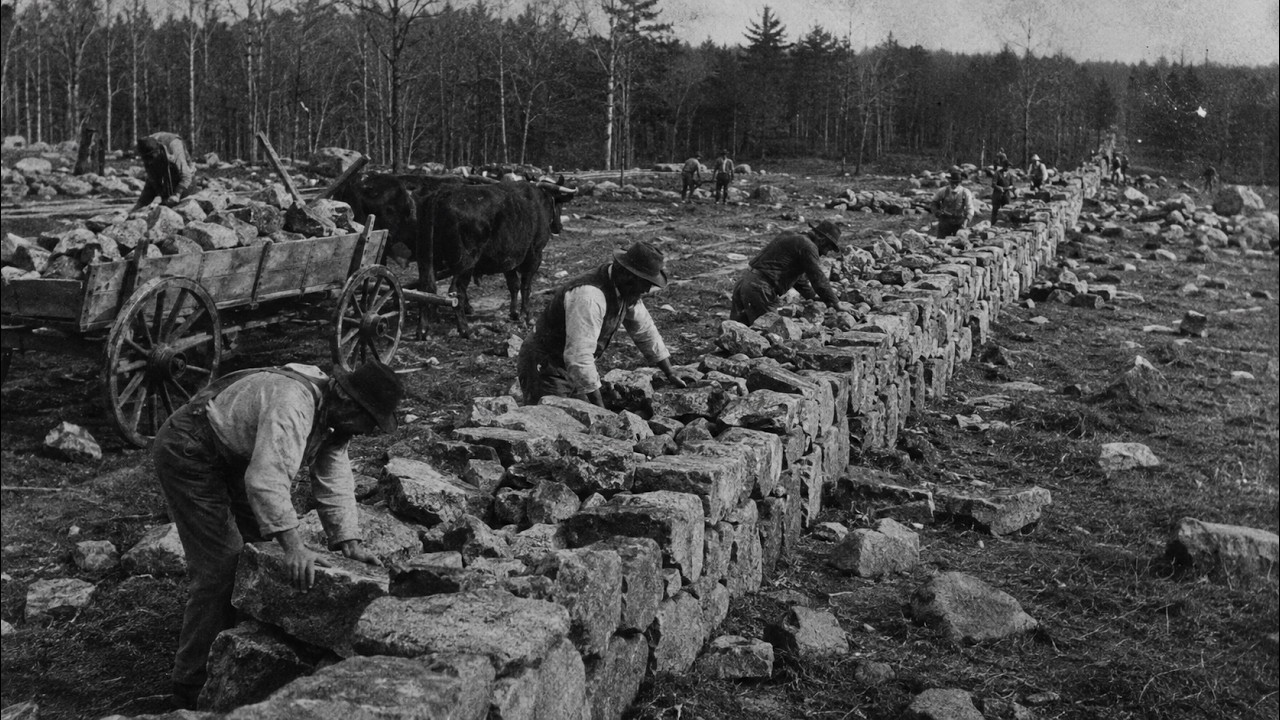
The people who built those walls were not kings, not architects, not men commanding machines. They were farmers, farm wives, hired hands, ox teams, and children with cold fingers and sore backs, all of them trying to solve the same impossible problem every spring. The ground kept growing stones. That sounds like a folk saying until you walk into the woods of Vermont, Massachusetts, Connecticut, New Hampshire, or Maine and find a wall running straight through the trees.
Deep in Vermont woods, where the land appears never to have been farmed, walls appear. You can follow one into the forest for half a mile, over roots, through ferns, past maples and hemlocks, with no road, no barn, no chimney, no field in sight. But those walls were not built in the forest. They were built in open fields.
Between 1650 and 1860, colonial and early American farmers pulled stone from the soil, dragged it to the edge of the field, and stacked it without mortar, using gravity, weight, patience, and a kind of practical intelligence modern people rarely stop long enough to notice. The story begins with desperation. Before New England could be farms, it had to be made farmable. And before it could be made farmable, somebody had to deal with the stones.
Twenty thousand years ago, a wall of ice moved across New England. The Laurentide ice sheet did not care about farms, fences, sheep, orchards, or towns that would one day carry names like Concord, Wethersfield, Sturbridge, and Derry. It pressed down on the country with a weight so vast it is hard to picture. It scraped bedrock.
It broke ledges. It picked up fragments of granite, gneiss, schist, quartz, and trap rock, carried them in its frozen body, ground some smooth, cracked others sharp, and left them scattered when the ice retreated. When the ice melted, it did not leave neat rows. It left a stony inheritance.
The first trees grew over it. Leaves fell for thousands of years. Soil formed. Roots knit the upper ground together.
By the time Europeans began clearing New England for farms in the 1600s, many of the stones were hidden under forest soil, lying just below the plow line, waiting. The first farmers thought they were cutting forests. They were really opening a stone field. A man could swing an axe and see progress.
A tree fell. A stump burned. Light entered the clearing. Corn could be planted.
Hay could be cut. Cattle could be brought in. For a little while, it must have felt like victory. But winter came.
Water soaked into the soil. The ground froze. Ice expanded. Soil lifted.
Stones moved. When the spring thaw came, the earth settled back down, but the stones did not always return to where they had been. Frost heave nudged them upward, an inch here, two inches there, season after season. A farmer cleared a field in October, came back in April, and found new stones waiting for him.
That is the impossible part. The enemy was not a single boulder, not one bad acre. It was an entire region where the soil itself seemed to resist the plow. Every spring, just when the farmer needed to plant, the ground offered him more work, and the work could not be delayed.
A stone in a field was not just ugly. It could break a wooden plow, lame a horse, trip an ox, ruin a scythe, turn a day of planting into a day of repair. For a family living close to hunger, a broken tool was not an inconvenience. It was a threat.
So the farmer bent down. He lifted the small stones by hand. He pried the large ones loose with wood or iron. He rolled the round ones.
He dragged the stubborn ones. He cursed some of them, saved some of them, and stacked all of them somewhere they would not get in the way. And that is where the great contradiction begins. The stone wall was not the goal.
The field was the goal. The wall was the byproduct. The men and women who built 252,539 miles of wall were not setting out to decorate New England. They were trying to plant corn, graze sheep, cut hay, and keep animals where they belonged.
The wall was the long pile at the edge of survival. The first walls were rough. Many were not really walls at all, at least not at first. They were dumps, long stone piles along the edges of fields, beside wooden rail fences, beside roads, along property lines, or at the margin between pasture and mowing land.
Farmers called some of them disposal walls because that is what they were: places to dispose of the stones the land kept giving back. But a pile has a way of becoming a structure. A farmer who placed one stone carefully saved himself trouble later. A stone laid flat stayed better than one thrown loose.
Two stones leaning against each other could hold a third. Large stones could anchor the base, smaller stones could fill gaps, long stones could bridge the top. Nobody needed a drawing. The wall taught the builder as it rose.
This is the wonder of it. A wall made without mortar should not seem permanent. No cement, no poured footing, no steel, in many cases no survey crew, just field stone, muscle, and judgment. But gravity has a language of its own, and farmers learned to speak it.
A good dry stone wall is not a stack of random rocks. It is a balance of forces. Each stone leans, presses, locks, or settles into the next. The weight that could crush a careless wall is the same weight that holds a careful one together.
The builder had to think like the wall, feel where pressure would go, know which stone belonged at the foot, which in the middle, which should be saved for the top. That knowledge did not come from books. It came from lifting. A boy learned by carrying small stones.
He learned which ones fit a gap and which would roll out. He learned not to waste a flat stone where a round one would do. He learned that a pretty face on the outside did not matter if the center was hollow, that a wall built too straight without a battered lean could slump, that a wall built too loose would invite frost, roots, and cattle. The fathers did not need to lecture much.
The stones corrected the children. By the 1700s, New England farms were expanding inland. Timber fences still mattered because wood was plentiful at first. Split rails could be made from the forest that had just been cut.
Zigzag fences could be moved. Brush could be piled. But as farms matured, the problem changed. The old-growth forest was gone.
Fields had to be maintained year after year. Wood for fencing became less convenient in many places. Stones kept surfacing. The old wooden fence line became the natural place to put the stone.
Over time, the stone pile supported the fence. Then it replaced parts of the fence. Then, in many places, the wall became the fence. A man who had no spare money could still build with what the field gave him.
That was the harsh beauty of it. The material was free, but the price was paid in labor. One mile of stone wall is hard to imagine. Not the distance, the work.
A mile is 5,280 feet. If the wall is only waist high, that is still thousands upon thousands of stones. A single stone might weigh five pounds, another fifty. A stubborn fieldstone might weigh two hundred.
Some could only be moved by two men, a pry bar, an ox team, and patience. Picture doing that after morning chores, after milking, after feeding animals, after cutting wood, after mending harness, after repairing tools, after breaking ice from the water trough. The wall rose during spare time, which is another way of saying there was no spare time. The seasons ruled everything.
Spring revealed stones, but spring was also planting time. Summer was haying, weeding, grazing, and repair. Autumn was harvest, slaughter, cider, wood, and preparation for cold. Winter was the season when fields rested, but people did not.
That was when many farmers had time to haul the bigger stones across frozen ground. Winter made the work possible. A heavy stone that would sink a cartwheel in mud could slide on snow. Ice turned poor roads into hard tracks.
Oxen could pull a stone boat, a low wooden sled built close to the ground, across a frozen field with less strain than a wagon in summer. The stone boat was one of the plainest tools on the farm and one of the most important. It was not pretty, and it did not need to be. It was built low so the load did not have to be lifted high.
A man could pry a stone onto it or roll it with a lever. The oxen leaned into the yoke. The chain tightened. The sled scraped forward.
A stone that had sat in the field since the glacier could move slowly toward the wall. That is the kind of engineering that never gets a monument. No patent office, no inventor’s portrait, no factory name stamped on the side. Just a sled, a team, and the understanding that if the stone could not be lifted, it could still be dragged.
The tools were simple because they had to be. Wooden pry bars came first in many places, cut from tough hardwood. Later, iron bars made prying easier, though never easy. A sledgehammer could split or nudge.
A crowbar could loosen. Chains could pull. Wedges could persuade. Hands did the rest.
The farmer did not conquer the stone all at once. He negotiated with it. A stone too large for the wall might become a corner. A flat slab might become a cap.
A long stone might tie two faces together. A boulder too heavy to move might remain in the field, and the wall might bend around it. The finished line was sometimes straight because the boundary was straight. Other times it wandered because the work followed the ground.
That is why old walls feel alive. They record decisions. One notch means a ledge was in the way. One bulge means a big stone refused to go farther.
One sudden turn means an old lane, a vanished pasture, or a property line whose deed may be gone. One gap may have held a gate. One heap may mark a place where a farmer finally ran out of patience and dumped the rest. But all walls were not the same.
The simplest were single-stack walls, the cheap version, if cheap can be said about five hundred man-hours per mile. Often one stone thick, quick to build by local standards, useful for sheep, good enough where the pressure was not too great. Sheep are persistent, but they do not lean into a wall like cattle. A single-stack wall could mark a field edge and hold a flock if it had enough height, enough roughness, and enough help from brush or rail.
Cattle are different. A cow is a living force of inconvenience. It rubs, it pushes, it leans, it finds gaps. Cattle needed stronger barriers, and that is where double-stack walls mattered.
A double-stack wall has two outer faces, one on each side, with smaller stones filling the core. The best builders tied the two faces together with long stones that reached deep into the wall, making the structure more stable, broader at the base, better able to survive frost, animals, and time. A good double wall is not just stronger, it is more honest. You can see the labor in it.
Each side had to be faced, each gap packed, each lift of stone considered twice. If the wall leaned out, it would fail. If the core was loose, it would settle badly. If the stones were all small, it would scatter.
If the large stones were wasted too high, the base would suffer. The wall judged the builder. Then came lace walls, the kind that makes a walker stop. Tall, open, careful, almost airy in places, built with stones set so the spaces between them give the wall a lightness that seems impossible for rock.
These were often built around houses, lanes, or special places where appearance mattered along with function. They required better stone and better hands. A farmer could throw a disposal wall together because the field demanded it. A lace wall asked for pride.
You can tell when somebody cared, not because the wall is perfect, but because it is deliberate. The stones stand, lean, and lock with attention. The wall has rhythm. It has a face.
It carries the mark of someone who had done this long enough to make rough material behave. Estate walls were another matter. More ordered, decorative, formal, built around larger properties, village houses, institutions, and later country estates. They could be taller, smoother, more architectural.
Sometimes specialists were hired. Sometimes quarried stone was used. Mortar entered the work. These walls speak a different language: ownership, display, permanence.
But the heart of the New England story is the farm wall, the unmortared field wall, built because the cow needed containing, the sheep needed pasture, and the plow needed a clear path. Robert Thorson understood that better than almost anyone who has written about them. A geologist at the University of Connecticut, a professor of Earth Sciences, and one of the principal modern scholars of New England stone walls, Thorson wrote a book called *Stone by Stone* that helped many people see these walls not as charming rural clutter, but as records of geology, farm labor, and regional memory. He also helped build the Stone Wall Initiative, a public resource devoted to studying and protecting them.
What Thorson brought to the subject was rare. He saw the stone as both nature and history. A wall was not just a fence. It was the last stop in a process that began in ancient mountains, moved through glacial ice, slept under forest soil, rose through frost, met a farmer’s hand, and then waited under trees for someone to notice.
That is why a stone wall in the woods can feel impossible: it is not one story but several stories stacked together. Geology below, agriculture above, labor in between, memory over all of it. Henry David Thoreau saw that memory forming while the farm world was still alive. Born in Concord, Massachusetts, in 1817, remembered as a writer, naturalist, walker, and observer of ordinary things other people passed too quickly, Thoreau in the 1840s walked the fields, roads, wood lots, and walls of a town where agriculture and thought lived side by side.
He also worked as a surveyor. That detail matters. He did not only look at Concord as a poet. He measured it.
He moved through property lines, wood lots, pastures, and boundaries, and understood that a wall could be a legal line, a practical barrier, and a relic of human effort all at once. In his journal, Thoreau wondered how the work of ancestors could remain so visible while the people themselves became so transient. That is the grief hidden inside these walls. The stones remain.
The hands are gone. But before the grief, there was pride, because a farmer who built a wall had done something that worked. Not in theory, not on paper, but in weather, against animals, against frost, against debt, against hunger. A wall that survived one winter had proved itself.
A wall that survived one generation had become part of the farm. And then, in the early 1800s, the wall-building boom arrived. The cause had wool on its back. William Jarvis was not a poor hill farmer.
He was a Boston-born merchant, a diplomat, and the United States Consul to Portugal, with connections in Europe, money, and an eye for opportunity. During the wars around Napoleon’s Spain, the old Spanish control over Merino sheep weakened. Merinos were prized for fine wool. Jarvis helped bring them into the United States around 1810, and he later made Weathersfield, Vermont, one of the centers of the new sheep economy.
This changed the New England hills. Merino sheep could graze rough land, rocky land, thin land. Land that was not kind to wheat could still feed sheep. Wool prices rose.
New England textile mills wanted fiber. Farmers looked at their stony pastures and saw money on four legs. Therefore, walls multiplied. From 1810 to 1840, the Merino sheep boom drove much of the wall construction remembered today.
Sheep needed boundaries. Pastures had to be enclosed. Flocks had to be separated. Neighbors had to know whose animals were whose.
A farm that once needed some walls now needed more. A hill that once seemed too rough for crops could be cleared for grazing. The sheep did not build the walls, but they gave farmers a reason to keep building. In Vermont, by the late 1830s, sheep numbers soared past one million.
In some places, sheep seemed to outnumber people so badly that the joke hardly felt like a joke. The hills were cleared. The pastures widened. Stone walls divided the slopes.
Woodlots shrank. The country looked more open than many Americans today can imagine. This is the part people get backward. They imagine old New England as deep forest, always forest, ancient forest, with stone walls tucked naturally among trees.
But in 1830, Massachusetts was roughly sixty percent cleared land. Open, worked, cut, grazed: hayfields, pasture, orchards, lanes, barns, cellar holes, and stone walls under a broad sky. The trees that now shade many of those walls were not there. The walls stood in sun.
Sheep moved beside them. Cattle pressed against them. Men mended them. Boys crossed them.
Women passed through barways on the way to gardens, wells, neighbors, and church roads. By 1840, the sheep boom had already begun to show cracks. Markets changed. Tariffs changed.
Wool prices fell. Western competition grew. Farmers farther west could raise animals on land that was flatter, larger, less stony, and cheaper to work. New England farmers were trapped by the very ground they had fought so hard to improve.
Their walls were good. Their land was hard. That is a cruel combination. A family might spend generations clearing stones from a hillside farm only to watch a western farm produce more with fewer hands.
Ohio, New York beyond the Hudson, Michigan, Illinois, and later farther states offered deeper soil and wider fields. The Erie Canal and railroads changed distance. Grain and wool could move. The old hill farm no longer competed only with the next town.
It competed with the continent. Therefore, the great abandonment began. From 1860 to 1910, many New England farms were left behind. Not all at once, not in one dramatic exodus.
A son went west. A daughter married into a mill town. A family sold out. A barn roof failed.
A pasture grew brush. A cellar hole filled with leaves. A lane stopped being used. Taxes went unpaid.
The stone walls remained because stone has no reason to leave. Wooden houses sagged, barns collapsed, fences rotted, apple trees went wild. But the walls stayed. This is where the story turns from pride to grief.
Not grief as spectacle, not horror, just the quiet grief of forgotten people. The names gone from memory. The men buried under leaning headstones. The women whose labor never made the farm account books.
The children who carried the small stones and became old before anyone thought to write down what they had done. A wall does not tell you the builder’s name. It tells you his reach. It tells you how far he could carry.
It tells you where he stopped. It tells you what he thought was worth doing well. But it does not tell you whether his back hurt when he rose in the morning. It does not tell you whether he lost a child that winter.
It does not tell you whether the farm saved the family or broke it. It does not tell you whether the woman of the house stood at the doorway and watched the oxen drag another stone boat across the snow, wondering if the land would ever give more than it took. The records can count miles. They cannot count that.
The 1871 survey counted 252,539 miles of stone wall. The number is so large it almost becomes useless. Enough to circle the earth ten times. Enough to run from Boston to California and back again many times.
Enough to outmeasure almost any road system of its day. But a mile is a better unit for respect. One mile of wall is estimated at about five hundred man-hours of labor. That means 252,539 miles comes to roughly 126 million man-hours.
One hundred twenty-six million hours. That equals about fourteen thousand years of human effort. Not machine effort. Human effort.
Hands on stone. Boots in mud. Shoulders under strain. Oxen breathing steam in winter.
Children carrying cobbles. Men placing rocks after chores. Women keeping farms alive while the wall work took time from everything else. Hired hands earning wages.
Neighbors helping after a storm. A father showing a son where the big stone goes because the wall will fall if he wastes it. Fourteen thousand years is older than farming in many parts of the world. And New England put that much work into walls that many people now pass without seeing.
The walls were built primarily between 1650 and 1860, but the great surge came later than people think. The popular image says colonial: buckled shoes, early cabins, first settlements. Some walls do go back that far. But much of the wall work belonged to the late 1700s and early 1800s, when farms had matured, forests had been cleared, wood fencing had become less convenient, and sheep gave the work new urgency.
This matters because it rescues the builders from legend. They were not vague ancestors in a storybook past. They were early Americans working in a young republic. Some had lived through the Revolution.
Some had sons in the War of 1812. Some read newspapers by candlelight. Some watched railroads arrive. Some saw mills grow in river towns.
Some heard talk of western lands and knew quietly that their children might not stay. But they kept building, because a farmer does the work in front of him. That sentence may be the closest thing to the whole story. The work in front of him was stone.
Spring after spring, stones came up. A farmer could complain, and surely he did. But he still had to move them. He did not need to love the wall.
He needed the field. Therefore, the wall rose. In this way, the walls became accidental monuments. Nobody planned a regional memorial to farm labor.
Nobody voted to build a stone record of New England endurance. Nobody stood in a town meeting and proposed a project that would circle the earth ten times. Yet that is what happened, one farm at a time, one boundary at a time, one cartload at a time, one stone boat at a time. That is why the scale feels unreal.
Great works usually have a center. A pyramid has a king. A canal has a charter. A railroad has investors.
A mill has owners. The stone walls had no single master plan. They had thousands of small necessities repeated until they became enormous. A man cleared his north field.
His neighbor cleared the south pasture. A town widened a road. A family enclosed sheep. A father divided land between sons.
A hired hand rebuilt a collapsed section. A child stacked stones too small for the base. Multiply that by decades, counties, states, and seasons, and the ordinary becomes almost impossible to believe. The work had its own methods.
When stones surfaced in spring, the smallest could be carried in baskets, aprons, or by hand. Medium stones might go into a cart if the ground allowed it. Larger stones waited for a better day. A farmer might mark them, pry around them, and come back when he had help.
Two-man teams mattered for heavy stones because one man could pry while the other blocked, rolled, or guided. The safest lift was often no lift at all. Better to roll, better to drag, better to slide. Oxen were patient power.
A good ox team did not hurry. It leaned, it listened, it knew voice commands. It pulled sledges, carts, logs, and stone boats. Horses had their place, but oxen were steady, strong, and suited to slow farm work.
A pair of oxen could turn an impossible stone into a movable one. The sound must have been everywhere in winter. Wooden runners over packed snow, chains tightening, men calling to oxen, stone scraping onto stone, a sledge ringing against a stubborn edge, breath in cold air, then the hollow thud of another rock settling into the wall. And after all that, spring could still undo part of it.
Frost heave did not only lift stones in fields; it moved walls too. Water entered gaps. Ice expanded. Stones shifted.
A wall that looked sound in October might bulge by April. Hunters, livestock, tree roots, and time added their own damage. That is why walls had to be mended. Building was one job; keeping it upright was another.
A wall was never finished forever. It was finished for now. That is another old lesson nearly forgotten. Modern shortcuts promise final solutions: pour it, seal it, bolt it, replace it, buy another.
The farmers of New England lived closer to the truth that gate, roof, harness, wall, ditch, and road needed attention. A farm survived because small failures were handled before they became large ones. A gap in a wall was not a symbol. It was a sheep problem.
A loose stone was not rustic charm. It was tomorrow’s repair. There is dignity in that kind of attention. It does not ask to be admired.
It simply prevents trouble. Tom Wessels, in *Reading the Forested Landscape*, taught many walkers to read old woods for human signs. Not just walls, but cellar holes, wolf trees, old roads, charcoal sites, pasture juniper, barbed wire swallowed by bark, and the shapes of trees growing where fields once lay. His work helped people understand that a forest can be young even when it feels ancient, and that the ground under your boots may have been a farm not very long ago.
That is what New England does so well. It hides history in plain sight. A stone wall under maples looks eternal. But the forest around it may be second growth.
The wall may be older than most of the trees. The trees may be growing because the farm failed. The roots now prying the wall apart belong to the forest that returned after the people left. In 1830, Massachusetts was roughly sixty percent cleared.
Today it is about sixty-four percent forested. That reversal is not just a statistic. It is a change you can walk through. A field becomes brush.
Brush becomes saplings. Saplings become woods. Pines rise first in many old fields. Hardwoods follow.
Stone walls that once divided sunny pasture become shadow lines under leaves. Ferns cover the lanes. Cellars fill. The old orchard drops sour apples for deer.
By the early twentieth century, many old farms had become woodland again. Some were bought for timber. Some became estates. Some became town forests.
Some became state land. Some were simply forgotten behind newer roads and houses. In the 1900s, people began to romanticize the walls. Artists painted them.
Writers praised them. Homeowners rebuilt them. Suburban builders borrowed their look. But the old farm walls were not built for romance.
They were built because the land demanded a response. That response still shapes the region. Drive a back road in New England and you may see stone walls running along both sides, dipping under leaves, broken by driveways, vanishing behind houses, rising again near an old cemetery. Walk behind a school, a church, a town hall, a conservation trail, or a patch of roadside woods and you may find them.
They are nearly everywhere in forested New England if you learn how to look. Some are mossy and low. Some are tumbled, more mound than wall. Some still stand chest high.
Some disappear into hillsides. Some run into wetlands and stop. Some climb slopes where no tractor would dare. Some cross modern property lines that did not exist when they were built.
Some pass close to cellar holes where lilacs still bloom. Those lilacs can break your heart. A wall alone tells you labor. A cellar hole tells you home.
A lilac tells you somebody wanted beauty there. This is the final turn of the story. The walls are engineering, but they are also evidence of feeling. A farm family did not live by stone alone.
They planted gardens. They raised children. They buried parents. They argued with neighbors over boundaries.
They borrowed tools. They went to meeting. They heard sheep at night. They knew which wall section always failed, which field was too wet, which pasture was thin, which ox was stubborn, which child could be trusted to stack small stones neatly.
History often saves the names of men like William Jarvis because he changed markets. It saves Henry David Thoreau because he changed American writing. It saves Robert Thorson because he gave the walls a scientific and cultural voice in our own time. But the wall builders were mostly unnamed.
That does not make them less important. It makes the walls more important, because the wall is the record they left when the paper record did not bother with them. A census might list a farmer’s household. A deed might mark a boundary.
A town book might record a tax. A church might record a marriage. But none of those records tell you the exact weight of the stone he moved after dinner, or the way his daughter stacked the small ones because her hands were quick, or how the oxen knew the path to the north pasture without much command. The wall tells you someone did the work.
Not who. But someone. And sometimes that is enough to create respect. The farmers who built these walls were not perfect figures from a clean past.
They were people in a hard world, part of settlement, displacement, property making, and the heavy reshaping of the ground. Their farms came after indigenous homelands had been taken and transformed. Their walls marked ownership in a way earlier peoples had not used in the same manner. To honor labor honestly, we do not need to pretend the past was simple.
It was not simple. But the work was real. The stones were real. The effort remains.
That is why the walls deserve a serious eye. They are not just quaint, not just old-time decoration. They are one of the largest handmade structures in North America, spread not as one monument but as a web of work across farms, towns, and woods, built mostly without mortar. That detail still stops me.
No mortar means no glue, no binder, no chemical promise. The wall depends on placement, on the builder’s eye and the stone’s own weight. Put the wrong stone in the wrong place and the wall remembers. Put the right stone in the right place and it may stand longer than the house.
There is a lesson there, though I do not want to polish it too much. Old work lasted because it had to answer to weather. A farmer could fool a neighbor for a week with a bad wall. He could not fool January.
He could not fool the April thaw. He could not fool a bored cow. The wall either stood or it did not. Every season audited the work.
That kind of judgment is severe. It is also fair. The wall does not care what a man intended. It cares what he built.
By the end of the nineteenth century, when many farms were emptying, the walls had already begun their second life. They were no longer just fences. They were relics. Thoreau had sensed it.
Later writers deepened it. Robert Frost would make a New Hampshire wall famous in the early twentieth century through poetry. But the walls did not need poetry to matter. They already held the memory of work.
Today, a walker may step over one without thinking. A deer may follow one as a path. A chipmunk may live inside it. A snake may warm itself on it.
Moss may soften it. Roots may loosen it. Rain may wash soil into it. But the wall still draws a line.
Not always a legal line anymore. A human line. A line between forest and field, past and present, memory and forgetting. When you stand beside one of these walls in the woods, you stand beside a decision repeated thousands of times.
Pick up the stone. Move it. Place it. Go back.
Pick up another. Do that until the field can be planted. Do that until the pasture is enclosed. Do that until daylight fades.
Do that every year the ground gives you more. It is easy to admire the final number, 252,539 miles. But the number can become too grand. It can float away from the body.
Bring it back down to one stone. One stone lifted from wet soil. One stone cold enough to hurt the fingers. One stone rolled with a boot.
One stone pried loose by a tired man who still had animals to feed. One stone carried by a child who did not know that two hundred years later strangers would call it heritage. One stone placed by someone who expected nothing more than a better field. That is where the awe belongs.
Not only in the mileage, but in the repetition. The quiet repeated act is what built the impossible thing. A pyramid rises because a ruler commands it. A cathedral rises because a church funds it.
A railroad rises because investors expect return. New England stone walls rose because thousands of families faced the same stubborn ground and reached the same practical answer. Move the stones to the edge. Stack them.
Keep going. That is why they outlast everyone. The farmers who built them are gone. William Jarvis is gone.
Thoreau is gone. The sheep boom is gone. Many of the farmhouses are gone. Many of the barns are gone.
The open hills returned to trees. The wooden rails rotted. The lanes vanished. The hand tools rusted away.
Even the names of the builders in many places have slipped beyond recovery. But the walls remain. At the end of a long walk, when the light drops and the trees turn dark, an old wall can appear almost by accident. A low line of stone, green with moss, half collapsed, still moving through the woods with a purpose no modern map explains.
I have put my hand on those stones and felt the strange closeness of it. Not because I knew the man who placed them, I did not. Not because the wall was grand, it was not. But because the work was still there.
A human hand had lifted that stone. Another human hand was touching it now. Between those two moments were winters, wars, railroads, mills, abandoned farms, returning forests, paved roads, electric lights, chainsaws, satellites, and all the noise of modern life. The stone had waited through all of it.
The next time you walk in New England woods and see a stone wall running between the trees, do not think of it as scenery. Think of it as a field edge. Think of a farmer in spring finding stones where he had already cleared stones. Think of frost lifting the old glacial rock.
Think of oxen pulling a stone boat across winter snow. Think of children stacking the small ones. Think of sheep pressing against a single-stack wall, cattle testing a double-stack wall, a careful lace wall near a house, and a mortared estate wall trying to look more refined than the labor beneath it. Think of 1830, when open land spread where trees now stand.
Think of 1871, when the surveyors counted enough wall to circle the earth ten times. Think of 126 million hours. Think of fourteen thousand years of work. Then look again at the wall.
It is not abandoned, not really. It is still doing what the best old work does. It reminds us that people were here before us, that their lives were heavy with labor, that their names may be gone, and that the things they made by hand can still stop us in our tracks. The men who built them are gone.
The women who held those farms together are gone. The children who carried the small stones are gone. The fields became forests. The forests hid the walls.
But the walls outlast everyone.
