It is late afternoon on the first of October, 1789, at a creek in the far southwestern corner of Virginia. Jenny Wiley stands in the doorway of a log cabin, a baby on her hip, four other children behind her inside the single room. She is pregnant with her fifth. In the ninety seconds it will take for the door to open and close again, three of those children will lie dead on the dirt floor.
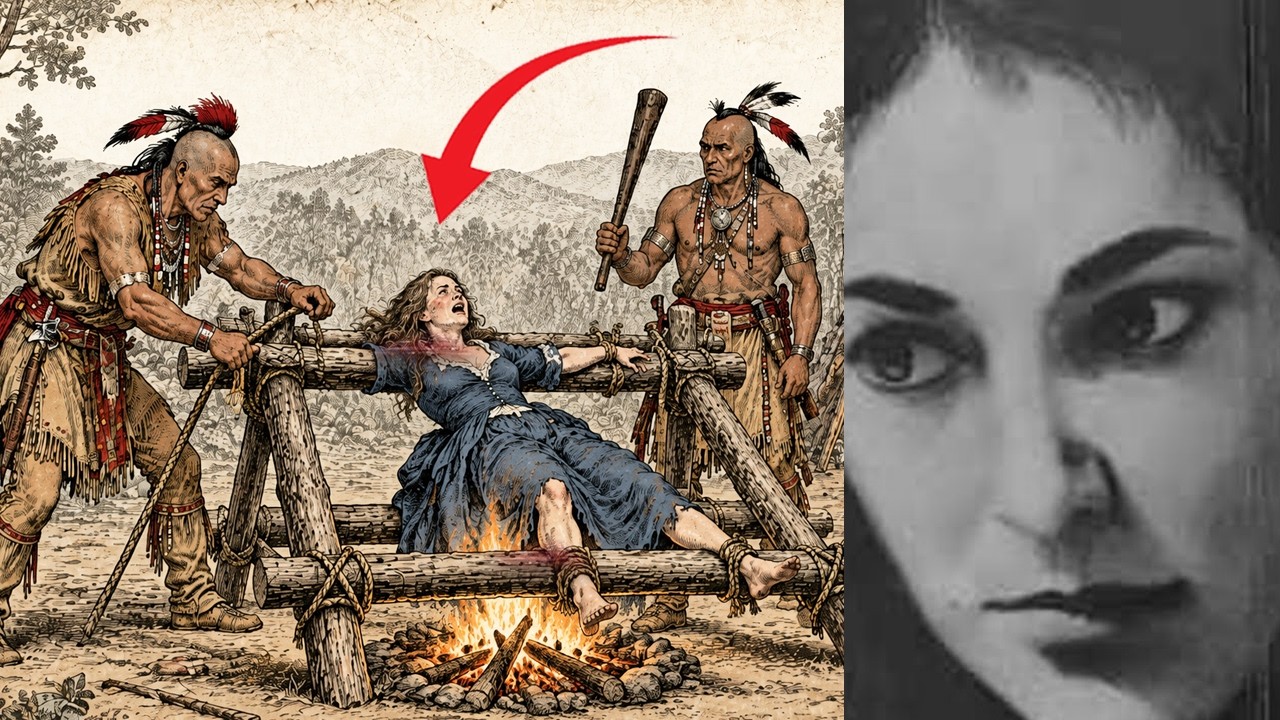
Her teenage brother will die beside them. And Jenny herself will be dragged into the forest, beginning an ordeal that will last most of a year and end in something worse than death for the children who survive the cabin. There are five children in that cabin, counting the infant. Before a kettle could boil over an open fire, four of them will be gone.
The raiding party walking toward that door did not come for scalps or plunder. They came, in a way Jenny will not understand for months, to the wrong house. There is a strong chance they believed the cabin on Walker Creek belonged to Matthias Harman, one of the most feared Indian fighters on the frontier. It did not.
Jenny paid for the reputation of a stranger. And the children who survived the cabin did not die quickly. They died in stages. One on the trail, killed by a warrior who did not want to hear crying.
Another months later, in a ritual involving a piece of bark, a frozen creek, and an old man who was not deciding whether the child would live. He was reading signs in the water. The question that will haunt the rest of this story is why they kept Jenny alive. Everyone in that cabin was dead within two minutes.
She was a pregnant woman who would walk through the mountains with a screaming infant, slower and louder than the bodies they had just left behind. Yet for reasons that reveal something dark about the border wars, they took her. Before Jenny steps one foot into the forest, you need to see the cabin she is standing in. Jenny Wiley is in her late twenties, maybe just past thirty.
She was born Jenny Evans, daughter of a poor Virginia family, and she followed a man named Thomas to Walker Creek because Thomas Wiley believed there was a life to be built at the far edge of the map. Today, October first, Thomas is not in the cabin. He is out hunting. This is not neglect.
It is how the family lives. The cabin is one room, maybe two, with packed dirt floor, a single hearth, and a loft above. Hides hang on the walls. The smell of wood smoke never leaves the timbers.
Four children move around her, the oldest not yet ten, the youngest a fifteen-month-old on her hip. Every task in this cabin is done with ears tuned to the sound of anything moving between the trees. Fifteen miles from here, in the Big Sandy Valley across the mountains, stands a small fort called Harman’s Station. It belongs to Matthias Harman, a man who has killed enough Shawnee and Delaware warriors to have his name carved into their villages the way certain names are spoken with hatred.
Thomas Wiley is not Matthias Harman. But the trails through these mountains do not always know the difference. Somewhere to the north, a small party of warriors moves through the hills. Most historians put their number at eight to twelve men.
Shawnee, Cherokee, perhaps some Delaware. They are survivors of tribes whose hunting grounds were cut up into cabins like this one over the course of a generation. They are not an army. They are men who watched the treaty line move west, and then west again.
They came for revenge, or for hostages, or for both. And they were told there was a station on Walker Creek belonging to the man who killed their people. It was late in the afternoon when Jenny’s younger brother came running. He is fifteen, maybe nineteen.
Even his name is uncertain now, lost in two centuries of storytelling. He had seen signs: footprints in the mud, smoke where there should be no smoke. He tells his sister to take the children and run to the neighbors. Jenny gathers up the baby.
She turns toward the door, and the door opens by itself. The children in that cabin ranged from the oldest son, not yet ten, through three middle children, down to the fifteen-month-old in Jenny’s arms. Their names were never reliably recorded. The historical record kept the mother’s name and let the children disappear, a particular form of erasure.
Jenny herself is pregnant and worn from the working season, but physically strong from years of frontier labor. She has carried water up from that creek every day of her adult life. Her legs are what will keep her alive later, when nothing else can. Her brother is a teenager, unarmed or nearly so, running the last quarter mile toward the cabin.
Thomas is absent out of necessity. Men on this frontier hunted or starved. The cabin is isolated. The nearest neighbor is Jenny’s sister, who lives at a distance.
A man named John Borders will not arrive until dusk. The small group outside numbers eight to twelve men, according to most accounts. It is a mixed party, which was the pattern on this frontier. Shawnee families had intermarried with Delaware and Cherokee families, and war parties reflected that diversity.
They carry single-shot flintlock rifles, tomahawks, knives, and war clubs. The tomahawk mattered more than the rifle. A rifle fires once. A tomahawk kills as long as your arm can keep moving.
Local tradition and the more careful modern historians point to something that changes the entire meaning of the raid. The group may have been hunting Matthias Harman. They believed his cabin was somewhere on this creek. They were wrong.
They found the Wiley family instead. Everything that followed, the killings on the floor, the march through the mountains, the infant on the bark, happened because a raiding party could not read the trail well enough to tell one cabin from another. Walker Creek lies in a narrow valley of dense hardwoods and broken hills. A raiding party could stand a hundred yards from the cabin and no one at the door would see them.
The routes west run through the mountains toward the Tug Fork of the Big Sandy River, then drop into the valley that now forms the border between Kentucky and West Virginia. It is not a road. It is a rumor of a road, followed by memory. Winter is coming.
The temperatures will drop within weeks. There is a moment in the seconds before the door opens that gets almost no attention in the accounts. Jenny’s brother is a boy, fifteen or seventeen, depending on the source. He had been running.
His lungs burn. He saw something in the woods, and he did what a boy does when he sees something in the woods. He ran toward his sister’s house instead of away from it. He could have kept running.
He could have gone to the neighbors. The trail he saw was moving toward the Wiley cabin, not his own. He was not yet in any real danger. But he chose the cabin.
The accounts differ on whether he shouted through the door or came inside. What they agree on is that he arrived, told Jenny what he had seen, and stood in front of her when the raiders burst in. Which means that at some point in that last minute, a teenager on a creek bank in Virginia made a decision no logic supports. He stayed.
He is the first person killed in this story. His body will be on the floor before Jenny’s mind understands what is happening. His name was not preserved in any letter Governor Randolph read. The records kept Jenny’s name.
She outlived her brother. But you need to know that before Jenny Wiley took one step into her ordeal, someone had already died rather than leave her. That will mean something to her for the rest of her life. The door opened, and suddenly the cabin was full of men.
The sound comes first: a sudden cry that writers later called the “savage yell,” a sound designed to paralyze anyone who heard it. The brother falls first. Tomahawk, knife. He is the first body on the floor, falling at the door he had just run through to save his sister.
The children are next. Three of them die in those first minutes. The oldest first, then the two next in age. The killing is done with edged weapons, not rifles, because rifles are loud and the raiders do not know how close the militia might be.
The killings happen so fast that Jenny, standing with her child, will later describe the silence of the room before she understood what that silence was. Scalps were both loot and proof. Every child in that cabin was scalped. The record will use that exact word three weeks later.
Then the band makes a decision in seconds. The pregnant white woman has value. The child she carries on her hip is either a burden or a bargaining chip. She lives.
The child lives, for now. Four bodies on the floor, a woman dragged toward the door, and the entire event fits in the time it takes to walk from your kitchen to your car. Frontier raids were not battles. They were something much shorter and much worse.
Dusk. John Borders arrives at the cabin expecting to find Jenny and the children at her sister’s. He is a neighbor, in his twenties or thirties, part of that small circle of families living within reach of one another. He expected to be offered a bowl of something hot.
He was carrying a lantern. The lantern is what shows him what is on the floor. Borders rouses the settlers. A pursuit party forms.
By dawn on October second, the men are on the trail. They find an abandoned campfire still warm to the touch. They find a torn piece of cradle cloth among the leaves. Then, in a hollow off the path, they find the fifteen-month-old.
The infant had been killed on the trail because it cried. The men bury him under leaves and pile stones over him. They have no time for better, and they turn back because the raiders are already miles into country the settlers do not know as well as the men they are chasing. Three weeks later, Lieutenant Walter Crockett of the Montgomery County militia will sit at a table and write a letter to Governor Beverley Randolph of Virginia.
He will describe what happened at Walker Creek in the driest sentence possible, the sentence of a man who has written many such sentences. He writes: “On the first instant, a party of Indians stole the family of Wyleys, killed and scalped four of his children, and took his wife and youngest child prisoners. ” That is the entire archive of the massacre. One sentence.
Four children. A wife. And the smallest word in the sentence, “four,” is the beginning of a historical dispute that has never been fully settled. Jenny, meanwhile, is on the trail.
She is pregnant. She goes barefoot within a day or close to it. She is forced to walk at the pace of men who have been walking for weeks. She carries the infant.
They climb the hills. They wade the creeks. They do not stop when she falls. Someone pulls her to her feet.
Sometimes a hand, sometimes a length of rope. Imagine what a hundred miles on foot in October 1789 in the Appalachians means. There are no roads. No trail wide enough for two people to walk side by side.
The copperheads are still active in the leaves. Rivers rise overnight. And she does it pregnant, carrying a child, sleeping four hours a night, eating what her captors leave her, which is not much. They argue about her the way you argue about a slow horse.
Kill her, keep her, kill her, keep her. She lives from one decision to the next, from one day to the next. The timeline becomes tangled here, and the accounts do not agree. What everyone agrees on is this: in the first days of the march, the youngest child is killed in Jenny’s arms.
In some accounts a warrior dashes him against a tree, in others by a different means. Jenny is not allowed to bury him. That will come later, with a different child, in a different place, and it will be the only mercy granted her in the entire ordeal. By the time the leaves fall, they are deep in country no white settler has mapped, and winter has not yet begun.
The march covers somewhere between one hundred and a hundred fifty miles of mountain country, October turning into November. The route runs west and north through the hills toward the Tug Fork of the Big Sandy. Jenny’s clothes wear out and tear. Her feet bleed.
The band wraps her feet in hide. The cold sets in. First frost, first snow. Food is what the men hunt, what they carry, what she is given last.
She starts to pick up words of their language. She listens the way a captive listens, searching for names, numbers, anything that tells her where she is. She has seen five people she loves die in under a month. Her brother, three children in the cabin, one more on the trail.
She is pregnant with a sixth. And the mind in this condition does something very specific. It switches off. It stops feeling the individual blows and begins to absorb them like weather.
She will describe this later, as an old woman, to the preacher who writes down her story. She will describe it as walking through a cold that had crept into her chest and settled there. The reason she survived what killed her children is not strength, not luck. It is that the band decided a pregnant white woman was worth something to someone, while the children were worth nothing.
That is the most brutal calculation of the border wars. That is what the mythmakers left out. It is why she reached the winter camp when no one else in her family did. They arrive at the mouth of Cherokee Creek, in what is now eastern Kentucky, in late autumn.
The rock house is a natural shelter in the face of a cliff, common in the Appalachians: an overhang, a sloping floor, a fire pit near the entrance. Jenny was allowed to live there alone with her remaining child. That is unusual, but it is not kindness. The reason is that the band does not want her in the main camp.
She is a resource. They kept her the way grain is kept in a separate storehouse. The rock is cold in a way wooden walls are not. Water seeps through the stone and freezes in streaks along the back wall.
Her fire, when she is allowed to build it, throws light on rock that has never seen summer. She sleeps with the child pressed to her chest, wrapped in whatever is available. When she wakes, the moisture in her hair has crystallized. Winter in a rock house cannot be survived.
But she survived it. In the account she gave the preacher sixty years later, she recalled the winter in the rock house in the language of endurance, not complaint. Asked, essentially, how she did it, her answer, as it has come down to us, was not bravado. It was a report of fact.
“I do not fear death,” she is remembered as saying. She did not mean she wanted to die. She meant fear had left her, and once fear is gone, a person can do many things a fearful person cannot. The child survived the winter with her in the rock house.
But he did not survive the spring. When the ice began to break on Cherokee Creek, the men came to take her son. They did not tell her what they intended. She understood the way captives always understand, by watching the older men, by watching which of them carried something and which did not.
There was an elder in the band. The accounts describe him as Cherokee. He was old enough that the younger men gave him a respectful silence when he spoke. He carried something inside him that they did not dare question.
Whether it was spiritual authority, a war record, or age itself, the records do not let us say. He conducted the test. They bound the child to a piece of bark, a kind of cradle. They placed the bark on the water.
The current carried it away. They forced Jenny to watch. Let this be clearly understood for what it is. This is not cruelty for its own sake.
In the culture of the men who did this, it was a way of asking a question the world had the right to answer. Would the child live? Would the water give him back? This does not make it less appalling.
It makes it different from the cartoon version. And that difference matters. The infant cried. It is not clear whether he cried from cold, from motion, or from something inside him that knew.
He cried, and Jenny lunged into the water after him, an act that cannot be rationally justified. The men read the crying as a bad sign. The water had spoken. The child was killed there at the creek.
Jenny was allowed, afterward, to carry his body back to the rock house. She buried him in a corner of the shelter, in a small hole in the floor of the place, covered with stones. It was the only funeral any of her children ever had from her hands. At some point in the same season, before or after the test at the creek, the records do not allow us to be certain, she gave birth to the child she had carried since before the raid.
It was a live birth, alone, in the rock house on a creek in Kentucky. The infant was killed shortly after. The reasons the records give are always the same. He cried.
They were on the move. It was another body that could not run. That is the story. That is what she carried with her out of that spring.
After the rock house, the group moved south and west through the Big Sandy Valley, crossing rivers at the Tug Fork and later the main Big Sandy near present-day Louisa, Kentucky. The warriors held her arms while she swam. She was wet, frozen, three seasons into captivity. She had learned enough of the language to understand fragments.
She heard, somewhere in the camp talk, the name of a station. Harman’s Station. She knows it is on a river. She knows it is close.
She has been a captive long enough that her captors have stopped watching her the way they once did. She runs errands. She looks resigned. She has made herself, in the terrible accounting captives learn, useful and unremarkable.
The trust the men gave her was not kindness. It was habit. And habit was what she was waiting for. She told the preacher, decades later, that the thought that returned to her in the final weeks was a single sentence.
She did not fear death. She had gotten past the fear of death back in October. She no longer wanted to survive. What she wanted now was to be the one making the choice.
The band went out. She does not tell us exactly what they left to do. Hunting, raiding, meeting another party. Something of the sort.
What she tells us is that the camp emptied, and for the first time in nearly a year, no one was watching her. She ran. One word. One decision.
A woman who had watched her children die and given birth to another in a rock house put down what she was carrying and walked out of the camp. There were between fifteen and twenty miles of Appalachian forest between her and the station. She had no shoes worth the name, no food, no weapon, no map. She walked.
She moved at night. She hid by day. She followed the water, because water runs downhill and downhill leads toward people. She crossed the hills.
She waded the creeks. She did not stop. It took days. When the trees finally opened and she saw a wall of logs and a chimney with smoke rising, she was, by the testimony of everyone who saw her, past the limit at which a human body can keep walking.
They almost did not recognize her as a woman. The men at the station saw her first from the trees. She was barefoot. Her clothes were rags, literally rags, torn strips of what she had been wearing when they took her.
Her hair was matted. She had lost a great deal of weight, the way people close to starvation do: hollows in the face, at the temples, along the collarbone. When they finally understood what they were looking at, she was a white woman. A moment later, they knew she was the missing woman.
They had heard, last fall, about the family at Walker Creek. The word had spread then. The story of the cabin and the four scalped children had crossed the mountains the way such news always does. And here she was now, standing at the edge of the clearing, the woman that story had ended with.
They brought her inside. They fed her carefully, because someone who has starved cannot eat quickly without getting sick. They warmed her. They sent word.
Think for a moment about what that word said. It said: the Walker Creek woman is alive. Nothing else in the entire story went the way it was supposed to. Not the raid, not the chase, not the winter, not the spring.
Only this one thing happened: Jenny Wiley came out of the mountains on her own strength. And that is why we know anything else that happened. The length of her absence is the second historical dispute this story raises. Family tradition, the telling handed down by her descendants for generations, says she spent eleven months, nearly a year, in captivity.
But there is a letter, dated July 4, 1790. Lieutenant J. D. Smith of Russell County, Virginia, wrote to Governor Randolph about the state of the frontier.
He mentioned Jenny Wiley. He described her captivity, in his phrase, as only a few months. Five or six months is what the official papers suggest, which would mean she was taken on October first and came out by spring, around nine months, not eleven. It is a small correction.
But small corrections are the difference between the story a family tells about itself and the story the evidence supports. Thomas Wiley came for her. Whatever he said to her, and whatever she answered, exists in no surviving letter. The records simply note that he came, that she returned to him, and that they left the station together and began, on the Big Sandy River, the extraordinary task of a second life.
The count, depending on the source, is four children or five. The letter says four were scalped in the cabin. Family tradition says her brother and five of her children were killed. The difference lies in the child no settler ever saw alive, the one born in the rock house.
He belonged to Jenny alone, and he appears in no official correspondence. The boy who ran to warn her was buried near the cabin with the other children before winter. There is no grave marker. There never was.
They came for Harman. They found the Wiley family, and everything that followed was the price of that mistake. The test at the creek was not madness. It was the reading of an omen by an elder who believed the water would answer him.
The water answered, in his hearing, and the answer went against her son. They kept her alive because a pregnant white woman on the frontier was worth something a corpse was not. It was not mercy. It was inventory.
She survived because she was worth more moving than still. And in the end, she made herself worth less than the trouble of watching her, and she walked. She and Thomas moved to the Big Sandy. She gave birth to five more children: Ezekiel, Jane, Sally, Adam, and William.
She lived to be an old woman on a farm in what is now Johnson County, Kentucky. A creek near Paintsville was named for her: Jenny’s Creek. Her descendants are still there. But there is one thing to say before we leave her on that farm.
In her later years, a preacher came to visit her. He brought papers. He asked her to tell him what had happened at Walker Creek and after, and she sat with him for hours. In those hours, an old woman of the frontier gave the only firsthand account of Jenny Wiley’s captivity anyone has ever known.
That manuscript is why you have just heard this story. But the story that manuscript created was not entirely the story that happened. By the time William Elsey Connelley published “The Founding of Harman’s Station” in the 1910s, Jenny Wiley had become more than a woman at a creek. She had become a symbol, a figure in the frontier pantheon alongside Daniel Boone and Simon Kenton and the other names white Appalachia chose to enshrine.
Her ordeal was retold at church suppers and in school readers. Connelley’s book, based on family tradition, stated plainly that the Indians killed her brother and five of her children. Five, not four. And the difference between four and five is the difference between the letter Walter Crockett wrote in 1789 and the story the family had trained itself to tell for a hundred and twenty years.
Here is the revised truth that retellings tend to soften. Every dramatic detail of the captivity, the cry at the door, the test at the creek, the old Cherokee man, the piece of bark, the burial in the rock house, comes to us through that single manuscript. As one modern historian puts it: “When Jenny was an old woman, a preacher sat with her and wrote down the story of her captivity. Although Jenny may well have embellished it many times over, it is the only firsthand account we have.
” Read that carefully. The only account, from a woman who told it for sixty years in a culture that expected certain shapes to captivity stories, to a clergyman with his own reasons for writing it down. Everything you know about what happened at that creek passed through that room. What the legend built, it also cut away.
The teenage brother lost his name. The children lost their names. The band that captured her lost the reasons they came, the land, the treaties, the burned villages behind them. In the frontier teaching, they became simply “the Indians,” a category instead of a group of men with fathers and grievances.
And that flattening worked. It made the story easier to tell. It made the settlement of the Big Sandy Valley easier. It made Matthias Harman, the man the raiders may have been hunting in the first place, a hero rather than a cause of conflict.
Back to the threshold. October first, late afternoon, the light beginning to fade. A woman in her late twenties, a child on her hip, four other children in the room behind her, a pregnancy she can feel in her back, a brother running between the trees, a door about to open. She does not know yet that the men on the other side of it have come to the wrong house.
She does not know she will walk a hundred miles by the time the leaves fall, or that she will bury a child in the corner of a rock house before they return. She does not know it will be her who walks out of this. All she knows is that the door opens. And when it opens, the frontier changes.
The name on the creek in Kentucky is Jenny’s. There is a reason it is no one else’s.
