In 1936, a twenty-two-year-old Californian named Bob Wian sold his roadster for roughly three hundred dollars, borrowed fifty more from his father, and bought a tired ten-stool lunch counter in Glendale called The Pantry. He scrubbed the place until it shone and put his own name over the door. For six months it was just another diner. Then a band of musicians off the big band circuit walked in one night, tired of the menu, and asked him to make them something different.
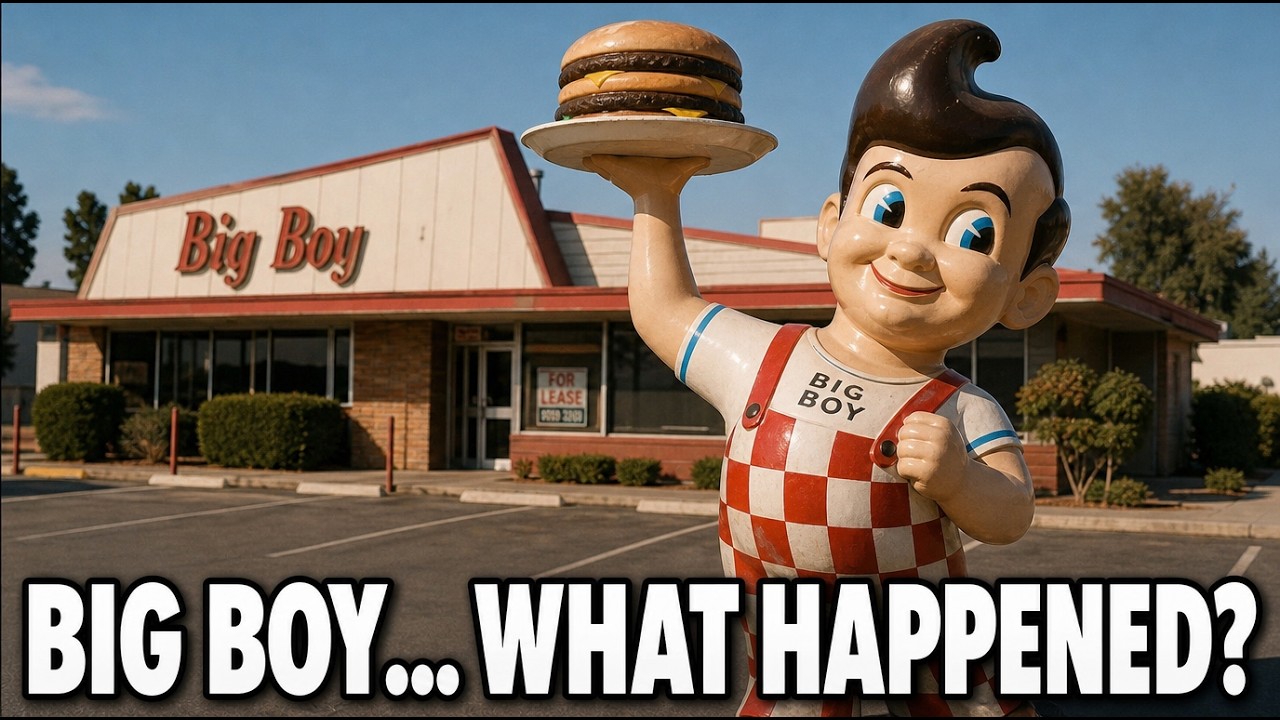
Instead of slicing a bun in two, Wian sliced it into three, stacked two beef patties, added lettuce, and spread on a homemade red relish. He later said he wanted the thing to look ridiculous, like a leaning tower about to fall over. The band loved it, word spread quickly, and everybody wanted the big one. The burger still needed a name, and it came from an accident.
A chubby six-year-old boy named Richard Woodruff hung around the shop sweeping floors for free burgers. One afternoon Wian blanked on the kid’s name and just called out, hello, Big Boy. That was it. The kid’s first nickname had been Fat Boy, but there was already a Fat Boy’s Barbecue down the road, so Big Boy stuck.
The burger became the Big Boy, the restaurant became Bob’s Big Boy, and the double-decker sold for fifteen cents. Big Boy was never really just about the burger. The menu ran on forever. Frisch’s had a fish sandwich people still talk about like a lost relative.
Eaton Park had a strawberry pie more famous than the burger. There was the salad bar and a blue cheese dressing people bought by the bottle, the Sunday breakfast bar, a spaghetti plate big enough to defeat a grown man, and the hot fudge cake, warm cake, cold ice cream, hot fudge down the sides. And at the center of it all was the sauce, that reddish, tangy relish Wian had mixed up himself, half the reason the burger tasted like nothing else. There were people who still bought it by the jar.
The mascot came almost too perfectly. A young animator named Ben Washam, who would spend the next thirty years drawing Looney Tunes cartoons alongside Chuck Jones, was hungry one day and short on cash. He sketched the chubby boy on a napkin and traded the drawing for a free lunch. That was the going rate for one of the most famous mascots in America.
Then the boy got his own comic book, Adventures of the Big Boy, first written by the same small company about to become Marvel, with some issues by Stan Lee himself. The comics were handed out free to kids at the tables and ran all the way to 1996. At its peak, that little giveaway comic printed well over a million copies an issue, outselling Superman and Spider-Man several times over. A whole generation read its very first comic in a vinyl booth waiting on fries.
By the late 1940s, Wian’s idea was spilling out of California, and he wanted his name protected everywhere. To grow coast to coast fast, he cut franchise deals that were almost suspiciously generous. When the Elias brothers in Detroit signed on as his first big franchisee in 1952, they paid him one percent of sales. That was not a franchise fee, that was a tip.
But the tiny fee was not the important part. Wian let every operator keep their own name right next to his. In Michigan it was Elias Brothers Big Boy. In Cincinnati, Frisch’s.
Down south, Shoney’s. In Pittsburgh, Eaton Park. Then Azar’s, Manners, Mark’s, Kip’s, JB’s, Elby’s, Abdow’s in New England, Becker’s in upstate New York. On and on until there were something like thirty-four different names all flying the same flag.
Each one did its own thing, its own prices, its own local specials, its own sauce. Most customers never even knew. If you grew up on Frisch’s, Frisch’s was just Frisch’s. You would have been stunned to learn that the Bob’s out in California were serving you the same burger under a completely different sign.
At the time it looked like pure genius, and for a while it was. The name was everywhere fast, at almost no cost. But there was never really one Big Boy. There were dozens of them all wearing the same overalls, and every single one kept a door propped open that nobody would notice for thirty years.
There was a second problem too. Wian could trademark his name and his grinning boy, but nobody could trademark two patties on a bun. Anybody with a grill could copy that burger. By the 1950s and 1960s, Big Boy was not just a restaurant, it was part of the furniture of American life.
The parking lot was the whole social world of a small town on a Friday night, car hops weaving between the cars with trays, gearheads showing off muscle cars, cruising slow circles around the building. Inside, up at the long counter, the same old men every morning on the same stools, drinking coffee. Some locations out west ran an all-you-can-eat taco Tuesday that college kids planned their whole week around. By the end of the 1970s, there were more than a thousand Big Boy restaurants across the country.
Michigan alone had around a hundred, Ohio about the same, California the same. That statue became a genuine landmark, some of them sixteen feet tall, and people gave directions by it. Turn left at the Big Boy. Meet me at the Big Boy.
He was on piggy banks and irresistible to carloads of teenagers, since half the towns in the country have the same story about the year some kid stole the statue off the lot. The oldest one still standing, Bob’s in Burbank, opened in 1949 and is now a protected California landmark. In the summer of 1965, four young men from Liverpool sat down in a booth there and had a meal. The Beatles ate at Bob’s Big Boy.
Director David Lynch loved that same spot so much he came in nearly every afternoon for years, always for a chocolate milkshake. Later the same grinning statue got shot into space as a rocket in an Austin Powers movie. That was how deep this was baked into America. To most people, Big Boy was just there, every town, every Sunday, a booth that felt like it had your name on it, so ordinary it never crossed your mind it could go away.
Both quiet problems, the propped open door and the burger nobody could own, came due at the exact same time. The burger went first. In 1967, McDonald’s rolled out a new sandwich, two all-beef patties, a three-piece bun, special sauce. They called it the Big Mac, and it became the most famous hamburger in the world.
The man credited with inventing it, a McDonald’s franchisee named Jim Delligatti, had worked in the Big Boy world first. He knew that double-decker cold, and he never pretended otherwise. He said it was not like inventing the light bulb, the bulb was already there, all he did was screw it into the socket. Big Boy had lit that bulb thirty years earlier in a ten-stool stand in Glendale, and now it had to stand back and watch a rival ride its own idea straight to the top of the world.
That same year, the propped open door started to matter. Bob Wian sold the whole company. He had taken losses on a side business, his board pushed him, and he handed Bob’s Big Boy and the national rights to the Marriott Corporation for seven million dollars. Wian had built the chain on handshakes and let the operators run their own show for a tip.
Marriott was a corporation that wanted corporation profits. They ended the sweetheart deals, and the warmth started draining out. Families who had gone to the same Big Boy every Friday for fifteen years did not read memos about franchise fees. They just started to notice that their place did not quite feel like their place anymore.
It was a terrible time to lose a step, because the whole way America ate was changing. McDonald’s, Burger King, and Wendy’s were built for one thing above all else, speed. You pulled up, grabbed a bag out of a window, and you were gone before you would even have been seated at a Big Boy. Big Boy was the opposite, table service, real plates, a place to linger.
Everything that made it wonderful also made it slower and pricier than a drive-thru. But none of that is what nearly finished it. The real damage came through that door somebody propped open back in 1952. If you were a franchisee who had kept your own name the whole time, leaving cost you nothing.
You peeled the Big Boy off the sign and you were still you. Your customers barely blinked, because half of them thought they were eating at Frisch’s or Shoney’s anyway. First to go was Eaton Park in Pittsburgh in 1975. Marriott had killed the cheap deal, so why keep paying to fly a flag you did not need?
They dropped the name and rolled right on as Eaton Park, still around today. Then came the one that really hurt. Shoney’s down in the southeast had quietly grown into the single largest Big Boy operator in the entire country, nearly four hundred restaurants, 392 to be exact, more than a third of the whole national chain under one roof. In 1984, after a long trademark fight, Shoney’s paid Marriott thirteen million dollars just to buy its way out of the deal.
Then it walked. It dropped the name completely and simply became Shoney’s. In one move, more than a third of every Big Boy in America stopped being a Big Boy. That statue came down off nearly four hundred buildings, and the buildings did not even close.
They swapped the sign and kept selling the same food to the same people who never noticed a thing. Elby’s dropped it. JB’s out west let its deal expire and took another hundred restaurants with it. Abdow’s left.
One by one, the empire did not so much collapse as dissolve. Everybody quietly went home to the name they had been holding the whole time. There was never one Big Boy. It belonged to everybody a little bit, and the second the name stopped being worth the rent, everybody kept their piece and gave the rest back.
Up top, things were not sunnier. Marriott sold Big Boy back to the Elias brothers in Michigan in 1987. By the year 2000, even they had gone bankrupt. What survived kept its headquarters in Michigan, quietly the last stronghold of Big Boy country.
The strangest chapter was still coming, and it came for the one operator most people thought of as Big Boy itself, Frisch’s out of Cincinnati. For generations in the Midwest, that was Sunday dinner, that was the after-church spot. In 2001, Frisch’s locked in its own permanent rights to the name in its region and broke off on its own. It was fine until 2015, when the family sold Frisch’s to a private equity firm.
That firm sold off the actual buildings the restaurants sat in, then rented them right back. That made for a fast payday and a disaster when the rent came due. By 2024 it all came apart at once. Frisch’s fell behind owing millions, and the company that owned the buildings started evicting them.
In about four months, Frisch’s went from around ninety-five restaurants down to thirty-one. Whole cities lost their Frisch’s practically overnight. Places that had been somebody’s Sunday tradition for fifty years went dark with barely a warning. And then the story did something almost too absurd to believe.
With all those empty buildings in Ohio, the Michigan Big Boy Company saw a chance to move in and put real Big Boys in those exact spots. Except Frisch’s still owned the Big Boy name in that part of Ohio, so the Big Boy Company was legally forbidden from calling its own restaurants Big Boy in the middle of Big Boy’s own birthplace. In 2025, they opened under a different name, Dolly’s Burgers and Shakes, after the old girlfriend character from the comics, because it was the one thing they were allowed to use. The Big Boy Company opening Big Boy restaurants in Big Boy country, not permitted to say the words Big Boy, traced straight back to that one decision to let everybody own a piece of the name.
Those Dolly’s locations never stood a chance. They opened and closed in about seven months. A few years earlier, in 2020, the company had floated retiring the grinning boy for good. Fans reacted roughly like someone had suggested selling their grandmother, and the company caved almost immediately and brought him right back.
People still cared, and they were not about to let anybody take their Big Boy without a fight. Today there are still about fifty-four Big Boy restaurants run by the main company, most right there in Michigan, still sliding that double-decker across the counter to people who have been coming their whole lives. Frisch’s is hanging on with around thirty-one of its own down in Ohio and Kentucky. Out in California, four of the original Bob’s Big Boys are still standing, including the Burbank one, the oldest of them all, where the Beatles ate.
The statue is still out front on Riverside Drive today. And there are more than 274 Big Boy restaurants over in Japan, thriving, packed, most customers with no clue it was ever American. Big Boy basically faked its own death and moved overseas, and over there it never missed a beat. Nobody killed Big Boy.
There is no villain in this one. The burger belonged to everybody, so the whole world copied it, and one of those copies grew into the biggest chain on Earth. The name belonged to everybody, so when the hard times came, everybody kept their piece and walked. A thing that belongs to everybody a little bit turns out to be an awfully hard thing to hold on to.
And it all comes back to fifteen cents, the price of the burger the night a band dared a broke kid to make them something new. A sandwich anyone could copy, sold under a name he cheerfully handed to almost anybody. Everything that would make Big Boy huge, and everything that would let it slip away, was already sitting right there on the counter that first night.
They just could not see it yet, because they were too busy selling burgers to a room full of happy people.
