No one could have predicted that more than four decades later, a mysterious criminal case from 1983 involving abduction and murder would finally be resolved. Sherry Jo Elliott was reported missing after she failed to return home from school in Flint, Michigan, in November 1983. A teenage girl had been pulled toward a car in broad daylight, and the witnesses closest to the scene could not even agree on what that car looked like. That single contradiction was recorded by the Flint Journal in July 1984.
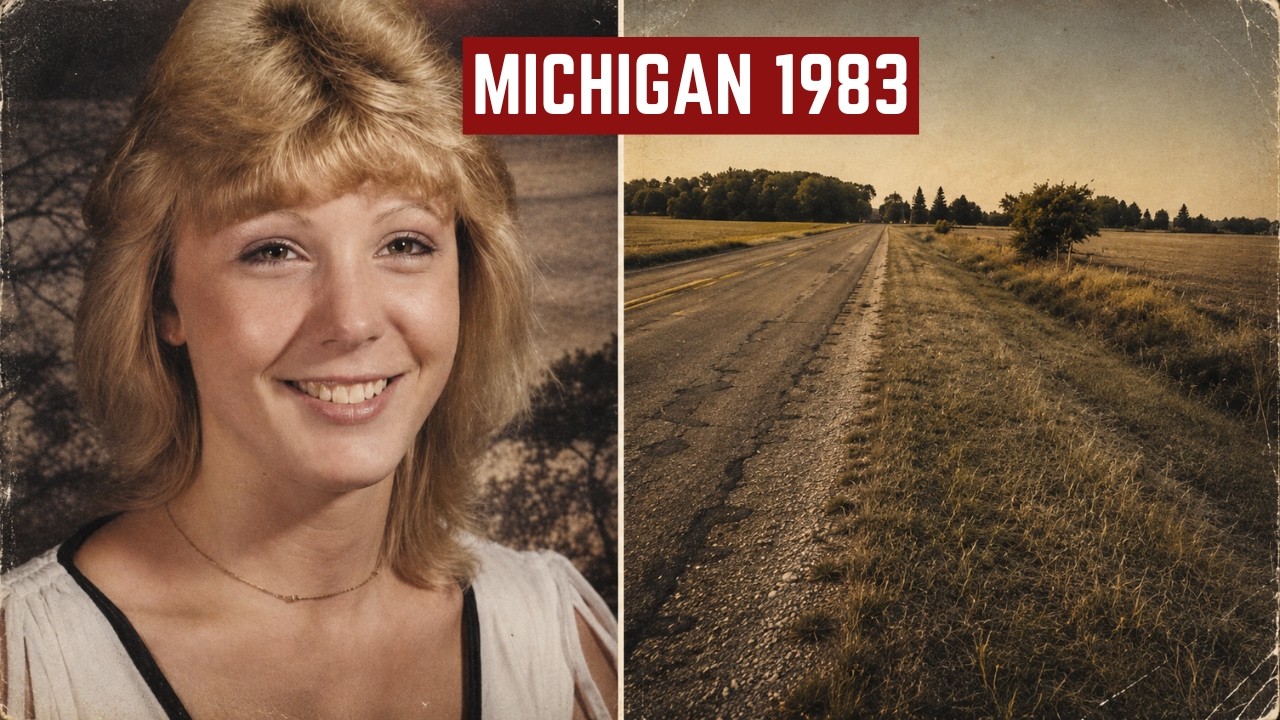
One witness described a gray-haired man in his thirties or forties forcing her into a dark vehicle near a bus stop in Flint. A second witness, recounting what may have been the same moment, remembered a completely different car. Authorities pursued both reports. Neither led anywhere.
For 42 years, that contradiction remained exactly as it was, unresolved, sitting in the files, waiting for evidence that no one yet had the tools to read. Sherry Jo Elliott was sixteen years old, a student at Flint Carmen High School. Only a few months earlier, she had not lived in Flint at all. For most of her life, she had lived near Charlotte, Michigan, with her father.
That changed in the summer of 1983, when she moved to Flint to live with her mother, Joyce. By November, she was still adjusting. A new home on Seneca Street, a new school, and a new set of streets to learn. Those around her described her consistently.
Quiet, cautious, the kind of teenager who thought before speaking to people she did not know. She worked part-time as a babysitter for families in the neighborhood, trusted to care for other people’s children despite being new to the area. Her relationship with her mother was close, and close in a way that would prove important later. If her plans changed, even slightly, she would call.
That single habit was why they were alarmed almost immediately when she did not come home. It was not just a vague feeling that something was wrong. It was the absence of a phone call she always made. Her grandmother would later tell investigators the same thing in different words, that Sherry Jo was not the kind of girl who wandered off or disappeared deliberately to make a point.
Everyone who knew her agreed on that without needing to compare statements. The morning of November 16 began like any other school day. At around six-thirty, she left the house on Seneca Street wearing a burgundy jacket and jeans, carrying her schoolbooks under her arm, and walked the same route she had taken every morning since the summer, heading toward the bus stop she always used. She never arrived.
When Sherry Jo did not return home that evening, her mother called the police that same day. There was no waiting period, no assumption that she had simply lost track of time. Given how strong the communication was between mother and daughter, the absence of a phone call was immediately treated as a sign of danger. Within hours, the response expanded far beyond the family.
Neighbors began organizing their own search. Local businesses agreed to post her picture in their storefronts. Officers knocked on doors in the surrounding residential blocks, asking everyone whether they had seen a sixteen-year-old girl in a burgundy jacket walking alone that morning. Her mother told reporters at the time that she believed someone must have seen something.
A residential street in broad daylight during a school-day morning. In her view, that was not a place where someone could disappear without being seen. She turned out to be right. Two witnesses had already come forward.
The problem was that they did not agree with each other. One described a man in his thirties or forties, gray-haired, forcing a teenage girl into a dark car near the bus stop. The second witness, recalling what seemed to be the same moment, described a completely different vehicle. Officers followed both leads.
Neither could be proven conclusively, and neither witness could be considered more credible than the other. The information that might have identified a suspect within days of the disappearance was just ink on paper. It led nowhere. For four days, they found nothing else.
No sightings, no calls, no trace. Then, on November 20, a man checking his muskrat traps along a drainage ditch on Mueller Road in Bloomfield Township, Saginaw County, found her body. It was isolated farmland, twenty miles from the bus stop where she was last seen. An autopsy followed.
What it revealed changed the course of the entire case. The injuries and evidence found indicated that she had not been killed where she was taken. She had been held somewhere for a period of time before her death. That single discovery meant investigators were no longer only looking for a particular car.
They were looking for a place where she had been held for days without anyone noticing. Twenty miles between the bus stop and the ditch. Four unaccounted-for missing days. Two witnesses who could not agree on what they had seen.
That was all investigators had to work with in November 1983. And at that moment, they had to make do with that. By the time investigators had exhausted their leads, they were left with two conflicting witness statements, a body found twenty miles from where she disappeared, and nothing else pointing to a name. What they did have was evidence.
Investigators collected biological material at the crime scene and later during the autopsy. The kind of forensic material that would be examined by computer within days today. In 1983, there was nowhere for that material to go. DNA testing, as an investigative tool capable of identifying a specific person, simply did not exist in any usable form.
There was no national database to compare against. There was no way to take biological evidence and turn it into a name, a face, or an address. The evidence itself was not lost, and it was not thrown away. It was preserved, cataloged, and stored exactly as procedure required.
What was missing was the ability to make it speak. Investigators spent the following months working every traditional angle available to them, re-interviewing people who knew Sherry Jo, following the two conflicting vehicle descriptions, and checking the movements of anyone who had been in contact with her in the weeks before her disappearance. None of it produced a suspect. It did not even produce a solid direction for the investigation.
By 1984, less than a year after her death, the case came to a complete halt. It was not closed by choice, and it was not set aside through neglect. It had reached the limits of what the science and technology of that decade could offer. The file was archived, the evidence stayed in storage, and the search for the person responsible quieted down.
It remained that way for the next 39 years. While that case sat frozen, about fifteen miles away in Grand Blanc, a man named Ronnie Collins was building his own life. In 1983, Collins was thirty-three years old. He worked during the day as a dental hygienist.
At night, he played bass guitar in the local music scene, known among musicians and bar patrons by the nickname Hendrix. He played with a band called Goodfoot, which performed regularly in bars across the Flint area, including a place called Scooters Bar and Grill in Mundy Township. Lisa Baker, the owner of that bar, would later describe how she felt when she learned the truth about Collins. For years, he had shared the stage with people in that room.
He was a familiar face, someone regulars considered part of the place, not someone who warranted caution. Baker said the news shocked the local music community, specifically because Collins never appeared to be a threat. He seemed like someone who belonged there. Collins was not a stranger hovering on the edges of Flint for four decades.
He was embedded in it, performing, working a steady job, and living openly in front of a community that had no reason to suspect him. He had no criminal record. He was never questioned in the original 1983 investigation into Sherry Jo’s disappearance. His name did not appear anywhere in that case file for the following forty years.
But an earlier chapter of his life had already drawn police attention, long before he ever encountered Sherry Jo Elliott. In 1969, when Collins was about nineteen, two teenage girls disappeared on Halloween night in Oscoda, Michigan. They were Patricia Spencer and Pamela Hobley. Witnesses at the time reported seeing them talking to a man driving a truck shortly before they vanished.
Collins, who spent time in the Oscoda area and was known to drive a truck matching that general description, was brought in and questioned as a person of interest. He denied any involvement. No charges were ever filed. The disappearance of Spencer and Hobley was never solved, and Mary Burrell, Pamela Hobley’s sister, had spent decades publicly demanding answers.
Burrell said Collins was known to spend time near the beach area in Oscoda, near where the girls were last seen. On its own, that detail proved nothing in 1969, and proves nothing now. A man in a small town driving a common type of vehicle is not evidence of anything. What changed after more than 50 years was that his name resurfaced in connection with a confirmed case elsewhere, and that alone was enough to make investigators revisit a question no one had answered the first time.
In 2023, the Third District Cold Case Unit of the Michigan State Police made the decision to reopen Sherry Jo Elliott’s file. By that time, the file had sat without any meaningful follow-up for nearly four decades. What made this reopening different from any previous review was a partnership most cold case units do not have access to. The Cold Case Program at Western Michigan University, founded and directed by sociology professor Dr.
Ashlyn Koesten, connects student investigators directly with active detectives on unsolved cases. Access to the program is not casual. Every student who joins is fingerprinted through the Michigan State Police, undergoes a complete background check, and completes confidentiality training before being allowed to see a single page of an active case file. Dr.
Koesten has stated publicly that in five years of running the program, there has not been a single breach of that confidentiality. Three students were assigned to work on the Elliott file. Two juniors, Ella Beilke and Christian Waugh, along with their fellow student Hailey Warner. Their task was not dramatic, but it was the foundation on which everything else would be built.
Forty years of paper records, handwritten investigator notes, old evidence logs, and scattered documents had to be turned into something searchable. That meant cross-referencing names, vehicle descriptions, license plates, and even passing comments buried in decades-old notes that had never been indexed or searched. Both Beilke and Waugh have stated publicly that they were around the same age Sherry Jo was at the time of her death, and that connection stayed with them throughout the months of work. The file was not just a theoretical case to them.
It was a girl who never got the chance to reach their age. What that work produced was not a new lead in the traditional sense. It was something investigators had never had in this case. An organized, searchable foundation built from evidence that had existed all along but could not be used that way.
That foundation is what eventually allowed the 1969 Oscoda connection to surface, a connection that had been sitting in separate files in separate counties for more than 50 years, waiting for someone capable of searching for it properly. Even with the case file finally organized, investigators still faced the wall that had stopped everyone before them. The biological evidence collected in 1983 did not match anything in crime databases for a simple reason. The person responsible had never been arrested, fingerprinted, or tested.
Traditional searches could not identify someone who had never entered the system even once. Investigators sent the preserved evidence to Astrea Laboratories in The Woodlands, Texas, laboratories created specifically for old or degraded genetic material that is difficult to examine through traditional methods. In collaboration with the Michigan State Police Forensic Science Division, Astrea used forensic genome sequencing to build a complete genetic profile of the unknown person, more like a genetic blueprint than a simple match. From that point, the work shifted to something more like genealogy research than criminal investigation.
Specialists compared that profile against public genealogy databases, identified distant relatives, built family trees until a group that might start in the thousands narrowed to a handful of actual candidates, and finally to one person. It is slow, painstaking work, and that is part of why cases like this take months, even with the right technology. That process eventually led to a single name: Ronnie Collins. Once genetic genealogy narrowed the case to one individual, a standard procedure follows.
Investigators go directly to that person and request a voluntary DNA sample. A simple comparison confirms the match or eliminates the person entirely. Investigators followed that same procedure with Ronnie Collins. For a brief moment, it seemed this case would finally be solved the way most cases are solved.
A request for a sample, a sample provided, and a direct answer. But things did not go that way. In January 2026, before investigators could obtain the sample voluntarily and before a court order could compel him to provide it, Ronnie Collins ended his own life. His death did not end the investigation.
Medical examiners collected a DNA sample from him during the standard autopsy procedure that follows any death of that kind. That sample was sent for comparison against the biological evidence preserved from the 1983 crime scene. The two samples matched. There is no way to know exactly what Collins was aware of regarding how close investigators were to him in those final weeks.
No investigator or examiner involved in this case has claimed knowledge of his mental state, and this account will not speculate on it either. What the clearly documented timeline shows is this: his death occurred at the moment when the investigation was closing in on a name. Whether that timing reflects a conscious decision or mere coincidence is something the current records cannot answer. On April 13, 2026, the Michigan State Police announced the confirmed match, identifying Ronnie Collins as the person responsible for the abduction, sexual assault, and murder of Sherry Jo Elliott, more than 42 years after her disappearance.
There would be no trial. Under Michigan law, a person cannot be prosecuted after death. Lieutenant Kim Vetter of the Michigan State Police acknowledged this directly, stating that although Collins would never face trial, investigators believed the identification itself gave the Elliott family and the community answers they had waited decades to receive. It was not a court judgment that closed this case.
It was a confirmed scientific match, and the administrative end of a case that could no longer reach a judicial conclusion. Had DNA testing tools and genetic genealogy existed in 1983, this case might have been solved in months instead of decades. There is no way to apply that alternative scenario, but the gap between the technology that existed then and the technology that exists now represents exactly the distance between identification and trial. DNA confirmed who was responsible for what happened to Sherry Jo.
But it did not resolve everything involving the name Ronnie Collins, including the 50-year-old Oscoda case that is now being re-examined for the exact same reason. Those threads remain open. Joyce Schultz, Sherry Jo’s mother, said that not knowing whether her daughter was safe or suffering somewhere was harder to live with than the grief that followed later. Finding an answer, even a devastating one, was easier to put into words than living inside an endless question on the horizon.
She also spoke openly about an early chapter of the investigation that added weight to a period that was already unbearable. In the first months, suspicion turned toward her husband, Robert Schultz, a path she said she never believed, confident that he was not capable of harming a child. Robert Schultz died a year before Collins was identified. He never heard the case was solved, and he never saw his name formally cleared from public records.
When the match was finally confirmed, Joyce’s reaction carried two feelings at once: relief that there was an answer after all this time, and an honest admission that she was still trying to understand the meaning of that answer after more than four decades. Judy Secka, Sherry Jo’s aunt, described the years following 1983 as some of the hardest of her life, and urged families waiting for their own cases to be solved not to give up, pointing to this case as proof that evidence preserved for decades does not simply expire. Sherry Jo Elliott’s case has an answer now. The Oscoda case does not, not yet.
Investigators are re-examining it closely because of the revealed identity of Ronnie Collins. Two witnesses, two different vehicles, and one contradiction that stayed unresolved for 42 years, until a genetic profile built from evidence answered what neither of them could. Sherry Jo Elliott’s family finally got their answer.
Not every family in this story has gotten theirs yet.
