In May of 1527, an army of roughly twenty thousand unpaid, mutinous soldiers stormed Rome. Spanish Catholics, German Lutherans, and Italian mercenaries looted churches, murdered clergy, and destroyed priceless art. The city’s population collapsed from around fifty-five thousand to barely ten thousand. Pope Clement VII, a Medici, fled through a secret passage to the fortress of Castel Sant’Angelo, where he was effectively besieged for months before surrendering and paying a ransom of four hundred thousand ducats.
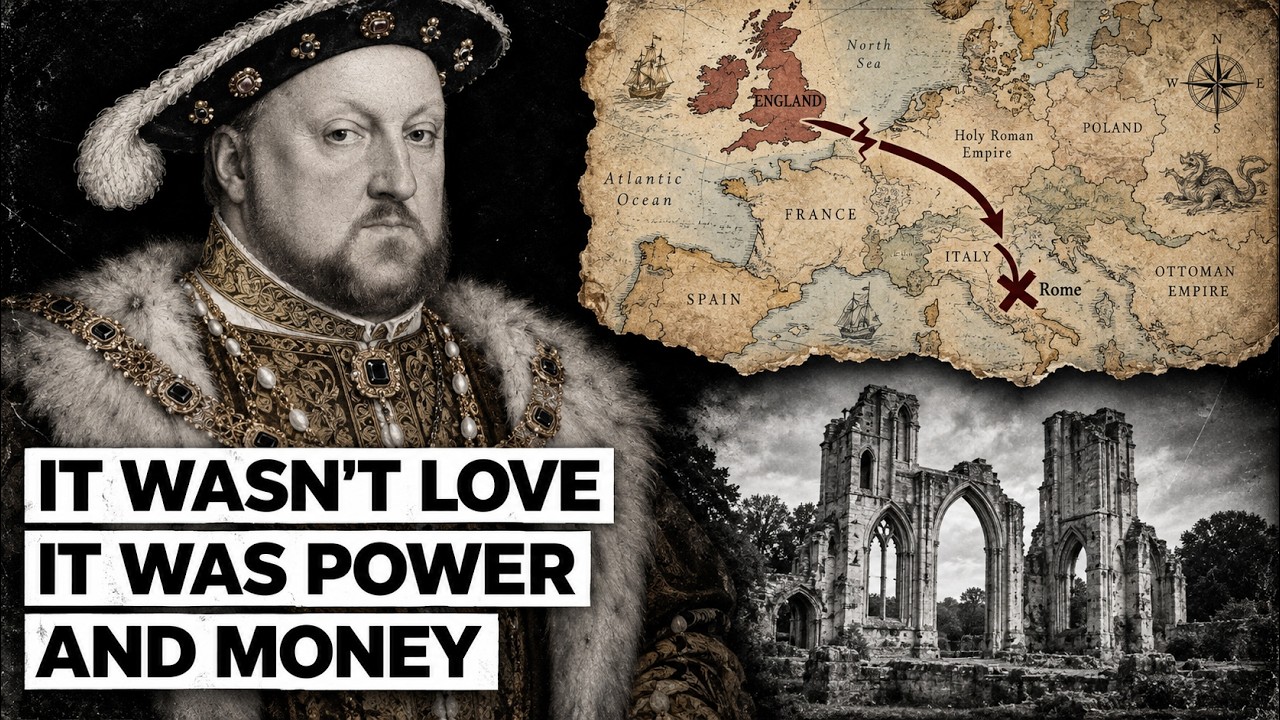
His apartments were stripped so bare that an English delegation found furnishings worth less than twenty nobles. The man holding the Pope prisoner was Charles V, the Holy Roman Emperor, whose territories spanned Spain, the Netherlands, southern Italy, and the vast Habsburg holdings of central Europe. And Charles V was the nephew of Katherine of Aragon, the wife of Henry VIII of England. This single fact would crack the English state open.
The popular story of England’s break with Rome is a simple one: a lovesick king wanted a younger wife, the Pope said no, and Henry started his own church. That version reduces one of the most consequential constitutional revolutions in European history to a tantrum. The truth is that the powder keg had been packed for centuries before Anne Boleyn ever lit the fuse. As far back as the 1300s, English kings had passed laws to limit Rome’s reach.
The Statute of Provisors of 1351 blocked the Pope from appointing foreign clergy to lucrative English benefices, positions that came with land and income and drained wealth out of the kingdom. The Statute of Praemunire of 1353 went further, making it a criminal offense to appeal to any foreign court, including the papal court, in matters the crown claimed as its own jurisdiction. The penalties were severe: seizure of lands and goods, indefinite imprisonment. These were not radical Protestant inventions.
They were medieval Catholic England asserting its sovereignty against an overreaching papacy, and they sat on the books for two centuries like loaded weapons, available whenever a king needed leverage against Rome. By the time Henry VIII took the throne in 1509, the kingdom his father left him was stable, wealthy, and well positioned in European politics. The young Henry was everything his cautious, frugal father had not been: extravagant, athletic, charming, and convinced of his own magnificence. Within a few years, he had burned through a significant portion of his inheritance on military campaigns against France that achieved little of lasting value.
By the 1520s, England’s finances were deteriorating rapidly. The man responsible for managing the crisis was Cardinal Thomas Wolsey. Born the son of a butcher in Ipswich, Wolsey rose with breathtaking speed through both church and state. By 1515 he was Lord Chancellor, the highest secular office in the land, and a cardinal.
By 1518 he was the Pope’s personal representative in England, with authority that superseded even the Archbishop of Canterbury. One man held the most powerful position in the English government and the most powerful position in the English church simultaneously. He answered to both king and pope, and in practice he answered mostly to himself. His residence at Hampton Court rivaled the royal palaces.
He traveled with a retinue of hundreds and wielded his dual authority with an iron fist, overruling English courts, collecting revenues for Rome, and enriching himself and his allies. Every time Wolsey invoked his papal authority to bypass English law, he reinforced a growing conviction among the nobility, merchants, lawyers, and members of Parliament that the Church of Rome had too much power in England and used it for political and financial gain rather than spiritual purposes. Anti-clerical resentment had been simmering for generations. In 1514, a London merchant named Richard Hunne refused to pay a mortuary fee to a local priest and invoked the Statute of Praemunire, arguing the church court had no authority in a financial matter.
The church responded by arresting him for heresy. He was found dead in his cell under deeply suspicious circumstances, almost certainly murdered. The coroner’s jury returned a verdict of murder against the bishop’s chancellor, but the church blocked the prosecution. The case caused a public uproar and deepened the conviction that the clergy operated above the law.
Into this tinder came the marital crisis. By the mid-1520s, Henry faced a problem both personal and political. His wife, Katherine of Aragon, had failed to produce a surviving male heir. Sons died in infancy; only Princess Mary, born in 1516, survived.
The Wars of the Roses were still within living memory, and Henry feared that without a legitimate male successor, England would be plunged back into civil war upon his death. He became infatuated with Anne Boleyn, a young woman of the court who had been educated in France, who was intelligent and ambitious, and who refused to become his mistress as her sister Mary had done. She wanted marriage. Henry convinced himself that his marriage to Katherine, who had previously been married to his older brother Arthur, was cursed by God.
He sought an annulment. But this was not a man who wanted to leave the Catholic Church. In 1521, Henry had personally authored a book attacking Martin Luther and defending papal authority so vigorously that Pope Leo X rewarded him with the title Defender of the Faith. Henry wore the title with enormous pride.
He had no interest in Protestantism. He wanted a straightforward administrative decision from Rome, the kind popes had granted other monarchs without difficulty. Instead, he ran headlong into the most consequential geopolitical collision of the sixteenth century. Pope Clement VII was for all practical purposes a prisoner of Charles V, who had made it clear he would not tolerate an annulment of his aunt’s marriage.
The Pope was trapped. Granting the annulment risked the wrath of the most powerful military force in Europe. Refusing risked losing England. Clement chose to stall.
For six years he delayed, appointed commissions, and proposed absurd compromises that never materialized. Henry tasked Wolsey with securing the annulment. Wolsey threw everything at the problem, sending diplomatic missions, pressuring bishops, convening a special court at Blackfriars in 1529. But the papal legate presiding with him had secret instructions from the Pope to do nothing.
After weeks of hearings in which Katherine made a dramatic personal appeal before the court, the case was recalled to Rome. It was a devastating humiliation for Wolsey, and he knew it meant his ruin. In October 1529, Wolsey was charged under the Statute of Praemunire, the very legal weapon created centuries earlier to check papal overreach. The charge was that by exercising his papal authority as legate, he had introduced a foreign jurisdiction into England without the king’s consent.
The powers that had made him the most powerful man in England were now being used to destroy him. He was stripped of his offices and wealth, forced to surrender Hampton Court, and arrested again on treason charges within a year. He died in November 1530 while being escorted to London. His fall created a political and ecclesiastical vacuum, and the question became whether the bridge between English governance and Rome would be rebuilt or whether something entirely new would take its place.
The answer came in the form of Thomas Cromwell. Born around 1485 in Putney, the son of a blacksmith, Cromwell had spent years wandering the continent as a soldier, merchant, and banker. He learned Italian, French, and Latin, studied law, and absorbed the financial and administrative practices of the Italian city-states. He rose to become one of Wolsey’s most trusted agents, and after Wolsey’s fall he performed a political miracle, gaining Henry’s ear and becoming chief minister within two years.
Cromwell’s genius was constitutional, not theological. He understood that the break with Rome could not be achieved by royal decree alone; it had to be done through Parliament and statute law, because that would make it irreversible. A king’s proclamation could be overturned by the next king. An act of Parliament supported by the nobility, the commons, and the crown together would create a new legal reality that could not easily be undone.
Through the Reformation Parliament, which sat from 1529 to 1536, Cromwell drove a series of acts that dismantled papal authority piece by piece. The Act in Conditional Restraint of Annates of 1532 cut off the payments English bishops made to Rome upon their appointment. The Act in Restraint of Appeals of 1533 was the critical legislation. Its preamble, almost certainly drafted by Cromwell, declared that England was an empire, a sovereign state governed by one supreme head, and that no external jurisdiction had authority within its borders.
All legal matters, including questions about the king’s marriage, would be settled in English courts. With that act in place, the newly appointed Archbishop of Canterbury, Thomas Cranmer, convened his own court and in May 1533 declared Henry’s marriage to Katherine null and void. Henry had already secretly married Anne Boleyn in January, and she was pregnant with the future Elizabeth I. In November 1534 came the Act of Supremacy, declaring the king the supreme head of the Church of England.
It was presented not as a revolution but as a restoration of an ancient supremacy that Rome had usurped. The deeper motivations soon became clear. By the mid-1530s, Henry’s financial situation was dire, and he faced the real possibility of invasion by Catholic powers. He needed money for fortifications, ships, and soldiers, and he needed it fast.
He turned his eyes to the monasteries, which controlled roughly a quarter of all cultivated land in England. In 1535, Cromwell commissioned a survey of monastic wealth that revealed an annual income of over one hundred thirty thousand pounds, an almost incomprehensible sum for the era. Teams of inspectors were dispatched to document corruption and moral laxity. Some reports were genuine; many were exaggerated or fabricated.
They provided the political cover Henry needed. In 1536, Parliament passed the Act for the Dissolution of the Lesser Monasteries, closing all religious houses with an annual income under two hundred pounds. Roughly three hundred smaller monasteries were shut down in the first wave. A massive backlash erupted in the north of England in the autumn of 1536.
The Pilgrimage of Grace, the most serious challenge of Henry’s reign, saw tens of thousands march under banners depicting the wounds of Christ, demanding restoration of the monasteries and removal of Cromwell. Henry suppressed it through a combination of deception and force, making promises of negotiation he never kept and executing the ringleaders once the crowds dispersed. With the rebellion crushed, Henry moved against the larger monasteries. Between 1538 and 1540, the great abbeys fell one by one: Glastonbury, Fountains, Rievaulx, Tintern.
Approximately five hundred fifty religious houses were suppressed. The estimated total value of the seized estates was around one and a half million pounds, the largest legal transfer of property in English history since the Norman conquest. Henry sold much of the land to the gentry and emerging merchant class at favorable prices, creating an entirely new class of landowners whose wealth depended on the break with Rome remaining permanent. He had bound the English ruling class to the Reformation through their wallets, making reversal economically impossible.
The dissolution destroyed more than monasteries. These institutions had been the primary providers of education, healthcare, and charity to the poor, running hospitals, schools, and almshouses. When they were destroyed, these services evaporated overnight, and nothing replaced them. The impact on England’s poor was devastating, and it took generations for secular institutions to fill the gap.
The break also permanently altered the relationship between the English monarch and Parliament. By using Parliament as his instrument, Henry had inadvertently enhanced its power. The precedent that fundamental constitutional change required parliamentary approval would grow over the following century, leading eventually to the English Civil War and the establishment of parliamentary sovereignty as the cornerstone of the English system. And the religious divide would haunt England for two centuries.
Henry’s children swung wildly between Protestantism and Catholicism: Edward VI pushed sharply toward Protestantism, Mary I dragged the country back to Rome and burned nearly three hundred Protestants at the stake, and Elizabeth I established a pragmatic middle way that became the foundation of the Anglican Church. Anne Boleyn was the catalyst, not the cause. The cause was a collision of forces that had been building for generations: the tension between royal sovereignty and papal authority, the resentment of clerical wealth, the financial desperation of the crown, the geopolitical crisis created by the sack of Rome, the intellectual ferment of the Reformation, and the constitutional genius of Thomas Cromwell, who saw an opening and drove an empire through it. The break with Rome was not a tantrum.
It was a revolution in the concept of sovereignty itself, establishing the principle that no foreign power could exercise jurisdiction within England without the consent of its monarch and its Parliament. Henry VIII did not just change his wife. He changed the structure of the English state, and that change has echoed through the centuries in the independence of the Church of England, the principle of parliamentary sovereignty, and the very idea of the self-governing nation state.
