In the spring of 1348, two pigs dropped dead in a Florentine street, and Giovanni Boccaccio says he watched it happen. A poor man had died of the pestilence, and somebody had thrown his rags out into the road the way you did with plague clothes when you didn’t dare keep them in the house. The pigs found the rags and did what pigs do, rooting through them with their snouts, tossing them about, chewing at them. Within a short time, Boccaccio says, both animals began to convulse, turned in circles as though they’d swallowed poison, and fell dead on top of the very rags they’d been shaking.
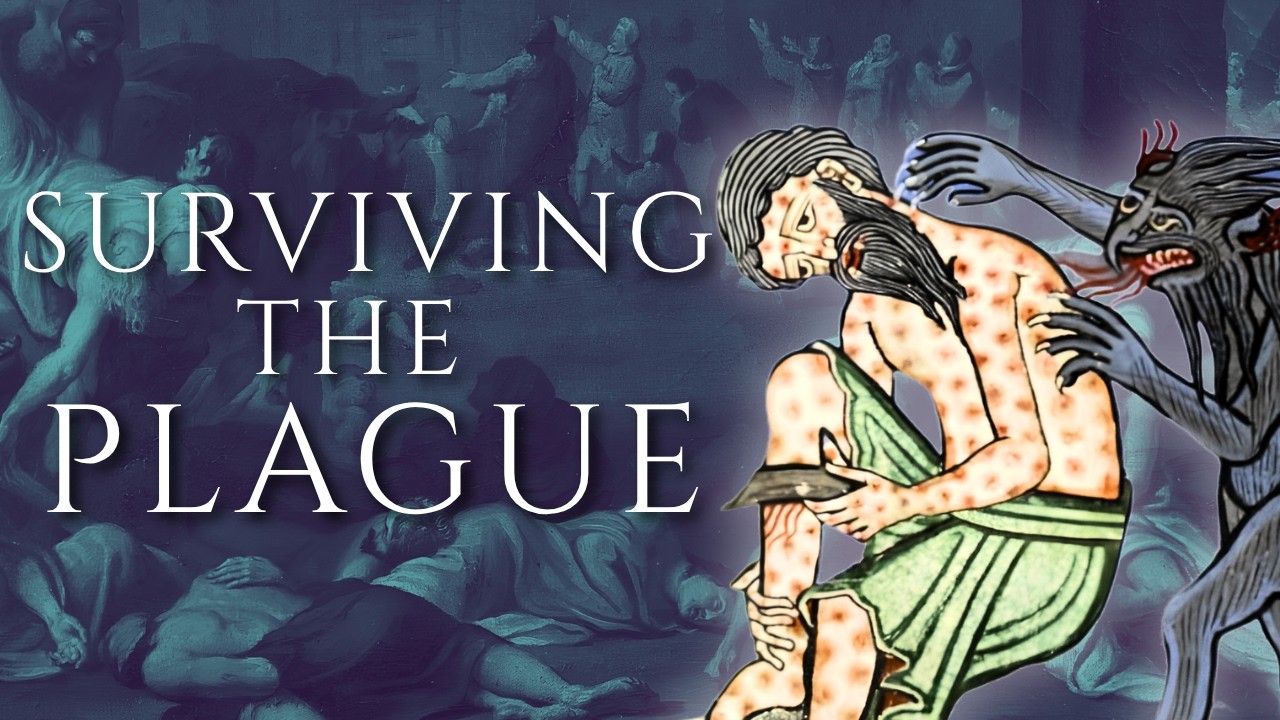
He tells that story in the Decameron as an eyewitness, a thing he saw with his own eyes in a city where the dead were being carried out of houses faster than anyone could count them. Whatever was in those rags, the people watching understood the message perfectly. Death had soaked into cloth. It could sit in a dead man’s shirt in the road and kill a passing animal in minutes.
And if it could do that to a pig, nobody standing on that street had any illusions about what it could do to them. The people who would face that threat with the least to work with were the peasants. Roughly nine out of every ten Europeans alive in 1347 were peasants of one sort or another, and when the greatest mortality in recorded human history arrived at their doors, they had to figure out how to live through it with almost nothing. To make sense of what the plague did to peasants, you first have to stand inside one of their houses.
A typical English peasant family in the 1340s lived in what’s called a cruck: two pairs of curved timbers set into the ground, joined at the top, walls of woven sticks packed with a paste of mud, straw, and animal dung. One room, sometimes with a low partition, a floor of beaten earth, a hearth in the middle with no chimney, so the smoke drifted up through the thatch and hung in the rafters. At one end, in many houses, the animals slept, a cow, a pig, chickens, all breathing the same air as the family. The family slept together on straw pallets, sharing blankets, sharing body heat, sharing lice.
Few in that house had any way of knowing that within a year or two the little biting things in their bedding would become one of the most dangerous animals in Europe. Everyone in that house already carried damage, and the damage had a date. A generation earlier, between 1315 and 1322, Northern Europe went through the Great Famine. The weather broke.
It rained through entire summers. Harvests drowned in the fields two and three years running. Seed grain got eaten because the alternative was starving that winter, and then the next spring nothing could be planted. Livestock diseases swept through and killed the cattle and sheep.
Grain prices went up by multiples. People ate bark. Chroniclers recorded folk eating dogs, eating cats, and darker rumors than that. Somewhere between 1 in 10 and 1 in 7 people in the affected regions died of hunger and hunger’s diseases.
A child who survived that famine grew up short, with bad teeth and bones marked by the years the food ran out. When researchers examined bodies from London’s plague cemeteries, they found grooves in the tooth enamel and lesions in the bone, the permanent stamp of childhood starvation. The generation the plague came for was a generation the famine had already chewed on. Village life itself ran on obligation.
Most peasants held their land from a lord and paid for it in labor, in produce, in cash, and in a hundred small humiliations written into custom. When a tenant died, the lord took the best beast from the family as a death duty, the heriot. A widow’s first act of mourning was often watching the manor’s officer walk off with her only cow. Serfs couldn’t legally move away, couldn’t marry off the manor without paying a fine, couldn’t even send a son to school without permission.
Wages were low and had been low for generations, since there were always more hungry hands than there was work. That was the deal in 1346. The plague was about to renegotiate it. News moved at the speed of a cart.
Through 1347, the rumors coming along the roads got strange. Merchants talked about mortality in the east, whole regions of India depopulated, cities in the lands of the Tartars where nobody was left alive, tales of poison clouds, of rains of vermin, of the sea throwing dead fish onto the shores. In October of 1347, it stopped being a rumor. Twelve Genoese galleys came into the harbor at Messina in Sicily.
A Franciscan friar in Sicily named Michele da Piazza wrote down what happened next plainly. The ships carried, he says, such a disease in the men’s bodies that anyone who so much as spoke with a sailor was infected and could in no way avoid death. The Messinese realized within days what had been brought into their harbor and drove the ships out, forced the galleys back to sea. It was already far too late.
The infection was ashore in the port workers, in the goods, and Messina began to die. Da Piazza describes the disease burning through the city with a speed that broke every social bond it touched. The sick developed swellings, then black pustules, then vomited blood, and were dead in days. People understood very quickly that the illness passed from person to person, so they stopped going near each other.
Fathers refused to enter the rooms of sick sons. Priests refused to hear confessions. The friar says corpses lay in houses with nobody willing to remove them, and the population began pouring out of the gates into the countryside, carrying the disease with them into every hamlet that took pity on a refugee. Sicily’s rural poor, people who had never seen a Genoese galley in their lives, started dying because a city thirty miles away had a harbor.
Where had the galleys picked it up? The story most people know comes from a lawyer in Piacenza named Gabriele de’ Mussi. He describes the siege of Caffa, a Genoese trading colony on the Crimean coast, in 1346. The army of the Golden Horde under a khan named Janibeg had the city surrounded, and then the plague got into the besiegers’ camp and started killing them by the thousands.
De’ Mussi says the Tartars, dying faster than they could fight, loaded the corpses of their own plague dead into their siege catapults and hurled the bodies over the walls into the city. The defenders dragged the corpses to the water and dumped them in the sea as fast as they came over, but in his telling, the air and water were already fouled. The disease took hold inside the walls, and when Genoese ships escaped the city, they carried it with them to Constantinople, to Messina, to Genoa itself. Historians point out that grain ships had been shuttling between the Black Sea and the Mediterranean the whole time, rats and fleas riding in every hold with or without flying corpses.
What nobody disputes is the route: the disease came out of Central Asia along the caravan roads, through the Crimean ports, and into the holds of Italian merchant ships. Trade built the bridge. The plague walked across it. From Messina and Genoa, the infection moved with almost supernatural efficiency through the winter of 1347 into 48.
Genoa turned its own returning galleys away with flaming arrows, and it made no difference. Marseilles took in ships that Genoa had rejected and paid for the kindness with one of the worst death tolls in France. Venice, Pisa, the ports of Spain, one after another. From every harbor the disease went inland along the roads and the rivers, from market town to market town, and from each market town out into the web of villages that fed it.
Ships without living crews became part of the landscape. Accounts describe vessels drifting into harbors or grounding on beaches with every man aboard dead or dying, cargo untouched, and looters who boarded them carrying the sickness home in stolen cloth. In 1349, a ship out of England carrying wool is said to have run aground near Bergen with its crew dead at their posts. From that wreck, the plague entered Norway and went on to empty something like half the country.
The disease itself was a bacterium, Yersinia pestis. Geneticists have pulled its DNA out of the teeth of plague victims buried in London, and in 2011 they reconstructed the entire genome of the medieval strain from bodies in the East Smithfield cemetery. Medieval people knew nothing of bacteria. The experience was all they had, and it came in three forms depending on where in the body the organism took hold.
The commonest was bubonic, and it started with a flea bite, usually a flea that had been living on a black rat. When plague swept through a rat colony, the rats died in their hundreds, in the walls, under the grain, in the thatch, and their fleas, suddenly starving on cooling bodies, jumped to the nearest warm-blooded thing available. In a peasant house, with the grain store in the corner and the family asleep on straw a foot off the floor, the nearest warm-blooded thing was a sleeping child. The bite itself was nothing.
Two to eight days later, the illness announced itself with fever, a splitting headache, chills, vomiting, and a fatigue so total that people simply lay down where they were. Then came the swellings. The bacteria collected in the lymph nodes nearest the bite, and those nodes ballooned in the groin if the bite was on the leg, in the armpit if on the arm, on the neck if on the face. The medieval word was bubo, from the Greek for groin.
Over a day or two the bubo rose under the skin from the size of an almond to the size of a hen’s egg, sometimes to the size of an apple or an orange, hot to the touch, discolored red and then purple black, and painful beyond describing. People with buboes couldn’t bear the pressure of clothing on them. A Welsh poet named Ieuan Gethin, writing in 1349 as the plague tore through Wales, described the bubo more vividly than any physician of the age: a painful, angry lump, the shape of an apple like the head of an onion, a burning cinder in the flesh, an ugly eruption of ashy color. If the bubo burst, or if a barber surgeon cut it open, what came out was a rush of thick pus mixed with blood, with a stench that people compared to nothing they’d ever smelled from a living body.
Some patients whose buboes burst and drained actually stood a better chance, since the suppuration meant the body was localizing the infection. Left untreated, bubonic plague killed somewhere in the range of half to four-fifths of the people it infected, usually within a week or so of the first fever. Some people did recover, in the same house, in the same bed. One brother died raving on the fourth day, and another sweated through it and got up two weeks later, hollowed out but alive.
Nobody could tell you why. The second form was worse. Sometimes the bacteria got past the lymph nodes entirely and flooded the bloodstream, a condition called septicemic plague. This one could kill within a day, occasionally within hours, sometimes so fast the buboes never had time to form.
The blood itself broke down, its clotting machinery failed and misfired everywhere at once. Victims bled under the skin in spreading purple black blotches, bled from the nose, bled from the gut. Fingers, toes, lips, and nose turned black as the small vessels clogged and the tissue died. This blackening of the extremities is one of the origins people point to for the name that came later, the Black Death.
In its own century, they called it the Great Mortality or the Great Pestilence or simply the Death. Septicemic plague was for practical purposes a sentence with no appeal. A person could sit down to their evening meal feeling feverish and be a discolored corpse by the following night. The third form went for the lungs.
Pneumonic plague, when the bacteria colonized the respiratory system, either as a complication of the bubonic form or caught directly from another person’s cough. This is the one that explains something the Italian chroniclers kept insisting on, that the disease seemed to strike through breath and through speech. A person with pneumonic plague ran a raging fever, felt their chest tighten, and began to cough, first frothy sputum, then sputum streaked pink, then frank blood, bright and thin, sprayed into the shared air of a one-room house. Untreated, pneumonic plague killed close to everyone who developed it, generally within two or three days, and every droplet of that bloody cough was seeded with bacteria.
In winter, especially, when families sealed themselves into their houses against the cold, one person coughing blood by the hearth could infect a whole household by morning. Put those three forms together in a single village and you get the texture of the catastrophe. Different neighbors dying in different ways at different speeds. One family loses a father over eight slow days of screaming, the bubo in his groin swelling and blackening while his wife presses hot poultices to it.
Two doors down, a healthy young woman drops in the lane between her house and the well and is dead before sunset, her hands already darkening. Across the way, a whole household of six is coughing, and everyone in the village can hear it through the walls, and everyone knows what that cough means. And running under all of it, the smell. Every account that gets close to ground level mentions the smell.
Boccaccio says people walked through Florence holding flowers and herbs to their noses because the whole air of the city was rotten with dead bodies. In villages, a farm cottage might stand shut up for a week with an entire dead family inside before anyone dared open it. The smell was often the announcement. That’s how neighbors learned the Tylers or the Smiths were gone.
Sound carried the same news after dark. Villages at the height of the dying were loud in ways nobody had heard before. Cows bellowed through the night, udders swollen, the woman who milked them three days dead and nobody yet taking over. Dogs howled outside sealed doors, shut away from masters who no longer fed them.
A child cried in a house nobody would enter, and every neighbor within earshot lay awake weighing mercy against their own children asleep beside them. How did it actually get from house to house? The classic answer runs through the black rat, Rattus rattus. The rat flea, Xenopsylla cheopis, is a remarkably grim little machine.
When it feeds on an infected rat, the bacteria multiply inside the flea until they physically block its gut. The flea starves, gets hungrier and hungrier, bites more and more desperately, and every time it bites, it vomits a plug of concentrated plague bacteria into the puncture. When the rats of a household died off, those starving fleas went looking, and the family sleeping on the floor was the pantry. Grain moved the whole system around.
A sack of wheat carried from an infected barn to a market, from a market to a mill, could carry rats or fleas or both. This is why the plague ran along the grain trade like fire along a fuse. In recent years, some researchers have added another suspect: a team modeling the death records of European outbreaks found that the pattern of mortality in many places fits better if the disease was also passing directly between people via the human flea and the body louse. Other scientists pushed back, and the argument continues.
But follow what it would mean in that one-room house: the family bedding down together on shared straw under shared blankets crawling with the shared parasites that were a normal fact of their lives, each louse a possible ferry for the thing killing them. The habit of nursing your sick, of holding your dying child through the night, of laying out and washing the body of your mother with your own hands, every act of love in that culture involved touch, and touch may have been precisely the mechanism of death. Whatever the exact balance, the outcome on the ground was the same. Plague took households whole.
Manorial records from England when they resume after the worst months show it plainly: holding after holding listed vacant because everyone who could have inherited was dead. Marchione di Coppo Stefani, a Florentine who lived through it, put it in one flat sentence, that when the disease took hold in a house, it often happened that no one remained who had not died. Two men in Florence and Siena wrote down what they saw with a precision nobody in a village could match. Boccaccio’s Florence first.
The plague arrived there around March of 1348, and by the time it burned out, he believed 100,000 people had died within the walls. Modern estimates put Florence’s loss at something like half or more of its population in a matter of months. Boccaccio catalogs the ways people tried to survive, and his catalog is basically the menu every community worked from. Some chose withdrawal, gathering a few healthy companions and shutting themselves into a comfortable house, eating delicate food, drinking moderately good wine, allowing no visitors, refusing to hear any news of the dead, passing their days with music.
Others went the opposite way, deciding that since death was coming regardless, the correct response was to drink heavily, sing, roam from tavern to tavern, take over abandoned houses and hold parties in them. He notes dryly that both groups died anyway, in large numbers. A middle sort tried to keep living normally but carried posies and scented herbs everywhere, sniffing at them constantly to fight the corrupted air. And a great many people with means simply left, fleeing to country estates as though, he says, God’s wrath could not find them outside the city walls.
Peasants couldn’t do most of that. No second house, no stores of delicate food, no option of not working. But the darkest thing Boccaccio records was available to everyone. Abandonment.
Citizen avoided citizen, he says. Kinsfolk held aloof. Brother forsook brother, uncle forsook nephew, and often wife forsook husband. And he adds what he calls perhaps the worst thing of all and almost past belief: fathers and mothers refused to visit or tend their own children, as though those children belonged to strangers.
Sick people lay alone in their houses and died alone. Many of the dead, he says, were discovered only by the smell, and neighbors, motivated less by charity than by fear of the corpses corrupting the air, dragged the bodies out with their own hands and laid them at the front doors, where every morning the streets displayed the night’s harvest. Florence’s machinery of death broke down in stages. At first the dead got funerals, small ones.
Then a class of men appeared whom the Florentines called becchini, corpse carriers, drawn, Boccaccio says, from the poorest sort, who would haul bodies for pay. Any pretense of ceremony collapsed into logistics. Biers ran short, so families laid their dead on plain boards or carried two or three at a time on a single bier, husband and wife together, or a mother with the son and daughter who had died in the same night. Priests heading to bury one corpse with a cross carried before them would arrive at the church to find six or eight more corpses had fallen in behind the procession, their bearers simply attaching themselves to whatever funeral was moving.
Consecrated ground filled. When the churchyards could take no more, the Florentines dug enormous trenches and put the dead of the poor into them by the hundreds, packed in layers, each layer covered with a thin scatter of earth, then another layer of bodies on top until the trench was full. Boccaccio compares it to a ship’s hold being stowed with cargo. Stefani reached for a homelier comparison, and his is the one nobody who hears it ever forgets.
Earth and corpses, layer on layer, he wrote, just as one makes lasagna with layers of pasta and cheese. He was describing the burial of his own neighbors. Stefani is also the man to go to for what the catastrophe did to prices and to human decency. The corpse carriers charged so much that many of them got rich, even as they died in droves themselves.
Hired nurses, men and women who would actually enter a plague house and tend the sick, demanded between one and three florins a day, plus expensive food and comforts on top, sums an ordinary worker couldn’t dream of. The goods a sick person needed went insane. A pound of sugar, he says, sold for as much as three to eight florins. Poultry, eggs, wax for funeral candles, medicinal ingredients, all of it priced out of reach of exactly the people dying fastest.
When the sick of the poorer classes couldn’t pay for nursing, they got none, and when they couldn’t pay the becchini, their bodies waited. Siena, forty odd miles south, gives us the most personal document of the entire pandemic, and its author was neither nobleman nor scholar. Agnolo di Tura was a shoemaker who also did work as a tax collector, a completely ordinary townsman married to a woman named Niccoluccia, with five children. The plague reached Siena in May of 1348, and Agnolo wrote down what the following months were like.
The mortality began in May, he says. It was a cruel and horrible thing, and he did not know where to begin telling of the cruelty and the pitiless ways. It seemed to him that almost anyone who witnessed it went out of their mind with grief. He says plainly that the human tongue is not capable of recounting the awful truth, and that anyone who did not see such horribleness can call themselves blessed.
The victims, he says, died almost immediately. They would swell beneath the armpits and in the groin and fall over dead while talking, mid-sentence. Agnolo repeats Boccaccio’s observation about families in a tradesman’s plain wording. Father abandoned child, he wrote.
Wife abandoned husband, one brother the other. For this illness seemed to strike through the breath and through the sight. And so they died, and none could be found to bury the dead, for money or for friendship. In Siena, at the height of it, you could not pay a man to bury your father.
Members of a household brought their own dead to the ditches as best they could, without priests and without any divine office, dragging bodies through the streets on planks, on their backs. Great pits were dug in various places around the city and piled deep with the multitude of the dead, day and night, hundreds going in, tumbled together and covered with a little dirt so that another layer could go on top. And some of that dirt was thrown so thin, he says, that the dogs of the city dug down, dragged the bodies back out, and ate them, in the streets of a Christian city, while the survivors walked past too exhausted and too frightened to intervene. He notes that the great bells of the cathedral no longer rang for deaths.
The city had ordered them silenced because the tolling had become continuous and the sound of it was destroying whatever remained of people’s minds. Then comes his sentence in the middle of the account, with no preparation at all. And I, Agnolo di Tura, called the Fat, buried my five children with my own hands. That’s the whole of it.
He doesn’t describe their deaths. He doesn’t give their names or their ages. Five children, one father, one shovel. He adds that many others did likewise, and that many bodies went into the ground so lightly covered that the dogs got them.
Niccoluccia, his wife, died as well. Agnolo lived. He went on living for decades, remarried, kept working, kept writing his chronicle. And in the same passage he left one more line that historians quote whenever they need to explain what mass death does to the inside of a person.
So many died, he wrote, that all believed it was the end of the world, and no one wept for any death, for everyone awaited death. Grief requires a future in which you are alive to miss someone. Siena in the summer of 1348 had stopped believing in that future. Work on the city’s great cathedral expansion, the huge new nave that was going to make it the largest church in Christendom, stopped that year and never resumed.
You can still see the unfinished walls standing there today, a construction site abandoned seven centuries ago mid-build. The workforce died, and the will died with it. Now take everything those two cities show us and shrink it down to a hamlet of forty people, six or eight households, a wooden church, mud lanes. That’s where most of Europe actually lived through this.
A village had no becchini to hire. It had no trenches dug by civic order, at least at first. It had a priest if it was lucky, and a churchyard the size of a garden. When plague came up the road, usually in the goods or the body of someone the villagers knew, a carter, a returning pilgrim, a son who worked in the town, the whole scale of the thing was intimate.
You did not hear statistics. You watched by name the specific deaths of every person you had ever known. Estimates for how long the plague typically spent actively killing in any one community run to a few months, often peaking over four to six unbearable weeks. Inside those weeks, a village of forty might bury fifteen or twenty-five, or in some cases, everyone.
While that was happening, what did people believe was causing it? They had a complete explanatory system. It just happened to be wrong at every level, and each wrong level produced its own survival strategy. At the top level, the cause was God.
The pestilence was a punishment for sin, collectively earned, collectively suffered, a new flood sent through the air instead of the water. The king of France asked the medical faculty of the University of Paris, the most prestigious doctors in Europe, for a formal explanation. Their report, delivered in October 1348, blamed a conjunction of Saturn, Jupiter, and Mars in the sign of Aquarius that had occurred on the 20th of March 1345. That alignment, they explained, had drawn corrupt vapors up from the earth and the waters and generated a poisoning of the air itself.
That middle level, the corrupted air, the miasma, was the piece of the theory ordinary people worked with day to day. Disease was bad air. You could smell bad air, rot, swamps, corpses, filth. All of it broadcast invisible corruption, and to breathe it was to take death into your body.
Wrong, and entirely reasonable from inside their world. And by accident, miasma theory occasionally saved lives. It told people to avoid the stinking sick, to get away from corpses, to flee foul places, to fumigate. Some of those behaviors genuinely reduced contact with infected people, infected fleas, and infected air in the pneumonic sense.
People doing the wrong thing for the wrong reason sometimes did the right thing. So walk through a plague village with miasma eyes. Fires burn at the crossroads and in doorways, sweet wood and juniper if people can get it, because smoke fights the corruption. Doors and windows on the south side stay shut, because southerly winds were held to carry pestilence.
Men and women go about with bundles of herbs pressed to their faces, rue, wormwood, rosemary for those who could pick it, anything strong smelling for those who couldn’t. Vinegar everywhere, splashed on floors, on hands, on coins. Coins in the market towns went into bowls of vinegar before changing hands, because everyone had worked out that money passed from person to person, and if plague clung to things, it clung to pennies. Then the actual medicine.
Every remedy in what follows was useless or worse, and every one of them was administered by people trying desperately hard, often at risk of their own lives, with the best knowledge their entire civilization possessed. The framework was humoral. The body held four fluids: blood, phlegm, yellow bile, black bile. Disease meant imbalance, poison, excess.
So the first-line response to plague fever was bloodletting. A barber surgeon, or in a village maybe just the one neighbor with steady hands and a sharp knife, would cut at the elbow or the ankle on the same side as the bubo and let the blood run into a bowl. For a patient already collapsing into septic shock, being bled was a push toward the grave. It was done to thousands upon thousands of the dying with complete confidence.
The buboes got direct attention. Physicians’ manuals advised bringing the bubo to a head, ripening it like an abscess so it could be opened and drained. Poultices went on first, hot compresses of figs and cooked onions, sometimes mixed with butter and yeast, bound against the swelling for days. If the lump softened, the surgeon lanced it.
No anesthetic exists in this world beyond wine and men holding you down. A blade goes into the most painful spot on a body already screaming with fever, and the surgeon presses and drains the thing and then frequently cauterizes the open wound with hot iron. Patients sometimes died of the shock on the table, the actual kitchen table of their own house. And yet, by the awful irony of the era’s treatments, this one may occasionally have edged toward doing something, because draining an abscess is real surgery, and a lanced bubo in a patient whose infection stayed localized was a survivable event.
Some did survive it, carrying the scars in armpit and groin for the rest of their lives, proof of the week they didn’t die. Beyond the knife, the pharmacy got stranger as it got more desperate. Recipe books recommended dried toads bound against the bubo to draw the poison out through sympathy, live plucked chickens held rump-first against the swelling, snakes chopped and applied, pigeons split open, and a poultice recorded in more than one place whose ingredients included human excrement mixed with herbs and smeared onto the open sore, on the logic that filth draws filth. The wealthy sick swallowed treatments priced like jewelry, because some of them literally were jewelry.
Theriac, an ancient compound of dozens of ingredients including the flesh of vipers, aged for years and sold at fabulous cost. Powdered pearls, powdered emeralds taken in wine or in food, on the theory that the gem’s virtue would fortify the heart. A rich merchant could die with a fortune in crushed gemstones in his stomach. A peasant had the hedge herbs, the pot of vinegar, the prayers, and the knife.
Their survival rates were the same. The beaked plague doctor, that figure in the long waxed coat, wide hat, and mask with the bird’s bill stuffed with herbs, has a date, and the date surprises most people. It’s associated with a French royal physician named Charles de L’Orme around 1619, during the later plague outbreaks of the seventeenth century, nearly three hundred years after the events in question. No peasant of 1348 ever looked up from a sick bed and saw one.
What a peasant of 1348 saw, if they saw any medical figure at all, was a man in ordinary robes holding a sponge of vinegar to his own nose, keeping near the door, examining their urine in a glass flask from across the room. Guy de Chauliac, the Pope’s own surgeon at Avignon, and probably the most capable medical man of the century, wrote afterward with brutal honesty that the plague was shameful for the physicians who could achieve nothing, and that many doctors simply refused to visit the sick for fear of being infected. He stayed at his post, caught bubonic plague himself, lanced and treated his own bubo, and survived to write about it, one of the very few clinical self-reports we have from inside the disease. What a peasant had was prayer, and they used it at every level of their world.
Villages held processions, the whole surviving population walking barefoot behind the parish cross, singing litanies, begging God to lift the scourge. In some towns those processions were enormous, thousands of penitents from the surrounding countryside converging, weeping, some whipping themselves as they walked, and of course breathing on each other, pressing together, sharing the crowd with whoever among them was already infected. Gatherings of the desperate became engines of the very thing they gathered against. People made vows, promised pilgrimages, paid for candles their families couldn’t spare the wax for.
They turned to the specialist saints. Sebastian, the Roman soldier martyred with arrows, became a plague intercessor partly through that image, the body pierced suddenly from a distance, the way pestilence seemed to strike a person out of clear air. And Roch, a pilgrim who, the story said, had nursed plague victims in Italy, caught the disease himself and survived, was shown in every image lifting the hem of his tunic to display the bubo scar on his thigh. Ordinary people knelt in front of a painted man pointing at his own groin swelling.
That was the icon their world needed. A saint who’d had what they had and lived. The parish priests died in staggering numbers. Their job was contact.
In England, where the bishops’ registers survive well enough to count, something like forty to fifty percent of the benefited clergy died in the plague years in many dioceses. Some fled, and the chroniclers scorch them for it, but the registers show an institution grinding through its own personnel, appointing replacement after replacement to the same parish within months, and then replacing the replacements. Some parishes ran through three or four priests in a single year. For the dying, the loss of the priest was a terror we have to work to feel now.
What a medieval Christian feared above death itself was dying badly, dying unconfessed in a state of sin, risking damnation. In January 1349, the bishop of Bath and Wells, Ralph of Shrewsbury, sent a letter through his dying diocese with an instruction that shows how far the emergency had gone. If the sick could not obtain a priest, he wrote, they should make confession to a layman, to any lay person. And he added, if no man was available, even to a woman, a concession unthinkable a year earlier.
In 1349, something more extreme marched through Germany, the Low Countries, and beyond in columns hundreds strong. The flagellants, brotherhoods of penitence, robed in white with red crosses, moving from town to town on a fixed circuit of thirty-three and a half days, one day for each year of Christ’s life on earth. Forbidden to bathe, to shave, to change their clothes, or to speak with women for the duration. Twice a day, sometimes three times, they performed their ritual in the market square.
They stripped to the waist, formed a circle, threw themselves to the ground in postures confessing their particular sins, and then rose and whipped themselves and each other with leather scourges tipped with iron spikes, chanting hymns until their backs opened and the blood ran down. Eyewitnesses describe the iron tips lodging in the flesh so deep they had to be torn free. Townspeople sobbed and pressed forward to catch the flying blood on cloths, treating it as holy. The movement carried a letter it claimed had fallen from heaven itself, announcing that Christ’s patience was exhausted and only this blood penance could avert the end.
Underneath the spectacle sat a brutal mechanism. Hundreds of unwashed men sharing quarters, sharing whips wet with one another’s blood, walking from infected town to uninfected town on a fixed schedule. More than one community first met the plague in the days after the flagellants passed through. By autumn of 1349, the movement had grown so disruptive that Pope Clement VI condemned it outright and ordered it dispersed.
The flagellants connect to something far worse. As the plague spread, so did an explanation for it that required no astrology and no theology, only hatred. The wells, people said, had been poisoned. The Jews had done it.
In the autumn of 1348 at Chillon on Lake Geneva, Jewish prisoners were tortured until they confessed to an international poisoning conspiracy, and written copies of those confessions were sent from town to town along the Rhine like evidence, arriving ahead of the plague itself. In Basel in January 1349, the Jewish community was herded onto an island in the Rhine, shut inside a wooden structure built for the purpose, and burned alive before the plague had even reached the city. Basel then resolved that no Jew would settle there for two hundred years. In Strasbourg on the 14th of February 1349, St.
Valentine’s Day, roughly two thousand Jewish men, women, and children were taken to their own cemetery, where a wooden platform had been built, and burned on it. Those who agreed to baptism were pulled out. Some mothers, the chronicler says, threw their children into the fire themselves rather than have them taken and baptized. The city council canceled all debts owed to the dead, seized their money, and divided it among the townsmen.
The chronicler Jakob Twinger von Königshofen, a Strasbourg priest writing within living memory, recorded all of it and then added his own verdict in one line. The money, he wrote, was the poison that killed the Jews. Strasbourg had not yet seen a single case of plague when it did this. The Pope, that same Clement VI, issued formal orders in 1348 declaring the accusation senseless, pointing out that Jews were dying of the plague like everyone else, and threatening excommunication for those who harmed them.
The orders mostly went unheeded. England is where the paperwork survives, and the paperwork lets us follow the plague down to the level of individual farms, individual widows, individual cows. The disease landed on the English south coast in the summer of 1348, traditionally at the little port of Melcombe in Dorset, off a ship from Gascony sometime around June or July. The bishop of Winchester, William Edington, wrote to his clergy that autumn in a letter that still reads like a man bracing his whole diocese for impact.
A cruel plague, he wrote, had begun a savage attack on the coastal towns, and he feared that the same hand would stretch inland, and he ordered processions and psalms every Friday, barefoot, heads bowed. Bristol caught it hard and early. Henry Knighton, a canon at Leicester who chronicled these years, wrote that at Bristol almost the whole strength of the town perished, seized, in his phrase, by sudden death, for few of the sick kept their beds more than three days or two days or half a day. From Bristol and the ports it went everywhere, up the roads, along the rivers, reaching London by autumn, and then rolling north through 1349 into the Midlands, into Yorkshire, into Wales and Ireland, and at last Scotland.
Knighton bothered to look at the countryside, and what he saw was an agricultural civilization having a stroke. He counted the dead in Leicester’s parishes: more than 380 in the small parish of St. Leonard, more than 400 at Holy Cross, more than 700 at St. Margaret’s.
Then he turned to the fields. In the same year, he says, a great murrain of sheep ran through the realm, and in one place more than five thousand sheep died in a single pasture, and their bodies rotted where they fell, so putrid that no beast or bird would touch them. Prices collapsed because the buyers were dead. A horse that had been worth forty shillings went for six shillings and eightpence.
He says a fat ox for four shillings, a cow for a shilling, a heavy sheep for a few pence. And even at those prices, animals wandered the country with nobody to claim them. Sheep and cattle roamed loose through the standing crops. The harvest of 1349 simply stood in the fields in many places, ripened, bent over, and rotted, while the people who should have cut it lay in pits beside the church.
The manor records take us closer still. English lords ran their estates on parchment court rolls listing every tenant death, every vacant holding, every fine and duty, and in 1348 and 49 those dry documents become casualty lists. At the manor of Walsham in Suffolk, the court roll of June 1349 records the deaths of over a hundred tenants since the previous session, in a community that had held maybe fifteen hundred souls. Entry after entry ends the same way: the holding passes to the heir.
The heir is dead. The holding passes to the next heir. That heir is dead too. The land remains in the lord’s hand for want of any living claimant.
At Halesowen in the West Midlands, historians working through the rolls reckon something above forty percent of the adult male tenants died in the space of months. Heriots, those death duties of the best beast, came in so thick that manorial accounts show the lord’s barns choking with collected animals nobody could sell. On some manors, the officials gave up recording causes and just wrote the same phrase over and over down the margin: mortua est, mortuus est. She is dead.
He is dead. On a few, the rolls stop altogether midyear and resume months later in a different clerk’s handwriting. The tax rolls for 1349 contain entries for villages that could pay nothing that year, and the reason given for one Shropshire settlement called Nash has become famous among historians for its bleakness. Nothing could be collected, the entry says, because the inhabitants are dead.
England has thousands of what archaeologists call deserted medieval villages, grassy fields where the humps and hollows of house platforms and lanes still show under the turf. Aerial photographs show the whole street plan of a community, gardens, boundary ditches, the church sometimes still standing alone, everything else gone under pasture. Sheep graze on top of the floor plans of houses where families were wiped out in the summer of 1349, and have grazed there for six hundred years. For a long time, historians assumed the countryside at least managed its dead decently in ordinary churchyards, one grave at a time, since villages had space and cities didn’t.
Then, starting in 2013, archaeologists digging at Thornton Abbey in rural Lincolnshire found something that overturned that comfort: a mass grave out on the grounds of the monastery’s hospital. At least forty-eight people in a single pit, men, women, and children, and children made up more than half, twenty-seven of them, some under a year old. They had been laid in carefully in neat overlapping rows over a period of days or weeks, bodies wrapped in shrouds, arranged with real care. Radiocarbon dating and two silver pennies in the fill put the grave in the middle of the fourteenth century, and when scientists tested teeth from the grave, Yersinia pestis was there.
The parish churchyard for those people was about a mile away. The fact that forty-eight of them ended up in a shared pit at the abbey means the ordinary system had collapsed, that the deaths were coming faster than a rural community could dig individual graves, and that the monks took in the dead of the surrounding countryside when the villages could no longer cope. Somebody still folded each body’s arms. Somebody still laid the babies in beside the adults in order, facing the right way.
London, meanwhile, did what cities had to do. When the churchyards filled in early 1349, wealthy men bought fields outside the walls for emergency cemeteries at West Smithfield and at East Smithfield near the Tower. East Smithfield was dug up by archaeologists in the 1980s, and it’s now one of the best-studied medieval mass burial sites on the planet. Several hundred excavated skeletons from a cemetery used only during the plague emergency.
Two long trenches, bodies laid in side by side, up to five deep in places. Even five deep, the bodies are orderly. Almost all face west in proper Christian position awaiting resurrection. Coffins for some, shrouds for others, and in a number of graves a layer of charcoal spread beneath and around the corpse to soak up the fluids of decay.
A chronicler’s figure claims two hundred a day went into the London emergency cemeteries at the peak. The city on the surface was chaos, and a few feet down, exhausted men with shovels were still trying to do it properly. It’s in the bones that the story starts bending toward who survived. An American bioarchaeologist named Sharon DeWitte spent years analyzing hundreds of the East Smithfield dead, comparing them against people buried in normal medieval cemeteries and testing the old assumption that the Black Death was a perfectly indiscriminate killer.
The bones say otherwise. The plague dead show significantly more skeletal markers of prior damage: the enamel defects of childhood malnutrition, the bone lesions of chronic illness and stress, shorter stature from stunted growth. The disease killed everywhere, but it killed the already weakened at higher rates. Think back to the Great Famine, thirty years before.
The generation that grew up eating bark, with famine written into their tooth enamel, were the middle-aged and older adults of 1348. The famine had loaded the dice, and the plague threw them. In the same period, a team of geneticists led by researchers at McMaster and the University of Chicago published a study built on the East Smithfield dead and on burials in Denmark, comparing the DNA of people who died before the Black Death, people who died in it, and people who lived after it. They were hunting for evolution in real time, and they found it.
The strongest signal sat near an immune gene called ERAP2. One version of that gene builds a full-length protein that helps immune cells chop up and display pieces of invading microbes, and lab tests showed immune cells with the working version restrained Yersinia pestis dramatically better. People carrying two working copies, the study estimated, were roughly forty percent likelier to survive the Black Death than people with two broken copies. In London, the protective version jumps in frequency between the people buried before the plague and the people buried after, one of the sharpest bursts of natural selection ever measured in human beings.
That same plague-surviving variant raises the risk today of autoimmune conditions like Crohn’s disease. An immune system tuned aggressive enough to fight the fourteenth century can turn on its own gut in the twenty-first. Scotland gave the chroniclers a grim comedy. Through 1349, as England died, the Scots watched from the north with something close to satisfaction.
The phrase that circulated, recorded by English writers with understandable bitterness, was “the foul death of England. ” Around the turn of 1349 into 50, a Scottish army gathered in the forest of Selkirk to invade the weakened south. The plague arrived in the camp before the army could march. It ripped through the mustered soldiers, killed by some accounts around five thousand of them in the field, and the survivors scattered home to every corner of Scotland, carrying it with them.
The pursuing English caught and cut down many of the sick stragglers, and then the foul death of England did to Scotland everything it had done to its neighbor. Roughly a third of Scotland is thought to have died. Ireland gives us the single most haunting document of the entire pandemic, even beyond Agnolo. In the friary at Kilkenny, a Franciscan named John Clyn kept the annals of his community as the plague closed in through 1348 and 49.
He records the deaths in Dublin, the pestilence so contagious that whoever touched the dead or the sick was straight away infected and died, the way whole households went together, the way it emptied villages and towns so thoroughly, he says, that one could scarcely find one where anyone was left alive. He counted his own losses: the friars of his order dying in their houses, twenty-five dead in the Drogheda friary and twenty-three in Dublin before Christmas. And then, knowing exactly what was happening, he did something writers almost never do: he addressed us. He wrote that he was setting these things down and leaving parchment for the continuation of the work, in case anyone might still be alive in the future or any person of the race of Adam might escape this pestilence to carry on what he had begun.
He describes himself as waiting among the dead for death to come. After his final entry in the manuscript, a different hand has added a single line. Here it seems the author died. The blank parchment he left got used.
Somebody did survive to continue the annals. In France, one Parisian voice deserves his moment, partly because he is nearly the only chronicler of the whole disaster who came from peasant stock himself. Jean de Venette, a Carmelite friar in Paris, born a peasant in the village of Venette, watched the plague take his city through 1348 and 49, and his account keeps noticing the poor. He records the mass burials at the cemetery of the Holy Innocents, five hundred a day at the height by his reckoning, trenches for the poor dead.
And he pauses over the nuns of the Hôtel-Dieu, the great hospital beside Notre-Dame. The sisters there kept nursing. While much of the city’s charity dissolved, they stayed in the wards with the dying, changing them, feeding them, holding them, and they died doing it in such numbers that the community had to be restocked with new sisters more than once. De Venette says they served with all sweetness and humility to the end, without regard for honor, holding fear in no account.
In the county of Flanders, in the town of Tournai, an elderly abbot named Gilles li Muisis wrote down how a community tried to govern death itself. Every death got the passing bell tolled, and the sextons paid by the toll rang for every corpse they could bill. As the deaths multiplied, the bells went from occasional to constant, all day into the night. Li Muisis says the sound itself began to kill the spirit of the living, for every peal told the sick what was coming and told the healthy to count.
So the town council banned the tolling. They also banned the wearing of black mourning clothes, for the streets had turned into one endless funeral and the sight was destroying morale. They limited the number of mourners allowed at a burial to two. They ordered graves dug six feet deep.
They forbade gatherings after funerals. And they shortened the church services for the dead. All across Europe, one of the first civic acts of plague time was turning off the sound of grief on purpose, as a public health measure for the mind. What could a peasant actually do, and what did the doing cost?
Strip away the theology and the medicine, and you’re left with a short, brutal menu, and every item on it came with a price. Option one: run. Flight was the universal first instinct of everyone with anywhere to go. The medical faculties endorsed it in a Latin tag that made the rounds: flee quickly, go far, come back slowly.
For a peasant, running was an entirely different gamble. Your food was here in the ground growing. Your obligations were here, and a serf who left the manor was legally a fugitive. And where exactly would you go?
Every road had refugees on it, and every village along the road was making a calculation about refugees, because taking in a stranger from a plague district was the classic way a clean village died. Communities barred their lanes. Strangers got stoned away from wells. A family sleeping in the woods with their children, having abandoned a standing crop, could starve in perfect health.
And the cruelest part: flight so often failed at the one thing it was for. The incubation ran days. People fled feeling fine, carrying the fever’s beginning inside them, and died in a hedge twenty miles from home, having exported the disease to everyone who showed them kindness on the road. Option two: hide.
Shut the door, seal the house, admit no one, wait it out. A peasant version existed, and it shades into the most agonizing decisions in this whole story. If the disease was in the village but not in your house, every contact was a risk. So you stopped going to church, stopped going to the well at busy hours, stopped speaking to neighbors except across distance, hauled your water at dawn, lived off what was in your own croft.
And if the disease got inside your own walls anyway, the choice inverted and turned monstrous. Stay and nurse your wife in a one-room house where her every cough reached you, or put her out, or leave yourself and let her die alone on the straw while you slept in the byre or the field listening. People did all three. The physicians’ advice made it worse, since the learned consensus held that even the gaze of a sick person, the vapor from their eyes, could transmit the poison.
Doctrine told you that looking at your dying son could kill you. Some fathers looked anyway and lived, and some looked and died, and some turned away and carried that for the rest of their lives. Option three: manage the things of the dead. Plague clung to stuff.
So possessions of the dead got burned. In a world where a family might own two blankets, the economics of that decision were savage. Burning the bedding your mother died in meant your children slept cold. Burning a dead man’s clothes meant burning clothes, full stop.
Some burned everything and shivered. Some couldn’t afford to, kept the blanket, and rolled the dice. Some sold the goods of their dead at market to strangers, and the goods traveled. Houses where whole families had died sometimes stood shut for months, and in a few recorded cases, communities burned the house entire, thatch and timbers, a whole family’s accumulated wealth going up in an afternoon.
Option four, and this one reshaped everything afterward: wall the sickness out with rules. The first generation of public health was invented in these exact years out of pure terror, by trial and error on human lives. Already in 1348, the city of Pistoia in Tuscany issued ordinances controlling who could enter, banning the import of cloth from infected places, regulating burials, banning the ringing of bells and announcements of deaths. Milan’s ruling family took the hardest line in Europe.
When plague appeared in the first houses, accounts say the authorities had the houses sealed up with the sick inside, and in the telling of it, the healthy household members still within, everyone walled in together to die. Milan, whatever we think of the method, got off lighter than almost any major Italian city in that first wave. Out of the Adriatic ports came the version that stuck. Ragusa, modern Dubrovnik, in 1377 ordered arriving ships and travelers from plague areas held in isolation for thirty days before entering, a trentino.
When the Venetians adopted and stretched it to forty days, quaranta giorni, it took the name we still use: quarantine. Villages posted watches on the road. Upland hamlets in bad years simply cut themselves off, met traders at a boundary stone, left coins in vinegar, took the goods when the other party had walked away. Peasants worked all of it out empirically, with no germ theory, by noticing who died and copying whoever hadn’t yet.
Did any of it work? Who actually lived? The honest answer starts with the least satisfying word in history: luck, though the luck had structure to it. Geographic luck first.
Mortality across Europe wasn’t a smooth blanket. It was blotchy, violently so. Whole districts died at rates above sixty percent while a valley two ridges over lost almost nobody. Milan escaped lightly.
Most of the kingdom of Bohemia got off comparatively easy in the first wave. Distance from trade roads helped. Distance from rivers helped. A village up a bad track in poor hill country, the exact places medieval life punished hardest in normal years, suddenly held the winning ticket, because the fleas rode the grain and the grain rode the good roads.
Then the body’s own lottery, where the genetics pulled an answer out of the graves. Bodies not previously wrecked by famine did better. Bodies with the right immune inheritance did better. Households away from roads and grain stores did better.
People who reduced their contacts did somewhat better. None of it guaranteed anything. Every survivor knew someone stronger, kinder, and more careful than themselves who had died. Eventually the dying slowed.
By 1350, 1351 in the far north and east, the first great mortality had run out of Europe to eat. Estimates for the total run from about a third of Europe’s population at the cautious end to well over half at the high end, with the most exhaustive modern reconstruction, Ole Benedictow’s, arguing for around sixty to sixty-five percent, something like fifty million people out of eighty million in four years. Even the cautious end is the worst thing that has ever happened to this continent. For the peasants still standing in 1351, the world that resumed around them had physically changed.
Fields gone to weeds, livestock feral or dead. Whole houses in the village empty, doors hanging, gardens swallowed. The mill silent while everyone argued over whose job it now was. A churchyard twice the size it had been, and a raw mound behind the church that nobody walked on and nobody talked about, and under it, everyone.
And here the story takes the turn that historians have been arguing about ever since. For as long as anyone living could remember, land had been scarce and people cheap. Now the proportions had flipped. Land everywhere, tenancies standing empty on every manor, harvests desperate for reapers, and perhaps half the hands gone.
The survivors did the math before their lords did. Within months of the first wave passing, English harvest workers were demanding double and triple the customary wages, and getting them, because the wheat would not wait for anyone’s principles. Knighton complains about it with the full indignation of a man watching the world turn upside down: workmen so puffed up and contrary, he says, that they paid no attention to the king’s command. Serfs began walking, legally bound to their manors or not, slipping away to the next lord over who was so short of tenants that he’d take fugitives with no questions, offer better terms, forgive the old duties.
Lords started competing for peasants. The people who owned England reached for the law. On the 18th of June 1349, with plague still actively killing across the country, the Royal Council issued the Ordinance of Labourers, and two years later Parliament hardened it into the Statute of Labourers of 1351. Every able-bodied man and woman under sixty with no land or trade of their own was required to work when offered employment.
Wages were frozen at the levels of 1346. Workers were forbidden to leave an employer mid-term, forbidden to travel to seek better pay, and employers were forbidden to offer it. Charity to able-bodied beggars was banned outright. Violators faced fines, the stocks, and prison.
Parliament and the council were the employers. The men whose harvests were rotting wrote themselves a law that their dead workforce’s replacements had to accept 1346 prices in a 1350 world. Enforcement was real, and it fell on ordinary people by the thousands. Special justices rode circuits fining labourers who’d taken an extra penny a day.
The records show entire villages presented together, mowers, carters, dairy maids, the village smith, all named for excess wages, all fined. And still it failed slowly everywhere, for supply and demand does not appear before justices. Employers forbidden to raise the daily wage instead offered meals, offered grain at harvest, offered a cottage rent-free, offered cash off the books. Women’s wages moved most of all, because the shortage of hands pulled women into harvest work, into brewing, into wage labour, narrowing the gap with men’s pay in a way England wouldn’t see repeated for centuries.
The poet William Langland, writing Piers Plowman in the decades after, grumbled about labourers who now turned up their noses at day-old vegetables and penny ale and bacon, and demanded fresh meat, fried fish, and fine white bread hot from the oven. Within a generation of the mortality, the scandal of the age was farm workers eating wheat bread and fresh meat. The land shifted just as hard. Entry fines, the payments a new tenant owed to take up a holding, collapsed on manor after manor.
Rents came down. The hated labour services, the days of unpaid ploughing owed to the lord’s own fields, got converted to small cash payments or quietly dropped, because a tenant asked to do the old boon-works could now shrug and walk ten miles to a lord who wouldn’t ask. Estates gave up farming their home fields with forced labour and leased the land out instead to ambitious surviving peasant families who stitched together the holdings of their dead neighbours into farms of a size their fathers never saw. Serfdom itself in England and much of the west went into a long terminal fade, dead in practice long before anyone abolished it on paper.
Within a couple of generations, the man farming eighty acres of leased land with hired help, whose grandfather had owed the lord three days a week and the best beast at death, had turned into someone new: the English yeoman. None of it happened graciously. Landlords used the courts to claw back what the market took, revived old servile dues exactly where they could still be enforced. The labour laws stayed on the books.
Then the crown, at war with France and broke, laid on the poll taxes, flat head-taxes falling on rich and poor alike, three of them between 1377 and 1381, each more resented than the last. In the summer of 1381 it all detonated. The rising we call the Peasants’ Revolt swept out of Essex and Kent. Tens of thousands of countrymen, many of them precisely the prospering, tax-paying, statute-fined people the post-plague world had created, marched on London under Wat Tyler, burning legal records, opening prisons, beheading the Archbishop of Canterbury and the royal treasurer on Tower Hill, demanding the end of serfdom itself.
The priest John Ball preached to them at Blackheath on a couplet everyone in England already knew: when Adam delved and Eve span, who was then the gentleman? The revolt was crushed inside a month. Tyler killed at Smithfield, the leaders hanged, the royal promises revoked. And the demands mostly happened anyway over the following decades, conceded to economics, one manor at a time.
The fourteenth century had no mercy. In 1361 the pestilence came back. Chroniclers called it the second plague, and they noticed immediately who it was killing: children. The mortality of children, more than one source calls it.
The adults walking around in 1361 were survivors, people whose bodies had met this bacterium and lived, seasoned by exposure or armed by the genetics. Their children, born into the quiet after 1350, had no such history. The second wave reaped the first generation of the rebuilding. Jean de Venette had marvelled at the fertility surge after the first mortality, women everywhere conceiving, an unusual number of twins and even triplets born, as though, he suggested, the world was hurrying to refill itself.
A decade later, plague came back specifically for that refill. The pattern repeated wave upon wave: 1369, 1375, and onward, roughly every decade for the rest of the century and beyond. A peasant born in 1345 who lived to sixty would have gone through five or six separate visitations, would have rebuilt five or six times. The survivors’ culture carried the mark.
On the walls of village churches across England and the continent, painters in the after decades kept returning to one scene: the Three Living and the Three Dead. Three young noblemen out hawking who meet three walking corpses in varying states of decay, worms visible, shrouds hanging, and the dead speak a line that became a motto of the age: As you are, we once were. As we are, you shall be. A little later came the Dance of Death, the danse macabre painted around charnel houses and cloisters, a chain of skeletons escorting every rank of society by the hand, pope, emperor, knight, merchant, ploughman, child, each in turn, no exemptions.
And here the most famous plague village story in the English language, though it carries a date three hundred years after everything else. The village of Eyam in the hills of Derbyshire met its plague in the late summer of 1665, during the outbreak that was killing a hundred thousand people in London under Charles II. The story begins with a bundle of cloth sent up from London to the village tailor’s household, damp on arrival and hung out before the fire to dry by the tailor’s assistant, a man named George Vicars. Warmth woke whatever was folded inside that cloth.
Vicars sickened within days and was dead by the 7th of September 1665, the first of the village’s dead. The disease crept outward from that hearth through the autumn, eased in winter, and came roaring back with the warm weather of 1666. What happened next is why the village is remembered. The rector, William Mompesson, working alongside the Puritan minister he’d displaced, Thomas Stanley, persuaded Eyam to seal itself in.
No one would leave until the plague had finished with them. A perimeter went up around the parish marked by stones, and arrangements were made with the Earl of Devonshire and the surrounding villages to leave food at the boundary. Coins in payment went into holes drilled in a boundary stone and filled with vinegar, or into the running water of a well, so that no infected hand touched a clean one. Church services moved outdoors to a hollow in the rocks, households standing apart from households in the open air.
Families were ordered to bury their own dead quickly, near where they fell in gardens and fields, because funerals and churchyards concentrated the living around the dead. Then they kept their word while the disease did to them everything it does. Something like 260 people died in Eyam out of a population usually reckoned around eight hundred, a proportion matching the worst of the fourteenth century. Two people from Eyam stand for all of it.
Elizabeth Hancock lived at a farm called Riley just outside the village centre with her husband and six children. In the first week of August 1666, the plague entered that farmhouse, and over eight days, the 3rd to the 10th of the month, it killed her husband and all six of the children, one after another. Quarantine rules said the family buried its own. So Elizabeth Hancock, alone, because neighbours dared not help, dragged or carried seven bodies from her house to the field, dug seven graves in eight days with her own hands, and put her entire family into the ground one by one, while people from the village of Stony Middleton reportedly watched from the safety of the far hillside.
She never took the disease. She survived the outbreak entirely, buried everyone she loved in a week, and eventually left to live with a surviving grown son in Sheffield. The graves are still there in the field above Eyam, fenced together under the trees. Alongside her, a rougher figure: the village’s self-appointed gravedigger, a miner named Marshall Howe, a huge man who had caught the plague early, survived it, and concluded he was now beyond its reach.
Howe buried the dead of households too weakened or too dead to do it themselves, and paid himself from their goods. His wife and his son both died in August 1666, and the man who had buried half the village dug those two graves too. Back in the 1350s, the survivors were doing what survivors do. They remarried fast, in a documented surge of weddings in the immediate after-years, widows and widowers pairing off within months, households recombining out of fragments.
The birth records show the other surge, a continent instinctively refilling. English legal records in the after decades are full of common people dating their lives by the mortality. Witnesses in property disputes asked when something happened answer “in the year of the great pestilence” or “two years after the first pestilence,” the way we might say “before the war. ” Their whole century had a crease folded through it, a before and an after.
For the rest of their lives, ordinary peasants measured time from the season the dying started. The plague itself never really left them. It returned decade upon decade, and stayed in Europe until it faded out of the west in the early 1700s, taking its final huge European bow at Marseilles in 1720, where it killed on a fourteenth-century scale one last time. The organism is not gone from the world even now.
Yersinia pestis lives on today in wild rodent populations on several continents, including ground squirrels and prairie dogs in the American West, and a handful of human cases still occur every year, treatable now with antibiotics. The thing that emptied Europe is in the twenty-first century a curable infection, provided it’s caught in time. In March of 2013, engineering crews boring a new rail line under London sank a shaft at the edge of Charterhouse Square, a quiet green space with plane trees and lawyers’ offices. Eight feet down in the dark, their machines uncovered human skeletons laid out in careful rows.
Archaeologists took over and brought up twenty-five people. Pottery in the soil, radiocarbon results from the bones, and the layout dated them to the years right around 1348 and 49. The location matched something historians had known from documents for centuries but never found: the emergency burial ground a knight named Walter de Manny had bought outside the city walls when the churchyards overflowed, ground that chroniclers claimed eventually received tens of thousands of London’s plague dead. Scientists drilled into the teeth of the recovered skeletons, into the pulp chamber where blood once flowed.
In four of them, Yersinia pestis was still there, the actual killer identifiable at the scene six and a half centuries later. Isotopes in the bones told the rest: hard lives, poor diets, childhoods marked by famine and want. The working poor of fourteenth-century London, the ones this whole story has been about. The rest of that burial ground has never been fully excavated.
It’s still down there under the square, rows of the mortality’s dead in the dark beneath the grass. On any warm afternoon in modern London, office workers eat lunch on that lawn, and pigeons walk on it, and the city goes about its business a few feet above the largest catastrophe its people ever survived. The survivors’ descendants, some of them carrying the exact gene that carried their ancestors through, sit on the grass over the ones it didn’t.
