In the spring of a year Harlem had long since learned not to mark too closely, a young woman stepped off a train from Providence and into a neighborhood that did not hurry strangers. Nora Quinn was twenty-six, a seamstress by trade, and she had come with a single question that had followed her since childhood: what had happened to her father, Thomas Quinn, who had vanished without a trace twenty years earlier. She carried an address in her mother’s faded handwriting, a photograph of a half-smiling man with a boy cropped out of the frame, and a letter warning her that some men in Harlem remembered more than they said, and some remembered nothing on purpose. Within hours of her arrival, her questions began moving through the neighborhood’s careful networks.
A numbers runner noticed her asking the same thing in different words and reported it. A barber went quiet at the name. A priest remembered an Irishman who worked for men who did not attend mass but paid for the roof anyway. By midmorning, the reports reached Walter Boyd, the man who ran collections for Ellsworth “Bumpy” Johnson.
Boyd did not know the name Thomas Quinn, and he had a rule that ignorance was never neutral. A name either had been erased on purpose or had never mattered enough to remember. Both required looking. Bumpy Johnson received the reports that afternoon.
The name did not arrive with a face attached, and that absence was its own kind of information. He gave a simple order: watch her, do not touch her, find out what she actually wants. Nora spent the next day walking the old Irish employment halls and asking a sharper question. She was no longer only hunting a man.
She was hunting a year, the early 1930s, a period when several men who worked for people uptown had stopped suddenly. A laundromat owner named Agnes Coyle went still at the name and told her carefully that some men who worked around there a long time back did not retire and did not move away. They just stopped. Go home, honey, she said.
Whatever happened, it happened to men who chose a dangerous life. The warning came next. A well-dressed stranger sat down at Nora’s table in a coffee shop and suggested she stop digging in old graves. When she asked which graves he meant, he smiled without warmth and said only the kind that don’t have headstones.
He left before she could answer. Her watchers reported the encounter immediately. The man was not one of Boyd’s people, not one of Bumpy’s. Somebody else was watching Nora Quinn, somebody outside Harlem’s usual economy of attention.
On the third morning, Nora found the last place on her list, an old Irish social hall on 145th Street, where a thin old man named Fergus looked at her the way a man looks at a photograph he had hoped never to see developed. You’ve got his eyes, he said. God help you. You’ve got exactly his eyes.
Fergus walked her to a park bench and told her, in pieces, that her father had worked for men connected to Irish interests downtown and had disappeared during a stretch when several such men disappeared at once, without funerals, without bodies. They called it the quiet season, he said. Thirteen men, maybe more. And some say it was the man who runs Harlem himself.
Bumpy Johnson. He said the name once, then walked away faster than his age should have allowed. That afternoon, the name Bumpy Johnson reached Nora Quinn for the first time in twenty years of silence. It also reached the man in the good coat, who made a telephone call of his own.
The voice on the other end listened to the report that the girl had spoken to Fergus and that the name was now sitting in her mind unguarded. Then it delivered four words without heat: Then let her die here. The reasoning did not need to be explained. An innocent woman killed on Harlem’s own streets, asking only about a vanished father, would hand every faction in the city the excuse they had been waiting years for.
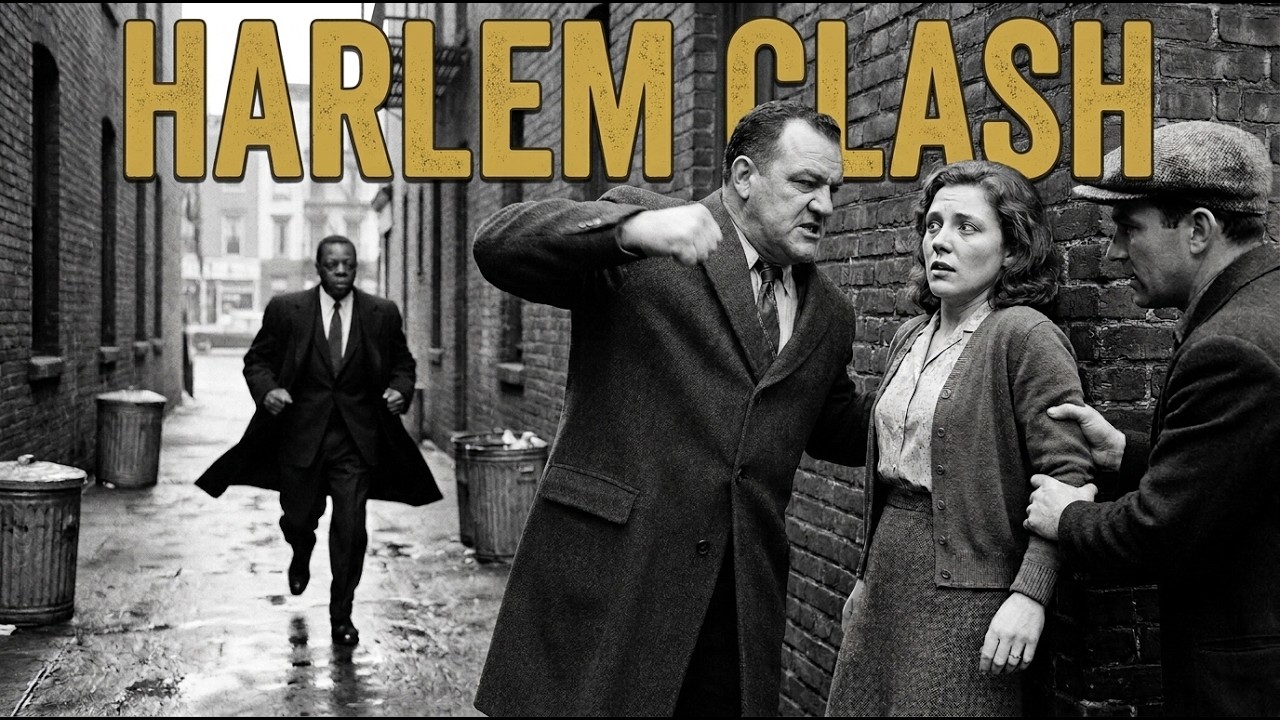
Bumpy Johnson, whether he ordered it or not, would be the name attached to the blood the moment it dried on Harlem pavement. That evening, Nora left a diner and took the shorter route back to her rooming house, through an unlit alley she had used twice before without a second thought. Two men were waiting past the first bend, and a third blocked the mouth behind her. She swung her handbag hard enough that its brass clasp caught one man across the cheek, and she ran.
Then tires touched the curb on the avenue. Bumpy Johnson had told no one where he was going that night, only that he wanted the route past 132nd Street himself. He saw the shape blocking the alley and was out of the car before the driver had finished braking. He crossed the sidewalk without calling out.
Beyond the man at the entrance, he caught one clear glimpse of Nora, three men around her, no purse snatched, no money demanded. Not robbery. The conclusion arrived before his next step did. The fight that followed was not a brawl the way the papers wrote brawls.
It was arithmetic conducted at close range by a man who had learned long ago that panic was the only truly fatal mistake. He took a blow to the jaw that rocked him back a full step and tasted blood, then answered with a strike that dropped the man to one knee. A shot went wide, cracking off brick instead of bone. The attacker with the knife caught Bumpy’s wrist and lost the knife to the pavement.
Nora grabbed a loose metal lid from a garbage can and swung it hard enough to change a man’s balance, and Bumpy used the change. When the last attacker tried to reach a fallen revolver, Boyd arrived through the alley mouth and leveled it at his chest. Enough. Boyd loaded the three men into a car, bound and silenced.
A brass key, stamped with the number 317, had been kicked toward a drain, and Bumpy trapped it under his shoe. That key, it turned out, opened a locker at a small bus terminal, where the men had been instructed to leave Nora’s personal effects. The typed instructions read: Personal effects to be left here. Do not keep anything.
Her handbag, her papers, her photograph, everything connecting the dead woman to the question she had been asking was supposed to disappear, so the body could remain a question long enough for other men to answer it however suited them best. Under questioning, the three attackers, low men, disposable by design, gave up what little they knew. One of them, a heavyset man named Feny, had heard pieces of an older story. Thomas Quinn had not vanished because of anything Harlem had done.
He had been erased by his own people over a theft too small to justify a war and too embarrassing to justify an honest explanation. Somebody was skimming collections meant for crews downtown. When it was found out, it was handled quiet, the way these things get handled when nobody wants a war over a bookkeeping problem. The silence had calcified over twenty years into a rumor blaming Harlem, and that rumor had nearly gotten Quinn’s daughter killed on someone else’s streets.
The man behind it all, an Irish boss named Cray, had sent the three men with one instruction: make it quiet, make it quick, make it look local. Her death would have silenced the daughter and blamed the rival, one murder solving both problems. Bumpy chose not to kill the attackers and not to kill Cray. A dead Cray, he reasoned, would be a martyr his people could rally around.
A live Cray, humiliated and indebted, was a weight around his own organization’s neck. He arranged a meeting at a warehouse near the river, where Cray arrived precisely on time, gray-haired and careful. Bumpy laid out what he knew without theater, that Cray had tried to solve a small old lie by creating a large new murder, and had tried to do it on Bumpy’s streets using his name as the alibi. Then he made the terms clear: your men returned alive is a debt you owe, and Norah Quinn is never touched again by you or anyone acting on your behalf.
The alternative was that everything known about the failed hit and the real story behind Thomas Quinn would travel to exactly the people who would most enjoy using it against him. Cray gathered his men without further argument. At the car door he paused and asked what happened to the girl now. That’s not your concern anymore, Bumpy said.
You forfeited the right to ask that question the moment you decided her life was worth spending on your convenience. Nora left that afternoon on the same line she had arrived on, four days and one lifetime earlier. Her suitcase was no heavier than before, but her notebook was considerably fuller. Names, dates, fragments of a father’s erased life, reassembled just enough to stop haunting the space where certainty used to be.
She had come for an answer, and she had gotten one. Not the whole one, but enough of one to stop asking strangers about it in alleys. Her unfinished letter to her mother was finally sealed, ready for a mailbox. Bumpy did not see her off at the station.
At the office window that afternoon, Boyd asked if he thought it was finished. Nothing’s ever finished, Bumpy said. It just stops being urgent for a while. That’s the only kind of peace this city actually knows how to keep.
Downtown, in a room with better furniture and a longer view of the river, a careful man filed the report on Bumpy Johnson one entry thicker: a private meeting, an Irish boss humiliated without a single shot fired, three men returned alive as a message rather than buried as a warning. Someday that file would matter. Not today.
Today it was simply filed alongside everything else the city preferred to remember quietly rather than discuss aloud.
