At 10:00 on the morning of October 5, 2018, in a shoe factory on Treasy Avenue in Batavia, New York, an executive named Hundley Elliot sent out a short message. There was no press conference, no farewell party, just a notice that the machines had stopped for good. One hundred fifty-one years earlier, two brothers had walked home from the Civil War and decided to build something with their hands. The company they founded grew into the second oldest footwear maker in the United States and the oldest women’s shoe manufacturer in the country.
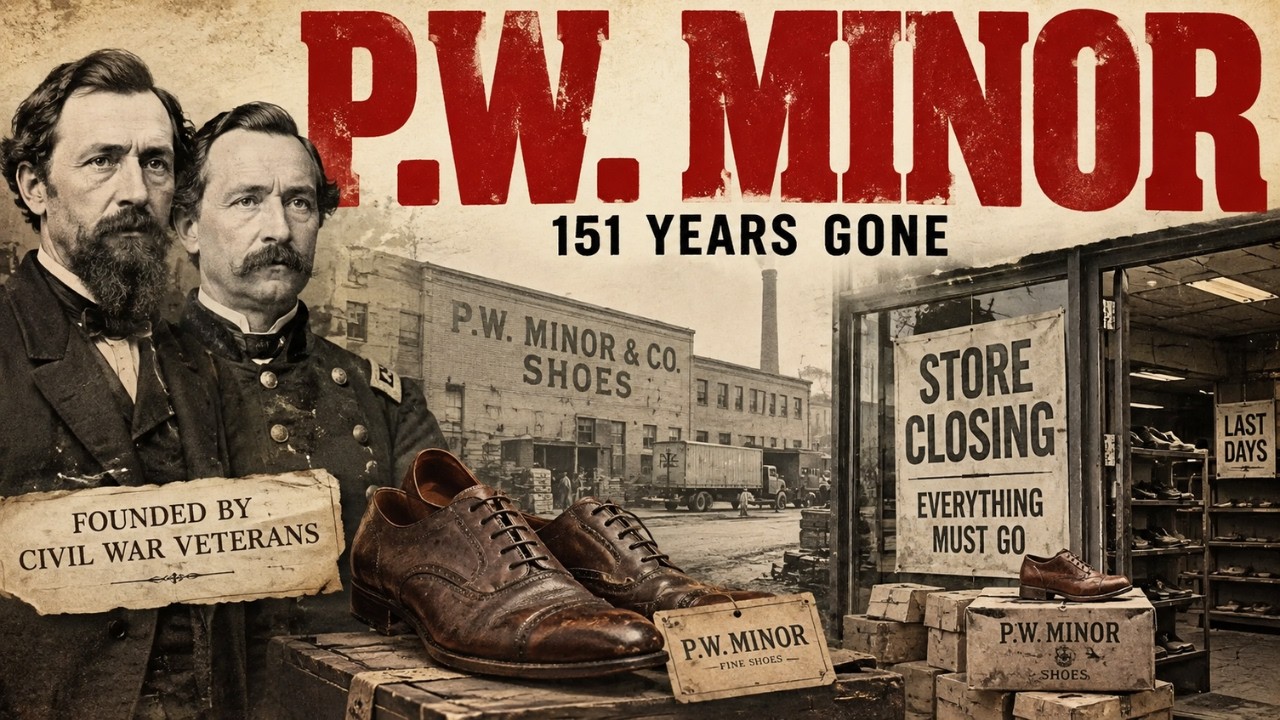
Four generations of the same family kept it running through wars and depressions and the slow collapse of American manufacturing around it. By the time cheap imports flooded the market, this small factory in Western New York was still making shoes the old way. The company had already survived cheap imports and two rescues by local businessmen determined to save it. It had not yet met a private equity fund with a plan of its own.
The story does not begin in Batavia. It begins on a road home from the Civil War in 1867. The war had ended in the spring of 1865, but for two brothers named Peter Wyckoff Miner and Abram Voorhees Miner, the walk home took longer than the fighting had. Both had served in the Union Army, both came from Interlaken, a small town in the Finger Lakes region of New York, and both returned to it once their service was finished.
Somewhere on that road, according to the story the family would tell for generations, the two brothers began talking about what came next. They settled on shoes. In 1867, Peter and Abram Miner opened a small shoemaking operation in Interlaken. There was nothing industrial about it at first.
Shoes in that era were still largely built by hand, cut and stitched and shaped one pair at a time by workers who had learned the trade the way their fathers had. The Miner brothers built their business the same way, selling boots and shoes to neighbors in a farming community that needed footwear durable enough to survive a New York winter. For nearly three decades, the operation stayed rooted in Interlaken, growing slowly the way small manufacturing towns did in the years after the Civil War. Then, in February of 1896, the company relocated roughly fifty miles northwest to the town of Batavia in Genesee County.
The move put the business closer to rail lines and larger markets, and Batavia would remain its home for the rest of its existence. By 1905, the company had a real factory built on the west side of State Street, constructed specifically to house the growing shoemaking operation. The Interlaken years had been about survival; the State Street years were about scale. For the first half of the 20th century, the company remained a family business run by the Miners, making shoes for ordinary Americans.
It survived the Depression. It survived two world wars. It passed from one generation to the next, each inheriting a factory in Batavia that had become quietly one of the oldest continuously running businesses in the entire region. But being old was not the same as being essential.
By the middle of the century, the company was a solid, respected shoemaker in a country full of solid, respected shoemakers competing in the same mainstream market as everyone else. That changed in the 1960s under the leadership of Henry Miner, known to nearly everyone as Bud. Instead of continuing to compete in the crowded, low-margin world of everyday footwear, he steered the business toward something narrower and far less glamorous: shoes built for people with foot problems. Orthopedic shoes, medical shoes, footwear designed for feet that ordinary shoes could not accommodate.
Out of that shift came the product that would carry the company for the rest of its life, a line called Extra Depth. The idea was simple but precise. Build a shoe a quarter to a half inch deeper than a standard shoe, creating enough internal space for a custom orthotic insert. It was not a fashion decision.
It was an engineering decision aimed at a customer that mainstream shoe companies had largely ignored. The strategy worked, and it worked for a long time. By 1998, the company was 131 years old. Three generations of Miners worked there at once.
Bud Miner, 77 years old, still served as chief executive. His son ran the company as president. The plant was producing more than 1,100 pairs of shoes a day across more than 100 different styles, with the Extra Depth line as its clear centerpiece. The year before, the company received an offer to relocate its manufacturing to North Carolina, where labor was far cheaper.
The family said no. Batavia was where the company had grown up, and the Miners chose to stay rather than chase a lower cost of production somewhere else. Through the 1980s, 90s, and into the 2000s, the ground underneath American footwear manufacturing kept shifting. Labor costs overseas were a fraction of what they were in Western New York.
Factories in Asia could produce shoes at a scale and a price that a family-run operation in Batavia simply could not match. Slowly and then not so slowly, the company began doing what nearly every other American shoe manufacturer had already done: it moved production overseas. By the years leading into 2014, roughly 80 percent of the company’s shoes were no longer being made in the Batavia factory at all. The strain showed in other ways too.
A family business built on family capital has a natural ceiling. There is only so much money a family can raise on its own, only so many years a small group of relatives can keep reinvesting in aging equipment while competing against companies with access to outside financing. By the early months of 2014, that ceiling had been reached. In early July of 2014, the company announced publicly that it was in danger of shutting down entirely.
Without a buyer or a rescue, the company planned to cease operations by September 1st of that year. The number attached to that announcement was 60: sixty jobs in a community where a 147-year-old shoe factory was not just a business, but one of the oldest continuously operating employers in the entire county. The buyers who stepped forward were not shoe people. Andrew Young worked in real estate.
Peter Zeff worked in renewable energy. What they had instead was a shared history in Batavia’s local business community and a conviction that a company with the Miner name on it was worth saving. They moved quickly, forming a new company called Batavia Shoes LLC. By August 8th of 2014, they had completed the purchase of the struggling shoemaker’s assets for $3.
6 million. Rather than gutting the workforce, they kept the 54 employees who were still working for the company and added 10 more. New York State awarded the company roughly $450,000 to help keep its doors open. In 2015, the new owners made their boldest public commitment yet.
In exchange for $1. 75 million in state tax credits, they pledged to bring 100 manufacturing jobs back from overseas to the Batavia plant. Alongside the manufacturing pledge came an effort to modernize the brand. The company brought in a veteran shoe designer named Rita Tamaro, whose task was to soften the clinical image the brand had accumulated without compromising the biomechanical features that made the shoes useful.
The company also opened a new retail store in downtown Batavia, built around a simple philosophy: if the product was made in Batavia, it should be sold in Batavia too. But underneath the optimism, the foundation remained thin. The turnaround depended on state incentives and on tax credits tied to specific job creation targets. By early 2018, roughly three and a half years after Young and Zeff had rescued the company from its first brush with closure, the ambitious rebuild had not delivered the stability everyone had hoped for.
The 100 jobs promised in exchange for state tax credits had not fully materialized. The company needed capital again, and this time the source of that capital would not be a pair of hometown entrepreneurs. The new investor was a private equity firm called Tidewater and Associates, based in Delaware. Unlike Young and Zeff, Tidewater was not a local business relationship built on years of civic ties.
It was an outside financial firm. In exchange for the investment the company needed to survive, control of daily operations shifted away from the men who had spent the last four years trying to save it. Peter Zeff stepped back from his role as chief executive and moved to a seat on the board of directors. In his place, Tidewater installed one of its own leadership team members, Hundley Elliot, as the new managing chief executive.
For the first time in 151 years, the company’s most important decisions were no longer being made by a member of the Miner family or by local owners with a personal hometown stake in its survival. In September of 2018, the company filed a formal notice with the New York State Department of Labor under the Worker Adjustment and Retraining Notification Act, a law that requires employers to warn the state before large layoffs or plant closures. The filing described a range of 42 to 82 employees who could be affected by a possible plant closing or a significant reduction in the workforce. On September 28th, the company confirmed a piece of that warning.
It announced it would lay off 45 full-time employees, closing its Goodyear Welt manufacturing line, a specialized process used to construct and resole high-quality shoes. The other 40 employees would keep their jobs, and the company was careful to say publicly that the Batavia plant itself was not closing. Elliot told reporters the company would remain open, focused on its core diabetic and orthopedic footwear lines. Within a week of that announcement, the number in the WARN filing would prove to be the truer of the two documents.
Friday, October 5th, 2018. The factory at 3 Treasy Avenue opened that morning the way it had opened thousands of mornings before it. Workers arrived at their stations. Machines that had spent decades cutting leather, stitching uppers, and shaping soles sat ready to run another shift.
The email went out before most of the day’s business had even begun. It was addressed to the company’s drop ship customers, the retailers and online partners who relied on the factory’s inventory to fill their own orders. The message came from Brian Benedict, the company’s vice president of sales. He wrote that he regretted to inform them that as of 10:00 that morning, the company had ceased operations.
Within hours, the formal statement arrived carrying the name of chief executive Hundley Elliot. The company confirmed that it had ceased operations effective that day and that all of its assets had been transferred to its senior creditor, an entity called Batavia Shoes LLC, the same name Andrew Young and Peter Zeff had created back in 2014 when they first bought the company out of its earlier crisis. Elliot’s statement focused on the people rather than the mechanics. He said the company’s focus through the entire process had been on its employees’ well-being.
He thanked them for their dedication, their loyalty, and their hard work. The number of people affected was 81, by some counts 82. Whatever the figure, it meant every remaining employee of the company, including the 40 workers who had been told less than two weeks earlier that their jobs were safe. The company that had survived the aftermath of the Civil War, two world wars, the Great Depression, decades of foreign competition, a family run out of resources, and one determined local rescue had not survived a private equity restructuring that had begun less than a year earlier.
By the end of that Friday, the building on Treasy Avenue was quiet in a way it had not been in 122 years, since the company first arrived in Batavia in 1896. What remained after the closure was a building on Treasy Avenue that had gone quiet, a name that had appeared on shoes since 1867 now attached to nothing being made, and a small Genesee County town adjusting to the fact that its oldest business was no longer a business at all. But the people who knew how to work inside that building did not disappear. Peter Zeff, who had stepped back from daily control when Tidewater arrived, still personally owned the factory building and its production equipment.
Into that vacancy stepped Nicole Porter, a woman who had spent five years as an employee of the company before its closure. Rather than leaving the trade behind, Porter opened her own operation inside the same building, a company called Artisan Boot and Shoe Company. Chris Dioguardi, who had spent 23 years working in that exact factory, came back to work at the same machines under the new name. So did other former co-workers who returned because the skills they had spent decades building had nowhere else in the region to go.
Under Porter’s ownership, the building started hosting other people’s shoe companies. A former stock trading analyst who had begun designing inexpensive American-made shoes out of a spare room in his house brought his young company into the building, becoming a tenant inside the same walls where the Miner family’s descendants had once run production. By the end of the following year, five separate shoe companies were operating out of the old factory. Each one small, each one independent, none of them carrying the name that had been stitched into shoes made there for a century and a half.
The company had spent 151 years accumulating something no closure notice could transfer to a creditor: a small group of people in Genesee County who actually knew how to build a shoe by hand, from a flat piece of leather to a finished pair, using skills that took decades to learn and cannot be shut down with a single email. The name did not survive. The hands did.
