In 1902, a crew of twelve men stood at the base of a Douglas fir twenty-two feet in diameter and more than three hundred feet tall. The tree weighed over two hundred tons. They had no cranes, no hydraulic lifts, no diesel engines. Their tools were axes, saws, and cables of twisted steel, and a logging technique so dangerous that one in every five men who worked in the woods would be killed or permanently disabled during his career.
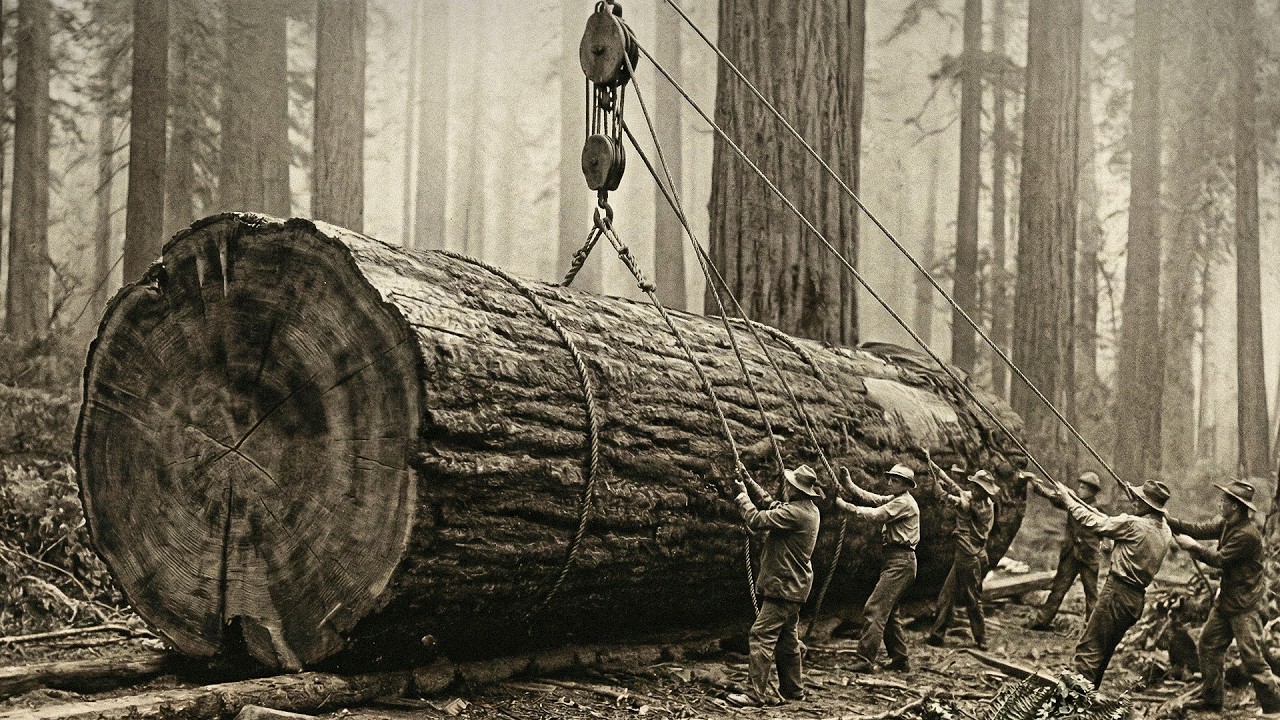
Within six hours, that tree would be on the ground. Within two days, it would be cut into massive logs, each weighing over a hundred tons. Within a week, those logs would be loaded onto railcars and shipped to sawmills—despite being far too heavy for any man to lift, and sitting in terrain too steep for horses to navigate. The forests these men faced were unlike anything else on Earth.
From northern California through Oregon and Washington and up into British Columbia, a temperate rainforest had been growing undisturbed for thousands of years. The dominant species was the Douglas fir, but western red cedar, Sitka spruce, and western hemlock also grew to enormous size. A typical old-growth Douglas fir stood between two hundred and three hundred feet tall, and the largest specimens exceeded three hundred and fifty feet, placing them among the tallest trees on the planet. More important to loggers, they were extraordinarily thick.
Diameters of ten to fifteen feet were common; trees exceeding twenty feet were rare but not unheard of. The wood was dense, heavy, and valuable. Douglas fir combined strength with workability, making it prized for construction, and a single mature tree could yield enough lumber to build several houses. The economic incentive to harvest these giants was enormous, but so was the challenge.
Consider the physics. A Douglas fir twenty feet in diameter and three hundred feet tall contained roughly fifty thousand board feet of lumber. With trunk, branches, and water content, its weight could easily exceed two hundred tons—about the weight of a fully loaded Boeing 757. The loggers had to cut that tree down with hand tools, control its fall with ropes, cut it into sections, and haul those sections over mountainous terrain with no modern machinery.
The terrain itself was brutal. Old-growth forest grew on steep slopes, with thirty- to forty-degree grades common, and operations frequently took place on hillsides approaching sixty degrees. The forest floor lay buried under decades of debris: fallen trees, thick undergrowth, and massive stumps left from earlier cutting. The trees grew so closely together that their canopies formed a continuous ceiling hundreds of feet overhead.
Light barely reached the ground, humidity stayed high year-round, rain was frequent, fog was constant, and mud, moss, and rotting vegetation covered every surface. By the 1880s, when industrial logging began expanding in earnest, the basic problem was plain. Billions of board feet of valuable timber were scattered across hundreds of thousands of acres of steep, muddy, difficult ground. The trees were too large to move with muscle power, too heavy for horses to drag, and too valuable to leave standing.
Whoever solved the engineering problem of harvesting them efficiently would become extraordinarily wealthy. The first loggers arriving in Oregon and Washington in the 1850s and 1860s borrowed techniques from the East Coast and Great Lakes regions, and those methods failed immediately at the new scale. Felling a tree two hundred feet tall and fifteen feet in diameter was fundamentally different from felling one sixty feet tall and three feet across. The physics of the cut, the dynamics of the fall, and the consequences of mistakes all operated on a completely different scale.
Early loggers learned this through bitter experience. The process began with selecting a tree and clearing the area around it. A falling tree three hundred feet tall, with a crown weighing tens of thousands of pounds, crushed everything within a radius of more than three hundred feet. Loggers had to identify the fall direction, clear escape routes, and remove anything that might cause the tree to split or shatter on impact—because a shattered tree lost much of its value.
Controlling the fall was both an economic necessity and a safety matter. The cutting technique evolved through the 1880s and 1890s. Cutting at ground level proved inefficient and dangerous. The base of an old-growth Douglas fir flares outward, sometimes reaching thirty feet in diameter at the soil line, even though the trunk narrows to twenty feet just ten feet up.
Cutting through all that extra wood was wasted effort. The solution was the springboard. Loggers chopped notches into the trunk six to twelve feet above the ground and inserted wooden planks. Standing on these narrow platforms, called springboards, the faller could cut above the flare where the diameter was smaller, saving hours of work.
Two men worked as a team to bring down a tree. They used axes to chop an undercut, called the face cut, on the side facing the intended direction of fall, removing a wedge of wood about a third of the way through the trunk. Then they moved to the opposite side and made the back cut with a long crosscut saw. These saws, nicknamed misery whips by the men who used them, ran eight to twelve feet long with large teeth and handles at both ends.
Two men pulled the saw back and forth through dense, resinous wood for hours. The saw had to stay sharp, the cut level, and the progress watched constantly. As the back cut neared the face cut, the tree would begin to lean, crack, and then fall. If the cuts were right, the tree dropped in the intended direction and landed intact.
If they were wrong, it might split vertically, killing the fallers, or fall somewhere unexpected, destroying everything in its path. Once the tree was down, the real work began. A three-hundred-foot tree cannot be moved as a single piece, so it had to be cut into sections, a process called bucking. Buckers marked the fallen trunk at intervals of sixteen to forty feet, depending on diameter and the transport system, then cut through each mark with crosscut saws.
Each section was still a log weighing anywhere from twenty thousand pounds to well over a hundred tons. Those logs had to move from where they fell to a collection point, then to a river, railroad, or mill. Here the old methods hit a wall. Horses could drag logs of a few thousand pounds over flat ground, but nothing close to a hundred-ton log up a forty-degree slope through mud and stumps.
Some companies tried oxen, which were stronger and better in rough terrain. Others built temporary rail lines into the forest, laying track to the trees and using small locomotives to pull logs out. Both approaches had severe limits. Oxen were slow, ate enormous amounts of feed, and still could not manage the largest logs.
Rail lines demanded massive investment, took months to build, and had to be extended constantly as cutting moved deeper into the woods. By the 1890s the most successful operations used a hybrid: horses or oxen dragged smaller logs short distances to a central point, where they were loaded onto railcars and shipped to a river to be floated to the mill. But this only worked for logs below a certain size on relatively easy ground. The largest trees on the steepest slopes remained economically impossible to harvest.
The industry needed a breakthrough, and it came from an unexpected source: a logger named Horace Butters, working in northern California in the early 1900s, who watched ship riggers in San Francisco Bay and had a radical idea. If sailors could lift tons of cargo with ropes, pulleys, and leverage, the same principles might move logs weighing more than any ship’s cargo ever had. The innovation became known as the high lead system, and it completely reimagined moving heavy objects through difficult terrain. Instead of dragging logs horizontally across the ground, it lifted them vertically into the air, suspended them from cables, and used gravity and mechanical advantage to carry them to a central location.
The concept was simple. Choose the tallest, strongest tree in the area and turn it into a spar tree by stripping off all its branches, leaving only the trunk standing. This spar tree, typically two hundred to three hundred feet tall and stripped to a height of a hundred and fifty feet or more, served as a stationary crane. Attach a large pulley block at the top, run steel cables through it, and you had a lifting system capable of hoisting enormous weights.
Implementing it took decades of failure. The first challenge was choosing and preparing the spar tree. It had to be tall enough to lift logs clear of every obstacle, strong enough to handle the forces of lifting hundred-ton loads, and positioned to serve the whole logging area. Creating a spar tree was dangerous work requiring its own specialized crew.
First the tree had to be topped—everything above a certain height removed. A worker called a high climber ascended using climbing spurs strapped to his boots and a safety belt cinched around the trunk, chopping or sawing off every branch in his path. Climbing two hundred feet up a standing tree with nothing but spurs and a rope required skill, strength, and absolute fearlessness. High climbers were the elite workers of the logging industry and paid accordingly.
They also had the highest casualty rate in the woods. A single mistake, a rotten section of trunk, or a moment of inattention meant a fall no one survived. Once the climber reached the desired height, typically between a hundred and a hundred and fifty feet, he cut off the top of the tree. He chopped an undercut on one side, then sawed through from the other, just like felling a tree at ground level—except performed while clinging to the swaying trunk of a living tree a hundred and fifty feet in the air.
When the top separated and fell, the remaining spar tree whipped violently from the sudden release of weight. The climber had to time the movement, brace himself, and avoid being thrown. With the tree topped and limbed, the crew installed the rigging. This required raising steel cables and massive pulley blocks to the top, combining traditional sailing techniques with industrial engineering.
The pulley blocks were enormous. Main blocks at the top of a spar tree could weigh several hundred pounds, with wheels two to three feet in diameter designed for steel cables up to two inches thick. The rigging used multiple cables working together. The main line, also called the haulback line, ran from a winch at the tree’s base up through the block at the top and out into the forest where logging was taking place.
Additional lines provided stability and control. The entire system had to be balanced to handle forces as great as the weight of the spar tree itself. The power came from the donkey engine, a steam-powered winch that pulled with tens of thousands of pounds of force. Despite the name, a typical donkey engine was a massive piece of industrial equipment weighing between fifteen and thirty tons, standing eight to twelve feet tall, and burning enormous quantities of wood fuel.
Large drums wound the steel cables, driven by steam pistons that developed tremendous pulling force. Operating it required constant attention. The engineer managed steam pressure, coordinated multiple cable lines, responded to signals from workers in the forest, and had to prevent cables from breaking under load. A cable failure under tension could whip through the air at lethal speed, cutting through anything and anyone in its path.
The engineer had to know the limits of every component and never exceed them. The high lead system operated as a coordinated ballet of men, machines, and physics. When a tree was felled and bucked, workers attached choker cables around each log. These were short lengths of steel cable with loops at both ends; one end wrapped around the log, the other attached to the main line.
Once the chokers were secured, workers signaled the donkey engineer, usually by tugging a smaller signal line that ran from the woods back to the engine. The engineer engaged the steam engine, the cable tightened, and the log began to lift. Because the cable ran up to the top of the spar tree before coming back down, the mechanical advantage lifted the log at an angle. The front end rose first, climbing into the air while the back end dragged along the ground.
As more cable was reeled in, the entire log swung clear and hung suspended in the air. With the log airborne, the real advantage appeared. It could be pulled horizontally through the air, clearing every stump and piece of debris on the forest floor, transported up steep slopes that would have been impossible to cross on the ground. The cable pulled it in a straight line to the landing, the central collection point where logs were gathered before loading onto railcars or trucks.
The distances were substantial. A single spar tree could service an area with a radius of eight hundred to a thousand feet, meaning a circle of forest covering more than fifty acres could be logged without moving the spar tree. When one area was exhausted, the whole rigging system was disassembled, moved, and set up again. The efficiency gains were revolutionary.
A high lead system with a good crew moved more timber in a day than a dozen teams of horses working for a week. It handled logs of any size, worked on terrain of any steepness, and operated in weather that shut down every other method. By the 1920s, high lead logging had become the dominant method throughout the Pacific Northwest, and the speed of timber extraction increased exponentially. At its core, the system relied on mechanical advantage, distributed loads, and careful management of forces that could easily exceed the strength of any single component.
The fundamental principle was using the spar tree as a lever arm. When a cable ran from a ground-level winch up to a pulley at the top of a two-hundred-foot spar tree and back down to a log, the geometry created a two-to-one mechanical advantage. A donkey engine capable of pulling with twenty thousand pounds of force could theoretically lift a forty-thousand-pound log. Friction and cable stretch reduced the advantage, but the principle held.
The height of the spar tree mattered beyond mechanical advantage. A tall tree lifted logs higher off the ground so they could clear obstacles more easily. It also changed the cable angle, affecting how much pulling force went into lifting versus dragging. A steeper angle meant more lift and less drag, which was essential moving logs up steep slopes.
The strength requirements were extreme. Steel cables in high lead logging were usually an inch and a half to two inches in diameter, made of multiple strands of steel wire twisted together, combining flexibility with tremendous tensile strength. A two-inch cable could theoretically support over a hundred thousand pounds before breaking. But cables were never loaded to maximum capacity, because failure was catastrophic.
Steel cable under tension behaves like a spring, storing enormous energy. When it broke under a load of tens of thousands of pounds, that energy released instantly. The broken cable could whip through the air at speeds exceeding a hundred miles per hour, and the flying steel was heavy enough to cut a man in half or demolish wooden structures. Every worker in the woods had seen cable failures, and the results were never forgotten.
To reduce the risk, crews inspected cables constantly for wear, rust, or broken strands, and replaced them on a regular schedule regardless of appearance. The donkey engineer never pulled harder than necessary and released tension slowly to avoid shock loading. Workers learned to position themselves where a broken cable could not reach them. The spar tree itself had to withstand forces that would destroy any normal tree.
When a hundred-ton log lifted off the ground and hung from a cable attached to the top, the spar tree experienced bending, compression, and lateral stresses all at once. It had to support the log’s weight, resist the pulling force of the donkey engine, and stay stable with no branches and limited lateral support. Selecting a proper spar tree required understanding wood strength and structural engineering. The tree had to be free of rot, cracks, or defects; it needed to taper gradually to distribute forces evenly; the root system had to be intact and firmly anchored.
Even so, spar trees occasionally failed under load, and when one broke while supporting a suspended log, the results were invariably deadly. Engineers calculated forces with the best mathematics and materials science of the era, but much of the knowledge was empirical. Logging companies learned from experience. They discovered Douglas fir spar trees could typically support loads up to roughly half the weight of the tree before failure became likely.
They learned that guy lines—additional cables anchored to stumps or surrounding trees—dramatically increased stability by distributing the lateral forces generated when a log was pulled horizontally. Without guy lines, the spar tree would bend and potentially snap under strong side loads. With six to eight properly positioned guy lines, a spar tree became part of a larger structural system where forces were shared among multiple anchor points, and could handle loads that would destroy an unsupported tree. The donkey engine provided raw power, but it had to be controlled.
Too much power applied too quickly snapped cables or ripped logs apart; too little and the log wouldn’t move. The engineer had to develop a feel for the system, sensing when a cable approached its limit, when a log hung up on an obstacle, when something was about to fail. Steam pressure in the donkey engine ranged from eighty to a hundred and fifty pounds per square inch. The drums around which cables wound were six to eight feet in diameter.
The relationship between drum diameter, cable length, and pulling speed meant the engineer could trade speed for power by changing which drum was engaged and how much steam was applied. Pulling a small log quickly required different settings than pulling a massive log slowly. The entire system ran at the edge of its capabilities every day, because logging companies pushed equipment as hard as possible—time was money, and the faster logs came out, the higher the profit. This created constant tension between safety and productivity, and in the early decades of high lead logging, productivity almost always won.
The human element cannot be separated from the machinery. These were not automated operations. Every aspect required skilled workers making constant decisions and accepting risks that would be considered insane by modern standards. A typical crew numbered fifteen to thirty men, each with a specialized role.
The high climber was the most skilled and dangerous. But every role carried risk. The faller cut down the trees. A mistake reading the wood grain, judging the wind, or making the cuts could send a tree down the wrong direction, split it apart, or set it rolling after impact.
Fallers were killed by falling trees, by trees that kicked back when partially cut, by branches falling from above, and by other trees destabilized by the falling process. Buckers cut fallen trees into sections, their precision vital because lumber value depended on cutting at the right points to maximize clear wood. They worked on unstable logs that could roll without warning, using razor-sharp saws that could cut through flesh as easily as wood. Bucker injuries were common and often severe.
Choker setters had perhaps the most dangerous job. They worked in the area where logs were being moved, attaching and detaching the steel chokers connecting logs to the main line. This required being close to logs weighing tens of thousands of pounds while those logs were lifted, dragged, and swung by forces far beyond human control. A log pulled by the high lead system did not move smoothly.
It jerked as the cable tightened, rolled unpredictably, crashed over obstacles. Choker setters had to approach these moving logs, work underneath and around them, secure the chokers, then get clear before the log began moving again. They had to judge the strength of attachment points, anticipate how the log would move, and be ready to dive out of the way. The casualty statistics were staggering.
In the peak decades of the 1920s and 1930s, logging was the most dangerous occupation in America by a substantial margin. Fatality rates of three to five deaths per thousand workers per year were common in large operations. Injury rates ran even worse, with fifteen to twenty percent of workers sustaining serious injuries in any given year. These were not abstract statistics.
Every logging camp had men with missing fingers, crushed hands, broken backs, missing eyes. The lucky ones still worked in reduced capacities; the unlucky ones became dependent on their families or disappeared into poverty. There was no workers’ compensation, no disability insurance, no safety regulations. A man hurt lost his income.
A man killed left his family nothing. Men kept working anyway, because the pay was better than almost any alternative open to working-class men with limited education. A skilled high climber in the 1920s could make four or five times the wage of a factory worker. Experienced donkey engineers commanded similar premiums.
Even entry-level positions paid well by the standards of the era, and for men willing to take the risks, logging offered a path to relative prosperity. The work culture in logging camps was shaped by constant danger. Men formed tight bonds with their crews because their lives depended on one another. A choker setter trusted the donkey engineer to respond instantly to his signals.
The high climber trusted the crew below to rig the safety lines correctly. Everyone trusted that equipment was maintained and that no one took unnecessary risks. That trust was not always justified. Production pressure led to shortcuts, deferred maintenance, and pushing equipment beyond safe limits.
Some companies were better than others, but even the best operations accepted casualty rates that would shut down any modern industry. The prevailing attitude was that danger was simply part of the job. The physical demands were extraordinary. A faller might spend ten hours swinging an axe and pulling a crosscut saw through dense wood.
A high climber would ascend multiple trees in a day, lifting his own body weight repeatedly using only arm and leg strength. Choker setters ran through the woods carrying heavy steel cables on steep slopes covered in mud and debris. Strength alone was not enough. The work required technical skill developed over years: reading a tree’s lean, judging wood quality from the way a saw cut through it, knowing when a cable was about to fail from the sound it made under tension.
These skills could not be taught in a classroom. They were learned through observation, apprenticeship, and surviving long enough to become expert. The demographics of crews reflected the social hierarchies and prejudices of early twentieth-century America. Skilled positions like high climber, donkey engineer, and head faller were almost exclusively held by white men, often of Scandinavian descent.
Scandinavian immigrants had a reputation for fearlessness and skill in the woods, and many companies specifically recruited from Norway, Sweden, and Finland. Lower-skilled positions were more diverse. Japanese, Chinese, and Native American workers were common in some regions, though they faced discrimination in pay and advancement. Black workers were rare in Pacific Northwest logging.
The camp social structure was rigidly hierarchical, and advancement depended as much on ethnic background as on skill. Living conditions ranged from barely adequate to miserable. Camps were temporary settlements built near active operations and moved every few months as timber was exhausted. Housing was rough lumber bunkhouses with minimal insulation.
Men slept in rows of bunks with no privacy, limited heating, and poor ventilation. Food was abundant but monotonous. Calories were essential given the physical demands, so meals emphasized bread, beans, potatoes, and whatever meat was available. Cooks held important positions, because keeping the crew fed was essential to productivity.
A good cook attracted workers; a bad one would see men quit regardless of pay. Isolation defined camp life. Camps were often dozens of miles from the nearest town, reachable only by logging railroad or rough roads. Men might work for weeks without leaving, and the only entertainment was what they created themselves.
Gambling, drinking, and fighting were common ways to pass the evenings. Some camps prohibited alcohol, but enforcement was sporadic at best. The 1920s and 1930s marked the peak of high lead logging. By then the techniques had been refined through decades of experience, equipment had improved, and the industry achieved an efficiency that seemed impossible in earlier years.
The largest companies operated like small military campaigns, maintaining multiple camps, each with its own crew, equipment, and railroad infrastructure. They owned thousands of acres of timberland, operated their own sawmills, and employed hundreds or even thousands of workers. Companies like Weyerhaeuser, Long-Bell Lumber, and Bloedel Donovan Lumber Mills became corporate giants built on Pacific Northwest timber. Technology improvements in the 1920s increased both the speed and relative safety of operations.
Donkey engines became more powerful and reliable. Steam pressures rose, drums grew larger, control systems improved. By the late 1920s, the best donkey engines could pull with forces exceeding fifty thousand pounds, moving logs that would have been impossible a decade earlier. Trucks began to supplement and eventually replace railroad logging in some areas.
The first logging trucks were crude vehicles with solid rubber tires and minimal suspension, but they offered flexibility railroads could not match. Trucks reached areas where laying rail was impractical and could be relocated quickly as logging moved to new sites. By the mid-1930s, truck logging had become common throughout the region. The economics were driven by seemingly unlimited demand.
The American construction boom of the 1920s consumed timber at an unprecedented rate. Everything from houses to furniture to packing crates required lumber, and Pacific Northwest mills ran at full capacity. Douglas fir prices stayed high, and companies expanded aggressively. That expansion came at an environmental cost not understood or acknowledged at the time.
Old-growth forests that had stood for thousands of years disappeared in decades. Entire watersheds were clear-cut. Streams clogged with debris. The landscape turned from dense forest to stumps and mud.
The concept of sustainable forestry existed in theory but was almost never practiced. The prevailing attitude was that the forests were so vast they could never be exhausted. By the early 1930s, it was clear they were not infinite. The best timber in the most accessible areas was gone, and companies were forced into more remote, difficult terrain.
The easy wood was cut. What remained required longer transport distances, steeper slopes, and larger investments. Costs rose while quality declined. Then the Great Depression hit the industry hard.
Demand collapsed as construction stopped, lumber prices fell by more than half, logging operations shut down throughout the Pacific Northwest, and thousands of men lost their jobs. The bustling camps became ghost towns. The industry survived, but it never fully recovered the economic vitality of the 1920s boom. World War II briefly revived demand, as aircraft manufacturing and military construction required massive quantities of lumber.
But the war also highlighted the limitations of high lead logging. The military needed timber from specific locations for specific purposes, and the inflexibility of high lead systems became a constraint. The war accelerated interest in more mobile, versatile methods. The end came gradually.
By the 1950s it was clear the era was closing. The most obvious factor was the depletion of old-growth timber. The massive trees that had made high lead systems necessary and profitable were largely gone from accessible areas. What remained was second-growth forest with smaller trees that did not require such elaborate systems.
Technological advancement was equally important. Diesel engines replaced steam, providing more reliable and portable power. Mobile cranes and purpose-built logging equipment did the work of spar trees and donkey engines with greater flexibility and safety. Chainsaws replaced crosscut saws and axes, allowing one man to fall trees that once required a team.
The environmental movement and changing social attitudes played a role as well. By the 1960s and 1970s, clear-cutting old-growth forest became controversial, and regulations began restricting where and how logging could occur. The unlimited exploitation that characterized the early twentieth century became politically and legally impossible. Logging continued, but the scale and methods changed fundamentally.
The last true high lead operations in the Pacific Northwest shut down in the early 1970s. A few systems remained in remote areas into the 1980s, but they were anachronisms. The era of lifting hundred-ton logs fifty feet into the air with nothing but cables, steam power, and courage was over. For roughly fifty years, from the early 1900s through the 1950s, the high lead system made possible the harvesting of the largest trees on Earth under conditions that seemed to defy practical limitations.
The men who worked the woods accepted risks few modern workers would tolerate and accomplished feats that seemed almost impossible on close examination. The legacy of the era is visible throughout the Pacific Northwest. The forests that remain are fundamentally different from what existed before industrial logging. The old-growth giants are mostly gone, replaced by managed second growth or protected remnants.
The logging towns that boomed during the peak years have mostly declined or disappeared. What remains are the stories, the photographs, and the knowledge that human determination combined with mechanical advantage can accomplish remarkable things, even at tremendous cost. The techniques and equipment of high lead logging are preserved in museums and historical sites throughout Washington and Oregon, where visitors can see the massive spar trees, the donkey engines, and the steel cables that made it all possible—artifacts that serve as reminders of an industry that shaped the region’s development, and of the men who risked everything to turn trees into lumber, and lumber into prosperity.
