In the spring of 1838, Henry Shreve stood on the banks of the Red River and made an announcement that would reshape the map of the American South. For six seasons, he and his crews had been tearing apart a solid mass of timber, mud, and rooted trees that stretched 165 miles along the river’s course. Now he declared it gone. The Red River Raft, a wooden barrier that had blocked navigation since before any European had set foot in the region, had been removed.
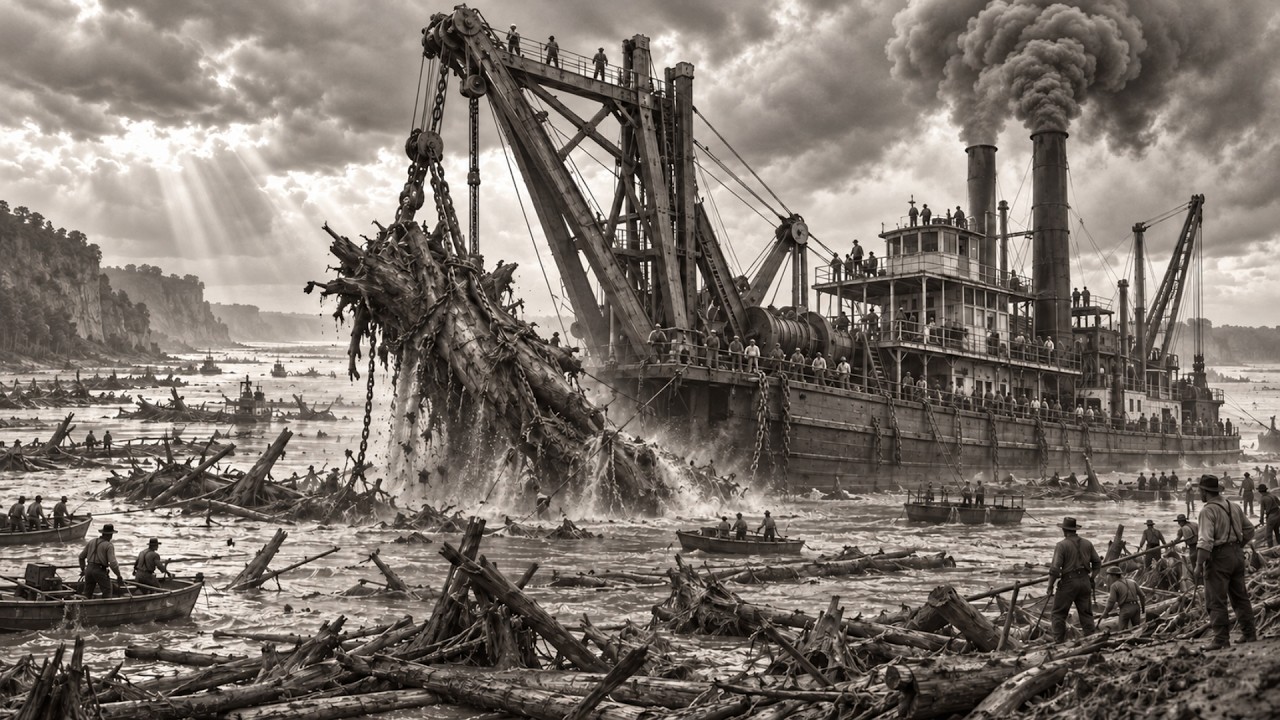
The river was open from the Mississippi to the Texas border, and 500 miles of previously unreachable country lay exposed to steamboat traffic for the first time in recorded history. But the river did not agree with Shreve’s declaration. It would take less than forty years for fifty miles of the raft to grow back, and a second removal would take the Army Corps of Engineers a full decade to complete. The raft had been there longer than anyone in the region could remember, and it had no intention of leaving quietly.
The story of how Henry Shreve came to fight the Red River Raft begins in 1826, when the United States government hired one man to take apart the Mississippi River, piece by piece. The task came with no completion date, no finished map, and no clear limit on costs. The river he was contracted to clean stretched more than a thousand miles from the mouth of the Ohio to the Gulf of Mexico. At any given moment, along any part of that course, there were hundreds of trees, some of them sixty and seventy feet long, buried in the riverbed at angles capable of punching through the hull of a loaded steamboat in the time it took to hear the impact.
The Mississippi of the 1820s was not the wide, orderly channel it later became. Travelers described it as a tangled maze of shifting channels, cut-offs, and crescent-shaped lakes, with whole forests standing in stagnant water and others lying beneath the main current. After a flood, an oak that had stood for two centuries on a high bank would topple inward. Its roots gripped the mud of the bottom.
The current worked on the trunk for weeks, stripping the bark and polishing the wood until it turned the color of iron. Then the tree settled there, pointed upstream just beneath the surface, invisible from the deck of a boat until the boat was directly on top of it. The men who worked the river had names for these trees. A fixed tree, its roots bound in the mud and its top angling toward the surface, was a planter.
Planters were bad enough. The sawyer was worse. A sawyer was a tree with one end still attached to the bank while its full length swung with the current. Its submerged end rose and fell with the push of the water.
One steamboat captain who had watched for sawyers described the experience of spotting one in time as a fleeting thing. You saw the water break in a certain way, you recognized what it was, and if you were lucky, you had a single heartbeat to turn the wheel. If you were not lucky, the end of the tree pierced the hull below the waterline before the lookout had time to shout. Between 1811 and 1849, the river and its tributaries sank more than three hundred steamboats on snags alone.
Some carried cotton, some carried passengers, and some went down so fast that their cargo kept burning from the boiler furnace until the water closed over the deck. Shreve came to this task prepared. He had been on the western rivers since his teenage years, piloting keelboats on the Monongahela and the Ohio before steamboats existed in any practical form. In 1816, he built a steamboat called the Washington and piloted it from Louisville to New Orleans and back at speeds that the men who legally monopolized steamboat traffic on the Mississippi had believed impossible.
They sued him. He beat them. Within three years, the monopoly collapsed entirely, and the era of open river commerce on the Mississippi began, thanks to a boat Shreve built and a lawsuit he refused to lose. By the time the government came to him about the river’s snags, he understood the Mississippi the way a man understands a road he has traveled in every season.
He knew what floods did to the banks. He knew where the current ran fastest and where it stalled. He knew that the trees the river put in its bed in March were not the same trees it moved again in September. And he knew, better than most, exactly what a wooden snag could do to the hull of a ship.
The machine he built to fight them had no real precedent. Think of the way a nutcracker works. Two arms meet at a fulcrum, force applied at one end concentrates at the other. Now scale that up to the size of a ship.
Shreve’s snag boat was built on two parallel hulls like a wide catamaran, with a gap between them running from the bow to a point deep within the vessel. At the front of the gap, where the two hulls met in a shallow V, he mounted a heavy wooden frame with a chain and a steam-powered winch. The idea was simple, as good ideas tend to seem once someone has thought of them. You positioned the boat so the snag slid into the gap between the hulls.
The gap caught it. Then you engaged the winch, which pulled the chain around the snag below the waterline, and the steam engine turned the drum until the tree either tore out of the riverbed or came apart in pieces. Either way, it came out. You hauled it to the bank, cleared it from the waterway, and went back for the next one.
His first snag boat was the Heliopolis, launched in 1829. On its first day of work on the Mississippi, the Heliopolis removed forty snags. A crew working by hand from a flatboat, the method that had prevailed before him, could manage about a dozen snags in a week under good conditions. Under bad conditions, they could remove nothing, because the force required to pull a waterlogged tree from the mud of the riverbed without a steam engine was not a force human arms could generate.
Within two years, Shreve had cleared the main channel of the lower Mississippi so well that the insurance companies in New Orleans began to notice a change in the number of claims they were paying. Boats still sank, boilers still exploded, fires still broke out in holds, and captains still misjudged the fog, but snag losses were down, and that meant the cost of shipping goods from St. Louis to New Orleans was down. At its peak, the Mississippi was carrying roughly one third of all American export trade.
The cost of moving goods on such a river was not a minor concern for anyone who dealt with it. The men who worked the snag boats did not share proportionately in this improvement. A deckhand on a government snag boat in the 1830s earned between eight and twelve dollars a month, depending on the river and the season. Work ran six days a week, from dawn until dusk, on water that never stayed the same for two days running.
In spring, when the rivers ran highest and new snags came as fast as old ones were removed, the current was so strong that a man who fell in the wrong place had little chance of being found before the next bend. The crews were diverse. Government records from Shreve’s operations show Irish immigrant laborers, free Black boatmen, and hired enslaved workers whose wages went to their enslavers instead of themselves. No complete payrolls survive from those years.
What the records do show is that when something went wrong on a snag boat, when a chain snapped or a wooden frame gave way or a log surfaced faster than expected, the men closest to the machinery were the ones who got hurt. Shreve worked under a system of contracts and reappropriated funds, returning to Congress every few years to ask for more once the initial appropriation ran out. Western senators wanted the rivers cleaned. Eastern members questioned why the federal government was involved in improving what nature had placed there.
Shreve spent as much of his career writing reports to the War Department as he did working on the water, and the river cared for none of it. He succeeded in clearing the main channels of the Mississippi to navigable condition by the early 1830s. Then the War Department sent him to inspect the Red River. The Red River ran west from the Mississippi through what is now Louisiana and Arkansas toward Texas.
At some point in the distant past, the Caddo people of the region had stories indicating the river had been there for generations before any European arrived. Part of the river had begun collecting debris. Trees falling from the banks washed down with the current and tangled together, sediment accumulated between them, and they began to root again on top of one another. The structure that resulted was not simply an accumulation of timber.
It was a floating island, a submerged maze, and a dam all at once. And it extended for 165 miles. The Great Raft, as it was called, completely blocked navigation on the Red River above a point about seventy miles from its junction with the Mississippi. Above the raft, the river had nowhere to go, so it spread everywhere, spilling into a chain of lakes, swamps, and flood channels across a vast stretch of country that would otherwise have been navigable.
Caddo Lake, which still lies on the Texas-Louisiana border and is one of the largest natural lakes in the South, exists largely because the raft held back the river’s waters for centuries. The raft made it. Removing the raft was nothing like removing ordinary snags. Imagine a log you could walk on top of.
The Great Raft was not just a scattered pile of timber. In some places, it had settled in place long enough for trees to root in the mud accumulated on its surface and grow to full height. There was dry ground on it. Animals lived on it.
The river ran underneath it in channels you could not see from the surface. Working on the raft meant working on something that was solid and liquid and moving all at once. Shreve began removing it in 1833 with the Heliopolis and a second snag boat called the Archimedes. The method was closer to demolition than precision.
The boats attacked the lower end of the raft, where the structure was youngest and most loosely packed. Broken pieces floated free and drifted down into the Mississippi. Then the boats moved to the next section. Then the next.
Progress was measured in fractions of a mile per week. In the first season, the crew removed about twenty miles of the raft. The river immediately began pushing new debris into the gap from upstream. The raft was not a fixed object.
It was an ongoing process. Shreve was not removing a pile of wood so much as fighting the river’s tendency to make one. He came back every year. In 1834, 1835, and 1836, his crews pushed into the channel above the removed section, trying to stay ahead of the new material that came faster than he could remove the old.
In the spring of 1836, with roughly half the raft removed, a town was laid out at the head of the newly navigable waterway. They named it Shreveport, after the man who was still upriver trying to keep the channel open. By 1838, after six seasons, Shreve declared the raft removed. The Red River was open from the Mississippi to the Texas border, making 500 miles of previously hard-to-reach country available to steamboat traffic for the first time.
The raft reformed. Not all of it, and not immediately, but enough. The river kept bringing trees. The channel above the removed section kept catching new material.
By the time the Army Corps of Engineers returned to finish the job in the 1870s, fifty miles of raft had accumulated again in the channel. The second removal took another decade. The level of Caddo Lake, freed from the dam that had created it, began to fall. By the early twentieth century, the oil boom in the region led to the construction of a new dam to raise the water level again.
The lake that the raft had made and Shreve had removed was recreated by a different kind of engineering. It is still there today. Shreve never saw any of it. In 1841, for no clear reason, the War Department removed him from his position as superintendent of western river improvements.
The man who invented the snag boat, removed the Great Raft, and opened 500 miles of the Red River received a letter of thanks for his services and was struck from the payroll. He died in St. Louis in 1851, largely forgotten by the department he had served for fifteen years. His heirs petitioned Congress for compensation for inventions the government had used without payment.
The petition came to nothing. The boats he designed kept working long after he stopped managing them. The Army Corps of Engineers maintained a fleet of snag boats throughout the second half of the nineteenth century. By 1870, several vessels were operating on the Mississippi system continuously, moving between tributaries on a schedule set by the season and the flood calendar.
Each boat carried a crew of twenty to thirty men and a steam engine powerful enough to handle the logs the lower Mississippi produced. The work never stopped because the river never stopped putting new trees in its bed. The names of those boats have mostly faded from public memory. The government kept records, trip reports, snag statistics, and appropriations spent, but the records stayed in archives where the engineers deposited them.
The snag boat W. T. Sherman. The snag boat T.
C. Walsh. The snag boat William L. Marshall.
The full names of most of the men who served on their crews have not survived, which is the usual situation when you look for the history of labor on the river in that period. The government counted snags. It counted dollars. As a rule, it did not count workers in a way that preserved their names.
Corps district summary reports estimated the total number of snags removed from the Ohio, the Mississippi, and their principal tributaries between 1829 and 1880 at more than fifty thousand. That figure is almost certainly an undercount. In the early decades, accounting was irregular, and some districts submitted no records at all. To understand what removing fifty thousand snags means, consider what it takes to pull a single one.
A large snag in the lower Mississippi in the 1850s might be sixty feet long, three feet in diameter at the base, and buried four feet deep in the bottom. The wood was waterlogged and heavy. The mud around the roots had compacted over months of the current pressing it harder. A chain around the base of the trunk, driven by a steam engine producing perhaps sixty to eighty horsepower, had to overcome the suction of the mud before it could begin to lift.
Sometimes the chain snapped. Sometimes the wooden frame groaned audibly. Sometimes the snag rose suddenly and spun as it broke the surface. If anyone was in the wrong position, the spinning log hit them.
The Corps began keeping accident reports in the 1870s. In 1876, a deckhand on the W. T. Sherman was struck by a runaway cable and lost the use of his right arm.
The report records his name as J. Henry and notes that he was removed from the payroll. It does not record what became of him afterward. There was no federal system for compensating workers.
There was no pension for a man who lost a limb on a government boat in 1876. There was only a name in a report and a line struck through. The river the snag boats protected did serious economic work. By 1850, New Orleans was one of the richest cities in the Western Hemisphere, processing more cotton, sugar, and grain annually than any American port except New York.
More than a thousand steamboats operated on the western rivers at any given time. Each one depended on the channel being clear enough to navigate at night, in fog, in flood season, in water that never told you what lay just beneath its surface. A cotton merchant in Memphis calculating insurance on a shipment to New Orleans in 1855 was, without knowing it, calculating on the assumption that a crew of men on a government steamboat had been on the river the previous spring pulling trees. Remove the snag boats for two seasons, and insurance rates would rise.
Remove them for five, and boats would stop running at night. Remove them for ten, and the river would return to what it was in 1820, a river that destroyed a great portion of what it carried. There is a version of this story that runs cleanly from invention to achievement. Shreve builds a machine.
The machine cleans the river. The commerce of the continent flows. The industrial growth of the United States in the second half of the nineteenth century owes a debt to the trees that did not sink the boats. The version that actually happened was less tidy.
The Red River Raft reformed. The snag boats worked every season, and with every season the river added more work. The men who served on the crews had no safety net and left almost no record. Congress debated appropriations every time they were proposed and cut them whenever it found political advantage in doing so.
The boats wore out and had to be replaced, and getting approval for a replacement meant another round of testimony before another committee. And the river kept changing. The channel pilots learned to read in 1845 was not the same in 1860. The shortcuts made by floods in one decade became the main channel in the next.
Snags moved with the banks, and the snag boats moved with them. What Shreve actually built was not a machine that solved the problem. It was a machine that made the problem manageable. That distinction mattered to the men who budgeted the operation, who sometimes confused the two and cut appropriations in years when the channel was clear, as if it had become clear on its own and would stay that way without maintenance.
It would not. The Mississippi is not a road. It is an ongoing process. The cleaning was never finished.
It was merely ongoing. The last conventional steam-powered snag boats in federal service left service in the early decades of the twentieth century as the Corps shifted to newer equipment. By then, the mission had changed in nature and degree. The locks and dams the Corps built on the upper Mississippi beginning in the 1930s tamed the flood cycle that had caused most of the snags in the first place.
Controlled water levels meant less bank erosion. Less bank erosion meant fewer trees falling into the river. The ever-present snag boats of the lower river were no longer needed in the same numbers. The channel the Corps maintained afterward was managed in a way Shreve would have recognized in principle if not in style.
You manage the water, and the water manages the wood. Today, the city of Shreveport, Louisiana, still bears his name, though you would have to look up the reason. The city on the Red River, which did not exist before he began clearing the raft in 1833, has grown to hundreds of thousands of residents nearly two centuries after the season his crew opened the first gap in a pile of logs that had been there longer than anyone in the region could remember. Caddo Lake still exists on the Texas-Louisiana border.
It looks old the way only cypress swamps look old. Trees stand in the water on their prop roots, moss hangs in the dim light, and the surface is broken only by what moves across it. People come for the reasons they have always come. It is quiet and vast, and the story of how it got there is not obvious to anyone who arrives without knowing to ask.
The Heliopolis is gone. The Archimedes is gone. The W. T.
Sherman, the T. C. Walsh, and the William L. Marshall are gone.
Shreve’s twin-hull mechanism survives in the engineering records of the period, if you know where to look. The War Department reports he filed are in the National Archives in Washington. The congressional debates over appropriations are in the Congressional Record. And if you go to the lower Mississippi in late spring, when the river is full of snowmelt, you can still see exactly what Shreve’s crews spent their lives fighting.
Banks erode, trees fall, the current strips them to bare wood, and somewhere downriver, they settle into the mud and become part of the bottom. The Corps still has vessels working that stretch. The problem Shreve identified in 1826 and spent fifteen years trying to manage has been continuously addressed every year since. It was never solved.
It is managed. The river never ends.
