The English coastal town of Dover, 1663. A woman was taken into custody there, then carried off against her will to the kingdom of Denmark. She was a king’s daughter. Her name was Leonora Christina, Countess Ulfeldt, and she had done nothing wrong.
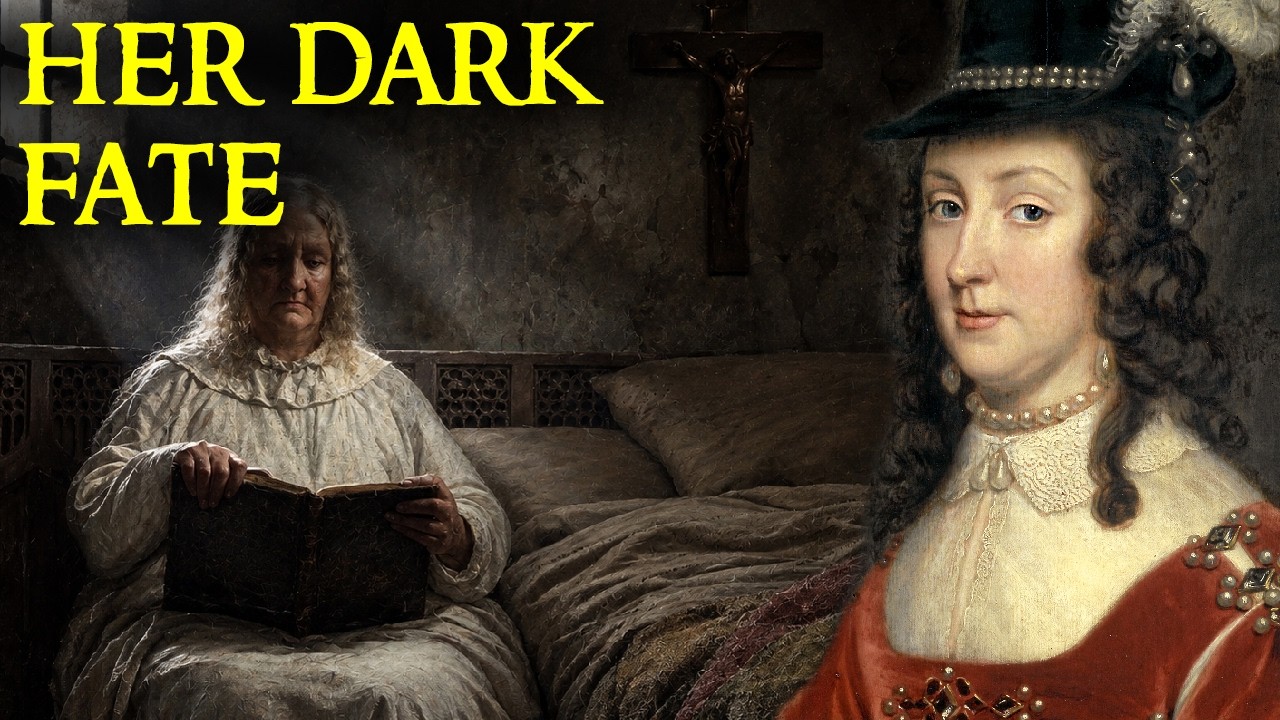
No charge was ever brought against her, no trial held, no sentence pronounced. And yet she was removed from English ground and handed back to her homeland, where a lifetime of imprisonment awaited her. For the twenty-two years that followed, she would be held inside a tower in Copenhagen, cut off from the world, deprived of a freedom she had once accepted as entirely her due. This is her story.
She was born Leonora Christina on July 8, 1621, at Frederiksborg Castle in Denmark. Her father was King Christian IV, who had taken the throne as a child and had reigned since 1588. Her mother was Kirsten Munk, a wealthy Danish noblewoman whom Christian had wed in 1615. Unlike Christian’s first wife, Anna Cathrine of Brandenburg, Kirsten came from no ruling house and held no royal title, which by definition made the union a morganatic one.
Indeed, Kirsten’s formidable mother, Ellen Marsvin, had obtained a promise from Christian to marry her daughter before she would permit the relationship to begin at all. Christian and Kirsten had fifteen children together, though at least three are thought to have been born before the marriage, making them illegitimate, and only eight lived to adulthood. Leonora was their fifth child after the wedding, and therefore a legitimate daughter of the king—in practical terms, a princess. But because of her mother’s modest social standing, she did not receive the same royal titles as the children Christian had fathered with his first wife.
She was known instead as a countess. At court, this distinction meant that Leonora and her siblings were seen as socially inferior to the king’s older children. Her father, however, paid little heed to such distinctions. He loved Leonora deeply and treated her as an equal to his other children.
Much of what is known about her childhood comes from her own later memoirs, which may not be entirely reliable. She appears to have spent her earliest years with her parents at the royal palace in Copenhagen, growing up in close familiarity with her three half-siblings, including the future King Frederick III, the sons of Christian’s first wife, Anna Cathrine of Brandenburg. But her childhood was not limited to Denmark alone. At some point she was sent to live with relatives in the Netherlands, and the voyage itself was a disaster: the ship carrying her was caught in a violent storm and nearly went down.
Then, while abroad, she fell ill with smallpox, the most dreaded disease of the age. She survived it, but a young boy she loved came to visit her during her illness, caught the disease from her, and died. This childhood tragedy clearly left deep psychological scars on her, wounds she would describe decades later. In 1630, Leonora’s family life was thrown into upheaval when Christian accused his wife Kirsten Munk of infidelity and divorced her.
Despite the scandal surrounding her mother, Leonora’s position at court remained fortunately secure, and she continued to enjoy her father’s goodwill. Around the same time, when she was only nine years old, word came that she was to be married to Corfitz Ulfeldt, a man from the king’s own inner circle who was twenty-four years of age. Because of her youth, the marriage was not officially concluded until October 1636, when she had turned fifteen. There had been many other suitors before the wedding finally took place.
The ceremony in Copenhagen appears to have been more lavish than any her sisters had received, an extravagant display that reflected how much her father treasured her. Yet the marriage had an ominous beginning in other respects. Leonora soon discovered that her new husband was drowning in enormous debts. She had to sell some of her gold and jewelry to help pay them off.
At the time, she could hardly have known that this was only the beginning, and that her husband’s actions would eventually drag her into a catastrophe from which she would never recover. Corfitz Ulfeldt had an unusual connection to the wolf. His surname, Ulfeldt, literally meant wolf. In 1647, a painting was made of Leonora with a small dog at her side, symbolizing her wifely loyalty, while a wolf stood beside her, representing her husband and his family.
Perhaps the symbolism was meant to suggest that the Ulfeldts remained inferior to the royal family, but as Leonora would soon discover, the wolf was not tame at all. The marriage in 1636 marked the beginning of Ulfeldt’s rise. And tragically, in the end, it would mark the fall of everyone involved, especially Leonora. Her husband was intelligent and well-educated, fluent in several languages, and possessed of immense ambition.
His marriage to the king’s daughter helped push him to the top of the Danish government at a critical moment in European history. Both Denmark and Sweden had been drawn into the Thirty Years’ War then raging across central Europe. In time, the count became governor of Copenhagen and head of the Danish treasury. Then, in 1643, he reached the peak of his political career when he was appointed Lord High Steward, the highest political office in the kingdom of Denmark.
By this stage, Leonora was, in many respects, the first lady of a Danish court that had no queen. Her marriage to Ulfeldt appears to have been happy as well, at least compared to those of her sisters. But behind their privileged life, Ulfeldt was exploiting his powerful positions to enrich himself on a staggering scale. He manipulated the Danish currency, acquired vast tracts of land, and used his influence to extort money from officials and nobles.
Worse still, his corruption reached into the military: funds meant for the Danish army and navy were diverted into his own coffers. The consequences became clear when Sweden attacked Denmark in December 1643. The Danish forces were completely unprepared, and when the resulting Torstenson War ended in 1645, Denmark was forced to cede several territories, including Gotland, while Sweden emerged as the dominant power in the Baltic. Yet despite the catastrophe, Ulfeldt kept his office, for the time being.
His spectacular fall, however, was imminent. The war with Sweden had been a disaster for Ulfeldt’s faction at the Danish court. Moreover, the death of Christian IV in February 1648 deprived Leonora’s husband of his most important patron and reduced her own standing in the royal establishment, given her mother’s lesser status. The new king, Leonora’s half-brother Frederick III, detested Ulfeldt and had no inclination to show much sympathy toward his half-sister and her husband.
Worse still, Frederick’s wife, the new queen Sophie Amalie, grew to loathe Leonora. Why she felt such hostility is not known for certain, though it may have arisen from Leonora’s unwillingness to surrender her position at court, or from small slights Leonora was reputed to have aimed at the queen. Whatever lay behind it, Sophie Amalie’s enmity brought consequences that would follow Leonora for decades. The first result was an inquiry into Ulfeldt’s tenure as head of government, and the crown set about seizing his estates and assets.
Then a strange charge made matters far worse. A woman by the name of Dina Vinhofvers came before the queen and alleged that Leonora and her husband were conspiring to poison the king. An inquiry was launched, and it quickly exposed many inconsistencies in her account; neither Leonora nor Ulfeldt was convicted of anything. Even so, the scandal did further harm to their reputations at a moment when they could least afford to lose them.
Then, in July 1651, they made a ruinous choice. They left Copenhagen without the king’s permission. It was a decision they would soon have cause to regret. After departing Copenhagen, Leonora, a royal princess at heart, spent twelve weeks dressed in men’s breeches and sleeping in peasant beds and barns as she traveled in secret with her husband toward northern Germany.
She may well have embroidered these later adventures. At a garrison near the town of Stade, for instance, she claimed to have won a tidy sum by playing cards with some drunken soldiers. In time they settled in Swedish Pomerania, in what is today northern Germany and northwestern Poland, and there Leonora took up writing for the first time. At last, in 1656, Count Ulfeldt judged that the tensions over his role in the Danish government during the 1640s had cooled sufficiently for Leonora to go back to Copenhagen.
He sent her back to negotiate with her half-brother and to secure their return home. But she never reached her brother, King Frederick. At Korsør she encountered another of her half-brothers, Ulrik Christian Gyldenløve, who commanded her to leave Danish territory. It was a betrayal that drove Ulfeldt past the point of no return.
When war broke out between Sweden and Denmark once more in 1657, he openly took the Swedish side, helping to negotiate the humiliating terms that forced Denmark to give up yet more territory in 1658. That triumph did not last for the disgraced couple, however. Within a year the count’s Swedish patron had changed his attitude toward him, and Ulfeldt was arrested at Malmö in 1659. He suffered a stroke that left him unable to speak, and for months afterward Leonora found herself acting as his chief defender.
In the end, during their trial, they resolved to flee Sweden. By then the count had recovered enough to take a ship to the city of Lübeck in northern Germany, while Leonora set out once more for Copenhagen. Neither journey went as planned. Instead, they were seized and shipped to Hammershus on Bornholm, a fortress perched on the cliffs above the Baltic, where the governor, a major general named Fuchs, methodically robbed and starved them.
They finally managed to escape in April 1661, with Leonora said to have climbed down a rope of seventy-two feet to freedom, while one of their servants had to be rescued from a ravine. People later said that this daring escape was so extraordinary that Leonora must be a witch. Afterward, an agreement was reached that let the couple live quietly at an estate at Ellensborg. But that arrangement did not last long.
The Ulfeldts were soon fleeing again. They managed to live quietly at Ellensborg for only a little more than a year before the situation shifted once more. In 1662, Leonora’s husband went abroad, having obtained permission on the pretext that the warmer air of southern Europe would improve his health. In truth, he had begun conspiring to win allies against the Danish crown and to regain power there at some future time.
When the Elector of Brandenburg, a relative of King Frederick of Denmark, reported the count’s activities to Copenhagen, Frederick decided that the cup had run over. Ulfeldt was tried in absentia, and an effigy of him was symbolically beheaded. In any case, he died near Basel in the Swiss Confederacy in early 1664, while fleeing from bounty hunters. By the time of her husband’s death, Leonora’s grim fate was already sealed.
At the height of their power in the 1640s, the Ulfeldts had lent money to numerous foreign monarchs and nobles. Among their debtors was the House of Stuart, in exile as a result of the English Civil Wars. Leonora now went to England to seek repayment from King Charles II, who had been restored as ruler of England in 1660. Instead, while she was in England, the Danish government asked the English authorities to detain her because of her husband’s actions on the continent.
In 1663, she was arrested and deported from Dover back to Denmark. For Charles II, this had the convenient side effect of getting rid of a woman pressing a substantial debt his family owed her. For Leonora, the consequences were devastating. She returned to Denmark not as a princess, but as a prisoner, and she would remain one for a large part of the rest of her life.
At home, Leonora was sent to the Blue Tower, a square tower with a blue roof in the courtyard of Copenhagen Castle, where she was first imprisoned on the eighth of August, 1663. Ironically, it stood only a stone’s throw from the place where she had grown up. Leonora was never formally charged with any crime. Six months later, her husband’s death removed any need for the Danish crown to pursue further legal action against the family.
Yet she remained imprisoned, not because she had been convicted of anything, but because her stepmother despised her, and her half-brother, the king, had little reason to trust her after two decades of scandals and intrigues. In the end, Leonora spent an astonishing twenty-two years behind bars. Her first cell in the Blue Tower was said to be a windowless room she later called the “dark church.” Leonora later described her imprisonment as a miserable and degrading life.
She claimed her cell was filthy, filled with fleas, and overrun with rats, so numerous that they nibbled at her candle while it burned. She also remembered having almost nothing to write with, forced to improvise ink from candle soot and to use the sugar wrappers she received as writing material. It is hard to know how accurate her account was, but there is no doubt her conditions were extremely harsh. As time passed, she adapted and gained greater access to books and the ability to write, turning her years of imprisonment into the unexpected beginning of her greatest literary work.
She started writing “Jammers Minde,” a memoir whose title translates roughly to “Remembrance of Woe.” In fairness to Leonora, separating truth from invention in her memoir is no easy task, yet she was a gifted storyteller, and the book was never an exercise in self-pity. It offered entertaining anecdotes about her years as a prisoner and the poor judgments of her youth. Elsewhere, the work included strikingly candid passages, among them a detailed account of passing a gallstone in 1682.
The tone of the work was frequently biblical, with Leonora presenting herself as a sort of modern-day Jacob, a figure who endured countless misfortunes, many of them at the hands of others. Her greatest sin, as she framed it, was that she had been an obedient Christian wife who would not abandon her husband despite his flaws and failures. In 1670, Frederick III died and was succeeded by her step-nephew, Christian V. Her treatment improved somewhat under the new king, who dispatched his ministers to ask the dowager queen, Sophie Amalie, to consent to her release.
Yet if Leonora’s account is to be believed, the dowager queen turned away their pleas. Leonora’s imprisonment finally came to an end with the death of Sophie Amalie in February 1685. On the morning of the nineteenth of May, Leonora learned that a royal order for her release had been issued. Word traveled fast, and crowds of the curious assembled in the courtyard beneath the Blue Tower, while the queen and her ladies-in-waiting looked on from a palace balcony, hoping for a glimpse of the mysterious royal prisoner.
But Leonora would not leave until darkness had fallen. At around ten o’clock, after nearly twenty-two years of captivity, she at last stepped out of the Blue Tower under cover of night, a veil concealing her face from the waiting crowds. At sixty-three years of age, Leonora Christina was finally free. In her final years, she was given the former convent of Maribo as a residence and granted a pension.
There she spent her last thirteen years writing and embroidering, carefully shaping her own legacy. She died on the sixteenth of March, 1698, at the age of seventy-six. Curiously, when her family’s burial vault was opened in the nineteenth century, her coffin was nowhere to be found. Her son Leo had moved it to Vienna after her death.
She and her husband had had children during their many adventures, ten in all, seven of whom survived to adulthood. One of her daughters took care to send the manuscript of “Jammers Minde” to Vienna. It stayed there in the archives for two centuries, until one of her descendants, Count Johann Waldstein, arranged for its publication in Copenhagen in 1869. By then, of course, the scandalous deeds of the Count and Countess Ulfeldt were no longer as politically sensitive as they had once been.
In the process, Leonora became a national heroine overnight. Some of her descendants, however, insisted she was a traitor who had colluded with the Swedes during a vital period of Danish history. Whatever one’s viewpoint, this remains an extraordinary testimony to a remarkable life filled with some rises and very, very many falls.
