William Bowers Bourne II built one of America’s most beautiful estates, a 56-room mansion with sixteen acres of formal gardens set in the hills south of San Francisco. He named it Filoli, a word derived from his personal creed: Fight for a just cause, love your fellow man, live a good life. Every year, more than 400,000 visitors walk its grounds. Most never know the name of the man who built it, or the complicated story of how the fortune that created it was made.
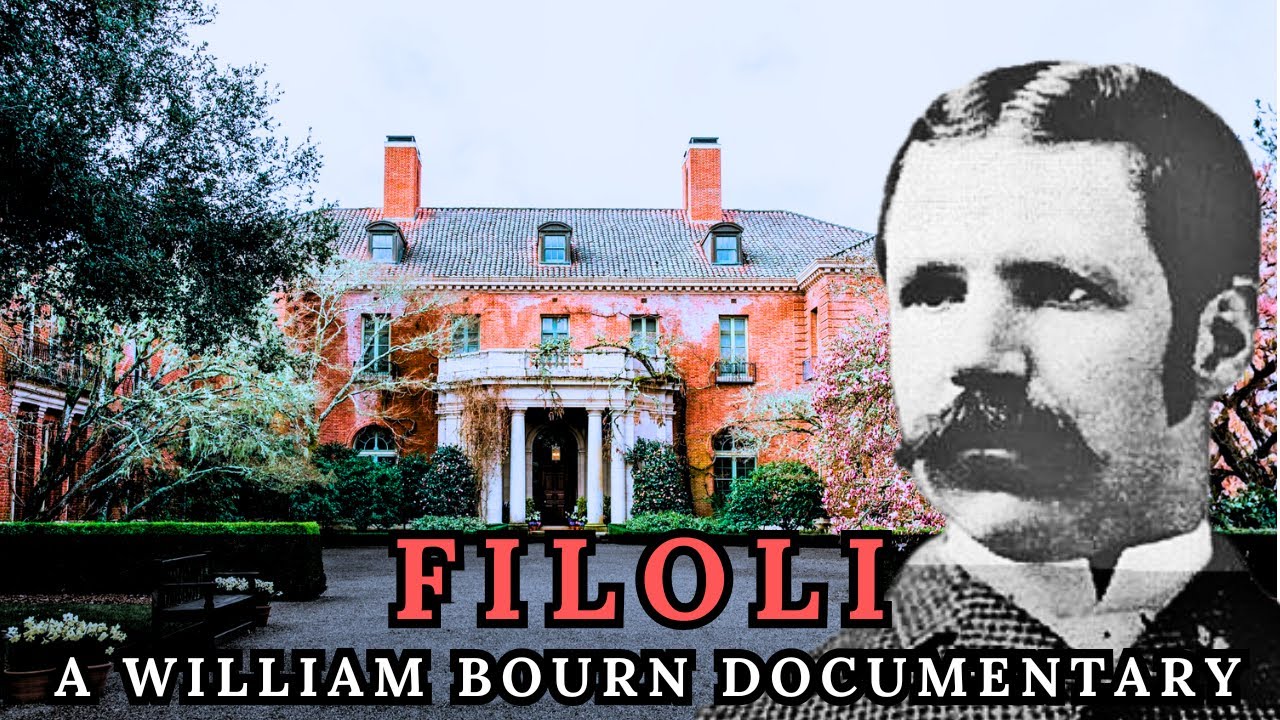
Bourne’s story began with his father’s suicide. William Bourne Senior had arrived in San Francisco during the gold rush and understood that the real money was not in finding gold but in selling to those who searched for it. He built a fortune and acquired controlling interest in the Empire Mine, one of the oldest and deepest hard-rock gold mines in California. But after the death of his ten-year-old son Frank in 1872, the family began to unravel.
The mine faltered, debts mounted, and on the morning of May 5, 1874, Bourne Senior was found shot in the bathroom of his Nob Hill mansion. A revolver lay nearby. The first inquest ruled suicide; a second, for reasons lost to history, ruled accidental death. He was 51.
His eldest son, William Jr. , was seventeen and studying at Cambridge University in England, three thousand miles away. He stayed there for four more years, completing his education, before returning to California in 1878 to face his inheritance. What he found was a disaster.
The Empire Mine had flooded, the ore at its deepest level was exhausted, and experts considered the property finished. Bourne, twenty-two years old, did the unexpected. He reorganized the company and announced he intended to dig deeper than anyone had ever attempted in California. He could not do it alone.
He found the men he needed in Cornwall, England, where miners had spent a thousand years perfecting techniques for going deeper and pumping water. The Cornish men came by the thousands, bringing their steam-powered pumps and their hard-rock expertise. By 1890, the population of Grass Valley, where the mine was located, was 85 percent Cornish. Bourne also hired his nineteen-year-old cousin George Starr, who rose from mucker to superintendent and introduced compressed air drills a full decade before most competitors.
The shafts pushed past 1,200 feet, past 3,000, each level revealing new veins of gold. The gamble had worked. Bourne became one of the wealthiest men in California. The triumph carried a brutal cost.
The Cornish miners worked ten-hour shifts, six days a week, for three dollars a day. The rock dust from the compressed air drills filled the tunnels with silica, slowly destroying the miners’ lungs with silicosis. There was no treatment and no compensation. An explosion in 1888 killed two men and sparked the first labor unionization in Grass Valley.
Strikes followed in 1907 and 1919. The newspapers celebrated Bourne as a captain of industry. They did not write about the men who coughed blood in boarding houses. With his gold fortune secured, Bourne saw opportunity in something even more valuable: the water supply of San Francisco.
The Spring Valley Waterworks had established a monopoly over the city’s water in the 1860s, using eminent domain to force the sale of private land at a fraction of its value. It was hated. San Francisco residents paid 24 cents per thousand gallons while residents of Los Angeles, served by a city-owned utility, paid 10. When the 1906 earthquake devastated the city, the shattered water mains left firefighters helpless as the fires that destroyed over 25,000 buildings raged for three days.
Spring Valley became a symbol of failure. Bourne bought a controlling interest in the company in 1908 and became its president. The San Francisco Chronicle called him a thief and a scoundrel for his water rates. He replied that the company deserved a reasonable return on its investment.
The argument convinced no one who paid a water bill. From those holdings came the land for his greatest monument. The 654 acres at the southern end of Crystal Springs Lake belonged to Spring Valley Water Company, assembled through decades of eminent domain seizures. In 1915, Bourne commissioned his architect Willis Polk to build a country estate there, a Georgian mansion adapted for California with reinforced foundations capable of withstanding earthquakes.
The site sat almost directly on the San Andreas fault. Bourne knew this. He built anyway. The house rose over three years, staffed by a hundred workers.
It contained 56 rooms, 17 fireplaces, quarters for fourteen staff, and a ballroom designed for concerts. The gardens, completed between 1917 and 1922, covered sixteen acres in a sequence of outdoor rooms. The sunken garden featured a reflecting pool holding 8,000 gallons of water. The irony was not lost on anyone.
The president of the Spring Valley Water Company, the man who charged San Franciscans premium rates for every gallon, had built an estate where water existed purely for beauty. By the time Filoli was completed, Bourne was 65 and had suffered a stroke that left him partially paralyzed. The man who had descended into mine shafts and crossed oceans would spend the next fifteen years confined to a wheelchair. At Filoli, the gardeners received instructions to stay out of sight when Mr.
Bourne was being wheeled through the grounds. Most mornings, weather permitting, he asked to be taken to the high place at the southern end of the garden, where he could look down over the formal gardens to the lake in the distance. It was all he had left of the active life he had planned. There was one final chapter he had not anticipated.
When he could no longer travel to his daughter Maud’s estate in Ireland, he commissioned artist Ernest Peixotto to paint five large murals of the Irish property for the ballroom, transforming the grandest room at Filoli into a permanent vision of a country he would never see again. To ensure they would fit, Peixotto built a detailed miniature model of the ballroom from the architect’s plans and painted tiny versions of his murals onto its walls. The murals were installed in 1925. Bourne could sit in his wheelchair in the seventy-foot-long ballroom and see Ireland surrounding him.
The losses came in rapid succession. In February 1929, his daughter Maud died of pneumonia on a ship crossing the Atlantic to visit him. She was 46. A Celtic cross, copied from one standing in the ruins of an Irish abbey, was erected on a hill west of the house.
She was buried there beside the infant son Bourne had lost a day after his birth decades earlier. Within months, Bourne sold the Empire Mine to Newmont Mining Corporation. The following year, the city of San Francisco finally purchased the Spring Valley Water Company. In 1932, the family gave the Irish estate to the Irish government as a memorial to Maud.
It became the first national park in the Irish Free State, the foundation of what would grow into Killarney National Park. Agnes Bourne developed diabetes in 1932 and was confined to her bedroom. The parties continued at Filoli, with Bourne’s sister Ida serving as hostess, but the owners no longer attended. They had withdrawn from the life of the house they had built.
Agnes died on January 3, 1936. William died six months later, on July 5, 1936, at the age of 79. He was buried on the hill beside his wife, his daughter, and the infant son who had never been given a chance to live. The house stood empty for only a few months.
William P. Roth, president of the Matson Navigation Company, and his wife Lurline purchased Filoli for $225,000. Like Bourne, William Roth suffered a debilitating stroke, in 1943, and Lurline adapted the property to accommodate him, adding a swimming pool for his rehabilitation. She threw herself into the gardens, persuading the elderly Isabella Worn, who had helped create the original plantings, to return as an advisor.
The gardens grew and evolved. Amelia Earhart visited in 1937 and took Lurline for a plane ride over the estate, months before the aviator disappeared over the Pacific. The pianist Ignacy Paderewski performed in the ballroom beneath Peixotto’s Irish murals. William Roth died in 1963.
Lurline stayed on alone in the 56-room house, continuing to tend and improve the gardens. In 1975, at 85, she learned that a buyer for the estate would not allow public access. She refused to complete the sale. Instead, she donated Filoli in its entirety to the National Trust for Historic Preservation with an endowment of $2.
4 million, saying, Filoli is too beautiful to be private. The cameras arrived almost immediately. Warren Beatty filmed Heaven Can Wait there in 1978, and the estate appeared in the opening credits of Dynasty from 1981, known to millions of viewers only as the Carrington mansion. On November 15, 2023, President Joe Biden and Chinese President Xi Jinping met at Filoli for four hours of talks during the Asia-Pacific Economic Cooperation Summit, their meeting broadcast around the world.
The empire Bourne built is gone. The gold mine sold, the water company absorbed, the Irish estate given to another nation. His family lies buried on the hillside beneath a Celtic cross. But the house remains, and the gardens flourish, and every year hundreds of thousands of people walk the paths he planned and stand where he stood, looking out at the hills of California.
He had hoped to grow young there. He grew old instead, watching from his wheelchair as the years slipped away. But the beauty he created has outlasted his fortune, outlasted his family, outlasted even the memory of his name for most of the visitors who pass through its gates.
