On May 15th, 2025, a fire broke out in the south wing of Nottoway, the largest antebellum mansion in the American South. By evening, the main house was gone. One hundred and sixty-six years of history had turned to ash. Fifty-three thousand square feet, sixty-four rooms, a white ballroom where seven daughters once danced—all of it reduced to rubble in a matter of hours.
The family cemetery remained. The outbuildings survived. The owners said they intended to rebuild, but the original Nottoway, the house that John Hampton Randolph built to last forever, existed now only in photographs. Nottoway was never supposed to survive in the first place.
The Civil War should have destroyed it, as it destroyed so many others. Time and neglect nearly finished the job. That it stood as long as it did was something of a miracle. That it burned in our own time felt like the closing of a chapter most Americans never knew existed.
Before the Gilded Age, there was another era of American fortunes. Cotton planters in Mississippi commanded more wealth than the bankers of Boston. Merchant princes in New York built marble palaces while the city around them was still mud and cobblestone. Immigrants arrived with empty pockets and died richer than kings.
By 1848, one man controlled nearly one percent of the entire American economy. His name was John Jacob Astor, and he was only the beginning. He could barely write his own name. The letters came out crooked, the spelling atrocious.
In polite New York society, men mocked his German accent and laughed at the way he wiped his hands on the tablecloth at dinner. He had no education, no refinement, no family connections. What he had was an understanding of money that bordered on the supernatural. Johann Jakob Astor was born in 1763 in Waldorf, a small village near Heidelberg in the German states.
His father was a butcher. His childhood offered nothing that would suggest future greatness—just the smell of blood, the grind of poverty, and four older brothers competing for scraps. At sixteen, he fled to London. Six years later, he boarded a ship for the new American republic.
He arrived in Baltimore in the spring of 1784, carrying almost nothing. Some accounts say he had a few dollars. Others say he had seven flutes he hoped to sell. What matters is what he did next.
Within months, Astor found work beating dust from animal pelts on the New York waterfront. Beaver fur was valuable; the fashion houses of London demanded it for hats. Astor learned the trade from the ground up, literally scraping flesh from skins with his bare hands. His employers noticed something unusual: the young German seemed to understand instinctively what pelts were worth, what traders would pay, where the best furs could be found.
By 1786, he had opened his own shop. Within a decade, he was bypassing middlemen entirely, traveling into the wilderness himself to trade directly with Native American trappers. He learned their languages. He earned their trust.
He paid them fairly, or at least fairly enough that they kept coming back. The fur trade made him rich. But Astor understood something his competitors did not. Fur was a commodity; its value fluctuated with fashion and supply.
Land, on the other hand, only moved in one direction. Manhattan in 1800 was a city confined to the southern tip of a long island. To the north lay farms, forest, and swampland. Most investors saw nothing worth buying.
Astor saw the future. In 1799, he began purchasing property—not the developed lots near the harbor where merchants crowded together, but empty acreage miles from the city center. Farmland others dismissed. Rocky hillsides no one wanted.
Five years later, he acquired a seventy-acre parcel at a place called Hellgate, overlooking the East River. A country house rose there for his wife Sarah and their children. It became known as the Astor Mansion. The strategy was simple and ruthless: buy land, never sell.
Lease it to developers who built houses and shops on the property. When the leases expired after twenty-one years, everything on the land—every building, every improvement—belonged to Astor. He could renew the lease at a higher rate or simply take possession of structures he had never paid to build. New York kept growing.
The city crept northward year after year, swallowing the farms and forests Astor had quietly accumulated. His bet was paying off beyond anything he could have imagined. By 1830, the fur trade had declined. European fashion had moved on from beaver hats.
Astor saw the shift coming and liquidated his fur holdings at the peak. He poured everything into Manhattan real estate. He also diversified into ventures that polite biographers later preferred to ignore: his ships carried opium to China. The profits were extraordinary.
The Astor House rose on Broadway in 1836, directly across from City Hall. Six stories tall with over three hundred rooms, it became the finest hotel in America. Running water on every floor, gas lighting throughout, a dining room that seated three hundred guests. Presidents stayed there.
Foreign dignitaries considered it essential. When Abraham Lincoln arrived in New York in February 1860 to deliver his famous address at Cooper Union, he checked into the Astor House. Astor himself lived modestly by the standards of his wealth. He spent his final years at Hellgate, wrapped in blankets, his mind slowly failing.
Servants reportedly tossed him in the air each day to stimulate his circulation. He died on March 29th, 1848. His estate was valued between twenty and thirty million dollars. At the time, the word millionaire was so new that newspapers had to explain what it meant.
Astor’s fortune represented somewhere between nine-tenths of one percent and one and three-tenths of one percent of the entire American gross domestic product. In modern terms, that would place him among the wealthiest human beings who ever lived. He left instructions for a library to be built in his name. The Astor Library opened in 1854 and later merged with other collections to form the New York Public Library.
It was his only significant act of public generosity. His heirs took control of Manhattan. The Astor family would dominate New York society for three generations. They became the definition of old money, the established aristocracy against which every new fortune would be measured.
When the Vanderbilts later tried to enter elite social circles, the Astors looked down on them as vulgar newcomers. But in 1848, the Vanderbilts were still running ferries. The Gilded Age had not yet begun, and John Jacob Astor, the butcher’s son from a German village, the man who could barely sign his own name, had shown America what was possible. New Yorkers called it a palace, and they were not exaggerating.
When the building opened on Broadway in 1846, nothing in America looked like it: five stories of Tuckahoe marble rising across from City Hall, enormous plate-glass windows that let sunlight flood the interior, a rotunda with a domed ceiling. This was not a shop. This was a cathedral built for commerce. The man who built it was an Irish immigrant named Alexander Turney Stewart.
Born in Lisburn, County Antrim, in 1803, he came to New York as a young man, taught school briefly, then returned to Ireland to collect a small inheritance from his grandfather. He used the money to buy Irish lace and linen, sailed back to America, and opened a shop. The first store was tiny—a rented room on Broadway, twelve feet wide and thirty feet deep. Stewart lived in the back.
But he had a different vision than his competitors. He put price tags on everything. No haggling, no negotiation, no different prices for different customers. The price was the price.
Women could browse without being pressured, compare, return. It sounds obvious now. In 1823, it was revolutionary. The Panic of 1837 destroyed dozens of New York merchants.
Stewart survived by buying their inventory at a discount. Within three years, he was a millionaire. Within six more, he needed a building that matched his ambitions. The Marble Palace became more than a store.
It became a destination. Women arrived by carriage to spend entire afternoons wandering the floors. Stewart installed full-length mirrors so they could admire themselves in the merchandise. He hired handsome young clerks.
He created seasonal sales, fashion shows, special events. Shopping became entertainment. Mary Todd Lincoln was a regular customer. When she visited New York, Stewart personally escorted her through the store and presented her with a lace shawl worth a small fortune.
The publicity was priceless. When the Civil War ended, Stewart ranked among the three wealthiest men in America. Only the Astors and the Vanderbilts could match him. He built a second store, even larger than the first—an iron-framed giant covering an entire city block between Broadway and Fourth Avenue.
New Yorkers dubbed it the Iron Palace. Then he turned his attention to Fifth Avenue. In 1869, Stewart commissioned architect John Kellum to build him a mansion—not a brownstone like his neighbors, but a residence faced entirely in marble. Fifty-five rooms arranged across three floors with a mansard roof in the French style.
The location was strategic: Thirty-Fourth Street and Fifth Avenue, directly across from Caroline Schermerhorn Astor, the most powerful woman in New York society. The interior was more museum than home. Paintings by European masters lined the walls. The art collection alone was valued at six hundred thousand dollars.
Chandeliers, tapestries, furniture imported from Paris. Stewart had built the first great mansion of what would become Millionaires’ Row. He never found acceptance among the old families. The Astors tolerated him.
Society attended his parties. But Stewart remained what he had always been in their eyes: a shopkeeper, no matter how rich. When President Ulysses Grant nominated him for Secretary of the Treasury in 1869, an old law barring importers from the position forced him to withdraw. Stewart died on April 10th, 1876.
His estate was valued between thirty-five and sixty million dollars. He left everything to his wife, Cornelia. What happened next was a tragedy of misplaced trust. Cornelia handed control of the business to Judge Henry Hilton, her husband’s lawyer.
Within six years, Hilton had driven the retail empire into receivership. The fortune that took fifty years to build was largely destroyed in less than a decade. Cornelia died in 1886. The mansion on Fifth Avenue was leased to the Manhattan Club, then demolished in 1901.
Today, the Empire State Building stands on the site where Stewart once displayed his art collection. The Marble Palace on Broadway still stands. It served as offices for the New York Sun newspaper for decades. The facade is darkened with age, the retail floors long converted to other uses.
But if you look up from the sidewalk, you can still see what Stewart built in 1846: a temple of commerce that changed the way Americans shopped. Frederick Stanton lived in his dream house for nine months. Then he was dead. Yellow fever took him on January 4th, 1859.
He was sixty-four years old. The mansion he had spent eight years building, the grandest private residence in Mississippi, became a monument to a man who barely had time to sleep in its beds. To understand what Stanton built, you first have to understand where he built it. Natchez, Mississippi, in the 1850s was not what most Americans picture when they think of the antebellum South.
This was no backwater of cotton fields and country farmers. Before the Civil War, Natchez had more millionaires per capita than any city in America—more than New York, more than Boston, more than Philadelphia. The wealth came from cotton. Over half of all American exports in this period were southern cotton, and much of it flowed through Natchez.
The city sat high on a bluff overlooking the Mississippi River. Steamboats lined the waterfront. Commission merchants like Stanton brokered deals worth fortunes. Planters who owned thousands of acres built mansions along the bluff to announce their status to every passing vessel.
Stanton was not born to this world. He arrived from Ireland in 1815, a young man of twenty-one with no money and no connections—County Antrim near Belfast, the same region that produced A. T. Stewart.
Something in that Irish soil bred men who understood how to accumulate wealth in America. He started as a clerk. He learned the cotton trade. He married Huldah Helm, daughter of a respected local family.
Year by year, he built his fortune as a broker and planter, buying and selling cotton, acquiring land, expanding his holdings. By 1849, Stanton had enough money to purchase an entire city block in the heart of Natchez. He hired Thomas Rose, a local builder, to design something worthy of his success. Construction began in 1851.
Six years later, the house was finished. Stanton called it Belfast after his homeland. Everyone else called it Stanton Hall. The mansion occupied the full block, surrounded by wrought-iron fencing with elaborate gateposts.
Two stories of white-painted brick rose behind a colonnade of Corinthian columns. The ceilings soared seventeen feet high. The cypress doors stood fifteen feet tall. Carrara marble mantels imported from Italy framed the fireplaces.
Bronze chandeliers from France hung in every major room. Sheffield silver hardware adorned the doors. The total cost was approximately eighty-three thousand dollars—in modern terms, several million. Local craftsmen, many of them enslaved, created the ornate woodwork and plasterwork that decorated every surface.
Their skill rivaled anything produced in New York or London. Natchez had its own class of master artisans, and Stanton hired the best. The white ballroom was designed to host the social events that defined status in Natchez society. This was a city obsessed with display, with hierarchy, with proving that southern wealth could match or exceed anything the North could produce.
Stanton Hall was his entry into that competition. He moved in sometime in early 1858. Months later, he was gone. Huldah Stanton lived in the mansion for another thirty-five years.
She raised their children there, survived the Civil War there, watched Union soldiers occupy Natchez there. When she died in 1893, the house passed out of the family. It became Stanton College for young ladies. It passed through various owners.
By the 1930s, it had fallen into disrepair. The Pilgrimage Garden Club of Natchez purchased it in 1938 and began restoration. Today, Stanton Hall is a museum and event venue. The chandeliers still hang.
The marble mantels still frame the fireplaces. The ballroom still hosts gatherings, though the guests now pay admission rather than receive invitations. Frederick Stanton built his castle to last forever. He just never got to live in it.
Fifty-three thousand square feet, sixty-four rooms, one hundred sixty-five doors, two hundred windows—an acre of floor space across three stories. John Hampton Randolph did not want a house. He wanted a castle. Randolph came from Virginia aristocracy.
His family had been prominent in the state for generations; his father served as a federal judge appointed by President James Monroe. But Virginia was old money, old land, old limitations. Louisiana offered something else: sugar. In 1842, Randolph moved his wife Emily and their growing family to a cotton plantation he named Forest Home.
Within two years, he had converted the operation to sugarcane. The decision transformed his fortunes. Sugar tripled his earnings over cotton. He began acquiring land relentlessly—neighboring plantations, swampland, river frontage.
At his peak, Randolph controlled over seven thousand acres and owned 176 enslaved people. By 1855, he was ready to build. He purchased a thousand-acre tract facing the Mississippi River in Iberville Parish. He wanted every steamboat captain rounding the bend to see his house and understand exactly who lived there.
In 1857, he hired Henry Howard, the most sought-after architect in New Orleans, and gave him a single instruction: spare no expense. Construction took two years. Enslaved workers made bricks from clay dug on the property. Cypress timber came from nearby swamps.
Craftsmen installed Baccarat crystal chandeliers, hand-carved marble mantels, Dresden porcelain doorknobs. Every floor had a bathroom with running water and flushing toilets. Gas lighting illuminated every room. In 1859, these were luxuries that most American hotels could not offer.
The white ballroom became the centerpiece. Randolph had it painted entirely white—walls, floor, and ceiling—to showcase the beauty of his seven daughters. Six of them married in that room. When construction finished, Randolph did something unusual: he destroyed the architect’s plans.
No one would ever build a copy of his house. Nottoway was the largest antebellum mansion in the South. Only one other plantation house in Louisiana, Belle Grove, was larger—and it burned in 1852. Nottoway stood alone.
Then came the war. Randolph sent his sugar equipment to Texas to keep the business running. Emily stayed behind with the younger children. Union and Confederate soldiers both passed through.
Someone fired a cannon that chipped a column, but the house survived. Unlike so many others, Nottoway was never burned, never looted, never abandoned. Randolph struggled financially after emancipation but held on to his land. He died in 1883, still living in the house he built.
His widow sold the plantation six years later. It passed through various owners for the next century. A doctor tried to run it as a sugar operation. His widow lived there alone for decades, unable to maintain it properly.
In 1980, a restoration began. Nottoway became a resort, a tourist attraction, a filming location. It earned four-diamond ratings and hosted weddings in the white ballroom. One hundred sixty-six years after construction, the largest antebellum mansion in the South still stood.
He destroyed the architect’s plans so no one could copy his masterpiece. In the end, no one needed to. The trees came first. Twenty-eight live oak saplings planted in two perfect rows, leading from the Mississippi River toward the horizon.
Someone put them in the ground around 1700, long before Louisiana belonged to the United States, long before anyone imagined sugar fortunes or Greek Revival mansions. Just trees. By the time Jacques Telesphore Roman III arrived at the property in 1837, those oaks had been growing for over a century. Their branches met overhead, creating a tunnel of green nearly a quarter of a mile long.
Roman saw them and understood immediately: the trees were worth more than the land. Roman came from New Orleans Creole society. His family had money, connections, and French refinement that set them apart from the rougher planters upriver. His brother André built Valcour Aime’s plantation house, considered the finest in Louisiana until it burned.
Jacques wanted something equally impressive. The oaks gave him his design. He commissioned architect Joseph Pilié to build a house at the end of that oak canopy, Greek Revival style, with twenty-eight Doric columns to match the twenty-eight trees. The symmetry was deliberate.
Everything about Oak Alley was designed to be photographed, though photography barely existed yet. Construction took two years. The house rose on brick piers to protect against flooding. Galleries wrapped around both floors, shading the interior from Louisiana heat.
The detailing was restrained compared to Nottoway or Stanton Hall—no elaborate plasterwork, no imported chandeliers. The oaks were the statement. The house was just the backdrop. Jacques Roman moved in around 1839 with his wife Celina and their children.
He ran a successful sugar operation, planting cane in the rich alluvial soil between the river and the swamps. Approximately one hundred enslaved workers lived in quarters behind the main house, hidden from view. Roman had borrowed heavily to build. The house cost money; the sugar operation required constant investment—steamboat passage, equipment, labor.
Within nine years, the debts had overwhelmed him. Jacques Roman died in 1848. Financial pressure appears to have contributed to his early death. Celina was left with the plantation, the debts, and five children.
Most widows would have sold. Celina Roman held on. She managed Oak Alley through the 1850s, one of the few women running a major Louisiana sugar plantation. She maintained production levels and slowly reduced the debt load.
Practical, determined, unwilling to abandon what her husband had built. Then came the war. Oak Alley sat directly on the Mississippi River, which made it strategically valuable and dangerously exposed. Union gunboats controlled the waterway by 1863.
Federal troops occupied the plantation. They used the house as headquarters. They confiscated sugar. They freed the enslaved workers who had made the operation profitable.
The house stood when the war ended. Belle Grove burned. Dozens of other plantation houses burned. Oak Alley remained.
The oaks continued their slow expansion skyward. Celina stayed until her death in 1881. After emancipation, the sugar business collapsed; without enslaved labor, the economics no longer worked for most planters. Oak Alley limped along for another generation before leaving the Roman family.
In the 1920s, Andrew and Josephine Stewart purchased Oak Alley. Josephine was the daughter of the governor of Mississippi. She had the money and the vision to restore what decades of neglect had damaged. The couple spent years bringing the house back, repairing columns, replacing rotted wood, maintaining the grounds.
They also understood something the Romans never had to consider: tourists. By the 1930s, Americans were driving automobiles along new highways, searching for glimpses of the Old South. Oak Alley, with its dramatic oak canopy and pristine white columns, drew visitors willing to pay admission. Local garden clubs organized tours.
The plantation transformed from private residence into public monument. Josephine Stewart died in 1972. She left Oak Alley to the nonprofit Oak Alley Foundation with instructions to preserve it permanently. Today, the property operates as a museum and event venue.
Weddings happen beneath the oaks. Tour groups walk the same path Jacques Roman walked when he first saw those trees. Hollywood discovered Oak Alley in the late twentieth century. The oak canopy appears in Interview with the Vampire, Primary Colors, and dozens of other films.
The avenue photographs well. The symmetry works on camera. The oaks remain. Twenty-eight trees still standing, still growing, planted by someone whose name nobody remembers.
They were there before the Romans. They outlasted the war. They outlasted everyone who ever claimed to own them. Two hundred years of growth cannot be stopped by debt or war or changing economies.
Jacques Roman understood that the trees mattered more than the house. The trees proved him right. Cornelius Vanderbilt died the richest man in America—one hundred million dollars. More wealth than John Jacob Astor accumulated in his entire lifetime, more than the federal government held in its treasury at the end of the Civil War.
He lived in a brownstone at 10 Washington Place in Manhattan, three stories, purchased in 1846 for around fifty thousand dollars. He died there thirty-one years later, in the same bedroom. Vanderbilt was born in 1794 on Staten Island. Ferryboats were the family business.
His father ran a small operation to Manhattan. The family had nothing beyond hard physical labor on the water. At sixteen, Cornelius borrowed one hundred dollars from his mother to buy a sailing vessel, promising to repay by plowing eight acres of rocky farmland. He delivered.
Then he undercut his father’s prices and worked longer hours. Two years later, he controlled most Staten Island ferry traffic. In 1813, he married his first cousin, Sophia Johnson. Thirteen children followed.
Sophia managed the household. Cornelius expanded the business. The War of 1812 brought government contracts; Vanderbilt supplied New York Harbor forts, working around the clock, sleeping on his boat. His savings grew.
By 1829, he had shifted to steamboats. Steam was faster, more reliable. He sold his sailing fleet and learned the steamboat business working for Thomas Gibbons. A decade later, he owned his own steamship line running Hudson River routes to Albany.
Lower fares, better service. Competitors tried to drive him out. Vanderbilt absorbed losses and outlasted them. They sold out or went bankrupt.
The California Gold Rush of 1849 created his next opportunity. Vanderbilt built a route through Nicaragua: steamship to Nicaragua, overland crossing, steamship to California. Faster than overland, cheaper than Cape Horn. Thousands of passengers monthly.
Extraordinary profits. By 1860, he had accumulated fifteen to twenty million dollars. He was approaching seventy. Railroads were next.
The Civil War proved railroads were replacing steamships for domestic transportation. Vanderbilt bought the New York and Harlem Railroad, the Hudson River Railroad, then the New York Central, running from New York to Buffalo. He fought a proxy battle and won. By 1867, he controlled the most important rail corridor in the eastern United States.
His fortune grew exponentially—by 1870, somewhere between sixty and eighty million dollars. Sophia died in 1868. Vanderbilt remarried a year later to Frank Armstrong Crawford, a distant cousin from Mobile, Alabama. She was forty-five.
He was seventy-six. On January 4th, 1877, Cornelius Vanderbilt died at age eighty-two. His estate was worth approximately one hundred million dollars. He left the overwhelming majority to his eldest son, William.
His other children received modest inheritances. Some received nothing. He left five hundred thousand dollars to establish Vanderbilt University in Nashville. The Commodore believed in earning money, not giving it away.
William turned one hundred million into two hundred million. His son built a mansion on Fifth Avenue that cost three million dollars. His grandson built Biltmore, the largest private residence in America: 250 rooms. The Commodore lived in a brownstone.
William Paulding wanted a castle. In 1838, he hired Alexander Jackson Davis, the most innovative architect in America. They chose a site in Tarrytown overlooking the Hudson River, thirty miles north of Manhattan—sixty acres of wooded land with views across the water. Davis delivered Gothic.
The house rose in pale stone with asymmetrical massing, pointed arches, and a tower dominating the roofline. Diamond-paned windows, elaborate tracery, crenellations along the parapets. Nothing in America looked like it. Paulding’s neighbors called it a folly.
Gothic was considered foreign, gloomy, unsuitable for a modern republic. Greek Revival represented democracy. Gothic represented medieval aristocracy. Paulding named the estate Knoll and lived there until his death in 1849.
His son inherited but found it expensive to maintain. In 1864, he sold to George Merritt, a Manhattan merchant who had made his fortune trading with China. Merritt brought Davis back. The architect doubled the size of the original structure, adding a massive north wing, expanding the tower, creating new galleries and reception rooms.
He filled the house with Asian art and artifacts. He renamed it Lindenhurst, later shortened to Lyndhurst. George Merritt lived there until 1873, when financial difficulties forced a sale. Jay Gould paid $250,000.
Gould was a name that made respectable New Yorkers flinch: railroad speculator, stock manipulator, the man who tried to corner the gold market in 1869 and triggered Black Friday, devastating thousands of investors. Gould emerged richer. His reputation never recovered. By the time he purchased Lyndhurst, Gould controlled multiple railroad lines and held stakes in Western Union Telegraph and the New York elevated railway system.
His fortune was estimated at seventy million dollars. Manhattan society had made clear he was not welcome. Lyndhurst gave him privacy—isolated, secure, difficult to approach unseen. Gould spent summers there with his wife Helen and their six children.
He added a bowling alley and a greenhouse complex that became one of the largest private conservatories in America. Helen Gould died in 1889. Jay’s health was declining. Tuberculosis killed him on December 2nd, 1892, at age fifty-six.
Jay Gould left Lyndhurst to his eldest daughter, Helen. She never married. She dedicated her life to philanthropy. When the Titanic sank, she donated $100,000 to relief efforts.
During World War I, she funded YMCA facilities for soldiers. She gave millions to churches, hospitals, and universities. Helen lived at Lyndhurst for forty-six years after her father’s death, maintaining the house exactly as it had been during his lifetime—the interiors unchanged, the art collection in place. She died in 1938.
Her younger sister, Anna, inherited the estate and lived quietly at Lyndhurst until her death in 1961. Lyndhurst passed to the National Trust for Historic Preservation. The house opened to the public in 1964. William Paulding built a Gothic castle when everyone else was building Greek Revival temples.
His neighbors mocked him. Alexander Jackson Davis proved them wrong. The folly became one of the most significant Gothic Revival structures in America. The census of 1860 revealed something extraordinary: more millionaires lived in Natchez, Mississippi, than in New York City.
Not per capita. Total numbers. Cotton planters along the Mississippi River commanded wealth that northern industrialists could not match. The richest people in America lived in the South.
Four years later, that world was gone. The Civil War did not simply interrupt southern fortunes. It annihilated them. The wealth of the plantation South rested on two foundations: land values and enslaved labor.
The war destroyed both. Land without workers to cultivate it was worthless. Workers who were now free could not be sold, transferred, or used as collateral for loans. Frederick Stanton’s fortune vanished.
John Hampton Randolph’s sugar empire collapsed. Jacques Roman’s heirs struggled to maintain Oak Alley without the labor force that had made it profitable. Across the South, families who had lived like royalty discovered they could barely pay property taxes. The physical destruction was devastating but selective.
Sherman’s march to the sea left a corridor of burned mansions from Atlanta to Savannah. Union troops destroyed plantations along the Mississippi River. Confederate soldiers burned their own property rather than let it fall into federal hands. But many estates survived.
Stanton Hall stood because Union forces used it as headquarters. Oak Alley remained intact because federal officers found it useful. Nottoway escaped fire through a combination of luck and Emily Randolph’s diplomacy. The houses that survived were often those that proved valuable to occupying forces.
Survival did not mean prosperity. A house standing in 1865 was often a house its owners could no longer afford to maintain. Property taxes came due. Repairs required cash.
Former plantation owners had land and buildings but no income. Many sold to northern investors. Others simply abandoned their estates and moved to cities. While the South burned, northern fortunes grew.
Cornelius Vanderbilt’s railroads carried troops and supplies; his wealth doubled during the war years. Industrialists who manufactured uniforms, weapons, and equipment made fortunes. Government contracts paid well and paid in gold. The war accelerated the transformation that was already underway.
Before 1861, the richest Americans were planters. After 1865, the richest Americans were railroad magnates and industrialists. The geographic center of American wealth shifted from Mississippi and Louisiana to New York and Pennsylvania. Consider the numbers.
In 1860, the collective wealth of the South was estimated at over four billion dollars. More than half that figure represented the value of enslaved people as property. Emancipation eliminated two billion dollars of southern wealth overnight. No compensation, no transition period—the stroke of a pen.
Land values collapsed. Before the war, prime cotton land in Mississippi sold for one hundred dollars an acre. By 1868, the same land sold for five dollars an acre, if a buyer could be found at all. Plantation owners who had been millionaires discovered they were bankrupt.
The Panic of 1873 finished what the war had started. Banks across the South failed. Reconstruction governments fell. White planters who had lost their fortunes blamed freed Black workers for their poverty rather than acknowledging that the economic system they had built was always destined to fail.
Some northern investors saw opportunity. They purchased southern land for pennies on the dollar and tried to resurrect the plantation system using wage labor instead of slavery. Most failed. The economics no longer worked.
Cotton prices had collapsed. Competition from Egypt and India flooded world markets. The age of King Cotton was over. The great southern mansions that survived stood as monuments to a vanished world.
Stanton Hall in Natchez, Oak Alley in Louisiana, Nottoway before the fire of 2025. They became museums, tourist attractions, film locations. Visitors paid to see how wealthy families had lived before the war. The houses that were built to display power became displays of loss.
Meanwhile, a new architecture of wealth was rising in the North. The brownstone gave way to marble mansions on Fifth Avenue. Cornelius Vanderbilt’s son William built a house that cost three million dollars. Industrial fortunes created estates that made the plantation mansions look modest by comparison.
The Civil War marked the end of one era of American fortunes and the beginning of another. The planters had their moment. It lasted less than a generation. The industrialists were next, and they would build bigger.
Caroline Schermerhorn Astor did not inherit John Jacob Astor’s fortune. She married into it. Her husband was William Backhouse Astor Jr. , the great-grandson of the fur trader who could barely sign his name.
By the time Caroline married into the family in 1853, the Astors controlled hundreds of Manhattan properties and collected millions in annual rents. They were American royalty. Caroline made it official. She installed herself at 350 Fifth Avenue, directly across from A.
T. Stewart’s marble mansion. Her ballroom held exactly four hundred guests. Anyone who mattered in New York society understood that if you were not on Mrs.
Astor’s invitation list, you did not matter. Ward McAllister, her social adviser, coined the term “the Four Hundred” to describe New York’s social elite. The number was not arbitrary. It was the capacity of Caroline Astor’s ballroom.
For three decades, Caroline Astor ruled New York society from that house. She decided who was acceptable. She determined which new fortunes were respectable enough to mingle with old money. The Vanderbilts fought for years to gain her approval.
She finally relented when Alva Vanderbilt built a mansion that cost more than Caroline thought was decent. William Astor died in 1892. Caroline continued to host her balls, to maintain her position, to dictate social hierarchy from her ballroom. But the world was changing around her.
Her nephew, William Waldorf Astor, built the Waldorf Hotel on the site of his father’s mansion at Thirty-Third Street and Fifth Avenue. The hotel opened in 1893, towering next to Caroline’s residence. She considered it an insult. In 1897, she retaliated by demolishing her own mansion and building the Astoria Hotel directly next door.
The two hotels merged. The Waldorf-Astoria became the most prestigious hotel in America. The Astor family wealth, built on real estate, had demolished its own homes to build more real estate. The strategy John Jacob Astor pioneered in 1799 was still working a century later.
Caroline moved uptown to 840 Fifth Avenue. She lived there until her death in 1908. Her funeral was attended by everyone who mattered. The Four Hundred mourned their queen.
The Vanderbilts had a different trajectory. Cornelius Vanderbilt’s brownstone on Washington Place was demolished shortly after his death. William Vanderbilt built twin mansions on Fifth Avenue between Fifty-First and Fifty-Second Streets. His sons built even larger houses nearby.
At the peak, the Vanderbilt family controlled an entire block of Fifth Avenue—a concentration of wealth and architecture that Manhattan had never seen. Then they tore it all down. William K. Vanderbilt’s mansion at 660 Fifth Avenue was demolished in 1926.
The Cornelius Vanderbilt II mansion at 1 West Fifty-Seventh Street fell in 1927. One by one, the Vanderbilt palaces came down to make room for commercial buildings. The family had moved on. The Gilded Age was over.
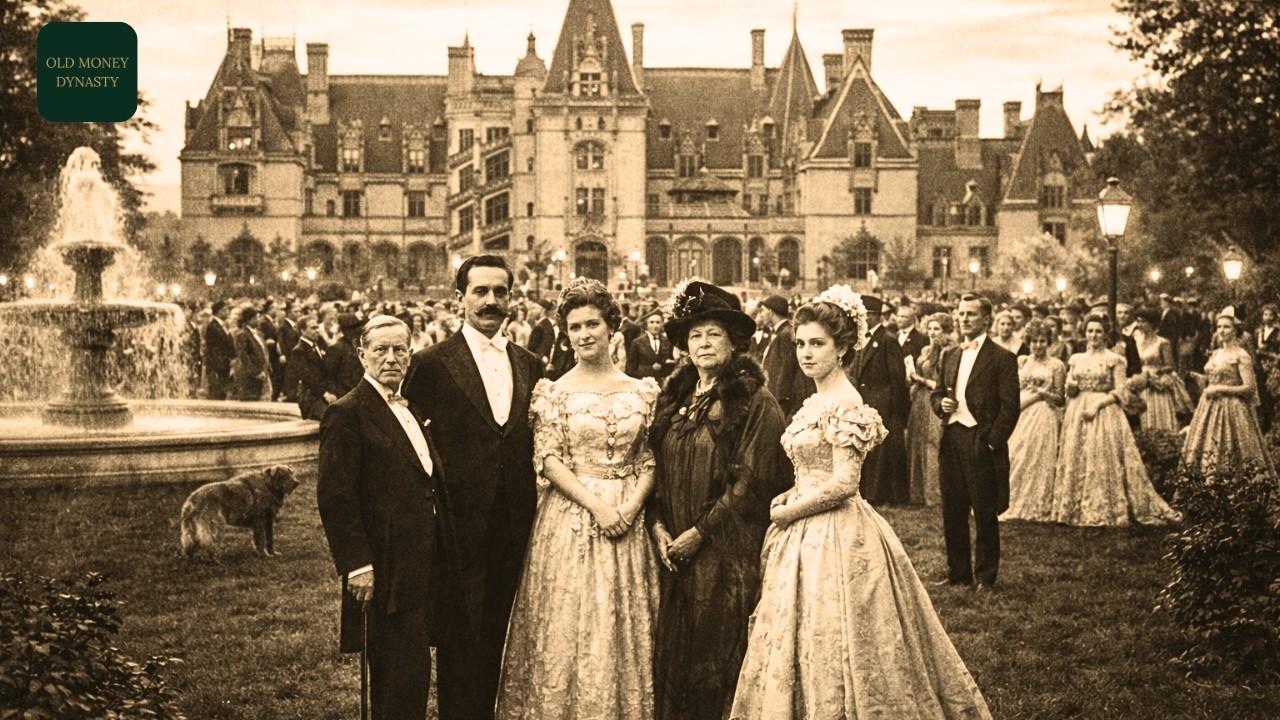
But one Vanderbilt mansion survived, and it dwarfed everything that came before. George Washington Vanderbilt II, grandson of the Commodore, built Biltmore Estate in Asheville, North Carolina. Construction began in 1889. The house took six years to complete: 250 rooms, 175,000 square feet, four acres of floor space—the largest private residence ever built in America.
George died in 1914 at age fifty-one. His widow, Edith, opened Biltmore to the public during the Depression to generate income. The estate remains in the family today, operated as a tourist attraction and winery. Eight hundred thousand visitors annually pay to see what Vanderbilt wealth built at its peak.
The southern mansions followed their own path. Oak Alley stood empty and deteriorating through the early twentieth century until Andrew and Josephine Stewart purchased the property in 1925 and began restoration. The Pilgrimage Garden Club movement in Mississippi saved Stanton Hall in 1938. These houses survived because someone with money decided they were worth preserving.
Others were not so fortunate. Belle Grove, the largest plantation house in Louisiana, burned in 1852. Windsor, a massive mansion in Mississippi with twenty-nine Corinthian columns, burned in 1859. Dozens of others collapsed from neglect, were demolished for their materials, or simply disappeared into the landscape.
The Empire State Building rose on the site where A. T. Stewart’s mansion once stood. Construction began in 1930, the same year the stock market crash destroyed fortunes that had seemed permanent.
The building opened in 1931, the tallest structure in the world, built on land where a shopkeeper had displayed his art collection fifty years earlier. John Jacob Astor IV, great-grandson of the fur trader, died on the Titanic in 1912. He was forty-seven years old and worth approximately eighty-seven million dollars. He helped women and children into lifeboats, gave his wife his gloves to keep her hands warm, and went down with the ship.
His body was recovered days later, a gold watch still in his pocket. The age of great fortunes that began with John Jacob Astor in 1784 ended with his great-grandson in the North Atlantic. The houses they built mostly disappeared. The wealth remained, transformed, adapted, invested in new ventures.
Cornelius Vanderbilt lived in a brownstone. His great-grandson built Biltmore. Frederick Stanton died nine months after moving into his dream house. The Astors tore down mansions to build hotels.
The pattern was always the same. Fortunes rose. Houses were built. Time passed.
Everything changed. What remains are the survivors: Biltmore, Lyndhurst, Oak Alley, Stanton Hall. They stand because someone decided they mattered more than the land they occupied. The rest became parking lots, office towers, and fading photographs.
Nottoway, the largest antebellum mansion in the South, burned on May 15th, 2025. Before the Gilded Age, there was another era of American fortunes. This is what became of it.
